Categories
Game Development Marketing/Business Personal Development Politics/Government

The Mixed Bag of 2025 & Planning 2026

Despite making a note to myself to do so, I didn’t spend as much time in December reviewing the past year and planning the next year, which is why my new year post is so late into the new year.

Last year, I set the following actionable goals for 2025:

  • Publish at least 1 free game by June 30th
  • Publish major Toytles:Leaf Raking quality improvement update (including demo) by December 31st

I also had the following aspirations (that is, goals I didn’t have control over so I don’t call them goals):

  • Earn 2 sales per month (+24 sales) by December 31st
  • Increase newsletter subscribers by 1 per month (+12) by December 31st

How did it go?

My Goals

Published Freshly Squeezed Entertainment Game – DONE

I did it! You can play my second Freshly Squeezed Entertainment project Clown Alley Creator, a family-friendly creativity tool for creating your own fun and zany clowns!

Well, technically it wasn’t done by June 30th. It was published on July 5th.

But I will count it as a win because the game was ready to be published, and I had to wait for reviewers at a couple of app stores. Next time, I should anticipate that kind of lead time.

What was intended to be a six month project took about nine months, from initial design to publication.

Why the difference? Well, I will create a post-mortem for the project soon, and I’ll share what lessons I’ve learned then.

But for now, I will say that I was fairly happy with how the project progressed, and it seemed well-received by players.

Published Toytles: Leaf Raking update and demo – NOT DONE

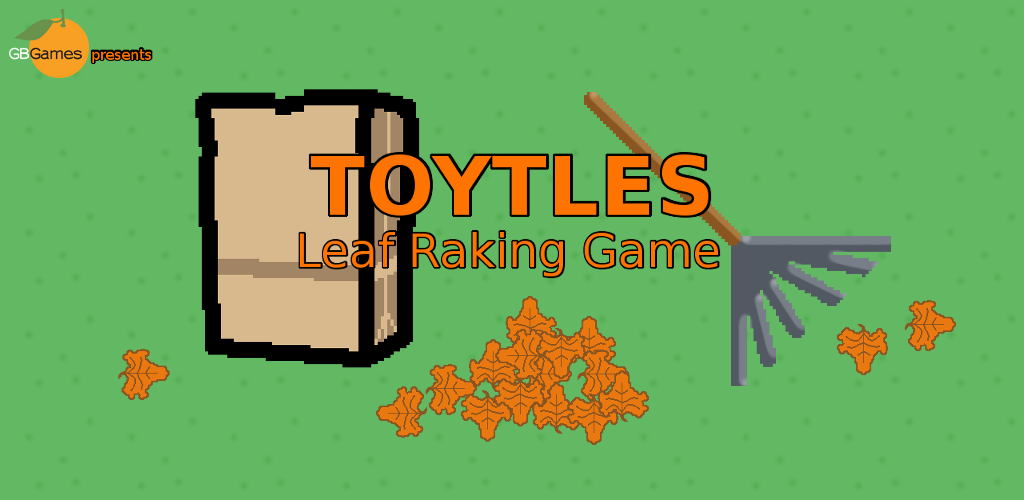
Toytles: Leaf Raking is my current flagship title, originally published in 2016.

Which means that 2026 is going to be its 10 year anniversary!

As I said multiple times last year, I wanted to celebrate by updating it with better visuals, audio, and game play. I started to call it a Major Update(tm).

After I finished Clown Alley Creator, I spent time trying to promote it, and I didn’t get started on Toytles: Leaf Raking right away.

In fact, I felt a bit unfocused, and it took me many weeks to get back into my game development routine.

When I finally had a new plan, it coincided with getting into the end of the year holidays, a notoriously unproductive time. I decided to set my sights a bit lower to at least have a significant internal update.

So before the end of the year, I wanted to release a new version of Toytles: Leaf Raking that should otherwise look and feel the same, but it will have an upgrade of libSDL from v2 to v3. I use libSDL as a cross-platform library that lets me make my games and have them play on many platforms. It is how all of my games currently support desktop and mobile across five operating systems without requiring a lot of effort to support it.

Most of the porting work was relatively easy thanks to the fairly well-written libSDL migration guide, and I had the game running with libSDL3 fairly quickly.

Well, without audio.

I used the audio management library libSDL_mixer for my audio, and the change to libSDL3 meant that libSDL_mixer was completely overhauled, which meant that my own code needed to be overhauled when it came to audio.

Between not putting in many hours of work into it and not having a clean design for the new audio code, I floundered, and the end of the year came and went without a new Toytles: Leaf Raking release.

My Aspirational Outcomes

Earn at least 2 sales per month by December 31st (Target: 24) – 9

I definitely fell short here, and it was mainly because I didn’t have much of a promotion strategy. I didn’t want to do a bunch of random social media posts or pay for ads without those tactics being grounded in something bigger.

In fact, early in the year I had planned to create a free booklet about games and online safety, but I switched focus and spent time trying to figure out what that bigger promotion strategy would be. I didn’t expect to find a universal perfect solution (or else everyone would already be doing it), but I did want to have something to inform the tactics I might employ.

For instance, if I wanted to establish GBGames as an expert for parents who care about privacy and ensuring that their kids are not bombarded with invasive advertising, perhaps that means I focus a lot on writing for that audience. Maybe I still create that free booklet, but now I have much better idea of what I am trying to accomplish with that booklet.

But as usual, I found myself focusing most of my available time on game development. Even when I did finish Clown Alley Creator, I spent most of my promotion time creating social media posts and sending out press releases for the next couple of months.

What’s kind of annoying is that most of those 9 sales of Toytles: Leaf Raking most likely can’t be attributed directly to my own efforts. It turned out a somewhat viral incremental game about raking leaves was released, and coinciding with its release was a spike in traffic and a few purchases of my game.

That’s right. I probably can’t even feel good about the low sales numbers I did get.

I mean, I’ll take the sales, and to be fair, I kept the game alive and working all these years to be available for those customers, but I don’t want to hope I get lucky that something like this will happen again and frequently enough to earn any significant amount of money.

GBGames Curiosities Newsletter subscribers net increase (Target: 12) — net 2

I gained 3 subscribers and lost one of them for a net gain of 2 new newsletter subscribers. Positive numbers are good, but it is still a very low number compared to where I wanted to be.

Once again, my lack of promotion is primarily the problem. However, there was a technical problem that I didn’t know about for months that could have also impacted things.

See, my Freshly Squeezed Entertainment line of games is part of my product development strategy.

The general idea is to quickly create relatively polished prototypes as complete playable experiences, release them for free to make it easier for them to find an audience, and hope that if enough people love them that they’ll be willing to sign up for the newsletter and give me feedback, and if enough people really love a particular game, I can then decide to make a “deluxe” version for sale with the expectation that I’ll have an audience already willing to pay for it.

And you know what? After Clown Alley Creator was released, I could see that people were visiting the newsletter sign-up form on my website from the game.

Now to be clear, I do NOT track anyone’s data in my games. I don’t want to do anything creepy like that, no matter how normalized it is in the industry as a whole.

But my website does track visitors the way almost any website does, and so the links in my games append a little information to the URL to let me know what game is sending the traffic, for instance.

And I can see that I got hundreds of visitors from Clown Alley Creator whereas I got way, way fewer visitors from my first Freshly Squeezed Entertainment, Toy Factory Fixer.

Unfortunately, it wasn’t translating into people actually signing up. I chalked it up to perhaps not offering a strong enough incentive to do so. Ah, well. Maybe the next game might do even better.

But then near the end of the year, I was checking some very, very old messages somewhere, most of which were spam (which is why I never check them), when I saw one person in August said that my newsletter signup form was broken.

And sure enough, it was!

I fixed it (it turned out that I had the same MailChimp signup form for many years and for some reason it stopped working relatively recently, but creating a new signup form seemed to do the trick), but it does mean I had months in which potential visitors interested in signing up for my newsletter couldn’t!

So I’m hoping that people continue to play the game and visit the site over the next few months, and with the working signup forms, I’m hoping that I get way more than 2 signups.

Speaking of, do YOU want to signup for the free GBGames Curiosities newsletter? You get free Player’s Guides to my existing and future games for free!

Analysis

I successfully worked my plan and got a third game published. I feel confident that I can do it again in a similar amount of time, and I think I learned some things about managing the project and prioritization that should help me deliver games faster.

I did not, however, get a major update for Toytles: Leaf Raking out. I didn’t even get a minor update out, unless you count the update I did to comply with ever-changing app store requirements, which I don’t. The libSDL3 update started out well, but it feels bad that I somehow spent a couple of months of calendar time and still didn’t get the audio part finished.

Despite tracking time for promotion, I am not sure how much good it did. Most of my early effort wasn’t actually DOING promotion so much as figuring out a strategy, and later when I was actively trying to promote Clown Alley Creator, I started to wonder just how impactful it was to spend time on my daily social media posting and sending out press releases.

But Clown Alley Creator seemed to be one of my more popular games, and it seems like people are playing it. Too bad I was oblivious to my mailing list signup form being broken for months to take advantage of the people potentially interested in signing up for it.

In the time between working on Clown Alley Creator and working on Toytles: Leaf Raking, I found myself updating all of my games for compliance with app stores before a deadline, which took some time away that I didn’t anticipate. I somehow need to find a way to be more productive AND allow for slack in my schedule to allow me to attend to things like this.

Also during that time, I found myself a bit knocked off course. I was steadily working on Clown Alley Creator, with a daily habit that often added up to 5-15 hour weeks, and then when I was done working on it, I felt like I didn’t know what to do without my regular development work there to keep me focused. Even when I had a list, and I knew what I could be working on, whether related to promotion or planning the next project, I just didn’t seem to be able to do so.

It was somewhat of an unplanned hiatus, one in which I felt like I should be doing something but wasn’t. I think the lesson is that I need to plan some deliberate downtime for the end of a project. I once had a very intense month-long project that took me months to recover enough to work on the next project, so maybe this isn’t a new insight. But I need the break, I need to recharge, and I need to make sure I am purposeful about it.

I have found that I can do the work indefinitely after I set myself on a particular trajectory. That is, after doing the hard work of planning, I can work the plan. I can even adapt the plan, sometimes significantly, and still continue on.

But momentum changes seem to be challenging for me, even if ostensibly the day to day should be the same. Switching from one project to another, I went from being slow and steady and consistent to just being slow and inconsistent.

It would be one thing if I can claim that the reason I was struggling was that I was bored of the older project or didn’t find it compelling, but I don’t think either of those statements are true. I’m pretty excited about the new Toytles: Leaf Raking updates, in fact.

What might impact things is that the country I live in has had a very, very rapid slide towards authoritarianism in the last year, so maybe my struggle comes more from struggling to justify my time working on games when I could be doing something to connect with my neighbors and friends more often.

Some numbers

I spent 252 hours on game development, at least 100 fewer hours than each of the last couple of years.

For comparison, a full-time developer working 40-hour weeks would have accomplished the same thing in 1.5 months.

I’ll try not to think about those numbers too hard.

I did 34.75 hours of writing and published 51 blog posts and 11 newsletters.

I did 1.75 hours of video development and published 0 videos, unless you count the trailers I created for Clown Alley Creator. I just didn’t focus on video creation at all.

I spent 67.50 hours on promotion efforts. I sent out a press release to 95 outlets and content creators over the course of four months. Most of them never replied or reported anything that I am aware of. I didn’t track how many published social media posts I created.

I earned less than $25, most of which I won’t see until this year due to how the app stores don’t pay out until a month or two after the sale.

I spent almost $4,000, about twice as much as last year, but most of the cost is due to getting myself a new computer to replace my main machine that I’ve had for over 10 years, plus getting a new LED printer to replace the one that used to complain about the ink not being legitimate even if it was.

These numbers are obviously not very sustainable.

As for personal goals, I think I am doing a good job maintaining a healthy-ish body.

I kept up my walking routine from the previous year, and I walked a total of 62 hours. Aside from a couple of instances when my lower back was bothering me slightly, I found my morning stretching routine seemed to keep me in fit enough shape to handle day to day life.

In fact, a few times I found that I was able to shovel snow or even carry heavy logs to help my wife’s family when they were cutting down trees, and I felt great afterwards.

While the last half of 2024 ended with me not doing any push-ups due to my wrist hurting, I started the year at 5 push-ups a day and then a couple of weeks later I was doing 10 push-ups a day. I think I intended to eventually go to 20 or more push-ups per day, but I decided not to push it, and I ended up doing them almost every day. I ended the year with 3,500 push-ups total.

Similarly, I had started doing squats again after not doing them for a long time, and I ended the year with 3,500 squats as well.

I had a goal to lose some significant weight, and while I lost a couple of pounds, my weight was fairly stable throughout the year. I suppose that’s better than losing a bunch and gaining everything back?

I read a total of 62 books, of which 31 were audiobooks. Some favorites include:

  • Feeding the Machine by James Muldoon, Mark Graham, and Callum Cant
  • Let This Radicalize You by Kelly Hayes and Mariame Kaba
  • Poisoning the Well: How Forever Chemicals Contaminated America by Sharon Udasin and Rachel Frazen
  • The Splendid and the Vile by Erik Larson
  • Her Fearful Symmetry by Audrey Niffenegger
  • The Field Guide to Citizen Science by Catherine Hoffman and Caren Cooper
  • The Last Archer by S. D. Smith
  • Don’t Talk About Politics by Sarah Stein Lubrano
  • The Age of Surveillance Capitalism by Shoshana Zuboff
  • The Extended Mind by Annie Murphy Paul
  • Subtract by Leidy Klotz
  • How Big Things Get Done by Bent Flyvbjerg and Dan Gardner
  • Recursion by Blake Crouch
  • Tears in Rain by Rosa Montero

As for games, please realize that I almost never find myself playing new games. I don’t tend to let myself play games that often, especially when I am barely making the games I want to make, so if I do play games, it is usually a game in my existing collection.

I played quite a bit of eFootball early on. I enjoyed it, especially if I ignore all of the weird card collecting things and just focused on playing games against the CPU to get my soccer fix. Unfortunately, at some point I found the somewhat consistent crash bug on the main menu to be too annoying for me to bother fighting past, and I uninstalled it from my Steam Deck. I am still looking for a good soccer game, and I’m a bit turned off from free-to-play monetization. I have my eye on getting Pixel Cup Soccer one day, but I am going to miss the high fidelity of eFootball.

I also played games on the PlayDate, such as Pick Pack Pup, Shadowgate PD, Tiny Turnip, and Battleship Godios. I really enjoyed both Saturday Edition and The Whiteout. Blippo+ was an obsession for a hot minute.

Since I built a new, more powerful desktop computer, I played Kerbal Space Program and found myself periodically checking on the status of Kitten Space Agency, the spiritual successor that is currently in pre-alpha.

I finally got around to playing Monaco: What’s Yours Is Mine, and I love the atmosphere and heist tropes.

After reading Recursion by Blake Crouch, I read another one of his books, Run. It is gruesome and harrowing…and it made me want to play Overland. I remember not doing so great the last time I played it years ago, but this time I managed to get pretty far before accidentally losing my dog and another member of my party to a weird teleporting thingie and suddenly finding my party surrounded by monsters.

I was listening to the audiobook The Stardust Grail by Yume Kitasei at the end of the year (it was the 2nd book I finished in 2026, and it will be a highlight then), and someone had just gifted me the game Outer Wilds, and I couldn’t have asked for a better pairing. My very first attempt as space travel in Outer Wilds didn’t go so well. I was so used to Kerbal Space Program’s relatively realistic rocketry that the more arcade-y space travel in Outer Wilds meant that I didn’t realize how close everything was. While I was trying to get my bearings and figure out how to fly towards one of the other planets, I noticed some reentry burn around the edges of the screen, and I turned around just in time to discover and flown directly into the sun. Whoops.

But the game I have been telling everyone about since I got it? Dice the Demiurge, the single-player incremental dice game. I love this game. It’s compelling, it does neat things with a wide variety of dice, it’s funny, and it has a lot of variety. It even has some demands on the real world that I really like.

I found myself playing one session of Dice the Demiurge each day, which allowed me to take just a few minutes to get some game play in with a game that was rich and engaging. I fell behind during the holidays, so I’ve been playing multiple sessions each day to try to catch up.

Goals for 2026

My goals for 2026 are very similar to the goals I had for 2025:

  • Publish major Toytles:Leaf Raking quality improvement update (including demo) by December June 30th
  • Publish at least 1 free game by December 31st

Both of these goals boil down to development/production goals with a definite output.

What I want to do is figure out at least one more goal that is focused on promotion that would similarly have an output I can control.

Unfortunately, I’m now weeks into the new year, and while I feel like I’ve got a better handle on what a promotion strategy might involve, I’m frustrated that I don’t something more solid in place despite spending a lot of time last year on trying to figure this out.

Most of the advice out there is probably fine if you are trying to make a big splash upon launch of a new game on Steam or if you are monetizing people’s attention on mobile with ads or in-app purchases. Based on the sheer amount of discussion related to this kind of hit-driven business, you’d think that it was the only way people know how to run a game development business.

I’m fine with slowly growing an audience who appreciates entertainment that doesn’t come with strings attached, that likes their privacy and doesn’t like feeling worried about whether they can trust their games. I want to make games for families who can feel peace of mind that my games are not spying on them, selling their data, or trying to convince their kids that maybe fascism and white supremacy is fine actually. I want to make games that encourage the player to be curious and to support their creativity.

So it sounds easy: I just need to talk more about the kinds of things that this kind of audience would care for.

I look forward to figuring out the how.

Happy New Year!

Thanks for reading, and stay curious!

Want to learn about future Freshly Squeezed games I am creating? Sign up for the GBGames Curiosities newsletter, and download the full color Player’s Guides to my existing and future games for free!
Categories
Geek / Technical Politics/Government

I’m Ending my 1700+ Day Duolingo Streak and Uninstalling

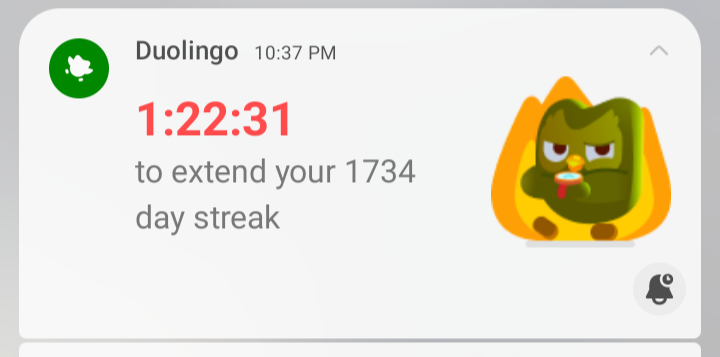
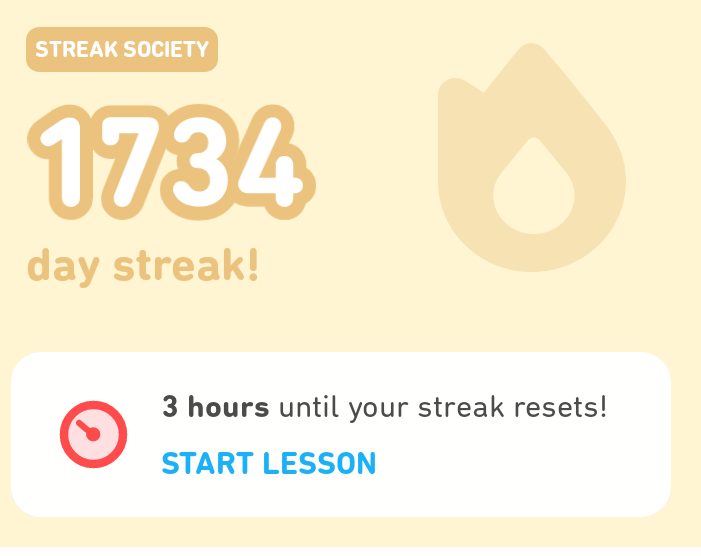
I’ve had Duolingo for many years. My goal was to learn Italian, and while I am still not conversational, I do find myself understanding some music more easily, and I can more easily understand the variety shows my parents watch on RAI on TV when I visit. But enough has changed with the company’s priorities that I stopped using Duolingo, despite having a 1734 day streak, and I plan to uninstall it soon.

Duolingo is very aggressive about ensuring that I stay engaged

Duolingo is very aggressive about ensuring that I stay engaged

My mom says Italian was my first language and that I “spoke it beautifully” when I was a toddler. Legend has it that I came home from pre-school one day and said I didn’t “want to talk Italian anymore”, that I didn’t like the language. Supposedly she slapped me for saying that, but I don’t remember the slap, and I didn’t remember any Italian.

Since then, I had taken a Saturday Italian class when I was in elementary school for a couple of months, but it wasn’t very rigorous.

I took three years of Italian in high school, and while I did well in the class, there is only so much you can do with memorizing vocabulary and Italian Christmas songs. I still found myself unable to follow any conversation between my parents and other members of my family and their friends.

So enter Duolingo. Self-paced language learning using the latest understanding in learning technology? Nice.

Before they completely overhauled the system a few years back, I remember it said I was 18% fluent at one point, and while walking in San Francisco with my wife, I remember overhearing a couple of older women speaking and realizing that they were speaking Italian because I could pick up about 18% of what they were saying.

The new system encouraged me to keep doing new lessons rather than keep reviewing older ones like I had been, and I think it really did help. They don’t pretend to grade your fluency anymore, but I’m confident that I can mostly parse sentences I encounter in real life.

I kept thinking that I should pay for it. The ads were annoying. But then one day, I discovered that I had finished the Italian course.

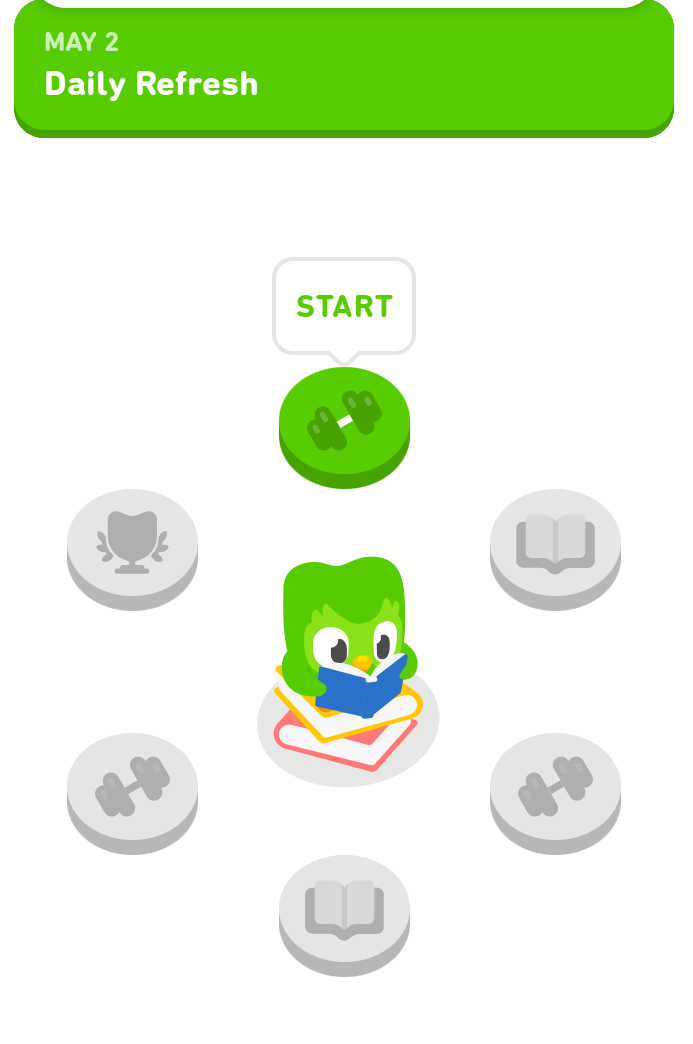
Instead of lessons on a trail, there was a now a “Daily Refresh”, and while it seems to cover past mistakes, it was repetitive and seemed divorced from the lessons in question. I am aware, for instance, that there are two words for table: the feminine tavola and the masculine tavolo. There is an appropriate time to use one or the other, but I was long past that lesson and cannot tell you today when I should use one or the other.

I’ve been doing Italian lessons twice a day for many, many months. I resented the gamification because there seems to be a subtle difference between encouraging me to learn vs encouraging me to be engaged with the app, and many of the changes feel like they have started leaning into the latter. And it works, which is what really annoys me. I want to learn Italian, but I sometimes realized I couldn’t go to sleep because I had a streak to maintain and hadn’t done my Duolingo lesson yet. I started caring about keeping the streak, or getting ahead in the leaderboards.

A good piece on how obnoxiously effective these kinds of user engagement practices can be on Duolingo is from Aftermath’s Riley MacLeod’s. My favorite line:

I absolutely do not want to engage in this cursed feature and turn my learning into a competition against strangers, but also damned if I’m not gonna beat the person below me.

Anyway, despite finishing Italian, I was about to finally start paying for it, if only to stop getting ads, but then I saw ads pushing their AI-powered Duolingo Max offering. While it sounds like it could be a really good use for AI, it just makes me think about all of the water and other resources used to pretend to have a conversation with an AI agent, plus knowing how much of AI is trained through plagiarism. It completely turns me off.

And then there was the recent news that Duolingo was getting rid of all of their contractors and replacing them with AI, and that’s when I decided I was done with Duolingo.

Learning a new language is hard, and I imagine creating a platform to learn many languages is really challenging. Each language has unique quirks, idioms, and more, and so I am impressed with the system existing at all. Still, I found myself struggling with the app badly pronouncing some words occasionally. It’s frustrating to find out that I got something wrong in a way that wasn’t my fault, especially since sometimes it means losing my ability to keep learning until I wait long enough to gain a heart back.

Clearly the course only take you so far and I wasn’t going to measurably learn more at this point, and yet I was compelled to stick to the top of the Diamond League and keep my streak alive. The lessons sometimes introduce concepts without explaining them well, which meant encountering idioms with no chance of getting them right or words without a way to learn what they mean without just purposefully getting them wrong to get the feedback. And of course the ads are obnoxious and slowly stealing precious minutes of my life.

Basically, I realized that I was tolerating quite a bit already.

Now that there was a push for using AI instead of real people, I can only imagine the kinds of errors I already encountered only multiplying with no real way to submit feedback that will get meaningfully handled. I can’t see the app getting better, and I no longer wanted to support the company.

As for actually learning Italian? I might just need to make plans to travel to Italy, take actual classes, and just immerse myself in books, movies, and music. Maybe I can even turn on Italian language options in the games that I play.

I’ve seen some people talk about replacing Duolingo with other tools, such as Mango Languages, which is supported by my local library. Let me know if you know of a good alternative that you love, although I worry that more and more, it seems good technology goes bad, whether you believe it is due to “enshittification” or “The Rot Economy”.

But for now, I’m exercising my ability to opt out.

Categories
Personal Development Politics/Government

Are We Invested Or Just Watching?

I subscribe to the great newsletter Reimagined by Nicole Cardoza (who, by the way, turns out to be a magician and now I hope to see her whenever she tours next), formerly Anti-Racism Daily, and the latest piece was about the weird publicity stunt of Blue Origin sending Katy Perry and an all-women group up into to space, presumably to promote and normalize space tourism.

Cardoza points out that while many people think that the science that NASA does is important, space tourism isn’t exactly a priority.

Yet, the current Republican administration seems focused on doing the opposite of what we, the people, want, and the marketing campaign to send an all-women crew seems to be out of step with the demolishing of DEI and erasure of women astronauts, among other prominent women in other industries and in history in general.

These private companies need public dollars to achieve their goals – including their hopes to scale their own commercial flights. That means that for this to work, the government will have to cultivate awe – not just for space exploration, but the billionaires that now govern it. It doesn’t help that Bezos and Musk, the new faces of space exploration that own Blue Origin and SpaceX, respectively, aren’t exactly media darlings. We deserve to be treated as active investors in this endeavor, not just people in the audience.

I liked this part. I think it captures some of what bothers me so much in tech and in politics. Many years ago, I remember Microsoft was going to invest a lot of money into schools to teach copyright to the youth.

That sounds kinda great, except when I read that it was geared towards teaching them to respect the creative works of major companies such as Microsoft, instead of teaching them that they, too, can create and enjoy the protections of copyright.

Basically, instead of teaching how copyright is for everyone, they just wanted to train everyone to be good consumers.

It was gross then, and it is gross now.

The destruction of the American government that has occurred over the last few months can be summarized roughly as the incredibly filthy rich thinking that they should control the fate of everyone else. The rule of law, equality before the law, checks and balances, regulations, etc … all of that just gets in their way.

And they strongly believe that they have the right and duty to get rid of it, and that your role is to be subservient to them, to be good consumers.

They expect everyone else to passively accept it.

As Cardoza says, we deserve to be treated as investors. But the rich and powerful are moving fast, because breaking everything quickly before everyone realizes how invested they were in the existing system means it is harder to recover.

I’m not sure how many people have come to the realization that there is no reversal of course, that we can’t go back. Our reputation in the world is in tatters, our systems are broken, and the only options are to dream up a new world order that is more in line with what we, all of us, want rather than what a handful of incredibly wealthy people had come up with.

Categories
General Politics/Government

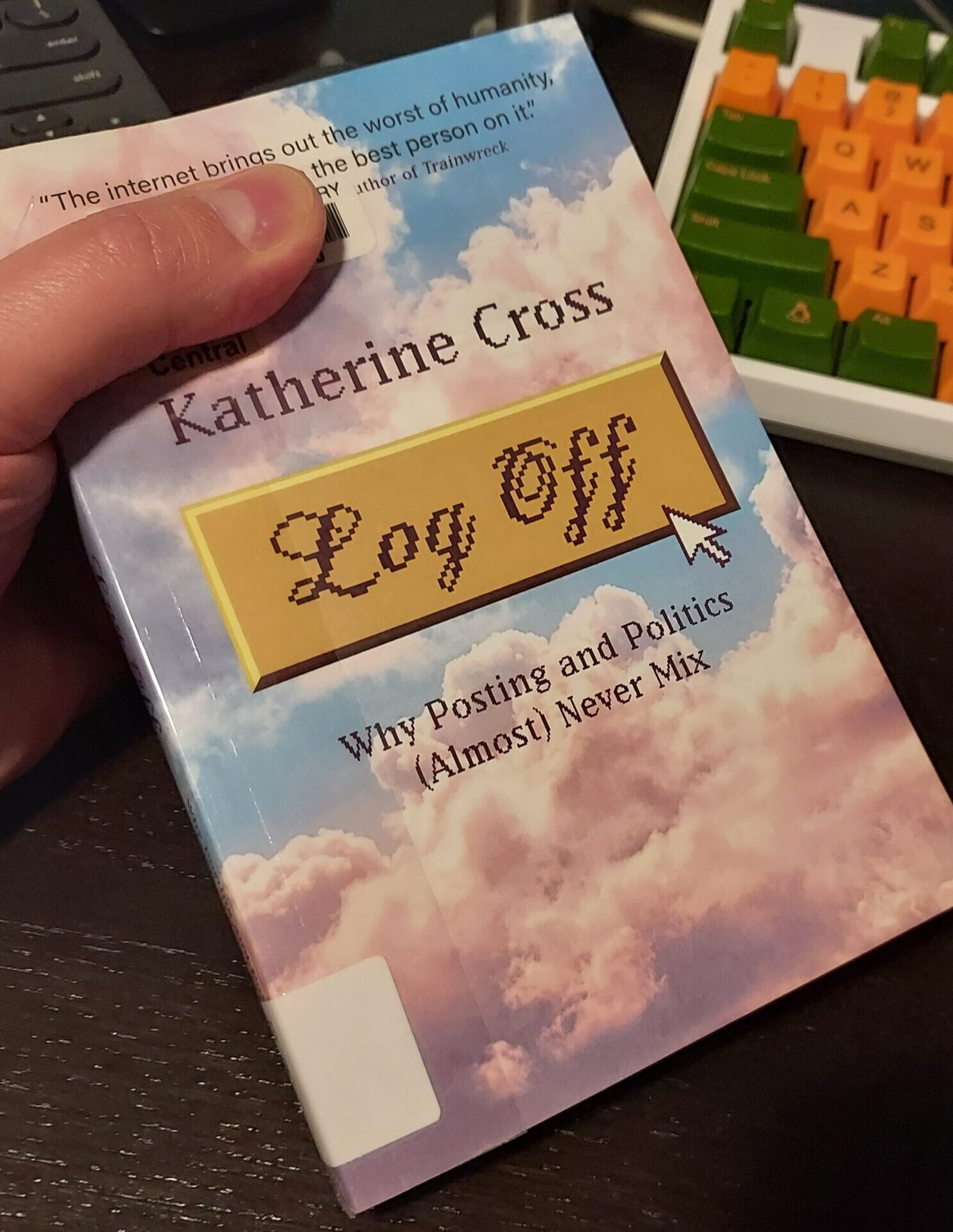
Books I Have Read: Log Off by Katherine Cross

Social media may be fun. It may provide opportunities, economic or otherwise. It may allow individuals to find others with similar interests.

But according to what Katherine Cross wrote in her latest book, Log Off: Why Posting and Politics (Almost) Never Mix, social media is pretty much only good at solving problems…that social media created in the first place.

Log Off by Katherine Cross

And the problems it creates can be big. Ugly and sometimes deadly harassment campaigns that utilize social media to be efficient and impactful can likewise get shut down thanks to social media. But again, the problem only existed because social media made it easy to exist.

Cross argues that social media is NOT good at solving other problems. Despite promising movements such as the Arab Spring that seemed to indicate that social media was good for democratic movements and for activism, most social media-based activism is ineffectual and eventually fizzles out.

Posting an earnestly written message online to spread awareness might feel impactful. You are saying something important, and the entire world might read it instantly.

But the nature of the algorithms, the interests of the people who own the social networks, and the affordances provided by the dopamine hits when you see likes and shares and reposts (as well as the angry replies) all combine to produce what is essentially nothing more than a very compelling and distracting entertainment.

It’s a form of entertainment that you pay for with your attention, time, and energy, and it can give the illusion that it was attention, time, and energy well spent.

Real collective action, real social movements, real impact comes from doing real work with real people, and social media provides a very poor substitute.

Much of the book is spent juxtaposing individualistic and collective perspectives. Social media, like much of capitalism, tends to encourage personal, individual solutions to what are collective/systemic problems. I appreciated reading the chapter about how social media seems to encourage bleakness and despair, enough that people feel the need to defend themselves by buying a gun and learning how to be self-reliant in an apocalypse.

(Of note, this book was published before the 2024 election, and reading it today, it feels kinda quaint reading about a younger Bluesky’s potential and Twitter’s meltdown and the apocalypses that we could see then)

But getting yourself a gun to protect yourself is an individual solution (one that the gun industry would happily scare you into accepting).

“In such circumstances, it can be hard not to look admiringly at the one thing that has always seemed to stop fascists dead in their tracks. Literally. Armed resistance. So why not get a little bit of that power for yourself? To protect yourself, and your family, from evil people who wish you harm? Isn’t the Second Amendment there for you too – and isn’t that what’s it’s for? Arming the citizenry against tyranny?

In the US, in this exact moment of pitched terror about the resurgence of fascism and the impending climate apocalypse, there is a very real belief among a bunch of frightened queer people and leftists that all the extremists who cheered on the execution of trans people, or the rape of a celebrity, who called a white nationalist terrorist a martyr for the cause, will come after them, and that resistance will only come from the barrel of a gun. In reality, they’re simply soothing themselves with another private non-solution to a collective problem, sold to them by social media with all the ruthless precision of a targeted ad.”

Cross goes on to argue that Second Amendment rights and the protections that goes with those rights does not, in fact, extend to everyone. The law might say one thing, but historically we’ve seen how there are double standards depending on who is wielding the weapon and who the police and the state want to wield those weapons against.

“In theory, the Second Amendment should protect all Americans’ right to own guns equally, but it doesn’t. Non-white people, leftists of all backgrounds, and anyone else who doesn’t fit the aforementioned frontiersman narratives have all taken up arms only to be literally cut down by the state, without a single peep from the NRA in defense of people who ought to be, by all rights, their fallen martyrs.”

I’ve seen discussions by some trans people and various left-leaning people talking about how banning guns would actually leave them defenseless, that they need those guns. And while Cross doesn’t think no one should be able to defend themselves, she does point out that the fantasy and illusion social media presents hides the reality of the work it would take to become the kind of person who might be willing to use a weapon in self-defense. It’s more than the cost of the gun and learning how to shoot.

Cross argues that even if weapons do sometimes become necessary, what worked against fascists before was not merely random people shooting them. It was organization. Guns and violence get valorized, especially on social media, when the real work of revolution and resistance also takes an army of non-militant roles such as nurses, translators, and more.

In the face of Project 2025 rolling back or destroying almost half (as of today) of the US government so far, we’re going to need collective action and organization to meet the needs that the government will no longer provide (and more that it wasn’t already providing in the first place). It is entirely possible, and maybe even likely, that things will get violent in the near future, but merely arming people won’t be enough.

“I can think of nothing less effective against fascism than scared, isolated people quaking with guns in hand, not talking to each other or making serious efforts to organize and pool their resources.”

What I took away from this book was that social media is fine if you treat it as mere entertainment, and it might be fine for finding others who are like you or have the same interests, but if we want real solutions to real problems, posting and doomscrolling aren’t doing enough positive things to outweigh the psychological damage and sapping of energy it entails.

Social media tends to make some minor things loom large (especially when reporters from major media outlets report on them and make them “news”) and gives the impression that “everyone” is saying something, when in fact, a few handfuls of Extremely Online(tm) trolls do not statistically represent 340 million people. We don’t take cues of what to pay attention to from a classroom of 1st graders, yet it is easy to think an equivalent-sized group of angry replies means that the world agrees with them.

I’ve long stopped actively using Twitter, and for some time I was using Bluesky as my new online home, and to a lesser extent Mastodon.

I was already questioning how much energy I was spending making these networks stronger and more valuable for others when my home on the Internet is really this website you are reading this post on right now. And I was questioning how much of my energy and time could be dedicated to doing something real and lasting.

I help put on the Central Iowa Trans Lives Fest each year, for instance, and while social media might get the word out somewhat, much of the real work is in reaching out to people and signing up vendors and coordinating volunteers and emptying the garbage bins. It is gratifying being part of the group that puts together a major event for people to celebrate being who they are, especially in the face of despair in our political reality, especially as Iowa becomes more and more hostile to families and friends alike.

But if I spent a ton of time posting online, arguing with trolls, and pretending that was helping to make that event successful or improving the conditions of life in Iowa? I’d be deluding myself, and the companies that provide social media are happy to help me in that delusion as I help them create more value for their shareholders.

And I would be squandering opportunities to make real connections and organizing for real change in my community.

There is a lot that the Internet and the World Wide Web provides that can be a force for good. Social media hasn’t really lived up to its promises, and unless your job is being a social media influencer, it probably isn’t worth all the labor of making the owners of the platforms richer while we all get poorer.

Social media can be fun, but taking it too seriously, which is seriously at all, is a waste of time.

Categories
Game Development Marketing/Business Personal Development Politics/Government

2024 Wasn’t Great, but Perhaps 2025 Can Be Better?

I’ve taken some time at the end of December to look back on the previous year and think about what I want for the coming year.

In 2024, I wanted to build upon the success of 2023, a year that saw me hitting a sales goal for the first time.

One sale per month is barely pizza money, but it is a start, especially since I had never earned that many sales before in the years I’ve been trying to run my indie game development business.

However, I decided that metrics like the number of sales isn’t really an actionable goal. It is more of a lagging metric.

So for 2024, I have the following outcomes I am aiming for:

Increase my newsletter audience from 30 to at least 42 subscribers by December 31st
Earn at least 2 sales per month by December 31st

As for actionable goals:

Release at least 2 Freshly Squeezed Entertainment games by December 31st
Perform at least 2 SEO activities per month by December 31st

My thoughts were that if I make and publish games AND do things to make my website more effective and easier for people to find what they want, then I can increase my audience and my sales.

So, how did I do?

My Goals

Published Freshly Squeezed Entertainment Games (Target: 2) — 0

Two games a year for someone to work on alone very, very part-time is technically doable, but I haven’t been able to do it yet.

In fact, I didn’t do it last year, either:

That’s two years in a row in which I did not publish a new game.

Much of my current business strategy depends on releasing games in my Freshly Squeezed Entertainment line, which are polished, playable prototypes that provide complete entertainment experiences and are given away for free. The general idea is that the games are supposed to be quick to develop and have a low barrier to entry so that they are more likely to find an audience. I hope to get feedback from that audience, and if enough interest exists, I can always create a “deluxe” version of the game that I can sell.

So not releasing a game isn’t great, because there cannot be an audience for a game that doesn’t exist.

At the end of 2023, I had put in a year of game development effort into a family-friendly, non-violent party-based role-playing game called The Dungeon Under My House, and it wasn’t anywhere near done yet. I didn’t have any reason to be optimistic that I could complete it within six months of 2024, but I moved forward as if I could.

About 20 months into the six month project, I decided to put it on hold. I finally sat down and scoped out what I thought the rest of the project looked like, and an optimistic estimate said I still had at least another year of development. Oof.

So I made the hard decision to put the project on hold. I published a post-mortem for The Dungeon Under My House, and I hope one day to publish a second one after I return to the project and truly finish it.

For now, I started work on a project with a much smaller scope. I normally try not to plan everything upfront and instead let the project build up in iterations.

This approach works fine. I’ve built and published games this way. But it clashed with my goal of releasing games quickly. I had to recognize that there was a difference between publishing a game eventually and publishing a game on a more or less predictable schedule, and that only the latter was going to help me satisfy my business goals.

Thanks to some advice I got from Dora Breckinridge (you should hire Dora, by the way), I decided to try to truly capture as much of the scope of my new project as I could, plan on working on features and technical infrastructure for only part of the project’s schedule, and leave the lion’s share of the schedule for leveraging what I had built to fill in the content of the game.

As of this writing, I am finishing up the first phase of work, and thanks to a realization I had about how to arrange the work in a more Agile way, I am incredibly confident that I will ship this project in six months easily, mainly because the project will always be in a shippable state long before then.

Basically, I went from a project with no end in sight to a project that could potentially be done early if I really want it to be.

However, it won’t be released in 2024. I can’t work miracles.

Perform at least 2 SEO activities per month by December 31st (Target: 24) – 2

Ok, so I abandoned this one fairly quickly. SEO felt like a solution that might not make sense in a world where search engines are getting less useful and almost actively hostile towards websites that aren’t in the top results, plus a world where genAI is allowing people to churn out garbage so cheaply that the search results are polluted anyway.

Also, my website barely gets any traffic. Not like it used to when I had more time to blog more frequently about a variety of topics, anyway. Much of that existing traffic is from game developers interested in my blog posts about project management and copyright for indies, and so not necessarily people who would be in the target audience for my games.

But just having this goal, even if I did give up on it, did get me to make some important changes.

I felt like I didn’t have a good baseline to know if my SEO was actually doing anything positive. I didn’t want to make a bunch of changes without any concern about how effective they were. A change could produce a negative outcome, and I would want to revert that change right away. But how would I know?

So I started creating automated metrics reports from my website, plus I started grabbing page visit and download data from the various app stores my games are in and throwing them in a combined spreadsheet. It’s a bit more manual of an effort, but it is worth it to know this data, and I can probably figure out how to automate some of it.

These metrics came in handy when I decided to experiment with ads for part of the year, giving me a good insight into whether or not a particular ad was moving the needle for my games in any particular app store.

I think I might revisit this goal for 2025, not because I want to improve my search engine rankings but because there are things I could do to make my website look and feel better to people who actually visit it. If I optimize the site for real people and their goals as opposed to trying to appease some search engine algorithm, I think things will work out better for everyone.

My Outcomes

GBGames Curiosities Newsletter subscribers net increase (Target: 12) — net 4

My current business strategy has my GBGames Curiosities Newsletter at its core. I want to cultivate an audience of people who specifically said that they wanted to hear from me and are fans of the kinds of games I make.

I don’t have many subscribers yet, and this is the second year in a row in which I was aiming for a net increase of one subscriber per month and didn’t make it.

Unfortunately, I didn’t do anything specifically to try to grow the list, so any efforts to do so were one-offs and not consistent at all. Still, I gained 4 subscribers and lost 0, which is a positive trajectory.

Clearly if I want this number to be higher, something needs to change in terms of my approach.

Earn at least 2 sales per month by December 31st (Target: 24) – 16

Last year I sold 13 copies of my games, beating my 1 sale per month goal by one. I was sure that doubling the goal was both ambitious and doable, especially if I kept up my promotion efforts.

Unfortunately I did not, as I spent much of my capacity trying to make progress on game development.

Now you might think that at least 16 sales is more than 13 sales. And it is true.

But the reason most of those sales appeared is because I spent money on Facebook ads, and unfortunately I spent more on ads than I earned in sales income.

On top of that, this is the first year I have put my game Toytles: Leaf Raking on sale. I was experimenting with the price to see if it might encourage more purchases at a lower price point, or if the act of being on sale made it show up more easily in various app stores. In the end, I think it just served to earn me less money for each sale.

To compare, in 2023 I sold 13 copies of my games and made a total of $103, much of it because of people contributing more than the minimum amount on itch.io. Despite selling 16 copies of my games in 2024, I only made $76 from those sales, and 0 came from itch.io.

Analysis

I sold more copies of my games but made less money, as I said above.

I didn’t take advantage of itch.io sales as much as I maybe should have. I think I was disappointed in the amount of work I put into some sales at the end of the previous year that resulted in nothing, and I am also wondering why I don’t always get advance notice from itch.io about joining an upcoming sale so I can prepare.

But frankly, most of my effort went into game development and not promotion, and so it is no wonder I didn’t see more success in terms of sales.

Last year, I said that my megaphone is tiny, and it still is.

My website has very little organic traffic, and my social media accounts all have limited ability to get awareness out.

I said then:

Basically, the more I rely on social media to promote my game, the more effort and/or money I need to expend for at best a temporary boost in potential traffic.

Focusing on social media isn’t sustainable, and it is partly why I wanted to focus on SEO. However, I worry that the days of useful search engines and a useful Internet in general are behind us.

So should I focus on advertising some more? Maybe. In my experiments this year, I basically proved to myself that if I could get my game in front of the right people that some of those people do, in fact, purchase the game.

That’s good!

But ads are too expensive to run for one-time sales, and I don’t have enough of a backlog of games to cross-sell and make it worth it.

However, if I focused on promoting my mailing list rather than any one particular game, then perhaps the calculus changes significantly. One purchase of a game today doesn’t necessarily mean more purchases in the future, but one mailing list signup today means being able to promote my games indefinitely.

On the other hand, it is entirely possible that people are finding that their inboxes are getting more and more useless the same way that search engines and the Internet as a whole are getting worse. Maybe all the data about how mailing lists are still very effective isn’t accurate anymore?

Or maybe they are, but most game developers are so tied to the app stores and Steam that they don’t find mailing lists useful for THEIR business models.

And I think my target audience doesn’t necessarily even know what Steam is, let alone uses it for finding and playing games.

Relying on Apple and Google to sell my games is therefore a bit risky because I have no way to contact the players who play my games unless they specifically sign up for my mailing list.

Some numbers

I did a total of 359 hours of game development for the year.

For comparison, a full-time game developer working 40-hour weeks would have accomplished that number in a little over 2 months.

I did 62 hours of writing and published 59 blog posts and 12 newsletters.

I did 23.75 hours of video development and published 12 videos.

The above mostly represents a weekly development log, plus the occasional video update, as well as some one-off blog posts and sale announcements.

I originally continued the weekly devlog videos, but the amount of work that went into each video took away from development work. After a couple of months of this pace, I decided to release videos once a month or so. It meant more details in each video, making them more compelling for viewers, plus an easier work schedule for me.

I wanted to focus on my health. In 2022 I had horrible back pain due to an unknown reason, and I think my regular morning exercises are keeping me strong enough to keep it at bay, but I felt like missing a day of exercises was enough to make day to day living feel risky.

So I started doing more exercises meant to help build up strength and stability. I used to do yoga, but I think I was doing something to cause problems. Instead, I started doing weight/resistance exercises.

Unfortunately, I couldn’t keep things up. My knees were hurting until I stopped doing squats only a couple of months after I started doing them, which is too bad because they were supposed to be a great all-around exercise. I did 780 squats total.

Also, my wrists were bothering me from doing push-ups. I stopped doing them in May, so I ended the year with only 1,230 push-ups.

The good news is that I added regular walking, slowly building up from 10 minutes a day to 25 minutes a day and from 2 mph to now warming up at 2.4 mph and increasing to 3.2 mph before cooling down at 2.4 mph again. I have done about 50 hours of walking for the year.

As for losing weight, I didn’t want to count calories or anything too onerous, so I simply cut snacks. I now eat three meals a day and if I have a snack it is once in awhile. I probably still have dessert too often. But I ended the year down a few pounds, despite heading into the holidays to potentially gain them all back.

I read a total of 60 books, of which 26 were audiobooks. Some favorites include:

  • Creativity Inc by Ed Catmull and Amy Wallace
  • The Impact of Iwata by Lucas M. Thomas
  • Secret Iowa by Megan Bannister
  • Black AF History by Michael Harriot
  • What I Talk About When I Talk About Running by Haruki Murakami
  • One Day in the Life of Ivan Denisovich by Alexander Solzhenitsyn (first time reading it since it was assigned reading in high school)
  • Useful Delusions by Shankar Vedantam
  • Killing Commandatore by Haruki Murakami
  • Hunter by Val Gale
  • Natural Beauty by Ling Ling Huang
  • Procedural Generation in Game Design by Tanya X. Short and Tarn Adams
  • Tomorrow and Tomorrow and Tomorrow by Gabrielle Zevin
  • LAN Party by Merritt K
  • Braiding Sweetgrass by Robin Wall Kimmerer
  • Zero by Charles Seife
  • Finna by Nino Cipri
  • This Is What It Sounds Like by Susan Rogers and Ogi Ogas
  • To Sleep in a Sea of Stars by Christopher Paolini
  • Mindful Games by Susan Kaiser Greenland

I was playing Minecraft heavily in the beginning of the year. I played in Hardcore mode, but each time I died, I would create a new world with the same seed and play again. It was like Groundhog Day in that I can’t keep anything I made except the memory of where resources and landmarks were located, and I found it quite compelling.

But otherwise I wasn’t playing games regularly. Steam says I only played 3 games, but most of the games I do play tend to be through GOG or Humble or itch so that’s not representative.

I found out that Flatspace, a game I reviewed a long time ago for GameTunnel.com, is available on Steam, so I played that game quite a bit. I played a little Tooth and Tail as well as Gods Will Be Watching. None are recent games.

More recent games included Once Upon a Jester, which I really enjoyed.

But the game I probably played even more was Kitsune Tails, a fun Super Mario Bros 3-inspired platformer, which did release in 2024, so I’m still hip and with it.

Goals for 2025

Once again, my goals will focus on game development efforts and promotion efforts.

I ended the year feeling very positive about being able to ship my next game in a few months, and I think it has given me confidence that I can repeat this feat.

But I also want to revisit Toytles: Leaf Raking, partly to improve it, which I know will take up some time. While I’m proud of the game and think it is still a good one, I can tell that it is rough around the edges and might not appeal to more people because of it, especially from screenshots.

So two actionable goals are:

  • Publish at least 1 free game by June 30th
  • Publish major Toytles:Leaf Raking quality improvement update (including demo) by December 31st

I think I’ll easily accomplish the first one early. I already have almost two of months of effort in, so I should be able to finish this six month project by the end of April. Still, I’m one person and very, very part-time at that. I could get sick, my day job could take up more of my time, or there might be family emergencies. So between April and June, expect my next Freshly Squeezed Entertainment game.

Meanwhile, I clearly need to do something more proactive and consistent in terms of getting my games in front of people.

I don’t know if I can capture it in a goal by quantifying specific activities such as SEO or ad campaigns, though.

In fact, those are tactics, and while they might be useful and important, I find that I struggle because I don’t have an overarching strategy for them to fit into. I’ve put the cart before the horse.

There are some fundamentals to marketing and selling a particular game, but I also want to promote GBGames as a whole.

Specifically, I want more people to think of GBGames when they think of compelling entertainment that encourages curiosity and supports creativity. I want people to think of GBGames when they think about family-friendly, LGBTQ+-affirming entertainment. I want people to think of GBGames when they want to play games that respect their time and their privacy.

And I’m still figuring out the how for making it happen.

Happy New Year!

Thanks for reading, and stay curious!

Want to learn about future Freshly Squeezed games I am creating? Sign up for the GBGames Curiosities newsletter, and download the full color Player’s Guides to my existing and future games for free!
Categories
Games Marketing/Business Politics/Government

Announcing the Post Election Stress Sale

There was a lot of anxiety before the election, and there are a lot of feelings to process now that it is over.

We know that there is a lot of work to do, a lot of organizing and community-building, and a lot of support to provide in the coming weeks, months, and years.

For now, in case you are looking for something to occupy your mind for a little while, I’m holding a sale on my leaf-raking business simulation game, Toytles: Leaf Raking.

Toytles: Leaf Raking

During the 90 days before winter, you’ll:

  • Seek out neighbors who need your services and turn them into paying clients.
  • Make key purchasing decisions, such as which types of rakes to buy and how many yard bags to keep in your inventory.
  • Balance your energy and your time as you seek to keep your clients happy without overextending yourself.
  • Visit the kitchen to ask your parents for their advice and wisdom.
  • Learn about personal responsibility and the importance of keeping your promises.

If you are a fan of older games like Lemonade Stand and other small business sims, or a fan of turtles, you can get it today at 50% off.

Categories
Game Development Marketing/Business Personal Development Politics/Government

Planning 2024: Building on the Successes of 2023

It is time for my annual review of the previous year and preview of the coming year!

How did 2023 go for me?

Well, it was a mixed bag, but I am very excited about my successes.

Last year, I wrote in “Reviewing an Underwhelming 2022, Previewing a Better 2023”:

I normally would right-size my goals based on the previous year’s results, but I think last year was an off-year for me. I think those goals are still doable despite the fact that I didn’t get them done.

So, I’m keeping them as my goals for 2023:

  • Release at least 2 Freshly Squeezed Entertainment games by December 31st
  • Increase my newsletter audience from 25 to at least 37 subscribers by December 31st
  • Earn at least 1 sale per month by December 31st

That’s at least one new subscriber and at least one new sale each month, and I’ll need to focus on shipping as quickly as possible to get two games out.

To hit my goals, I had two priorities: game creation/development and game promotion/awareness building.

Published Freshly Squeezed Entertainment Games (Target: 2) — 0

Despite putting in significantly more game development hours than I have ever tracked before (averaging over 7 hours a week, which still isn’t much in the grand scheme of things), I released 0 new games.

That’s two years in a row in which I did not publish a new game.

Much of my current business strategy depends on releasing games in my Freshly Squeezed Entertainment line, which are polished, playable prototypes that provide complete entertainment experiences and are given away for free. The general idea is that the games are supposed to be quick to develop and have a low barrier to entry so that they are more likely to find an audience. I hope to get feedback from that audience, and if enough interest exists, I can always create a “deluxe” version of the game that I can sell.

So not releasing a game isn’t great, because there cannot be an audience for a game that doesn’t exist.

My current project, The Dungeon Under My House, is perhaps too ambitious for my goals. Or maybe the scope of it is. For example, I spent a significant amount of time developing a way to customize the main characters in the game, and perhaps if I had my producer hat or my product development hat on, I could have decided that such work was a nice-to-have that could go into a potential deluxe version of the game so I could focus on the core of the project.

I am going to continue working on it because I like the concept (a non-violent 1st-person dungeon crawler focused on conversation and relationships) and I want to see it through, but I am really going to need to identify exactly what I want in the game and be strict about recognizing nice-to-haves vs enhancements that help make the game playable.

GBGames Curiosities Newsletter subscribers net increase (Target: 12) — net 5 (+8, -3)

My goal was to increase my GBGames Curiosities Newsletter subscribers to a total of at least 37, up by 12 from the previous year. In last year’s review, I lamented that I only increased the number by 3, which was only half as much as I gained the previous year and a far cry from 12.

My newsletter (have you subscribed and gotten your free player’s guides yet?) is the core of my business strategy. As such, it is very important that I grow my audience of people who are interested enough to hear from me that they give me permission to reach out to them.

I started the year with only 25 subscribers, and I ended the year at 30.

I gained 8 subscribers, which is more than I have gained in any one year since I rebooted the newsletter in 2020, so that’s good.

But for the first time since then, I had 3 people either unsubscribe or otherwise get removed from my newsletter.

So, this goal’s metrics had a positive trend, but I didn’t hit my goal and while I expect that over time people might unsubscribe or drop from my newsletter subscribers, I hope it doesn’t become a trend itself.

Sales (Target: 12) — 13

Ok, I am seriously excited about this one!

In the past, I’ve set sales goals such as “$10,000 in sales” or “$10/month in sales” or “1 sale per week” but I’ve always fallen short. They never really motivated me to take the drastic action needed to make them happen.

In 2022, I set a goal to sell at least one game per month, which I considered both a doable yet challenging goal. I figured that if I could hit this goal, I could build upon it, and maybe I should try to hit this seemingly small goal before worrying about making enough in sales to get anywhere near full-time indie status.

But 2022 was kind of a bust, and I had only 4 sales, which I guess was good despite my lack of promotion efforts.

In 2023, I took advantage of itch.io’s various sales and Creator Days throughout the year. Things seemed promising early on when I sold 4 copies of Toytles: Leaf Raking in March through itch.io’s Creator Day sale. I had done a little promotion on social media, and it seemed to be working out well! Add to those sales the two mobile sales I got, and the first quarter of the year was telling me that I was going to make my sales target early!

And then months went by with no sales, until itch.io had a Summer Sale followed by a Creator Day sale in August. I sold one copy of my game in each sale, plus someone donated money to get my free game Toy Factory Fixer. Mathematically, I was still on track for 1 sale per month, but it was disappointing that sales had slowed down.

My biggest disappointment was the combination of the Halloween Sale and the Black Friday Creator Day sale. Despite the time and effort I put into promoting my games then, including the creation of videos, I sold no copies of my game at all.

Luckily, for some reason, I sold three copies of Toytles: Leaf Raking for mobile between November and December, bringing my total to 13 sales for the year.

So on the bright side, I not only hit my target but exceeded it!

But I wish I knew why suddenly people decided to buy my game at the end of the year. Half of my sales came from itch.io, and as that’s where my promotion efforts were aimed at, it is clear that those sales came from my efforts.

But I don’t have any way to determine how customers found the game on the other app stores, and I would much rather have a good idea for how to reproduce these results.

Analysis

I had more sales in 2023 than I had in any of the previous 11 years. In 2011 I had sold 23 copies of my first commercial game Stop That Hero! totaling $91.25 in take-home money, which includes pre-orders as well as actual sales, but ever since, I’ve had very inconsistent and much lower sales numbers.

In 2023 I earned earned $103.91 from my 13 sales. That’s what I get after the various stores take their cut (which is why Creator Day sales are so nice, as itch.io allows me to keep all proceeds from sales on those days). That’s more than I’ve earned in the past six years combined and more than I have ever earned in sales from a single year.

So, relatively speaking, 2023 was a great sales year for GBGames! I mean, I know this is barely pizza money, and I’m not quitting my day job yet, but I set a new baseline for myself and my business!

How did I do so much better than previous years? I spent more time on promotion than before.

I think a big part of my early success was taking advantage of my Facebook page for GBGames. While I always shared my blog posts on that page, I otherwise didn’t do much with it.

At the beginning of the year, I decided to post daily on it. Monday through Friday, I would make sure I had at least one post on my Facebook page. While I still had my blog post link on Mondays, I also started sharing images of my past games, with links to their pages. I also would ask people to sign up for my newsletter weekly.

I didn’t expect miracles, but I thought things would grow, if slowly. I quickly got frustrated with Facebook’s algorithms because I was in a catch-22 of Facebook not showing my posts to people because people weren’t seeing my posts.

They’ll gladly take my money to help promote it, though, or at least the promise of doing so. I paid to promote my Black Friday sale event and got way, way fewer than the estimated number of people reached, so that wasn’t great, but on top of it Facebook said that they’ll show it to more people for real this time if I spend more.

Anyway, I suspect the reason why my sales figures dropped after the initial few months was because I tapped out my friends and family, the only people who Facebook was showing my posts to.

I also have Twitter and LinkedIn accounts, but my company’s Facebook page seemed the most likely social media account I had that could target actual potential customers rather than other game developers.

Recently I had asked a colleague of mine, someone who has had great success with his game sales going back almost 30 years, how he does promotion these days. He used to do a lot of search engine optimization, but in his response he said that “Search engines don’t seem to be the main driver of traffic anymore. Everyone is on social media” and so that is a bit disappointing.

Partly because the dynamics of social media mean that instead of having something out on the web that others can find on their own time, as Cory Doctorow said in The (open) web is good, actually, “The social media bias towards a river of content that can’t be easily reversed is one in which the only ideas that get to spread are those the algorithm boosts.”

Basically, the more I rely on social media to promote my game, the more effort and/or money I need to expend for at best a temporary boost in potential traffic.

If I think of my options for promotion as part of my megaphone, I have my website, blog, newsletter, and various social media accounts, including a YouTube channel that I started using earnestly at the end of the year. None of these have a large number of followers or subscribers. My megaphone is tiny.

Which means that even when I do expend a lot of effort, my megaphone only reaches a small number of people.

As I mentioned in my 2023 Black Friday Creator Day post mortem, even though I had put in more effort than ever before, and even though the metrics showed that the result was more views of my games than ever before, it still amounted to a total of only 50 views. And none of those views turned into a sale.

I go into more in that post mortem, but my overall promotion strategy has been to leverage my own megaphone as much as possible, and to supplement things, sometimes pay small amounts to unreliably leverage the much larger megaphone of a company such as Facebook or Google.

Clearly, this strategy has its limits, or at least my available megaphone has its limits at the moment.

Some numbers

I did a total of 397 hours of game development for the year, a new record for me since I started tracking my hours in 2013 (I was a full-time indie who didn’t track my game development time between 2010 and 2012). My previous record was 299 hours in 2021.

For someone working full-time, that amounts to less than 2.5 months, assuming a 40-hour work week. So it is not a lot of time, but it’s an improvement over not even doing 2 months of full-time game development in a year. You can see why I refer to myself as a very, very part-time indie game developer.

I wrote for a total of 75 hours, which resulted in 76 blog posts published and 18 newsletter emails sent.

My weekly development blog post got paired with a second blog post sharing my new video companion devlog. I published 13 Freshly Squeezed Progress Report videos in the final three months of the year.

I try to send out a monthly newsletter, but in my last few sales I sent out multiple newsletters for the beginning, duration, and end of a sale, which accounts for the relatively large number.

As for my budget, I mentioned my earnings from sales earlier. I also earned some money from a short contract job. While I haven’t been paid for all of my sales yet, I can say that I’ve taken home over $570. Again, not quite pizza money.

I spent slightly more than the previous year, but I still kept my expenses down by resisting games, books, and other purchases. My major expense categories were web hosting (a three year plan), educational subscriptions (Pluralsight and a book club membership), and the Apple App Developer Program annual fee, something that auto-renewed on me when I was still contemplating whether or not to drop it since I wasn’t earning enough to justify the expense. All told, I spent over $2,000.

Eventually I would like to report that I’ve made more than I’ve spent, but this isn’t the year.

I pulled back on some personal goals. I used to try to do a doodle a day and do 15 minutes of focused learning a day, mainly to take advantage of my Pluralsight subscription. But I found it was stressful trying to fit everything in, so I ended up dropping a lot of them. I fantasize about getting back to full-time indie status and being able to spend more of my time on these kinds of things.

In 2022 I had hurt myself badly enough to stop doing my regular exercises. After some physical therapy, I was back to exercising regularly in the morning, but partway through 2023 I had to stop again due to leg and back pain.

Around July, I started regularly doing push-ups again, but I ended the year weighing the most I’ve ever weighed.

I read a total of 64 books. Well, some were audiobooks, and 11 were trade paperback comic books. My favorites for the year were:

  • How to Write One Song by Jeff Tweed
  • Perennial Seller by Ryan Holiday
  • This Is How They Tell Me the World Ends by Nicole Perlroth
  • A Memory Called Empire by Arkady Martine
  • We Were Dreamers by Simu Liu
  • The Long Way to a Small, Angry Planet by Becky Chambers
  • The Lies of the Ajungo by Moses Ose Utomi
  • Good Arguments by Bo Seo
  • Sandy Hook by Elizabeth Williamson
  • Magical Mathematics by Persi Diaconis and Ron Graham
  • The Name of the Rose and The Role of the Reader by Umberto Eco
  • The Making of Another Major Motion Picture Masterpiece by Tom Hanks
  • Time Travel by James Gleick
  • Collaborative Worldbuilding for Video Games by Kaitlin Tremblay
  • Y: The Last Man (the entire series)
  • and Sweat the Technique by Rakim
  • I still haven’t figured out a regular game-playing schedule for myself. As I’ve said before, since I give myself so little time to work on game development, if I find myself with time to play a game, more often than not I treat it as time to develop.

    Steam shows I only played 4 games: Homeworld: Remastered, Etrian Odyssey HD, Nowhere Prophet, and Skatebird. I also played a Etrian Odyssey II on my Nintendo DS, plus Signs of the Sojourner, Oxenfree, Battletech, AI War Collection, Pontifex, and Baba Is You.

    The last two I played a lot while I was recovering from COVID.

    Oh, yeah, I tested positive right before my holiday break and was out of commission for a couple of weeks. I caught up on a lot of TV and played some games, but mostly I slept. It was a forced break that prevented me from finishing the year strong.

    Overall, last year I focused on game development and game promotion, and in both cases I can see room for improvement. My game development focus needs to drive towards shipping sooner rather than having a continuously open ended development. My game promotion revealed to me the need for some more baseline analytics data so I know how to make better decisions and can see whether or not my efforts are effective.

    Goals for 2024

    For years I was setting goals that I thought were right-sized and could be a jumping off point for bigger and better goals.

    But I kept failing to hit them.

    So I find myself in a new position when it comes to my sales goals. I hit my target, and now I can improve! Normally, I would take my 1 sale per month goal and double it. Can I sell at least 2 games per month in 2024?

    And since I haven’t increased my subscriber count by 12 in a single year, I would just keep that goal until I manage to accomplish it.

    But as my colleague Tim Beaudet likes to point out, “goals should be things you can control.” And I can’t control sales or subscriber numbers.

    Those are lagging metrics. They are the results that might get influenced by my actions, but I can’t influence them directly.

    And frankly, I think I struggled throughout the year with these as my goals. The only goal I could control was how many games I released, and even though I didn’t accomplish it, I knew that the thing I needed to do was make a game and publish it.

    But whenever I saw my other goals, there was a vague sense of “Ok, so?” A lagging metric is one that I can look at and see what already happened, but it didn’t by itself indicate actions I should take, and I think seeing those goals always put me in a position of needing to figure out what those actions are.

    So while I like to keep those lagging metrics as outcomes that I am aiming for, they can’t be my actual goals.

    So for 2024, I have the following outcomes I am aiming for:

    • Increase my newsletter audience from 30 to at least 42 subscribers by December 31st
    • Earn at least 2 sales per month by December 31st

    As for actionable goals:

    • Release at least 2 Freshly Squeezed Entertainment games by December 31st
    • Perform at least 2 SEO activities per month by December 31st

    Ok, so make and release games is a pretty straightforward goal. I just need to focus on the shipping part.

    But SEO activities? The benefits of search engine optimization would be more traffic to my site, which means more potential customers turning into actual customers and/or subscribing to my newsletter.

    What’s risky is that the major search engines are, well, becoming worse for people. They seemed to be doubling down on AI and making the search experience kind of awful. Google used to let me see results for multiple pages, but now it seems very interested in showing me videos after the first few results, and if I don’t want videos, there doesn’t seem to be a way to avoid it. Plus, lots of websites are now dominating the search listings with poorly generated content, which makes it hard to find good stuff.

    And as my colleague above said, most people are on social media these days, so what’s the point of SEO?

    Well, I can always stand to make my website better, more effective, and easier for people to find what they want. I can do keyword research, ensure my pages are optimized, and keep my site speedy and responsive.

    More importantly, I can control my website, while I can’t control how Facebook or YouTube algorithms impact whether or not people even see my content even when they like or subscribe to do so.

    I plan to continue my weekly devlog and companion videos, my daily social media posts, and more, but I didn’t think they made sense as annual goals. They are already something I’m doing, so “keep it up” seems the default. Plus, maybe I’ll find that some of these activities need to be changed or tweaked as I find out they are more or less effective or a good use of my time.

    2 SEO activities a month might seem low. If I think of my SEO work as experiments, I think one experiment a week would give me plenty of time to see if a particular change made a difference, and if I spend money to get more traffic, I can see the impacts much more quickly.

    But I am trying to keep in mind that I am not working on this full-time yet nor am I made of money, so giving myself a couple of weeks to make each dent seems reasonable, and if I find myself able to do so more quickly and easily, I can always do more.

    As for personal goals, I liked the ones I had for last year: make my physical health a bigger priority, invest time and money into learning, and give myself time to play.

    For all three, I need to be deliberate and make some habits. I already track my exercise and my reading habits, but perhaps 2024 is the year I start tracking which games I play.

    Well, happy new year! I hope 2024 is full of creativity and that you allow yourself to follow your curiosity wherever it leads you!

Categories
Game Development Marketing/Business Politics/Government

Time to Reread ea_spouse’s EA: The Human Story

On this day in 2004, a very famous livejournal post appeared, sharing insight into the real ways that major game company record profits come at the cost of worker bodies and blood.

Each year as winter comes, and the ground outside is quiet and white, I like to curl up and reread Blankets by Craig Thompson.

There’s no snow yet (and I worry one year soon there won’t ever be again), but I realized that I could add EA: The Human Story by ea_spouse to my annual reread for the winter.

It’s a relatively short post, but it is worth rereading to remind ourselves of what is at stake when it comes to how gross, inhumane, and exploitive a company can be.

Despite game companies not being smokestack-covered manufacturing mills from the late 1800s, despite much of the white-collar work done in what would be seen as cushy office jobs, with nice ergonomic chairs, fancy monitors, delicious snacks, other niceties, working conditions can be pretty dire.

Game developers have done 12+ hour days, working through weekends, and barely having any time off, all to meet deadlines set by leadership. Sleep deprivation and a lack of movement for many hours at a time isn’t good for the human body. People get burnt out, their mental health suffers, and their bodies start to fail. To someone who worked in mines or did other back-breaking labor, it might seem from the outside that it isn’t so bad to sit at a desk all day, but literally sitting at a desk all day is killing us, as much research has shown.

Yet the companies they work for either mandate this kind of “crunch time” or the work culture is such that not doing crunch is seen as not doing enough to earn a place on the team, potentially costing opportunities, rewards, and even the job.

So in the 19 years since EA: The Human Story, what has really changed? While much talk has been generated after this post, and many companies claimed to have tackled it, it still happens.

And way too often.

Way too often for it to be an accident.

Games such as Lego Star Wars: The Skywalker Saga, which sold 3.2 million copies within a few weeks of its release, which sounds great for the TT Games, the company that made it, but who paid the price to make it happen?

From Polygon’s report on crunch at TT Games:

“It was a very soft-spoken blackmail,” one former employee says. “‘If people don’t start doing overtime, there’s going to be problems,’” although the problems were never specified.

That article highlights working conditions that sound very similar to what was happening at EA.

And TT Games isn’t a one-off. Expectations of 80-100 hour weeks, and that employees need to literally sacrifice their lives to help the owners make a nice profit, are still way too normal in this industry.

I used to think that crunch was an indication of poor management at a company. If management decides that they need to crunch, then they aren’t being smart, because they are fooling themselves into thinking that they can pay the same amount of money and get more value out of the labor of their workers, ignoring the very real costs.

But I then read an insightful post somewhere that said something along the lines of “No, they know what they are doing. They know the costs. They just know they don’t have to pay those costs, so it is actually very smart of them to squeeze their employees dry.”

Crunch isn’t an accident. It has this reputation as an emergency measure a company might use to try to deliver a late project sooner, used only in small doses in strategic ways. But too often crunch is just normalized as something you do in the game industry, because game developers have “passion” and it is a dream job you’re lucky to have. “If they don’t like it, they can work someplace else” as ea_spouse wrote quoting multiple managers at EA.

And to add insult to injury, employees often don’t get rewarded for their sacrifices. ea_spouse mentioned EA taking way comp time, which means all of the overtime everyone was working didn’t translate into paid time off later. It just disappeared, which worked well for EA’s side of the equation. They paid nothing in exchange for their employees giving everything to the job.

This year, rereading ea_spouse’s words might be especially appropriate. 2023 was a big year for major game releases, with the game market expected to be growing even larger than it already is in terms of real dollars, but it is also a major year for layoffs. Over 6,000 game developers found themselves out of a job this year so far from over 100 companies, with EA, Take Two, Unity, Epic, Twitch, and many more game development, game media, and other game-related companies all involved.

EA laid off hundreds of employees this year. EA also reported higher profits than they originally anticipated a few days ago.

While Bethesda (which had employees included in Microsoft’s 10,000 person layoff reported in January in many places) claims they don’t do crunch anymore, it’s still such a pervasive thing in the industry as a whole that I find it hard to believe, especially since no one can cite any actions taken to eliminate crunch at a company that has had crunch reported for many years.

Now, I don’t have a lot of direct insight into any of these companies or how they operate, and it sounds like some companies probably do not crunch anymore, but I’ve seen quite a lot of people posting about being laid off recently, and I know a lot of the companies they worked for are making a ton of money off of the value that those workers created.

The game industry has a reputation for being a youthful one, and it is easy to think that the reason is that it is due to innovation driving the market and so old ideas (and old people having those ideas) get replaced naturally.

But it is sobering to know that the reason why the industry skews young is more horrible. We don’t have a lot of older talent, people with long memories and the ability to mentor others, because many of them get too sick, too tired, and too disabled. The lucky ones leave the industry to avoid dealing with toxic work places and all of the associated health costs.

The only ones left to do the work are the young people, who don’t yet have the experience of false promises and who have the optimism that their “passion” for games is what separated them from others to get their job, when “passion” on a job posting is just code for “we expect you to always go above and beyond at your own cost.”

So, today, curl up in a blanket, make yourself some hot cocoa, and make it a point to reread ea_spouse’s EA: The Human Story on the anniversary of its posting. It’s not comforting, granted, but it is eye-opening, and having open eyes in the game industry is potentially life-saving.

And if you work at a game company, join a union. It’s your best weapon and shield upgrade to fight back against exploitation. Learn more at Game Workers Unite

Categories
Politics/Government

Iowa Republicans Just Made Life Deadlier for Trans People

I want to use my spare time doing game development, but instead I’m scrambling to figure out how to get my 11yo trans daughter on my insurance since the Iowa Republicans have decided that her existing insurance won’t cover the gender-affirming care she needs in or out of state.

We had to tell her that she couldn’t pee in the bathroom at school that she always pees in. The look on her face broke our hearts.

It might seem like no big deal, but it is. The Iowa Republicans passed a law to make my daughter more anxious and a bigger target for bullying.

When she needs to use the bathroom, she can’t just go. She has to be strategic now. She has to occupy her mind with worrying about going before her class on a different floor of the building or risk being too far away from the “special” bathroom to make it back in time.

“What if I pee my pants at school?” she worried last night before bed.

Let’s leave aside the ostracizing and bullying she’ll potentially endure when she has to use a “special” bathroom or wets herself because she couldn’t.

Laws about where my daughter can pee are deadly.

Did you know that lots of trans people find themselves getting urinary tract infections or kidney issues because they find themselves too anxious or worried for their safety in public restrooms?

People DIE from UTIs, especially if they find themselves discriminated against in healthcare the way trans people tend to be.

Thanks, Iowa Republicans, for cruelly making my daughter’s school and her bladder part of your battleground.

Instead of addressing hunger, homelessness, poison in our waterways, or anything of import, the Iowa Republicans decided that inflicting death and destruction on the most marginalized and already hurt people in our society was “being deemed of immediate importance.”

Categories
Games Politics/Government

Get the Trans Witches are Witches Bundle

You may have heard about the problematic yet popular wizard game based on the problematic famous author, but have you heard about the Trans Witches Are Witches Bundle?

For $60 (or $10 if you can’t afford it), you get “a bundle of witchcraft and wizardry without the transphobia, antisemitism, and alt-right grifters.”

You can support independent LGBTQ+ creators, you get what is currently 69 games and other items, and you can rest easy knowing that your money is not supporting powerful people putting more pain and suffering into the world.

There are role-playing games, shoot ’em ups, platformers, visual novels, and more. It’s a “bundle of over $300 worth of magic themed games, music, zines, and other things from LGBTQ+ creators.”

The sale ends on February 24th.