Categories
General

A Goodbye to Diego, My Favorite Pair Partner

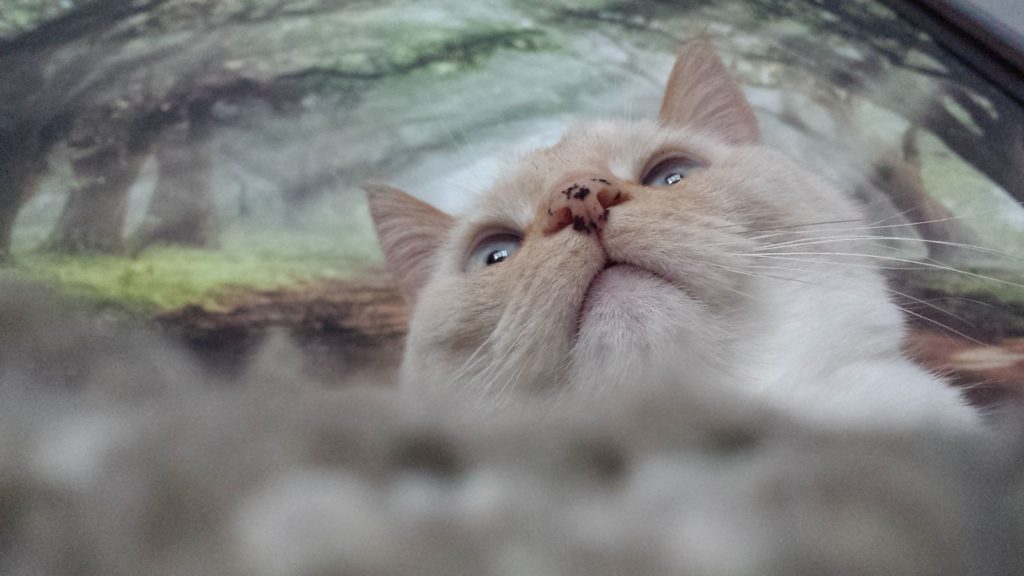
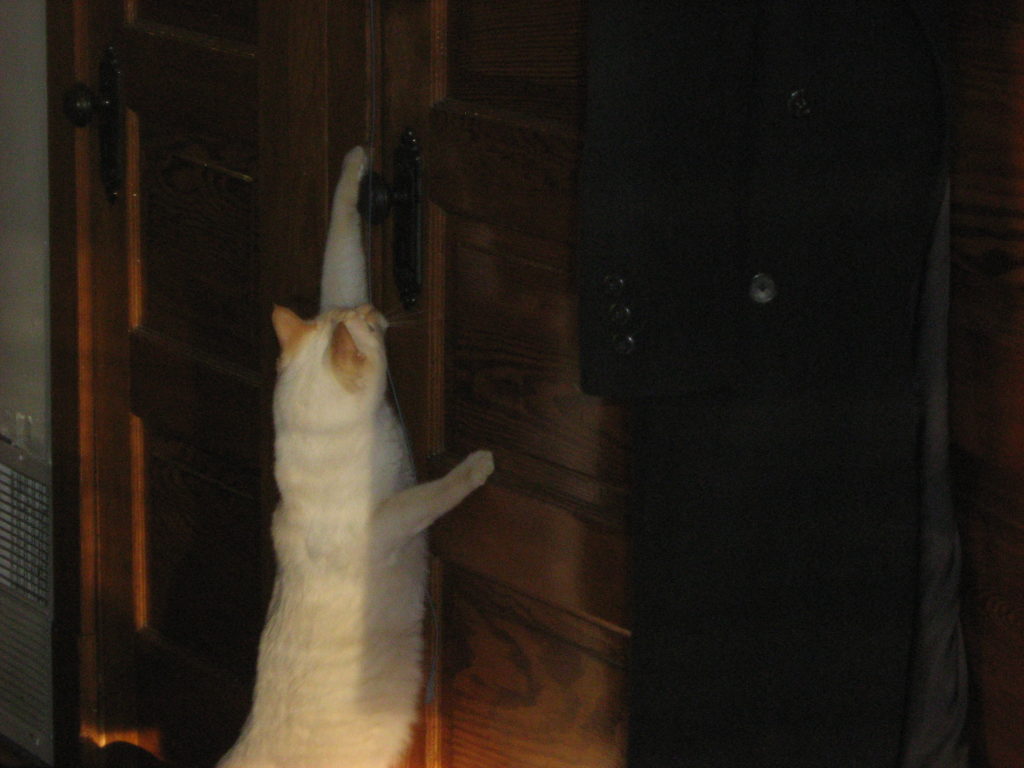
At 2:44am, I watched my cat Diego take his final breath. He was about 15 years old, and I knew him for 12 of those years.

Diego

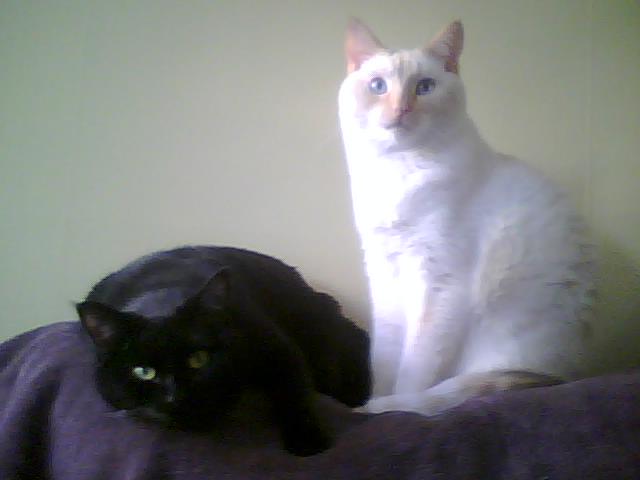
12 years ago, I was living in Chicago and visiting friends in Iowa, and I learned that their neighbor’s daughter was getting married to someone who was deathly allergic to her cats. She was looking for a new home for them, and since I happened to be interested in getting a couple of cats at the time, I took in Diego and his sister Gizmo when they were three years old.

I was told that he was named Diego because he looked like Diego from the movie Ice Age.

Gizmo and Diego

I quickly learned that Diego was a greeter. While his sister hid until she was sure the new people were safe, Diego was always interested in finding out who the new guests were right away.

Greeter

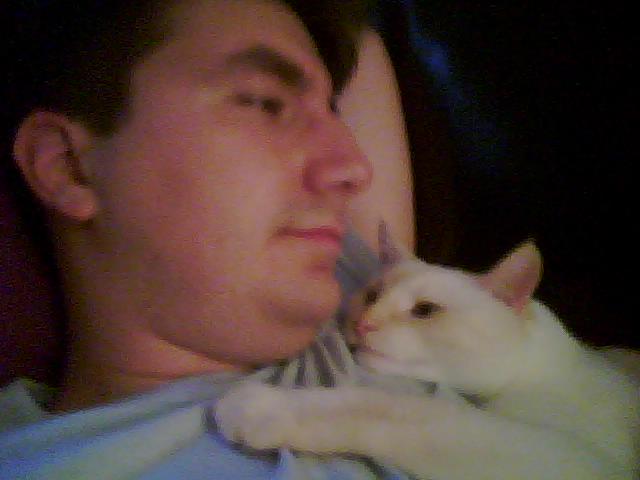
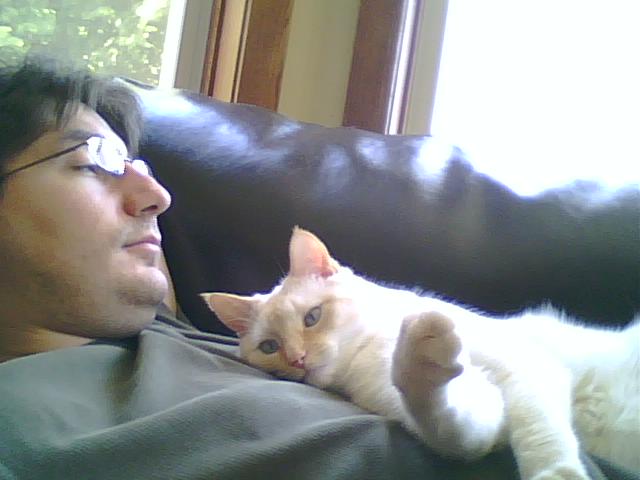
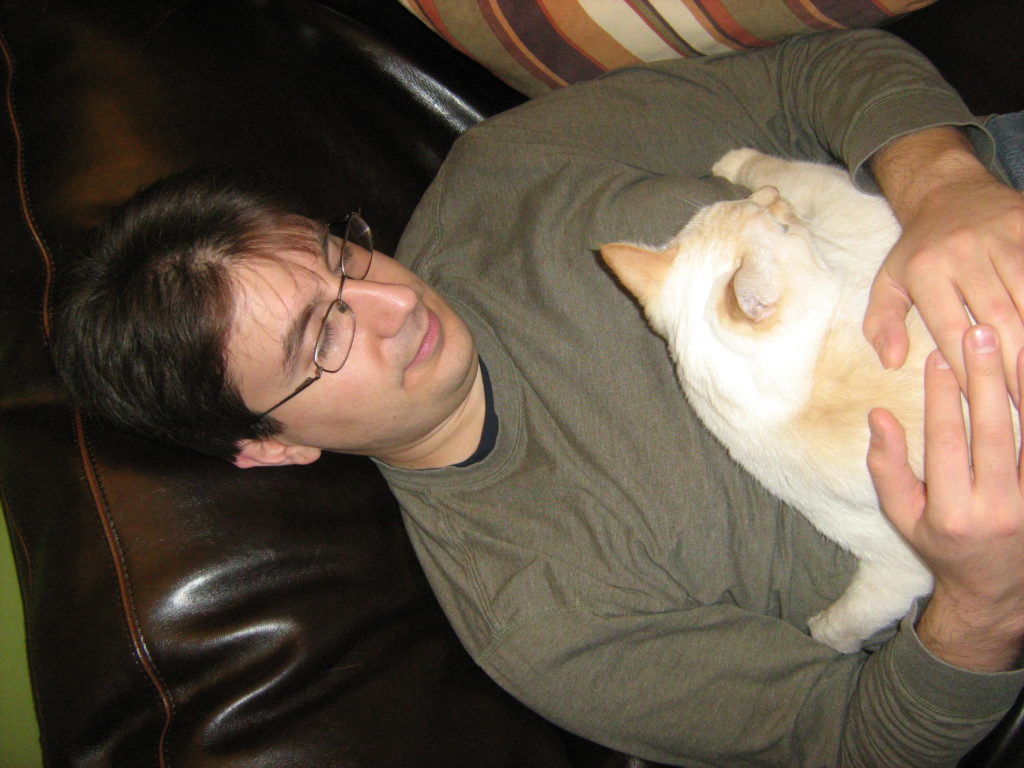
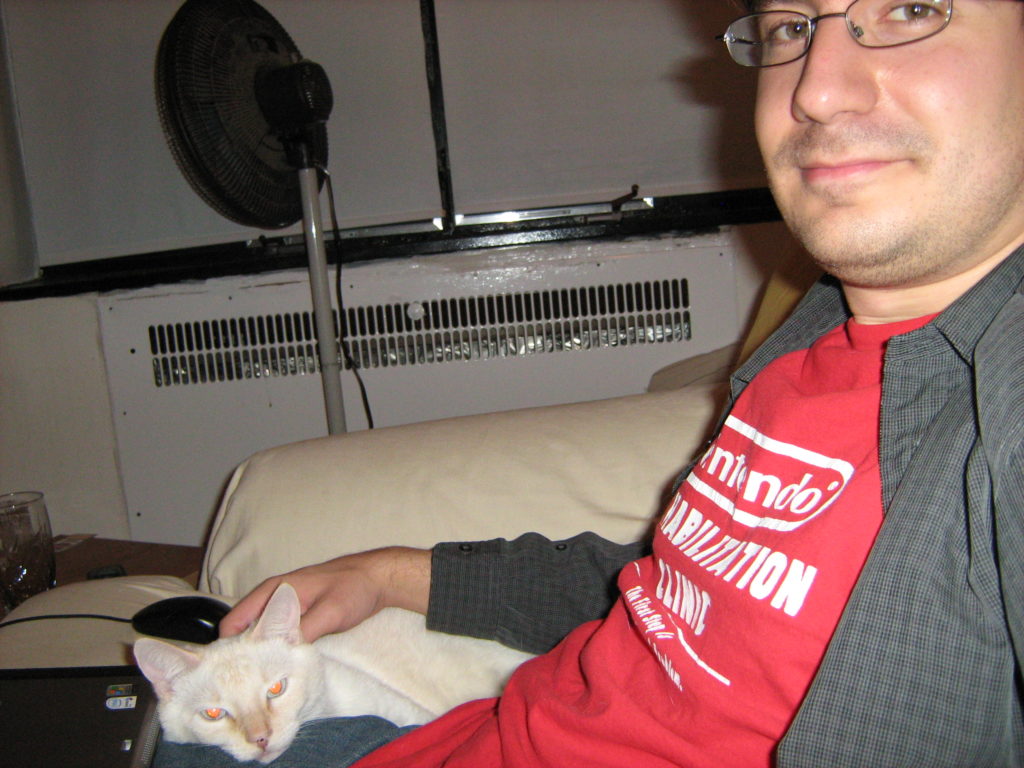
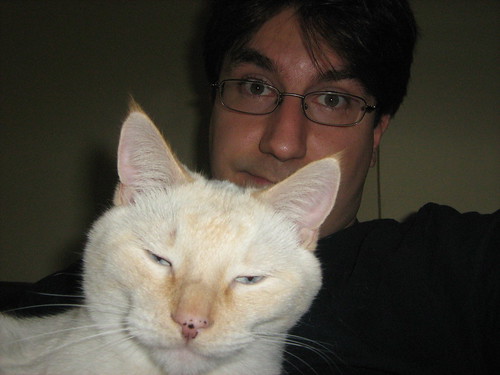
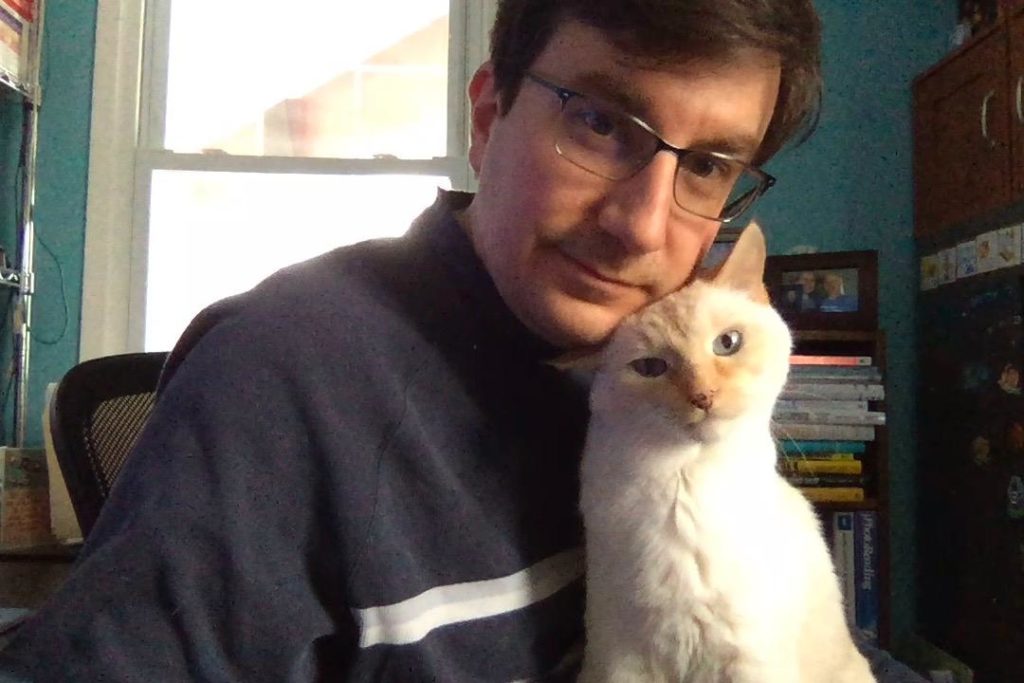
I remember when I was working at a company that made slot machines, and I was in crunch. So, I would leave early, come back late, and I would feel dead inside. I would plop myself onto the couch or a chair, and soon the cats would drape themselves across me. Diego would especially love to curl up with me. Napping together was great.

Me and Diego
Diego and Me
Diego cuddle time
Diego and Me

Even when I was not involved in crunch, whenever I came home, Diego would get up from whatever he was doing, meow frantically, and come see me. I would often pick him up and carry him, and he sometimes put his front paws around me like he was a child being carried by a parent.

I would whistle a certain way, and he often meowed in response, and every so often he would come to me, which was a neat party trick, except he never seemed to want to do it at parties or when other people were present.

Diego is hamming it up

Diego and his sister have been with me through five moves, two states, multiple Ludum Dare competitions, three jobs, and a few relationships. He has been my constant companion for almost a third of my life.

I don’t remember exactly when I realized he was growing old, but it was within the last few years. I might have been tossing him one of his toys and noticing that he was less interested in chasing it. He moved a little slower. But he was still playful, and he was fairly healthy throughout his life. I had to take him to the vet once to get some of his teeth pulled because they were not healthy, but he was fine.

I felt, however, I was on notice, and I realized that one day he might not be around anymore.

In the past couple of months, Gizmo had high blood glucose levels, and so she was on insulin to see if it would help. I changed their diet from dry food to wet food, as I read it can help with reversing diabetes. Gizmo’s levels dropped to the point that she no longer needed insulin, and she eventually bounced back to her old self.

Unfortunately, since I was so focused on Gizmo’s health and her eating habits, I didn’t notice when Diego stopped eating and drinking. They both lost weight, but I chalked it up to a better diet (they were both a bit on the heavy side), but at one point I realized that Diego felt a lot bonier than I could remember. I started to find him hanging out in strange areas, such as the upstairs bathroom, which is never a good sign in cats.

Last week we took him to a vet, and we made an appointment for an ultrasound for this coming Monday, but Diego’s health rapidly declined. It was very quick how he went from seeming perfectly fine to being on his death bed. I checked up on him throughout the day yesterday, but he got so weak that he could barely hold himself up.

My wife and I took shifts to stay with him last night, and when it was my turn, I found he was breathing very shallow breaths. He yowled a bit, and I had no idea if he could see me. I sang to him, talked to him, and pet him. I noticed his paw twitching, and every so often he would take a very large breath, stop breathing for a moment, then pick back up with the shallow breaths. It was awful.

At one point, I saw him stretch his paw out in front of him, which was a lot more movement than I had seen in a long while. A few moments later, he reared his head back, let out a deep groan of a sigh, and he was gone.

I am devastated. I don’t know why his health suddenly got so bad, and I hate that I didn’t see it earlier. I wish he didn’t have to go through as much suffering in his final moments as he did.

Diego, I love you. I will miss the way you climbed onto me whenever I was sitting or lying down. I will miss scratching you under your chin and seeing you close your eyes in contentment. I will miss dancing with you. I will miss your hugs. I will miss how you and Gizmo would curl up to sleep together. I will miss how it feels to come home and have you be one of the first to greet me as I walk in the door. I will miss how you would reach up to my face and pull it towards yours, probably to smell my breath or lick my chin.

I miss you.

My Favorite Pair Partner

Categories
Marketing/Business Personal Development

Don’t Pigeonhole Me: In Defense of the Jack of All Trades

Back when I was going to school at DePaul University in Chicago, the computer science school was introducing a game development minor. To kick it off, they had a panel involving a few people from local game companies such as Midway and Volition, as well as a few members of the Xbox team from Microsoft.

I remember the vice president from Midway Games answering a question from the students in the audience about how to get into the game industry. He referred to some advice that had shown up somewhere from Midway’s HR that essentially said, “Specialize, don’t generalize.”

I remember not liking that advice then, and I still don’t like it now. It sounded to me like “pigeonhole yourself and don’t you dare try to step outside of your hole”. Telling students who are interested in a future career, “You can improve your skills, but only in this one area of life” sounds overly restrictive and a path to misery. Or at least getting let go when your limited expertise is no longer needed.

Two Pigeons

Now, specializing isn’t necessarily bad advice. It’s just not the only valid option, and yet people like to talk as if it is.

I was catching up on my news feeds and saw that artist David M. Kessler wrote If You’re Talking to Everybody, You’re Talking to Nobody.

Don’t be a jack-of-all-trades. Pick what you like to do best, then get really good at it. Try to be better than anybody else. Let people see that you are an expert at the “thing” you do.

When you get known for that one “thing” you’ll see your art career soar. Now get in that pigeonhole and start working on your “thing.”

He says “Any successful marketer and business owner knows that you have to focus your efforts in order to target your market for sales. If you can’t target a market, you won’t make any sales – that’s business 101.”

He’s not wrong about needing a target market, but I don’t think “targeting your market for sales” is synonymous with pigeon-holing yourself into a single specialty.

He listed a bunch of artists as examples to further his point. The idea being that if you think of someone such as Monet or Jackson Pollock, you will inevitably call to mind some representative work of theirs.

But then, what about an artist such as Leonardo da Vinci? What was his “thing”? What about Leon Battista Alberti? Did he have just one thing?

How about someone more contemporary, such as Viggo Mortensen? I knew he was an actor from his role in Lord of the Rings, but I learned he is also an abstract painter and a poet, among other things.

There’s a lot of advice about specializing, and often it is very good advice, but just as often it is also not really supported by any sort of economic principle. Rather it’s more like “common wisdom” that “everyone” knows.

There’s no actual need to pigeonhole yourself into a specialty. Maybe it’s a tougher route to communicate your “thing”, since someone else can’t easily pigeonhole you as an abstract painter, but no one said it had to be easy.

Maybe rather than thinking about arbitrarily self-imposed limits, the more important thing is finding the thread that ties your story together as Pamela Slim argues in her book Body of Work.

Apple makes a lot of different products. Their thing isn’t merely iPhones or Macs. Their “thing” is elegantly, well-designed computing devices. Their “thing” is bigger than what a single product can encompass.

Telling executives at one of the most financially successful businesses in the world “Stop it. You need to niche down” wouldn’t make sense, would it?

The benefits to a focused approach are more than just increased sales. As you begin to focus your work, you’ll begin to get really good at it – better than you thought possible.

While I can see the logic, I also think that I could see someone get really good at their craft if they are able to work with different approaches, techniques, and mediums.

If all you know is oil painting, maybe you’ll get really good at oil painting. But if you know water color as well?

And if you think, “Huh, I wonder how it would look if part of the painting was oil but part was water color?” Would the result potentially be a more interesting work? Would the skill developed in each medium overlap, complement, or reinforce the other?

I don’t know, but I bet a conversation with someone who focused on creating the best work they could with all of their varied skills would be more fascinating and interesting than someone who is Yet Another Oil Painter.

And if their work is more fascinating and interesting, would commercial success also be possible?

According to Vigo Mortensen’s Wikipedia entry, “Mortensen experiments with his poetry and music by mixing the two art forms.”

Do you think his work in one influences the other and makes him a better artist, or does it reduce him to mediocrity because of a lack of focus? How about his music and his film efforts?

Dismissing the jack-of-all-trades as doomed to financial failure easy, but I see no supporting evidence. In fact, in software development, there’s a premium on so-called “full-stack” developers. Rather than hiring someone who only knows how to work with back-end databases or front-end forms, you get yourself a programmer who can do both as well as everything in between.

No one says, “Oh, sorry. we’re looking for a programmer who only knows one kind of programming language.” That’s like saying, “We want programmers who can’t think beyond one paradigm.”

On the other hand, a jack-of-all-trades without a larger purpose, vision, or mission? THAT I can see as being a problem, financially and otherwise.
Categories
Marketing/Business

Sears Needs a Better Purpose, Vision, and Mission

The day I was giving my presentation on the importance a well-defined, compelling purpose, vision, and mission for indie game developers, I read this timely article about a major company struggling with its identity.

Its Survival In Doubt, Sears Struggles To Transform Once Again from Morning Edition on NPR talked about the struggles of the once-giant Sears, which has been operating at a loss for quite some time, despite mergers and selling off brands.

A quote from a customer really sends home the message about how important it is to have a good purpose:

“It fits no niche. It’s not a discount place. It’s not high end,” Mullen says. “It has no identity anymore. I guess it tried to be everything to everybody and it was very successful at that. But now it’s nothing to nobody, which is sad.”

Is your indie game development business similarly raising question marks above the heads of players? Can people tell at a glance what they can expect your games to be about? Do you give them a compelling reason to care about you, or do you “just make games” like most other forgettable indies?

Categories
Game Development Marketing/Business Personal Development

Get Energized and Stay Motivated with Slides from my April 18th IGDA Des Moines Presentation

Most indies pay little attention to their purpose, mission, and vision, but then again, most indies don’t have sustainable businesses. The vast majority don’t make $500 in a year.

Rolling the dice and hoping for a hit, or at least something that earns enough to fund the development of another game, is not a serious strategy.

And there are a lot of new new indie game developers struggling with motivating themselves to work on their projects for more than a few days at a time before the pain of the creative effort overwhelms any enthusiasm they had to be a game developer. There are always posts online asking for tips of staying motivated.

At the most recent IGDA meeting, I presented an updated version of my 2014 talk Playing the Long Game: The Vital Importance of Purpose, Mission, and Vision to Your Indie Game Development Business.

I’m running my business part-time as I have a day job, but doing a poor job of running GBGames as a full-time independent game developer from 2010 to 2012 taught me some major lessons about running a business. Other indie game developers could benefit from my experience.

While there is no video of the presentation, I uploaded the slides with notes in a few formats:

Knowing who you are and what you stand for will go a long way towards reducing the stress and pain and fear that can otherwise be a regular part of running your own indie game development business.

At the very least, it will give you the energy and motivation to keep working on your projects for the long haul.

Categories
Game Development Personal Development

See Me Present at IGDA Des Moines on Tuesday, April 18th

The Des Moines chapter of the International Game Developers Association meets every third Tuesday of the month, usually at the Gravitate offices, a workplace community for entrepreneurs, freelancers and remote workers.

At this Tuesday’s meeting, I’m excited to be presenting an updated version of my 2014 talk Playing the Long Game: The Vital Importance of Purpose, Mission, and Vision to Your Indie Game Development Business, sharing lessons that can be drawn from my experience running an independent game development business full-time between 2010 and 2012, and talking about what I’ve done with my business since then based on those lessons.

Many indie game developers dive into the business head-first with nothing much more than a vague dream and some hope, and often with disastrous results. My aim is to help you clarify your Why, your What, and your How so that your efforts are clear, focused, and more decisive, both immediately and in the long term.

I hope to see you at this free event, whether you’re an established game developer, an aspiring one, or someone who is interested in learning about the behind-the-scenes of games.

You can register for the IGDA Des Moines April meeting, mainly to ensure we’ll have enough pizza and drinks for everyone. B-)

Categories
Games

Limiting Screen Time for Your Kids Isn’t Necessary?

When I was younger, my parents would tell me to turn off my Atari 2600 or my Nintendo because I was staring at the TV for too long. I remember one time in particular in which my father said something to the effect that it would ruin my eyes to play for so many hours at a time. I subconsciously rubbed my eye at that point, and he said, “Ah, hah! See?”

And I have felt self-conscious about rubbing my eyes after long sessions in front of the computer ever since.

But the main point is that I have always had this internalized idea that too much time playing video games or watching TV is bad (although it didn’t stop me from playing Civilization all night once…ok, a few times…I can stop taking turns anytime I want to!). There were health reasons, and there was also the idea that I should get outside into the fresh air more, or be more social.

As a game developer who is interested in creating entertainment that encourages curiosity, supports creativity, and promotes continuous learning, I would love to be able to watch my niece play the games I make and get not only real-time feedback but also help her on her journey to becoming a terrific person.

But when I visit, I find myself wondering if perhaps I shouldn’t contribute to even more of her screen time, as I almost invariably find her playing video games either on a tablet or on the computer.

If anything, my family is often getting her away from the computer to interact with people in the real world before she forgets how to do so. People like me, for instance. “Hey! I live over 300 miles away and only visit for a couple of days every few months. You could at least look at me once or twice!”

I know some people who use screen time as a reward for doing chores or good behavior, and taking away screen time is a punishment. By and large, their kids are not allowed to play games or otherwise use computers recreationally for more than so many hours per week.

But according to Christopher Ferguson of Stetson University, a recent study he led found that “there is only a negligibly small association between excessive screen time and higher levels of depression and delinquency among teenagers.”

Well, that’s good news. Playing too much Minecraft or Halo isn’t what leads your kids to becoming disaffected youth. Whew!

What’s more, Ferguson argues that since computers are so integral to society and how we live and work, preventing children from become familiar with modern technology is likely to prevent them from being able to participate in our increasingly fast-paced lives, which is the exact opposite of the result many parents might want when they limit screen time.

Funny, I’m pretty sure that was the argument I used to convince my parents to get me Mario Paint, which came with a mouse peripheral.

Naturally, our focus can shift from how long children play games to what games they are actually playing. I’m reminded of Steven Johnson’s Everything Bad is Good for You, which argued that today’s TV and video games are actually more challenging than they were decades ago, and so children watching TV and playing games today are essentially training themselves in decision-making and other important skills.

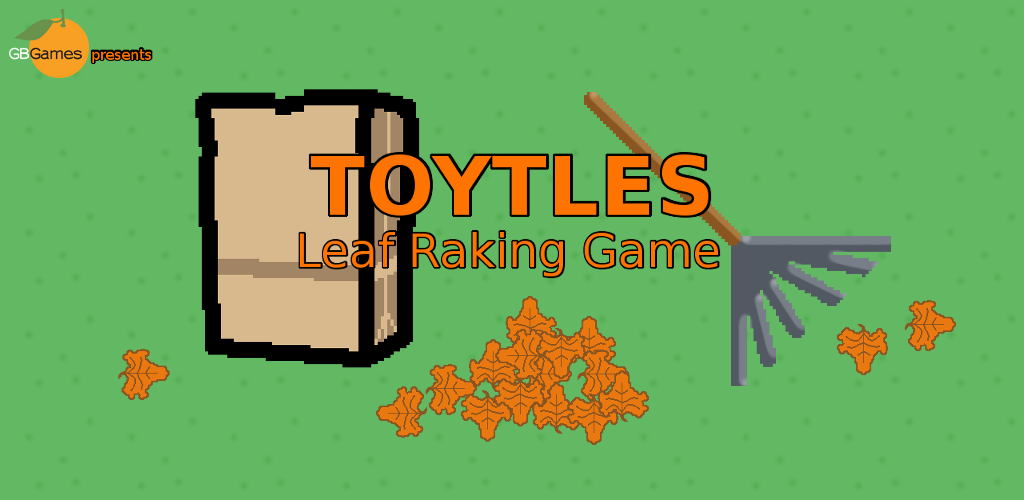
Even if too much screen time isn’t a real issue, I still might pry my niece away from games periodically, if only to be able to catch up and spend quality time together away from the screens. But the Ferguson’s study made me feel more comfortable letting my niece play games that teach responsibility and strategic thinking such as Toytles: Leaf Raking.

Of course, I also think a well-rounded video game education is in order, starting with the classics.

Let me dig out my Atari 2600…

Categories
Game Development Geek / Technical

Book Review: Behavioral Mathematics for Game AI by Dave Mark

Behavioral Mathematics for Game AI Book

Intrinsic Algorithm’s Dave Mark, a fixture at the Game Developer Conference’s AI Summit, is also the author of Behavioral Mathematics for Game AI.

Most game AI literature covers the basics in a general way, such as finite state machines, flocking and steering to control movement, pathfinding algorithms such as Djikstra’s or A*, goal-oriented action planning (or GOAP), and more.

Mark’s book, however, covers a specific topic in great depth: game AI decision-making.

You might have a character that can do interesting things such as hunt, flee, eat, track, alert nearby allies, etc, but if you don’t create a good system that allows that character to make decisions between those behaviors, it may not convince your players that it is intelligent at all.

The goal is to create behavioral algorithms to get computer-controlled agents responding to their environment in believable and sensible ways. To get there involves a journey through the subjects of psychology, decision theory, utilitarian philosophy, and probability and statistics, among others.

Mark was great at walking you through each step of this journey, combining theory with detailed explanations and examples, including code. Sometimes I felt the detailed explanations were a bit too detailed, but at no point did I feel like I was lost.

He never made a leap in logic that left me behind because he was holding my hand at every step of the way. Sometimes I appreciated that hand-holding, especially for the more involved statistics, but there were a couple of times when I found myself getting a bit impatient and wanting to run ahead.

And it is probably partly due to the fact that it’s a long journey. At one point, I realized I was over 300 pages into the book without feeling like I knew how to integrate and apply all of the individual tools I was learning into a cohesive system.

The examples he used to illustrate his point were sometimes bizarrely relatable. I have never tried to create a model of my behavior related to when I decide to replace my older razor blades with newer ones, but Mark did, and I actually found myself nodding with recognition that I do tend to use my last blade in the refill pack for way longer than my other blades.

Other examples demonstrate how his utility-based decision-making system can address problems with past games, such as the strategy game AI that kept sending its attack force towards the most vulnerable target. Savvy players can keep defensive forces outside of city walls, then place them in the city at the last moment and moving units out of a city far away. By doing so, they could keep the AI units moving back and forth, unable to carry out an attack, for as long as they want.

Solving this issue involves giving the AI the ability to have decision momentum by making decisions include all of the relevant information. The AI isn’t just deciding what city to attack. A single decision is what city to move to AND attack, which incorporates the time it takes to travel to a target city. Suddenly, the decision to change course in order to attack a different city is a bit more painful, and so the current target is more likely to be maintained.

I appreciated that he covered the problem of having the AI always making the best decision. While academic researchers might love that result, players are likely to find such AI as unrealistic and, worse, uninteresting. And if there are multiple AI agents that do exactly the same thing simultaneously, it’s even more of a problem. So there’s an entire chapter on ways to ensure that the game AI can be reasonable yet still interesting from one play session to the next.

The book was published in 2009, and so you would think it means that any information you could glean out of it would be obsolete after almost 10 years of advances and progress in the field. And yet, the basic decision-making system that drives behaviors is still relevant.

One of the benefits of reading an older book is seeing the ideas of that book illustrated in front of you in other media.

You can see Mark’s talks with Kevin Dill from GDC 2010 and 2012 in the GDC Vault. Improving AI Decision Modeling through Utility Theory and Embracing the Dark Art of Mathematical Modeling in AI both introduce the use of this utility-based system in games.

In 2013, Mark’s portion of the panel Architecture Tricks: Managing Behaviors in Time, Space, and Depth introduced the Infinite Axis Utility System, which takes the concepts from the book and puts them together into a simple yet powerful architecture.

In 2015, Mark and Mike Lewis presented Building a Better Centaur: AI at Massive Scale, in which they describe the Infinite Axis Utility System that was the architecture behind an MMO.

I’ve seen these videos before, but having now read the book, I found that upon rewatching them that I understand the sections on response curves and how they apply to the actions the IAUS chooses.

Behavioral Mathematics for Game AI is not a beginner’s book at all, but if you are interested in learning how to give your AI powerful reasoning abilities that produce rich, believable behaviors for your players and want it to be easy to understand and design with, I’m not aware of another book on the subject that is as accessible as this one.

Categories
Geek / Technical Politics/Government

How Much Do You Value Privacy and Security in the Apps You Use?

I tend to dislike relying on third parties to provide me with services I find indispensable.

If I can help it, I prefer having control over my own services, even if it means having a poorer experience than a flashier, proprietary solution might provide .

Staying in Control of my Mental Food Sources

For instance, years ago I used Google Reader quite a bit to keep up with news on the game industry, on blogs I followed, and more. It was a great service.

And then I imagine with the rise of social media my own usage dropped without me realizing it, so when they announced they were discontinuing it in 2013, I learned about it probably on Twitter.

There were plenty of tech-oriented news sites putting out articles on replacement services, such as Feedly, which I know lots of people recommend.

But I was curious about creating my own personal Google Reader-like site. It’s just collecting a bunch of RSS feeds and showing them, right?

Before I got too far wondering how to do it myself, I learned about Tiny Tiny RSS, open source web-based news feed (RSS/Atom) reader and aggregator.

Open source means I don’t have to worry about a third party disappearing or pulling the service for one reason or another. I also don’t have to worry about said third party collecting data on my reading habits.

It was years before I got around to setting it up on my own web host. In fact, I didn’t do so until last December. But now that I have, I feel like kicking my past self for not doing so sooner. It’s incredibly useful, especially as I can’t trust various algorithms (and the algorithm writers) at Twitter and Facebook to show me what I specifically wanted to see.

And the best part is that I am in control. I can backup my data and take it to another web host. I can use my own desktop computer to act as a server if I want. I can see everything without filtering or some company deciding that NOT showing me what I subscribed to is somehow better.

I just hope I never need to ask for support, unless I want to deal with the developer equivalent of the Soup Nazi. Reading through the support requests I did see when I was trying to figure out how to set up the software left a bad taste in my mouth. Yeesh.

But since Tiny Tiny RSS is open source, I technically have the ability to take my support requests elsewhere. Again, I have more control and more options.

My Any.Do Woes

More recently, I ran into a frustration with an app I depended upon to manage my todo lists. A few years back, a friend recommended the Android app Any.Do to me, and I’ve used it ever since.

It was intuitive, allowed me to setup recurring items, and showed me my items in the order I liked, separating things that are to be addressed today from the things of tomorrow or in the vague future.

I of course used it for one-off items. Maybe someone recommended a book to me in a conversation. I would pull out my phone, open up Any.Do, and add an item to remind me to look up the book later.

But the ability to set recurring tasks was a huge feature. I set reminders for mundane things like watering my plants every week or cleaning the litter boxes each morning. I used it for regular habits, such as writing a daily summary of the prior day each morning and using my evenings to plan for the next day. I even used it to remind me to write blog posts or update my finances.

At one point it started trying to get me to install their calendar companion app, but I was fine with my current situation, and I learned I could disable the reminder.

It also kept asking me to get the pro version, but as I had no interest in syncing between devices, I was fine with the free version.

And everything was fine. Well, mostly. It had a few minor bugs I got used to over the years. Every once in awhile, the UI would get glitchy. Sometimes the tasks would look like they were reloading on top of each other, and eventually I think there would be a conflict that would prevent me from swiping a task to completion or adding new tasks. Closing and reopening the app usually cleared it up, though.

The bigger, scarier one was when I would open Any.Do only to find a blank screen. My task list, the one that that I live by, was gone!

The first time, I had a moment of panic because, hey, free version, meaning no syncing, and therefore no backups existed. But then I not only closed the app but shut it down. When I launched Any.Do again, there was my list. Whew! Every critical bug with a workaround becomes a minor bug. B-)

So, I happened to see that Any.Do had an update in Google Play, and I went to check the changelog, and all it said was “Every update is a boost to the app’s stability, speed, and security…” Maybe they finally fixed the bugs?

So I update the app, and now I find out that the syncing feature of the pro version is required in the free version.

Required.

Now when I launch Any.Do, I see a screen asking me to create an account by linking the app with my Facebook, Google, or personal email account in order to keep my tasks and lists in sync across all of my devices.

And there is no way to get past this screen so I can see my list again if I want to avoid creating an account I don’t need.

I’ve learned that Any.Do is also integrating with Alexa and will have a chatbot to help you with your to-do items. I’m sure those are great features for people who like them, but I’m decidedly not an early adopter, and I think I prefer my to-do list app to be sans A.I.

TODO: Find Another To-Do List App

So the changelog lied, and now my choice is to comply and lose a bit (or a lot?) of my privacy, search for older APKs of Any.Do and worry about where they came from and whether or not it is safe to install them, or find another app.

I decided to look for another app, but I wanted to be more careful this time. I already hate it when seemingly simple apps ask for way too many permissions.

Unfortunately, almost all of the apps I could find that focus on privacy and limited permissions were too simple. Recurring tasks are almost never available as a feature.

Privacy Friendly To-Do List by the SECUSO research group would otherwise have sounded perfect in terms of limiting permissions and providing control.

I did find an app called To Do List & Widget. It had limited permissions, which boiled down to “it needs to read and write to files”, and it lets you back up your lists manually.

It’s only downside besides a UI that is somewhat less intuitive than Any.Do’s is that there’s almost no information about who made it and where it came from. It’s definitely not open source. While the permissions allow it to do only so much, I still found myself being a bit uneasy about trusting it on my device. And besides, what happens in the future? Will it continue to be updated?

So ultimately I settled on Taskwarrior, which is a GUI app wrapping the command line tool of the same name.

The underlying system is incredibly powerful, and so unfortunately I found the UI requires me to learn how to use it. Recurring tasks aren’t as easy to setup, for instance, but I can do more interesting schedules than what Any.Do restricted me to.

And if I ever do setup my own Taskwarrior server, I can get syncing on my own terms.

I was surprised that it requires a lot of permissions, but it boils down to the app needing to create and use an account on the device and needing access to the network to do the syncing. There are no in-app purchases or ads, and the source is available so I can build it myself and read through it to verify that nothing nefarious is happening under the hood. I also have the ability to continue updating it if the original maintainer disappears.

The user interface is awkward for me at the moment. Any.Do showed me my tasks for today, tomorrow, and later, and it even had a separate category for unscheduled stuff as “Someday”. A recurring daily task I completed would show up in the Tomorrow list automatically.

Taskwarrior’s default views are showing me everything, and while they are in date order, it’s not cleanly separated. Also, recurring tasks are automatically synthesized from the template task, and so I find I can have multiple instances of the task at once in my list.

Then again, these issues might be due to me not knowing how to use Taskwarrior properly.

What’s Important to You?

Some people might balk at the idea of investing time into learning how to use an app when a more intuitive one is available.

And that’s fine. I get it.

But I’ve been starting to value my privacy and my security even more these days.

And it’s not an absurd paranoia. Recently there was news about a popular makeover app with privacy red flags. Pokemon Go was a concerning app until they changed the scope of the permissions it required to run.

I already know that Google tracks where my phone goes, which means it knows where I go. I should really turn off the GPS when I’m not actively using the map functionality, in fact. It’s always disconcerting to see the notification telling me that it is using it because none of the running apps in the background should care where I’m at.

I mean, when I took a picture at my mother-in-law’s house during a party, I got a request to upload the picture and attach it to the search results of the nearby public park. Ick.

Artificial intelligence is huge these days, and with chatbots and intelligent personal assistants such as Siri, Google Now, Cortana, and Alexa, we’re seeing a lot of benefits in the way of convenience.

To get that convenience, though, we’re handing over our data to the people behind our devices. And yet, security is rarely treated as a priority, which means that even if we trusted our data to those people, it might also be getting to people we don’t trust.

And so, because I value my privacy and security, often it feels like my choice is to opt-out or roll my own solution.

And since everything is getting artificial intelligence integrated in, it often means tolerating third parties getting access to data more or using alternatives. And if I am going to use alternatives anyway, they may as well be ones I have the most control over.

Thank goodness for free (as in speech) software, eh?

Categories
Game Development Marketing/Business Personal Development

Looking Back on 2016; Looking Forward to 2017

Wow, it’s almost February? I’m incredibly overdue for the blog post in which I give a post mortem of the previous year and talk about my plans for the coming year.

Which isn’t to say that I’ve been doing nothing this past month. I just haven’t prioritized telling you about it over actually doing it. B-)

WHAT WENT WELL IN 2016

As I said in 2015, I improved my ability to remember my goals. I no longer did the equivalent of setting New Year’s resolutions that I forgot within weeks. Throughout the year, I knew how well or poorly I was doing according to metrics I tracked.

Unfortunately, it meant that I was very aware of how poorly I was doing most of the time.

Last year I set out to build on my success with remembering goals by focusing on what’s needed to actually accomplish those goals.

One big and important improvement I had was in the area of project planning.

In the past, even if tried to be formal about my project management, my actual planning efforts never amounted to more than creating a list of tasks.

Now, some developers find that they can do just fine with nothing more formal than a TODO list or two, and it worked fine for me if I just wanted to know WHAT to work on and maybe even in what order.

But when you’re a lone wolf indie game developer, you need to wear a lot of hats. I had no problem with donning the Software Developer Hat, but my Producer Hat was neglected and gathering dust.

So I might spend weeks working on a particular feature or task without realizing it because I never stopped to think about how the entire project’s progress was being impacted.

At the beginning of the year, I spent quite a bit of time in project planning mode. I even wrote about how I approached it in How to Create a Game Development Project Plan. Then I dove into executing the plan.

And I was very pleased at how well following the actual plan worked for me. Even when my project started running late and surprises appeared that I hadn’t planned for, having a more active Producer Hat meant that at any given time I was focused on actually shipping my game.

Which leads me to the next thing that went well: I shipped!

I published my business simulation game Toytles: Leaf Raking for Android.

I still need to write the post mortem for it, but it is my first finished commercial project in years. While there are still features and content I wished I could have added, I’m proud of what I put together.

The release of my first commercial game in years also gave me my first sales in years. After earning $0 in 2015, I like this new trend of actually earning money from my business.

Speaking of money, 2016 was also the first time I put together a detailed budget for my business.

I used to track my expenses and income as they happened, and my aim was to ensure I had enough money in my bank accounts to cover everything.

But I got tired of learning that my bank account balance was lower than expected, only to discover that an automatic renewal on domain names or web hosting had occurred. I felt like I should be able to anticipate such regular expenses instead of being surprised by them.

So, I put together a projected budget, which allowed me to see not only how much I anticipated spending in the coming year, but also when my expenses were expected to spike. For example, I knew that my annual web hosting renewal was coming up in August.

And then I tracked my actual expenditures against the budget. It was eye-opening, and not just because I was able to quickly learn that my web host increased its rates without telling me before autorenewing. B-(

As a side effect of being hyper-aware of where my money was coming and going (er, mostly going), I also added to my budget a plan for a monthly investment into my business. I managed to add a significant amount of money into my business bank accounts by the end of the year.

Also, I updated my website, which is something I’ve been meaning to do for quite some time. My blog used to be completely separate from the main site, and now it’s integrated.

WHAT COULD HAVE BEEN BETTER IN 2016

Aside from my newly detailed budget and more robust project plan, I didn’t have plans for much else.

I wish I had spent some significant time on creating a promotion plan for Toytles: Leaf Raking. I had done some keyword research and put together a list of reviewer contacts, but most of my effort was spent on actually finishing the game.

Once it was nearly ready, I struggled to make forward progress on getting it in front of people. I realized quite late that the reason I was struggling was because I had no real plan to make it happen.

I didn’t even blog much about it, so I rarely mentioned it during development. I was a bit too accidentally secretive.

For a long time, I had a TODO item on my list to create a skill development plan for myself. I wanted to direct my learning more rather than pick up things haphazardly, but all of 2016 passed without such a plan in place.

I read 54 books, but only 8 were business related, of which I believe only one was game development related.

My project ran late. I didn’t plan for balancing the design, and so quite a bit of work to make the game feel complete wasn’t in the original plan.

Had I published it in three months, I would have had the rest of the year to figure out how to promote it. I wanted to try earning $1,000 by December 31st, but between the late release and my lack of promotion, I fell way short of that mark.

WHAT I WANT 2017 TO LOOK LIKE

2015 was about keeping my goals in front of me and establishing habits.

2016 was about being outcome focused. I logged more game development hours in 2016 than in 2015, but the more important thing was that those hours were aimed at targets.

In 2017, I want to focus on promotion and sales.

Which means I’ll be putting together concrete, specific, actionable plans instead of hoping and praying, or haphazardly trying to tweet about what I’ve made, which is basically the same thing.

I’ve already started the year with efforts to port Toytles: Leaf Raking to other platforms. More platforms means more opportunities for people to find my game. First up is GNU/Linux, mainly because it is my development platform and is easiest for me.

But what about making other games? Project planning is one thing, but product planning is another thing entirely. I have various ideas for new games, but I don’t want to be random about picking something just because it appeals to me. It will be easier to promote new projects if I do my market research and ensure my projects already appeal to players.

My blog has historically been about running an indie game development business, and so my audience has been other game developers primarily. My customers, however, aren’t going to be other game developers and aren’t necessarily going to care about what happens behind-the-scenes.

The thing is, I like writing what I’ve been writing on my blog and don’t want to stop. Can I address players more directly, or do I need to separate my business from my blog to do so?

I am confident when it comes to creating games, but thinking about selling them is both exciting and terrifying to me, the way new things often are.

2017 is when I challenge myself to be incredibly proactive about putting myself and my work out there.

Let’s start. Oh, and happy new year!

Categories
Geek / Technical Politics/Government

Where To Donate Some Money Before the End of 2016

There’s only so much time left for your charitable contributions to count towards your 2016 taxes.

If you’re looking for recommendations, here’s two organizations I have contributed to because I believe in what they do.

Electronic Frontier Foundation

“Defending Your Rights in the Digital World” is the EFF‘s tagline, and I’m unaware of another organization focused on our rights and liberties in the context of our digitally-enhanced age.

Founded in 1990, EFF champions user privacy, free expression, and innovation through impact litigation, policy analysis, grassroots activism, and technology development. We work to ensure that rights and freedoms are enhanced and protected as our use of technology grows.

When the Digital Millenium Copyright Act was passed in 1998, there was a lot of abuse potential.The DMCA is overly restrictive in what it allows people to do legally with their own technology, and it allows large companies to abuse the system.

Yet the DMCA has become a serious threat that jeopardizes fair use, impedes competition and innovation, and chills free expression and scientific research. If you circumvent DRM locks for noninfringing fair uses or create the tools to do so you might be on the receiving end of a lawsuit.

In one high-profile example, Dmitry Sklyarov, working for ElcomSoft, was arrested by the FBI while he was in the United States on a trip where he spoke at DEF CON about ebook security, specifically Adobe Systems’ technology. Why?

Because…well, it wasn’t clear at the time, but Adobe Systems thought that his published research and software was a violation of the DMCA’s circumvention of their copy protection systems.

The thing is, Sklyarov is from Russia. The DMCA has no jurisdiction there, so what he or his company did wasn’t illegal.

Also, while Adobe’s software didn’t allow people to exercise Fair Use, ElcomSoft’s software did.

Throughout the years, the EFF has been leading the charge against abuses such as this one.

I like my copyright law to be used to promote the useful arts and sciences, not to allow copyright owners complete control over all potential uses just because there happens to be a DMCA-covered copy protection scheme to prevent my otherwise fair use.

I also like my privacy to be protected, and I don’t like finding out that my technology is forced to have backdoors or introduced a rootkit onto my computer.

So, I support the EFF’s work, including their projects such as HTTPS Everywhere which is aimed at helping to make our web browsing more secure, and recommend you do the same.

Contribute to the EFF and become a member.

The Internet Archive

I’ve been blogging for over 10 years, and a lot of the blogs and news sites I’ve linked to in the past are no longer around. Sometimes, I want to reread an article, but the link I have is dead.

Another issue that could arise on the Internet is that someone’s stance may have silently changed. You were pretty sure that politician was pro a few years ago, and yet they insist that they are con and always have been.

So I go to Archive.org‘s Wayback Machine and find the article from around the time it was originally published and prove that the politician has flip-flopped.

The Internet Archive not only has the history of over 279 billion web pages, it also has a library of books, movies, music, and software.

Did you want to watch The Great Train Robbery, the 1903 silent film with the terrifying surprise ending? Well, it’s not really all that terrifying, but back when it was originally in theaters, it made audiences jump out of their seats to safety because no one had seen anything like it before.

It revolutionized certain film-making techniques, and you can watch it for yourself thanks for the Internet Archive:

Or maybe you miss playing certain games on your Apple II computer, such as the classic game Lemonade Stand:

Oh, wow, does that take me back!

I believe in the importance of preserving our history and ensuring free and open access to knowledge is available to millions of people for many years to come, and I’m happy to support the Internet Archive in its efforts to be the most trustworthy and important non-profit library for the world.

Contribute to the Internet Archive today, and your donation will be matched 1-to-1 to double your impact.

Those are my two recommendations. What are yours?