Categories
Game Design Game Development Geek / Technical

LD50: Didn’t Make the Compo Deadline, Switching to Jam/Extra? #LDJam #LD50

So a lot got done in the final 12 hours of Ludum Dare 50 before the compo deadline.

Just not enough of it.

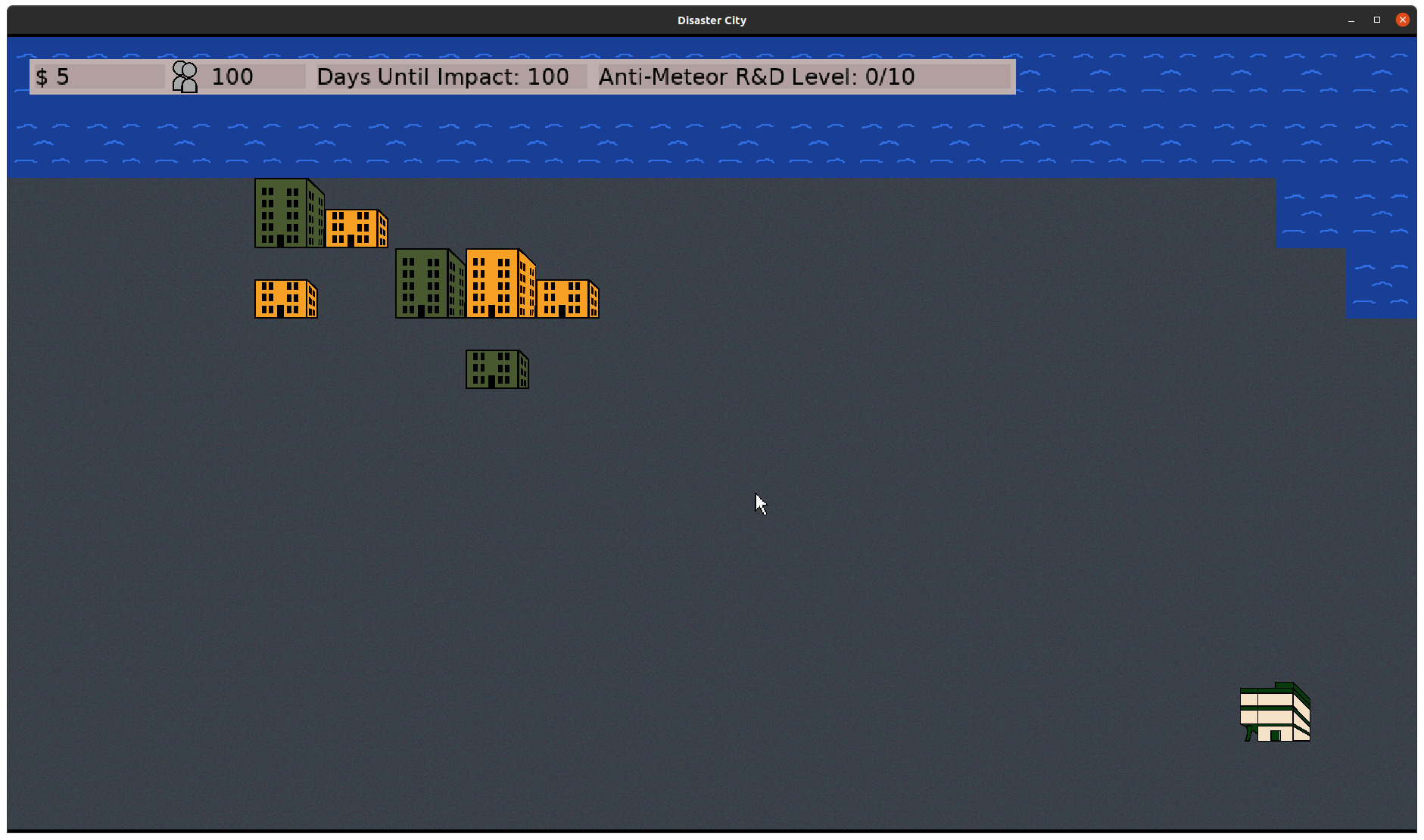
Disaster City already had the super secret anti-meteor R&D base (modeled off of the NASA Langley Research Center) and some skyscraper buildings. There was a river nearby that I intended to cause floods.

I set about creating the core game loop. Each turn would occur in phases.

There would be an report phase, in which you learn about any new disasters as well as how the previous day went. Then there would be a player command phase, in which you can decide to do various repairs or investments. Then the day would resolve based on what you did and what was going on.

Getting these turn phases in meant I could quickly put together an ending in which the inevitable meteor hits and you lose the game.

Then I created the ability to invest in R&D to prevent it.

Once I did so, I could make a happy ending, in which you successfully divert the meteor.

Then, the real game development needed to happen to make it interesting. Basically, I wanted a lot of disasters to befall the well-named city that you needed to spend your time and resources on instead of spamming the Invest button.

And since I didn’t have much time, I changed priorities to get the monster attack in sooner because I really wanted to take advantage of the drawing I had made earlier haphazardly and because I thought it would be more interesting than a flood or fire.

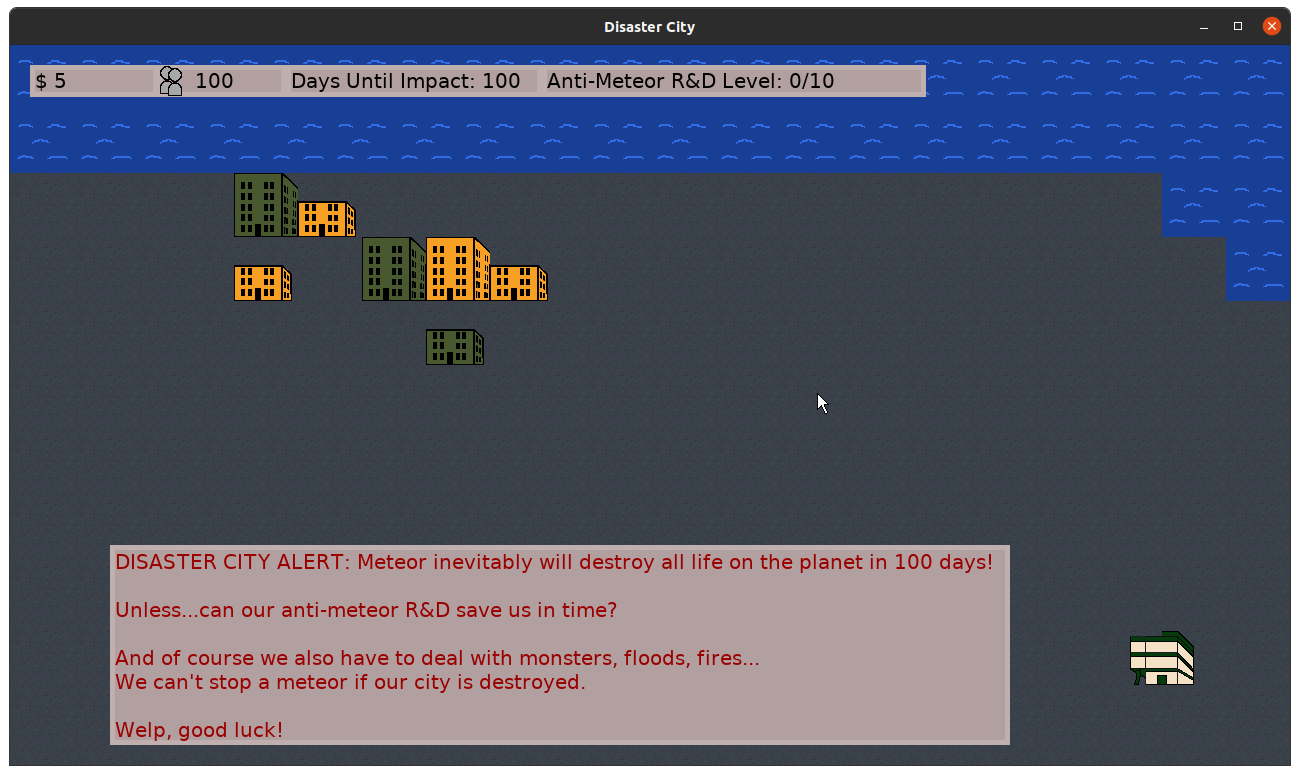
LD50: A disaster alert

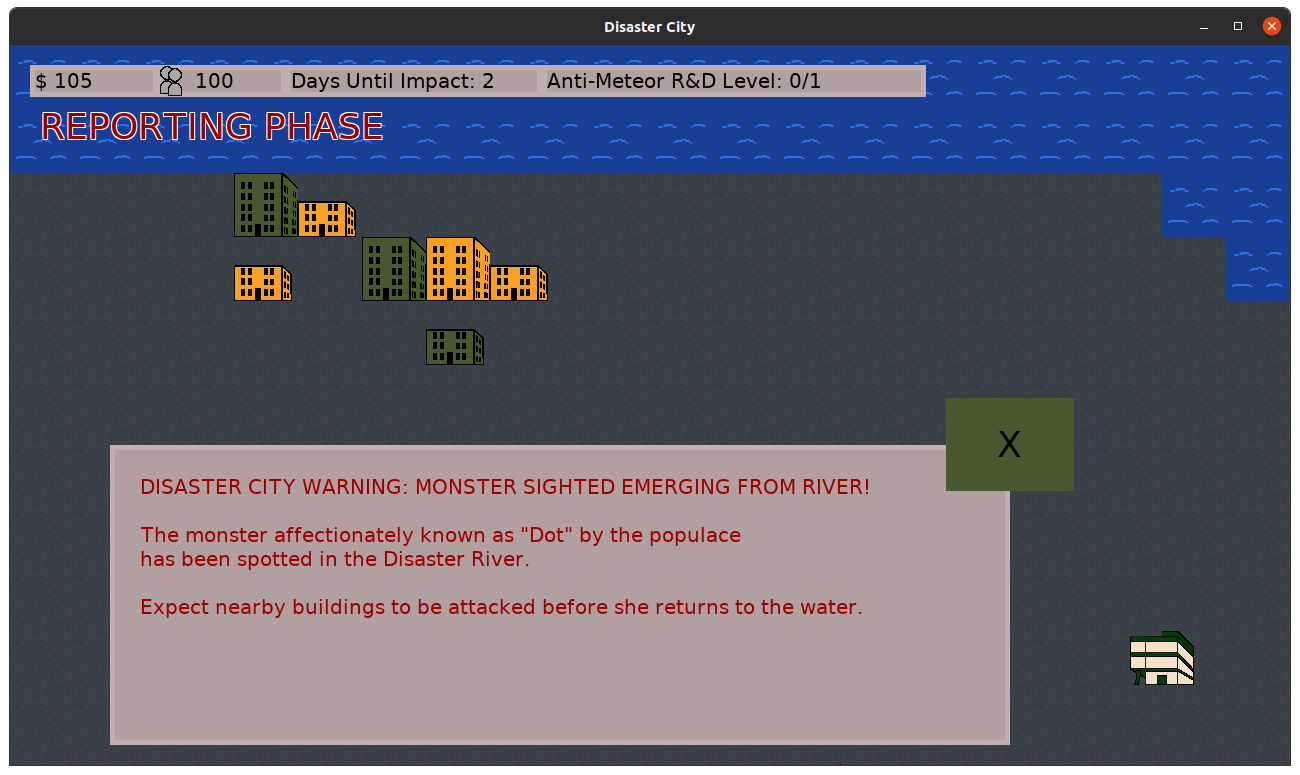
LD50: A disaster warning

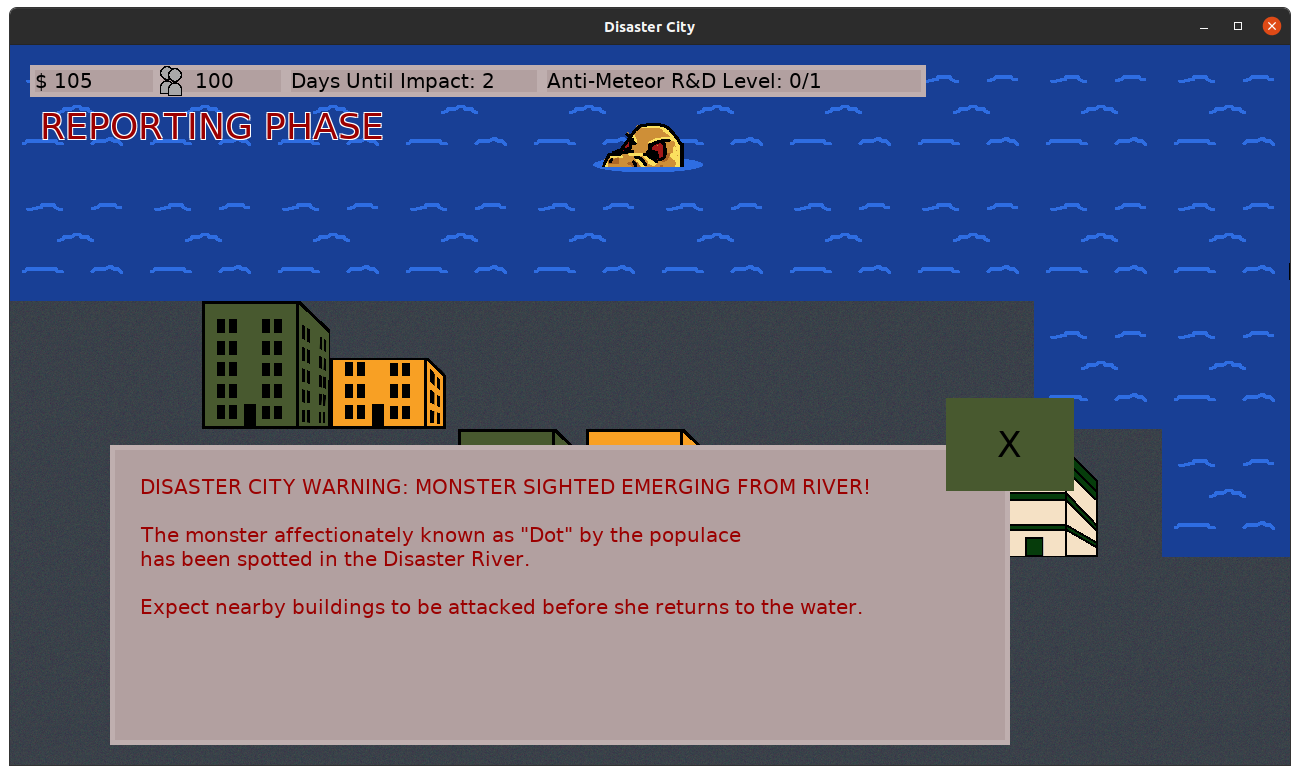
LD50: Changed scale of game

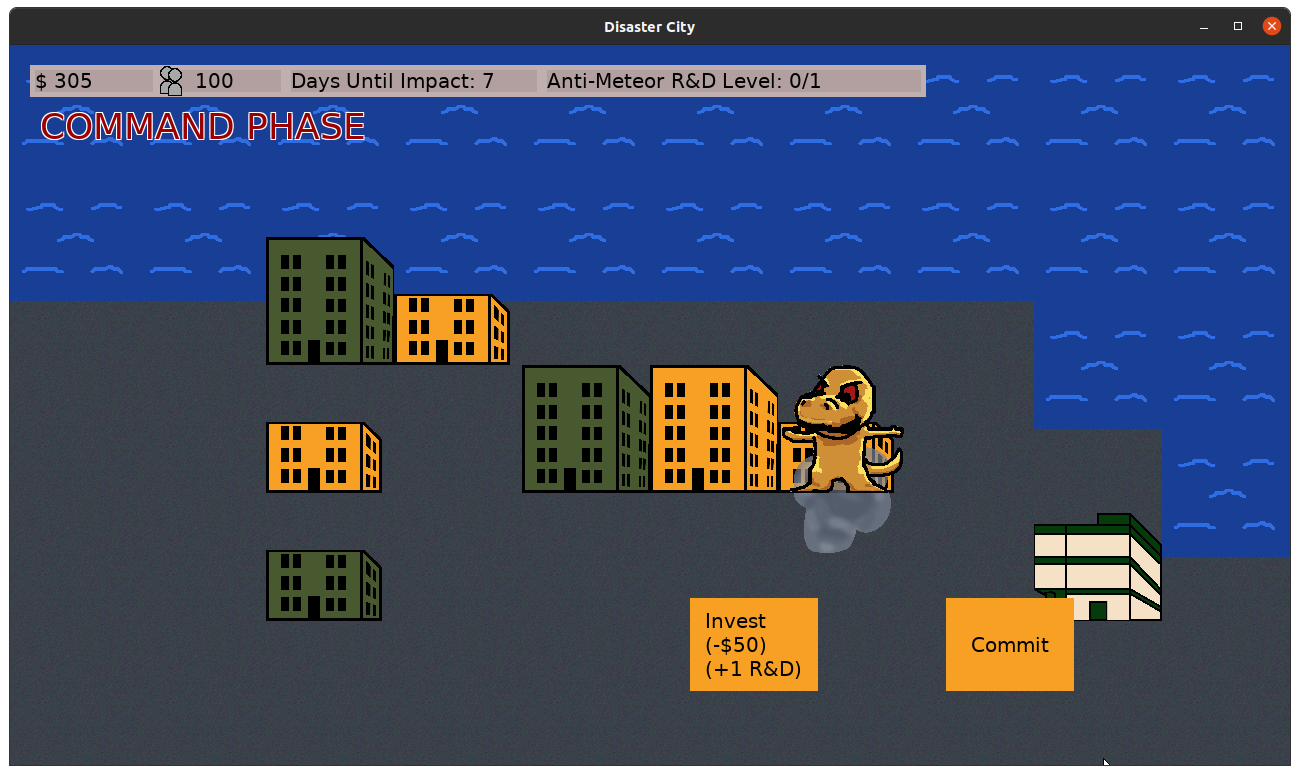
LD50: Monster attack

Unfortunately, getting the monster to appear, attack a building a bit, and disappear took a very long time. There were weird bugs, like when the monster teleported back into the water and kept coming at the same building turn after turn but never did anything. It was weird, and there was one defect I couldn’t figure out but somehow seemed to have resolved, and as I didn’t have a lot of time, I had to just hope I truly fixed it.

I changed the scale of the game up since I obviously wasn’t going to get to implement other features of the city that I wanted, like parks that could be destroyed (people leave when there isn’t greenery nearby), fire departments to handle fires, roads that could get destroyed and need repairing, etc. Luckily, I learned from a previous project to create my art at 1024×1024, then scale it down, which made it easier to scale up without it looking wrong. The game and the monster looks slightly more interesting without all of the blank space.

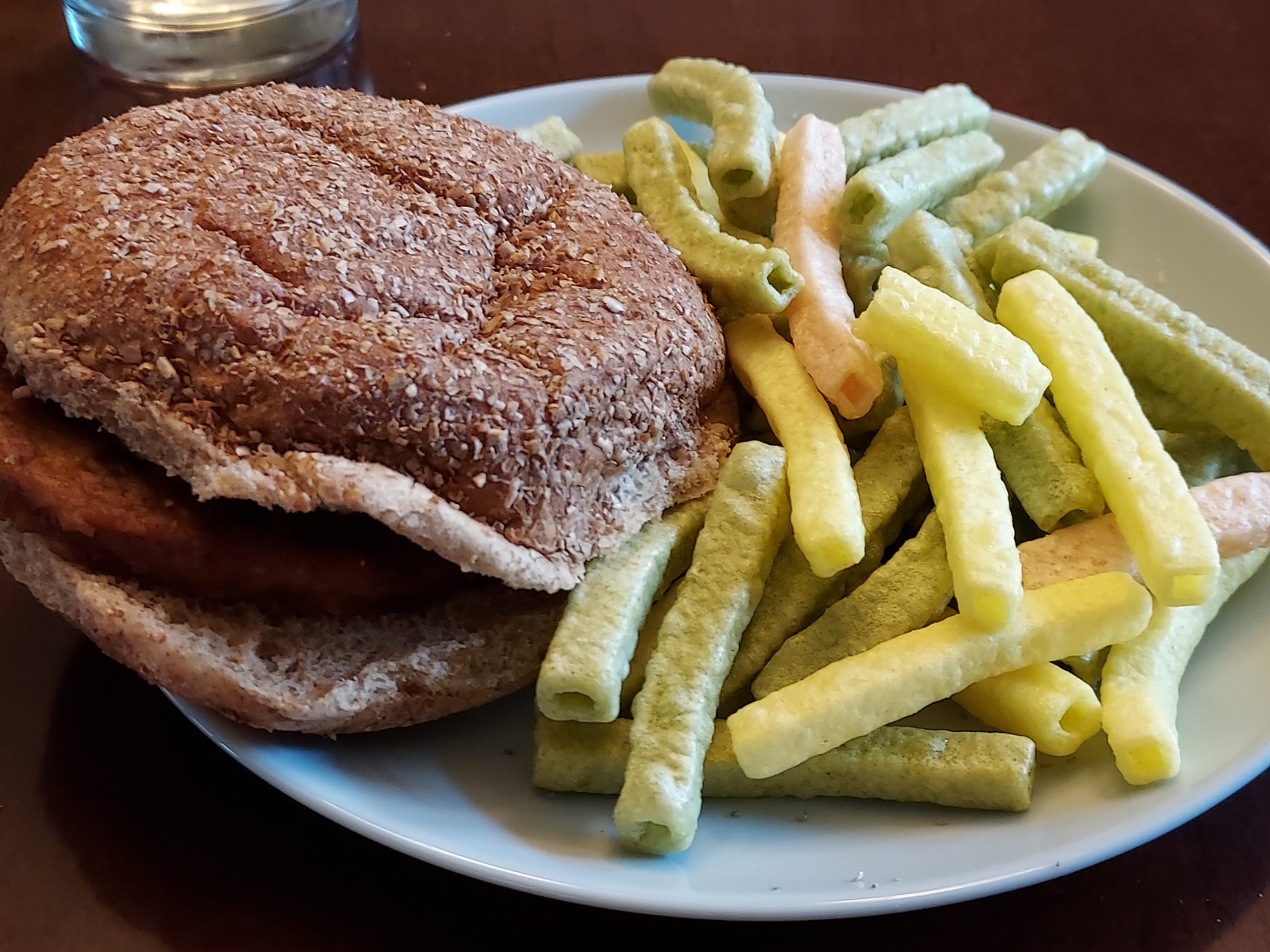
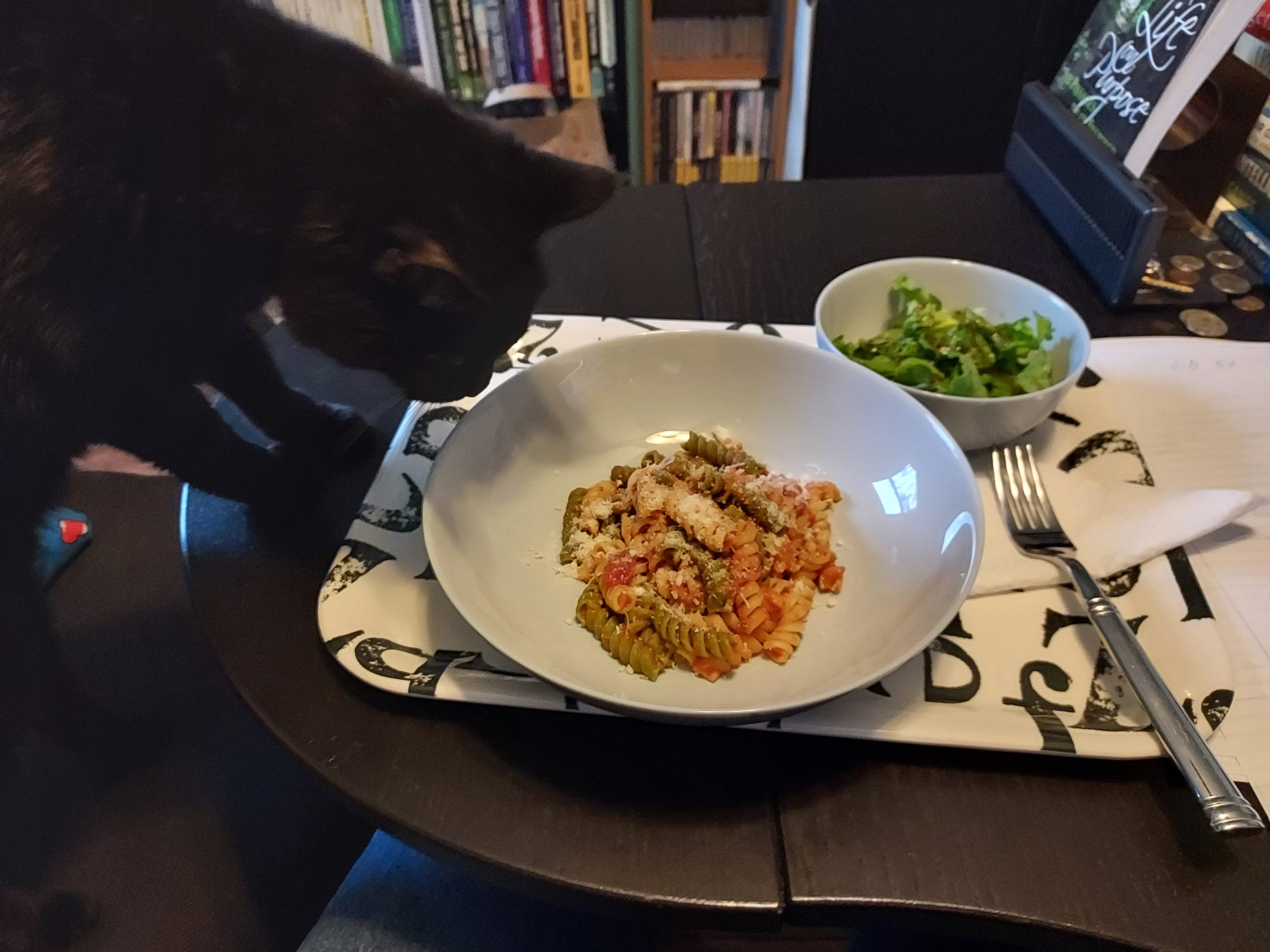
As for meals, I ate a quick lunch of a hamburger with a veggie patty and some condiments, plus some veggie straws, and later as there were only a few hours left in the compo my wife brought me the pasta and salad dinner she made to my office on a tray.

LD50: Veggie patty burger and veggie straws

LD50: Pasta and salad and a jealous Gizmo

Anyway, right around the deadline, I finally got buildings to get destroyed when attacked enough, and the population loss (uh, the people had to move because their home was destroyed, obviously) reduces your income, which means it is harder to win.

Except not yet, because all you need to do is spam that invest button still, and you can still win by ignoring the destruction.

You have no other meaningful actions yet, so the main dynamic of figuring out your immediate and long-term priorities isn’t in.

About half of my task list got done yesterday, so that’s a big accomplishment on its own. I went from having a title screen and some paper prototypes and notes to having a playable experiment to build upon.

I only blocked off this past weekend to work on it, though. I took today off from the day job to recover from LD, and there is a lot of catching up to do from the weekend in terms of the rest of my life and obligations.

The LD 50 Jam deadline is in 9 hours, and practically speaking I won’t be able to dedicate the entirety to game development.

But what can I do with a few more hours?

I have a monster that successfully attacks buildings. My intention was to have only one monster, as a monster attack was but one disaster possibility out of many, but I could easily make more instead of trying to make random fires or cause flooding.

So maybe there is a meteor coming, and you have to deal with multiple simultaneous monster attacks? Eh.

Giving you the ability to repair buildings that are damaged is my first priority.

Then I can balance the numbers and see if it might be enough to feel like a compelling game.

Then I’ll worry about multiplying monsters.

Oh, I guess I decided I was going to continue working on this game today after all.

Categories
Game Design Game Development Geek / Technical

LD50: A Very Long Task List, Only 12 Hours Left, and a Short Pep Talk for You #LDJam #LD50

Last night I realized that other than a bunch of disconnected notes and a few disconnected images I made, I didn’t have a rough plan in place, and it made it more difficult to move the project forward.

So I made myself a plan. Normally I use a spreadsheet and track weekly tasks, but I think for a 48-hour compo a simple TODO list in a text file works.

Right away, it felt simultaneously daunting (that was a very big task list, and I know I will discover more work as I go) and manageable (just start from the top and work my way down).

So I set to work, first by creating a city layout. It’s simple at the moment, and the most immediate urgency was putting in the river tiles, the ground tiles, and the super secret anti-meteor research and development center. I can put in other buildings (already drawn) later.

But then I thought it would make for a slightly better screenshot if skyscrapers and other buildings were there, too, and I was pleased that the work to add it was almost nothing.

LD50: Initial city layout

It’s not much now, but I hope to make this a more bustling metropolis soon.

I called it a night around midnight (so technically a morning?), even though I still don’t have game play in, but that’s a bigger lift than I was ready for without sleep.

This morning, I did some light exercise and ate breakfast.

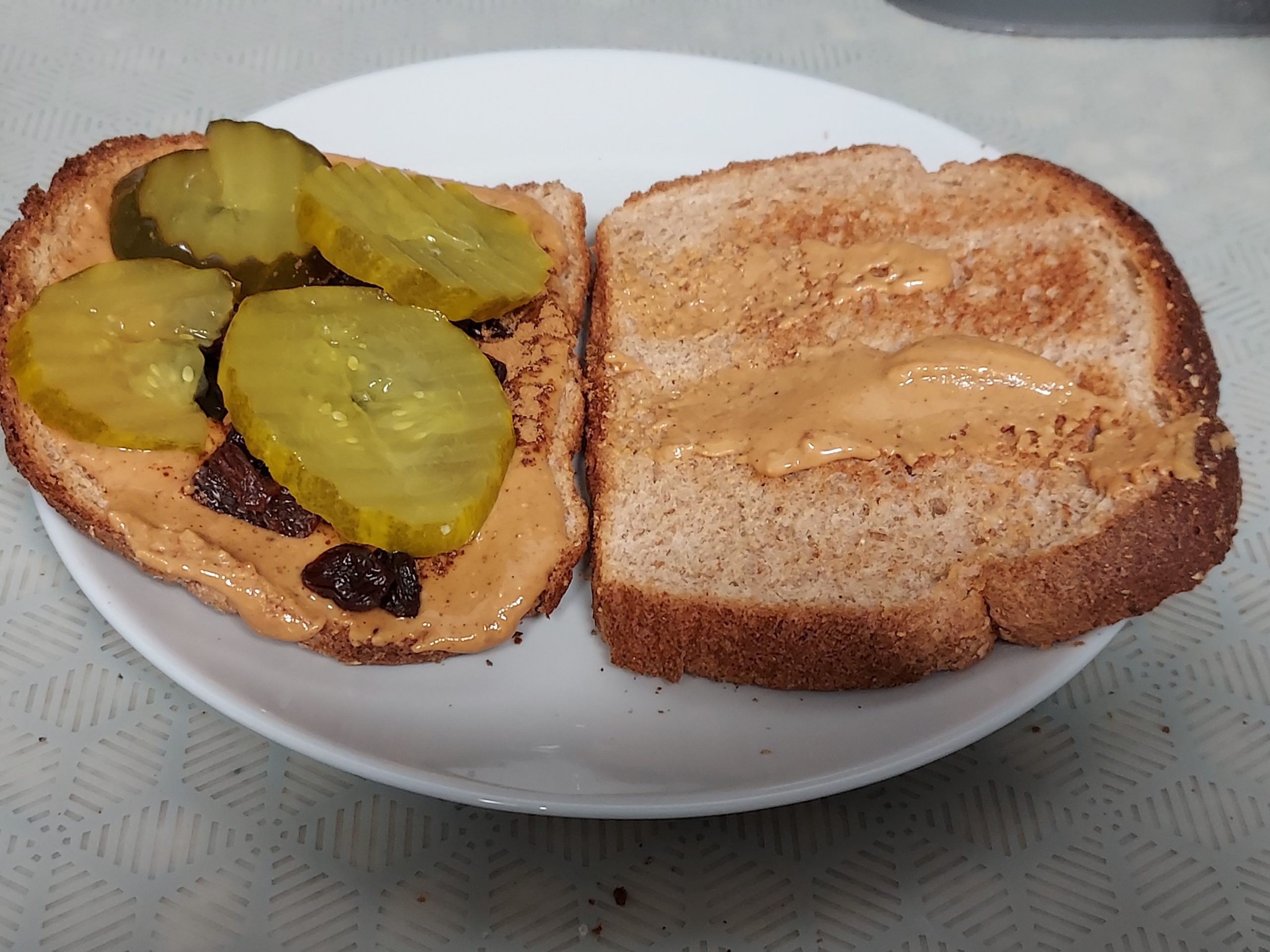
Behold, my peanut butter, cinnamon, raisin, and pickle sandwich.

LD50: the classic PB, raisin, and pickle sandwich

If you know, you know.

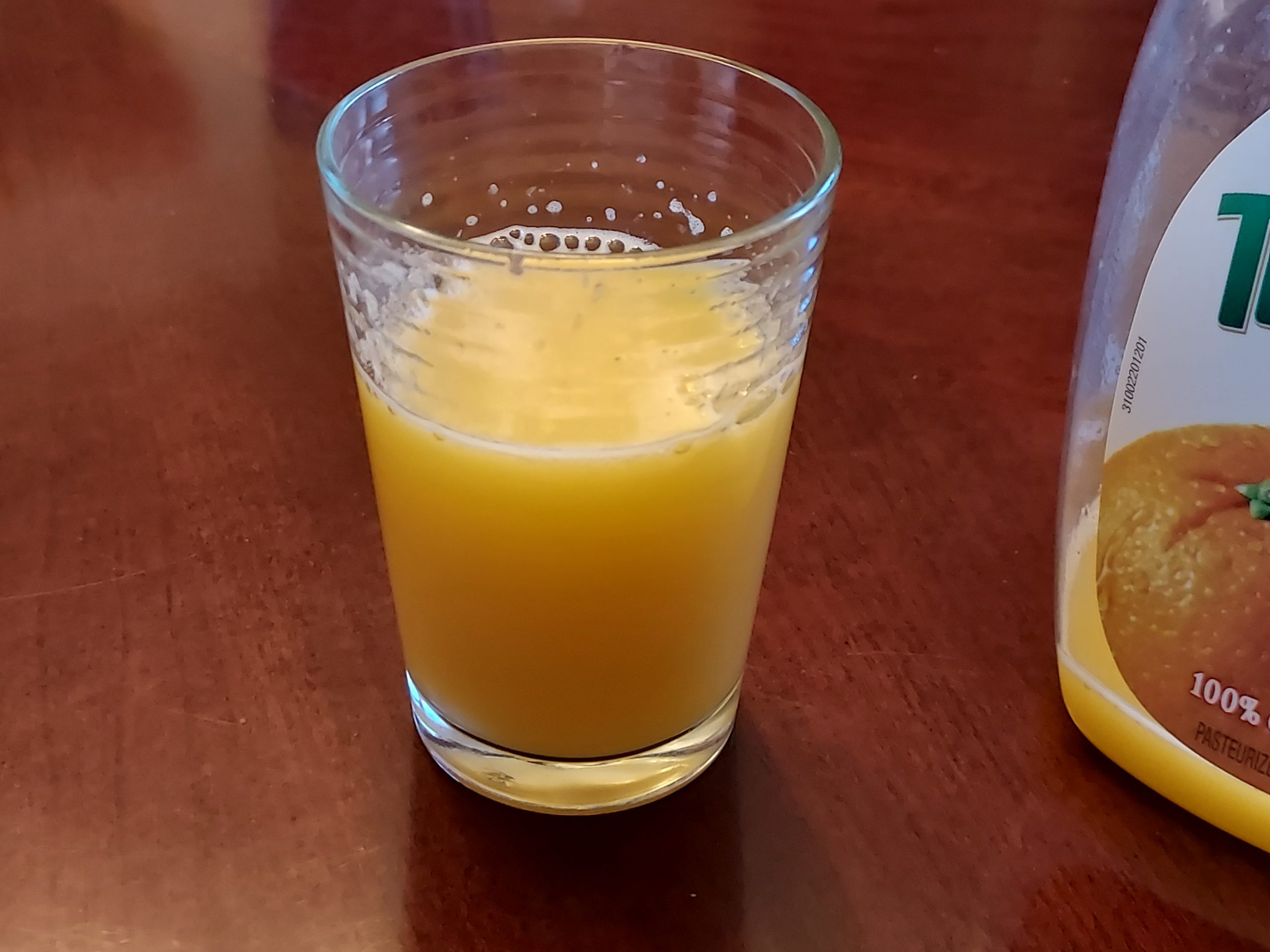
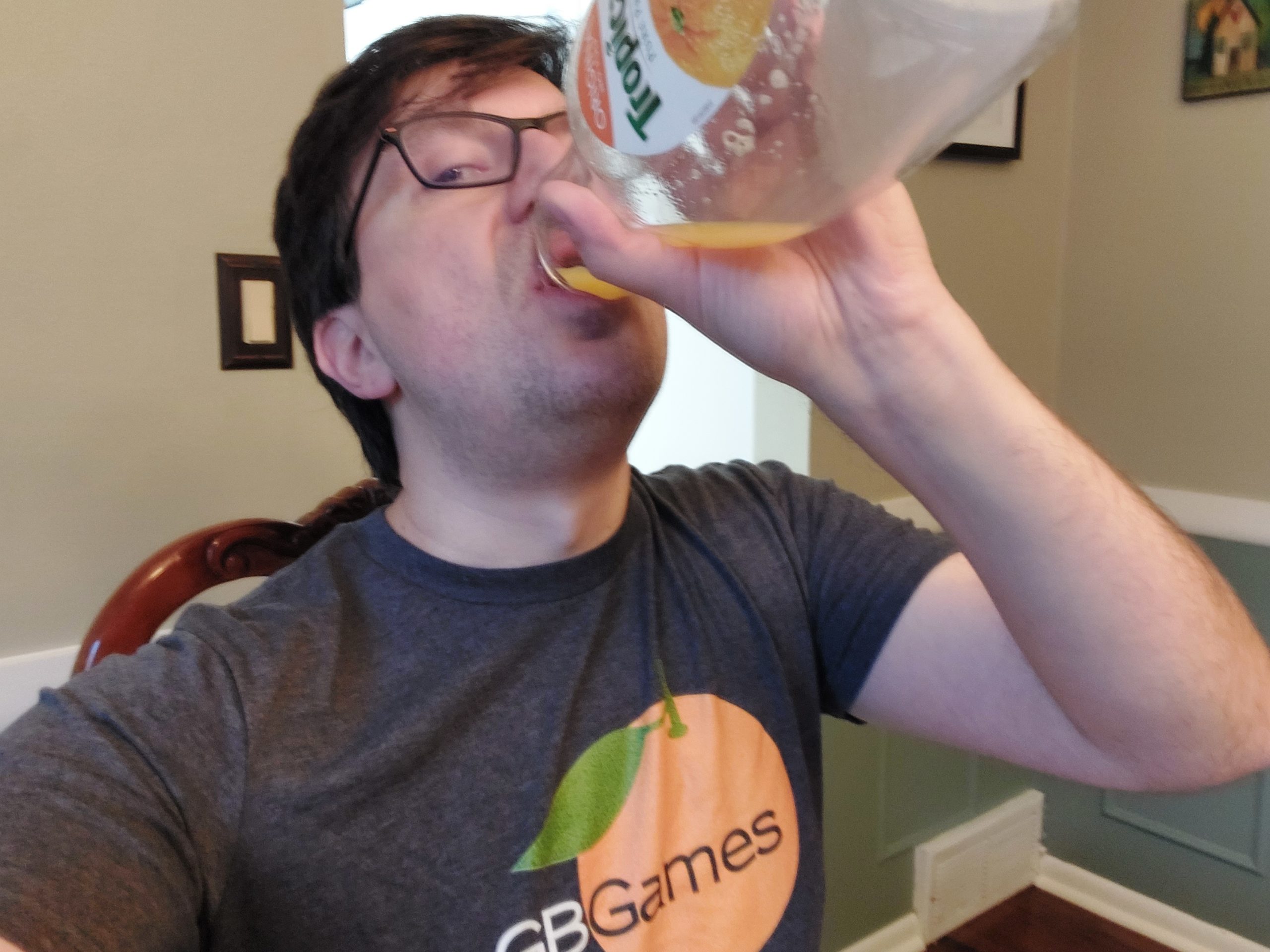
I washed it down with some orange juice (hah, classic Me, amirite?), and since there was only so much left in the bottle, I finished it off.

LD50: Small glass of OJ

LD50: There wasn't enough left in the bottle to put back in the fridge

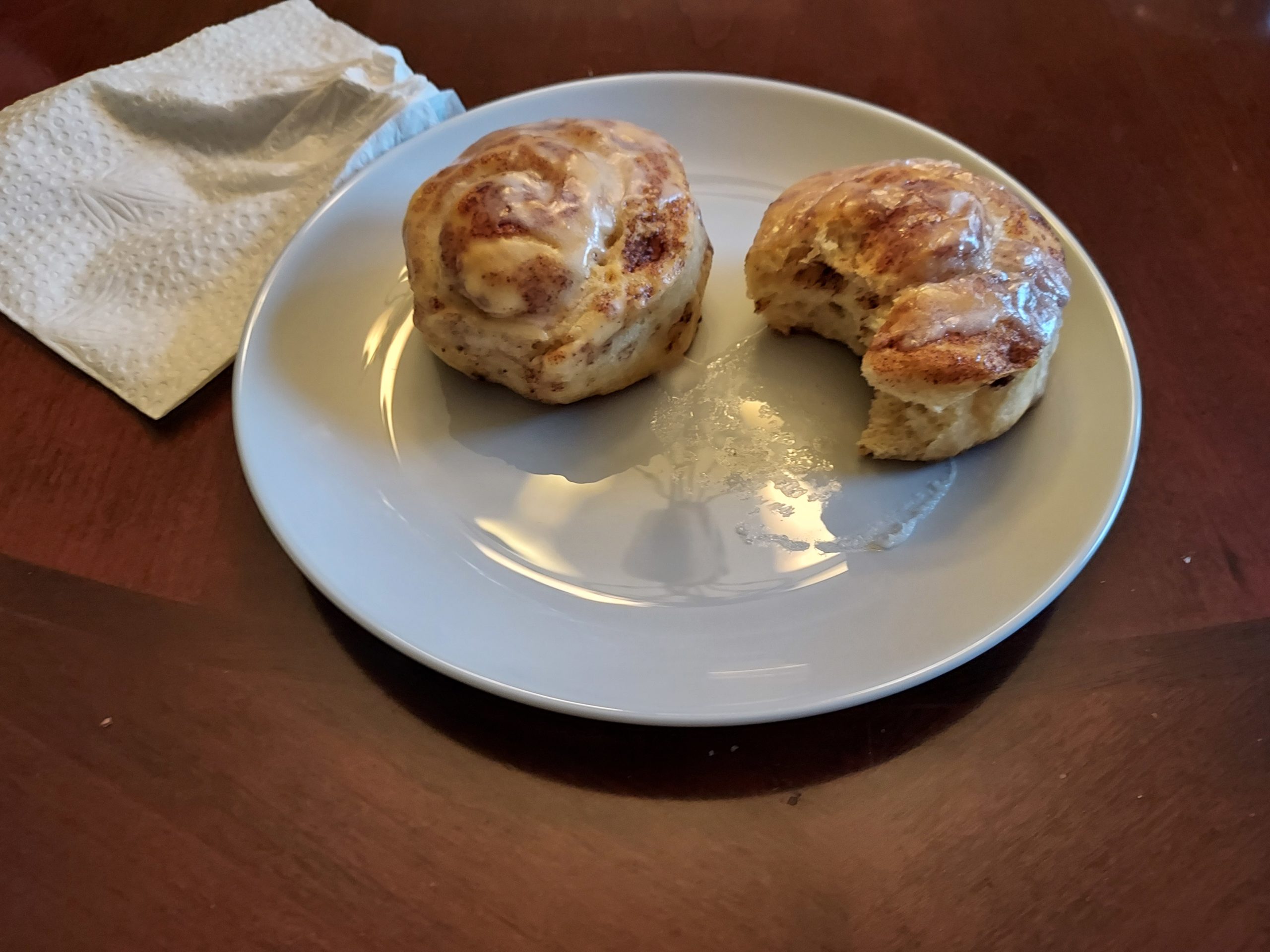
And my mother-in-law left us some cinnamon rolls, which my wife baked just now.

LD50: Cinnamon rolls!

So before I get back to game development, I did want to give you a pep talk if you need one.

Whether this is your first time participating in Ludum Dare, your first time doing game development, or even if you have been doing game development for a long time, you might look around at what everyone is accomplishing around you and think to yourself, “I don’t belong here.”

And I’m here to tell you that you do, in fact, belong here.

My first LD was #11 in 2008, but my first game jam was Game in a Day in 2005. I remember early on in the 24 hours I had to make a game that I kind of froze up.

I remember feeling like I simultaneously could do it but also that I should stop. It was a weird mix of fear and confusion. I didn’t know why I felt like I should stop other than a vague fear that I shouldn’t even bother, that I didn’t know what I was doing, etc.

I pushed through somehow, and even though the game I made was a very, very far cry from what I set out to do (24 hours isn’t a lot, it turns out), and even though it was buggy, and even though other game developers participating were professionals who made amazing things in those same 24 hours while I was merely an aspiring wannabe, I can say that I participated and I did, in fact, make a game that day.

When I participated in LD #11 a few years later, that same weird fear gripped me shortly after starting, but this time I recognized it. In hindsight, maybe it was Imposter Syndrome? But whatever it was, I successfully ignored it. I managed to successfully make a game and rank relatively highly, too!

And maybe it was because Ludum Dare in 2008 had something like tens of entries rather than thousands, and the community was smaller and more intimate, but there was definitely a home base in that IRC channel of supportive people who made you feel like you belong there just as much as they did. Game in a Day was even smaller, and I wish I could remember the name of the person who gave me advice to cut my scope, but that person also made me feel like I was being taken under his wing, that I was encouraged to be part of that community, too.

We have less than 12 hours to finish a game for the compo. Maybe you’re like me and have a large task list in front of you and you worry you might not finish in time. Maybe you don’t even have an idea yet, or you gave up on one project already. Maybe you see some of the amazing things that people are posting and think, “I am nowhere near that level!”

But don’t compare your efforts and struggles to published, polished efforts of a team of veterans. It is easy to imagine that everyone else knows what they are doing, but you’re only seeing the people willing to post their awesome stuff and not seeing the mistakes, dead-ends, and struggles behind the scenes for them and for many others.

Don’t compare your efforts except to your own previous experiences. And if you have no previous experiences, then consider this your baseline to compare yourself to next time.

And if you feel like you failed Ludum Dare because you couldn’t get it all together in time and publish a game, I’m here to say that after LD 11, I failed to put together a playable game in LD 14 and again in LD 32. There were Mini LDs that I “failed” as well. It was disappointing, but I never felt like I didn’t belong and shouldn’t have made the attempt.

Now, part of that might be cishet white privilege talking, but part of it was that by that point I was part of the Ludum Dare community.

So I want you to know that you belong and are welcome here, too.

Categories
Game Design Game Development Geek / Technical

LD50: More Notes, Meals, Conversation, but Less Game Dev #LDJam #LD50

After my last post, I continued writing down ideas and creating sketches.

But then I got an invite to participate in a chat with some of the people from the original LD community, and it was fantastic. I had a great time catching up and/or getting to know people, talking about how far things have come, and also expressing gratitude that all of us were still here.

But it also meant I was not working on game development, so I eventually jumped out of that virtual chat and got back to work.

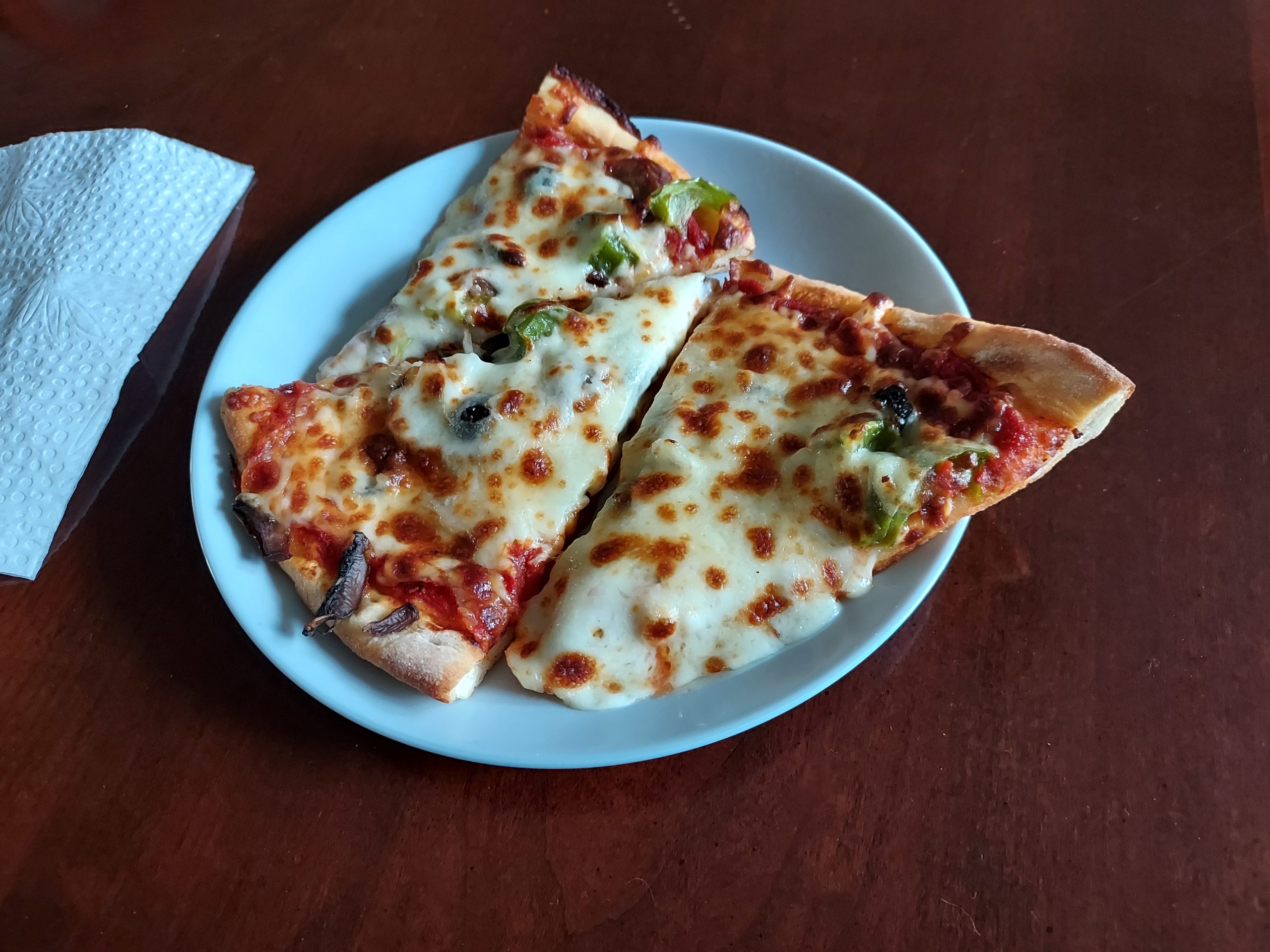
For lunch, I scarfed down some leftover veggie pizza.

Leftover veggie pizza

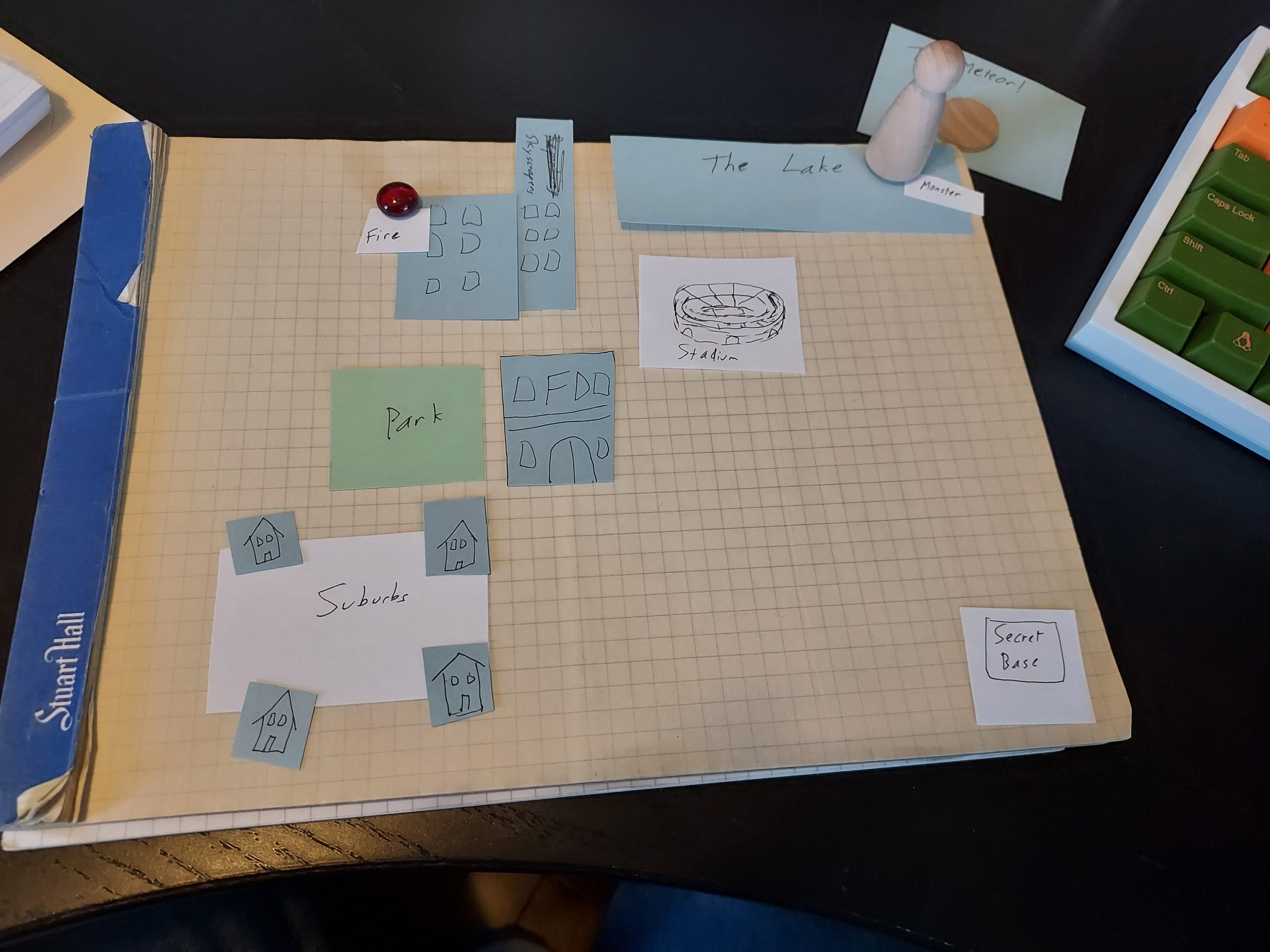
I felt like I needed to catch up, so I put together a paper prototype and tried playing through a bit. I did get some insight and realized I was missing something key, but I don’t think I’ve done nearly enough to explore this design.

LD50: Paper prototype

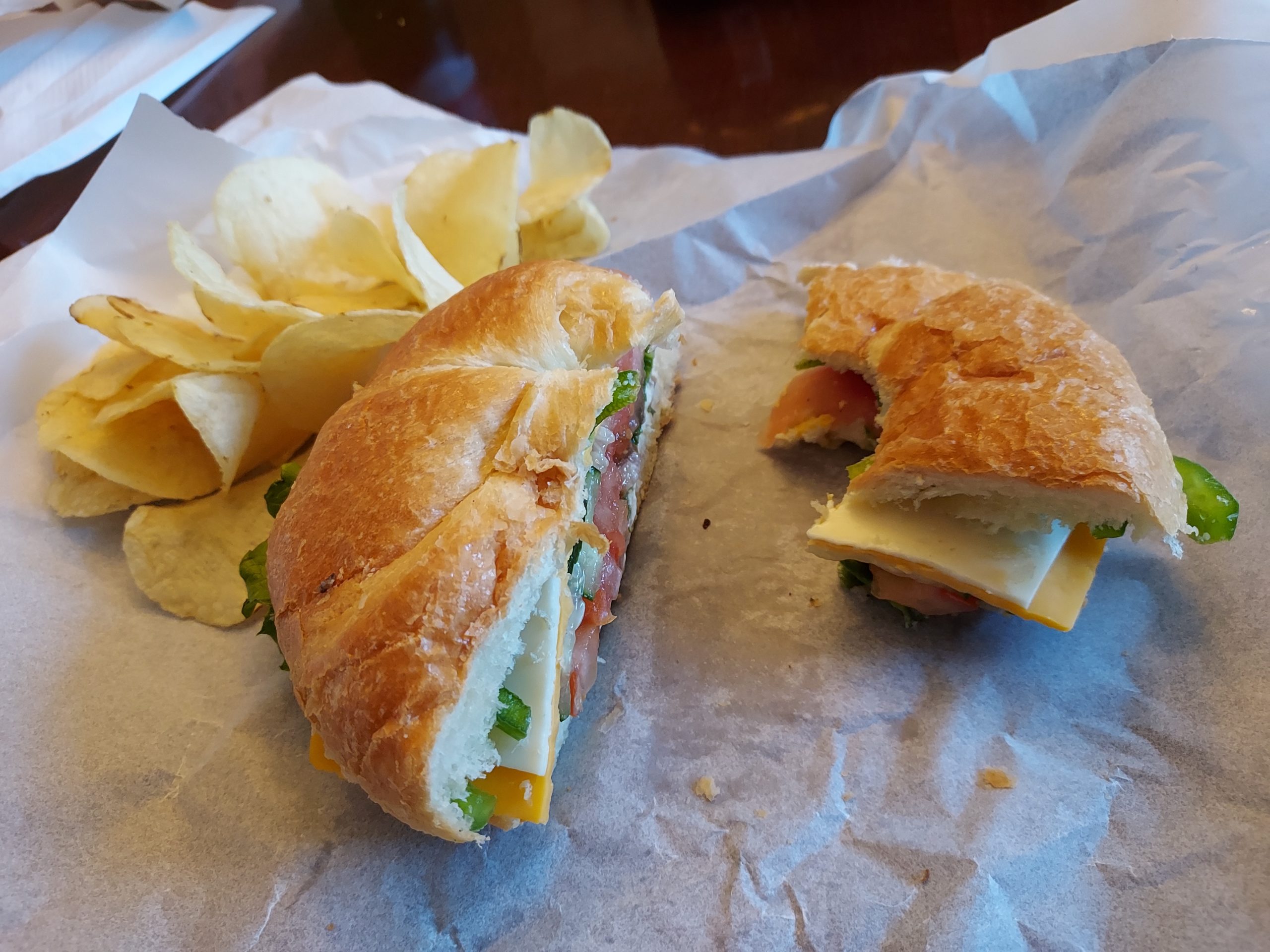
My wife had taken the kids out for a trip, and she brought me a veggie croissant sandwich and chips for dinner when she returned.

LD50: Veggie croissant sandwich and chips

We chatted a bit, then I jumped back into my office.

So paper prototypes are great, but I definitely wanted to get something playable as quickly as possible, which means I needed to start implementing things in digital form.

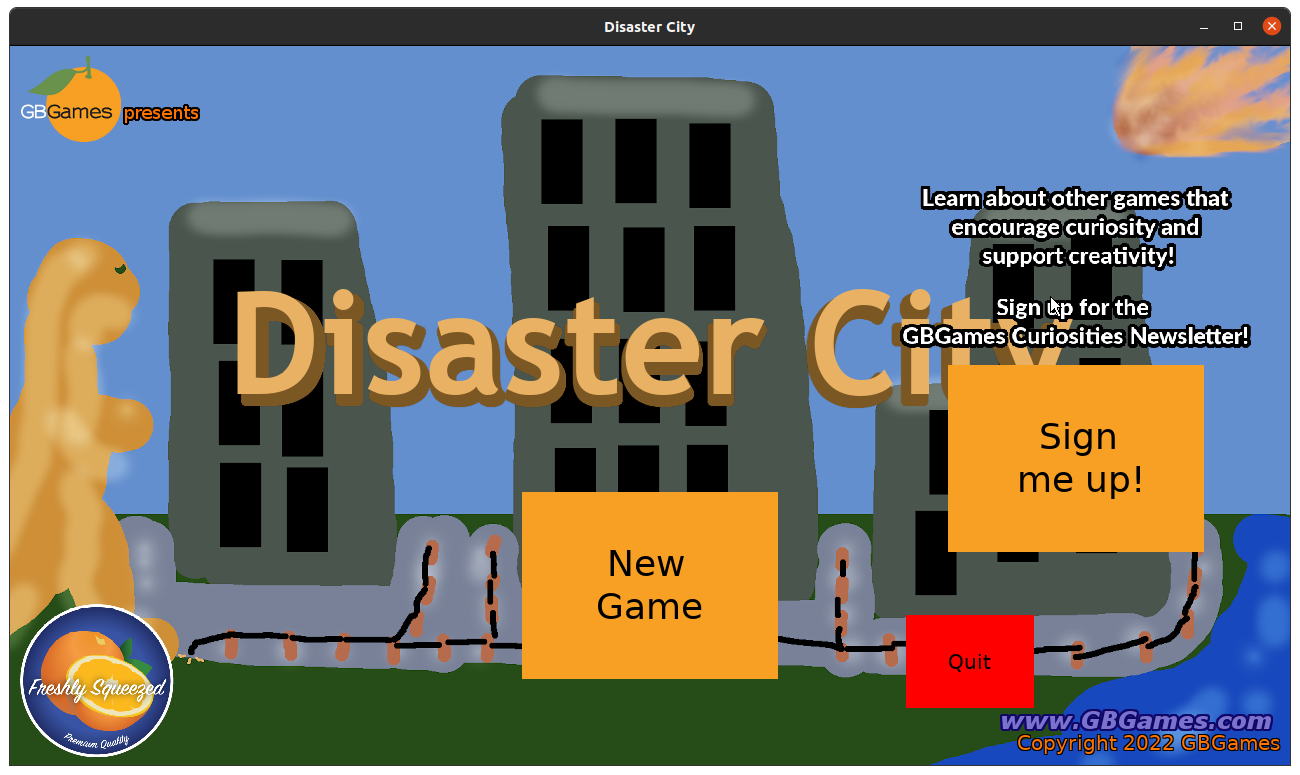
LD50: Title screen

I put together the title screen earlier, using the concept art as the background. It felt temporary at the time, but now feels likely to become permanent.

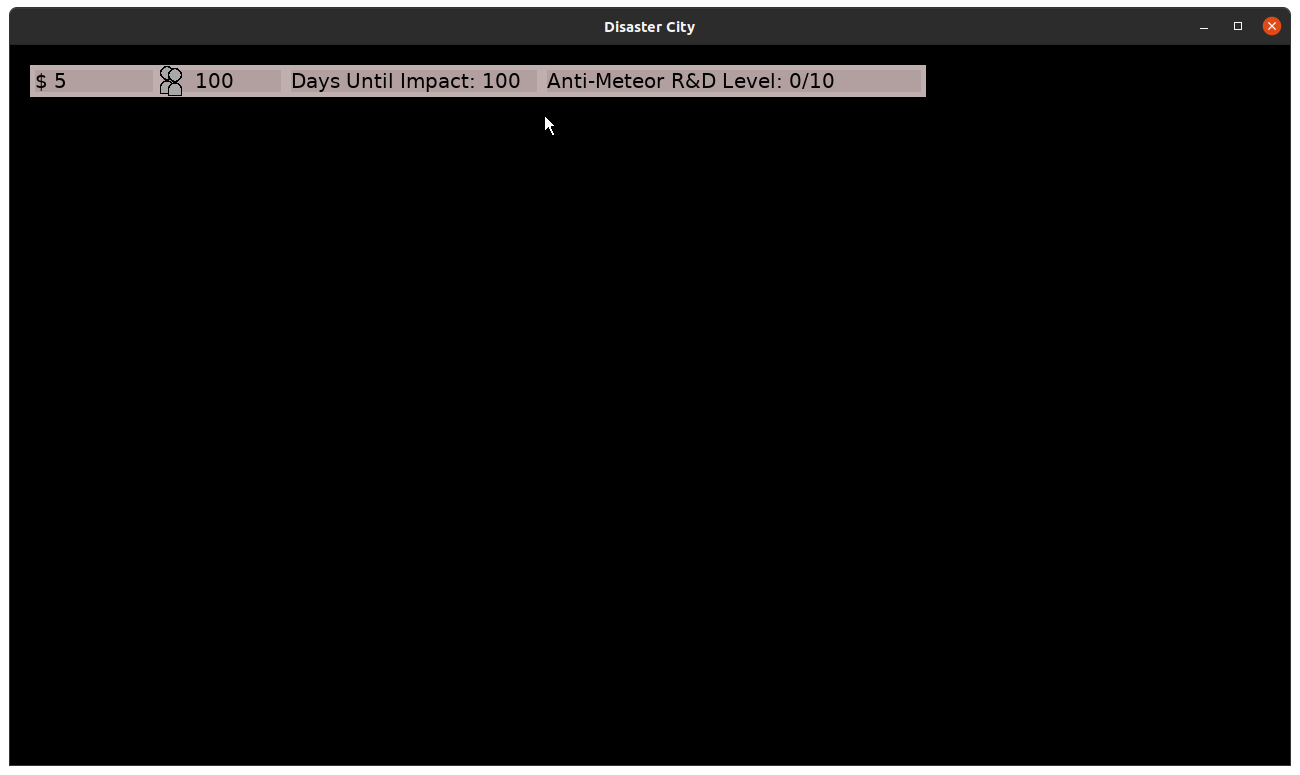
I drew a few icons and sprites, but I implemented the HUD first.

LD50: In-game HUD

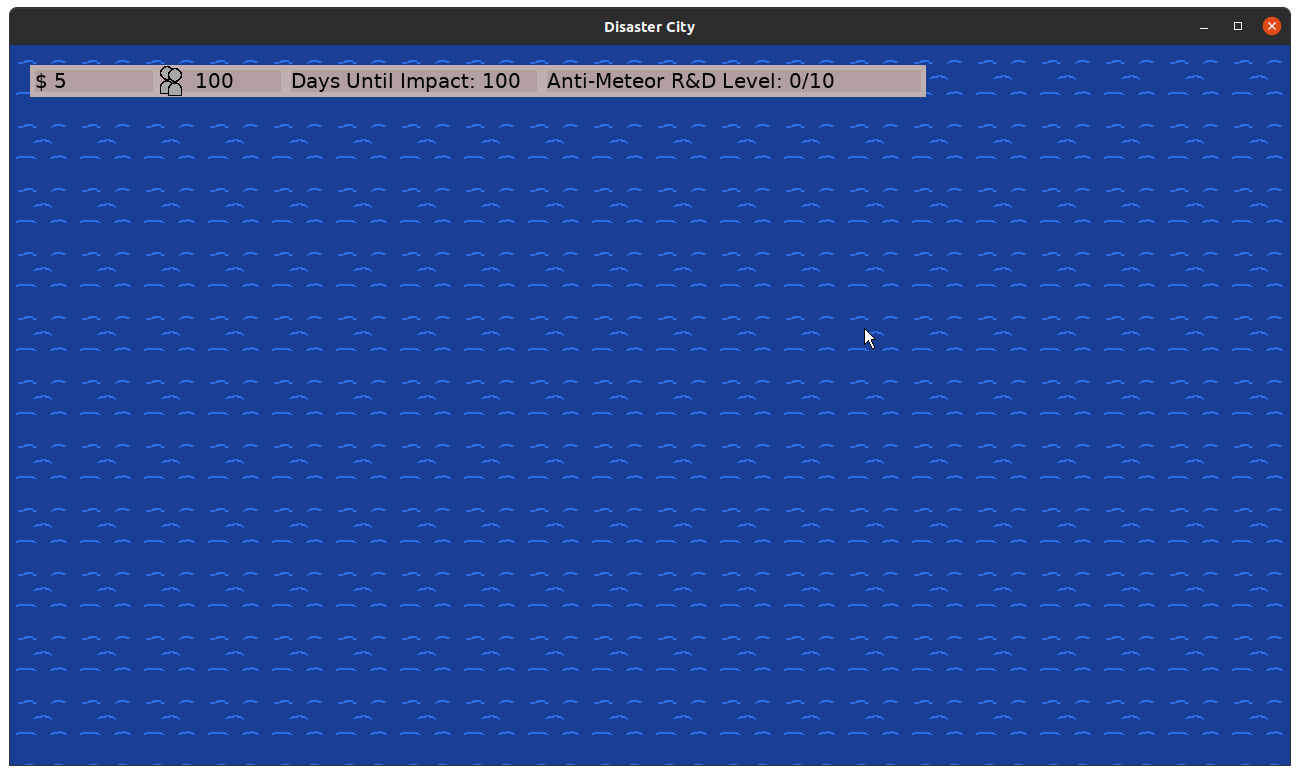
You can see the main stats include your money, your population, how many days until the meteor inevitably hits the planet, and how much anti-meteor R&D you’ve got left to do to maybe make things not so inevitable.

Then I wanted to draw the city, so I created a tile-based layout. So far, I only have a river tile to start with.

LD50: The city is flooded?

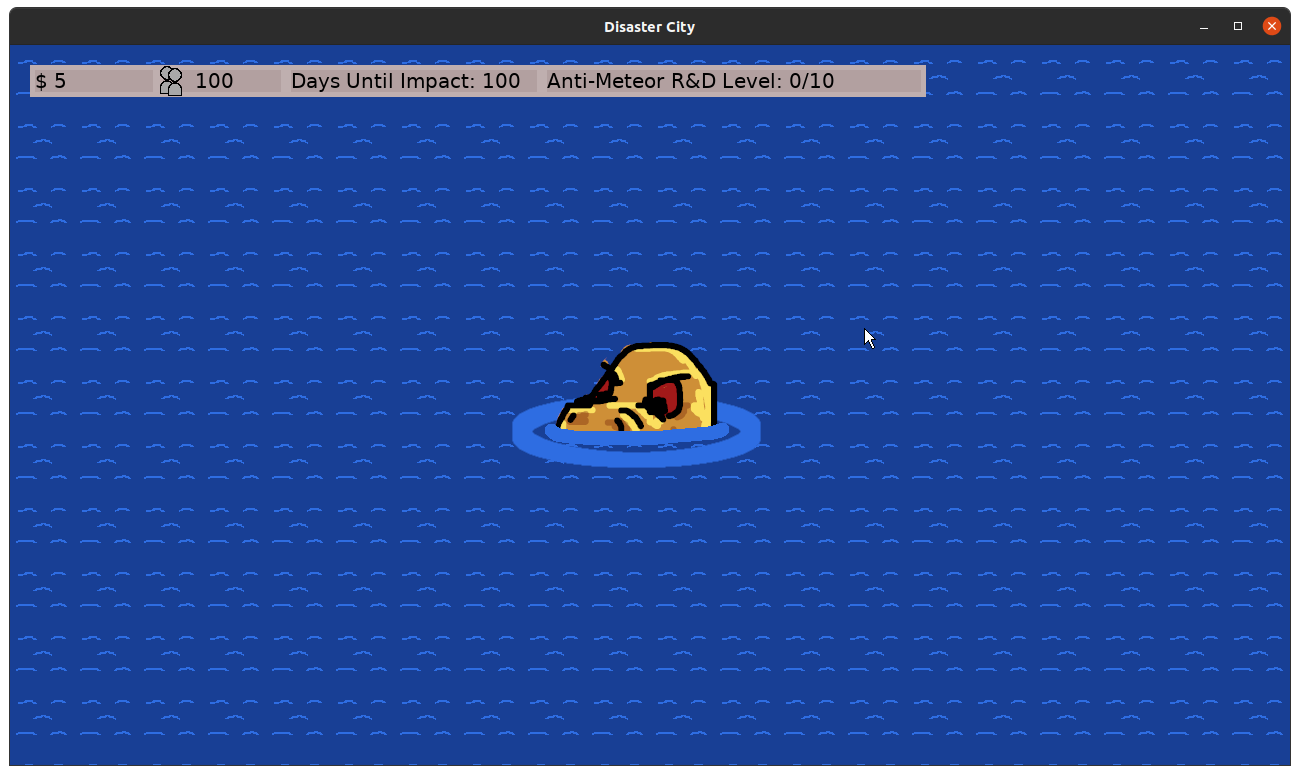
What’s not obvious in this still-frame is that the water is animated using a flipped version of the water tile. It’s not fancy or time-consuming to make, but it does make it feel more alive as a game.

My intention is for the monster to emerge from the water, as you can see in this mock-up.

LD50: Monster emerging mock-up

There is now less than 24 hours in the compo, and I’m about to lose some of that time to a good night’s sleep. I wish I was further along than I was, but I need to focus on getting that game play in more than ever.

Categories
Game Design Game Development Geek / Technical

LD50: Good Morning! Yoga, Breakfast, and Notes #LDJam #LD50

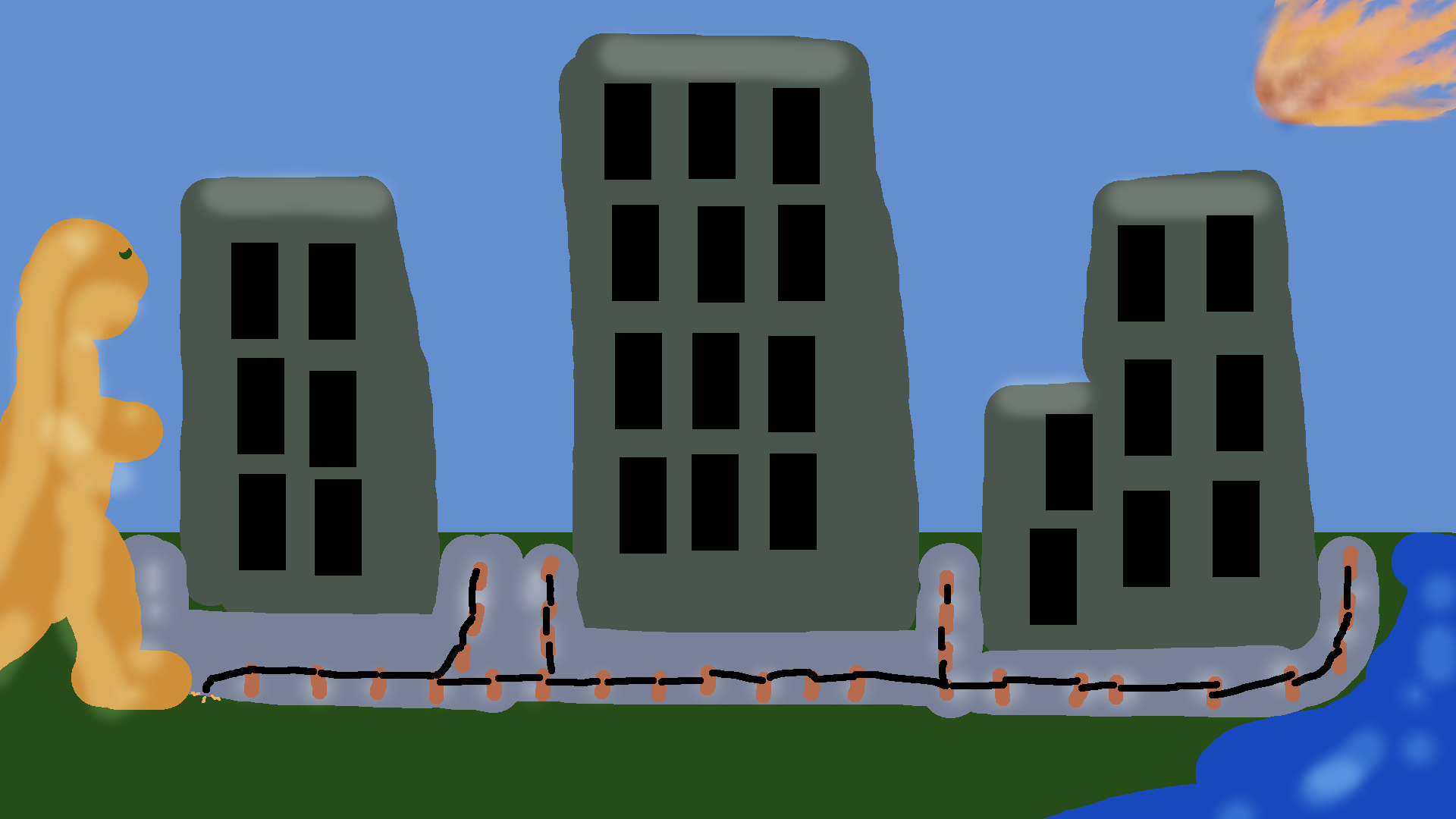
Last night I created some concept art for what I am currently calling Disaster City:

Ludum Dare 50 - Concept Art for Disaster City

When I went to bed, I thought of how the screen might look and what the player might do.

So this morning, despite wanting to exercise and get some breakfast first, I tried to write down some ideas, but Gizmo decided I shouldn’t be too hasty getting into game development.

Gizmo wouldn't let me jot down notes

So I did some yoga and other light exercise, which is good because my back was bothering me earlier this week but seems fine now.

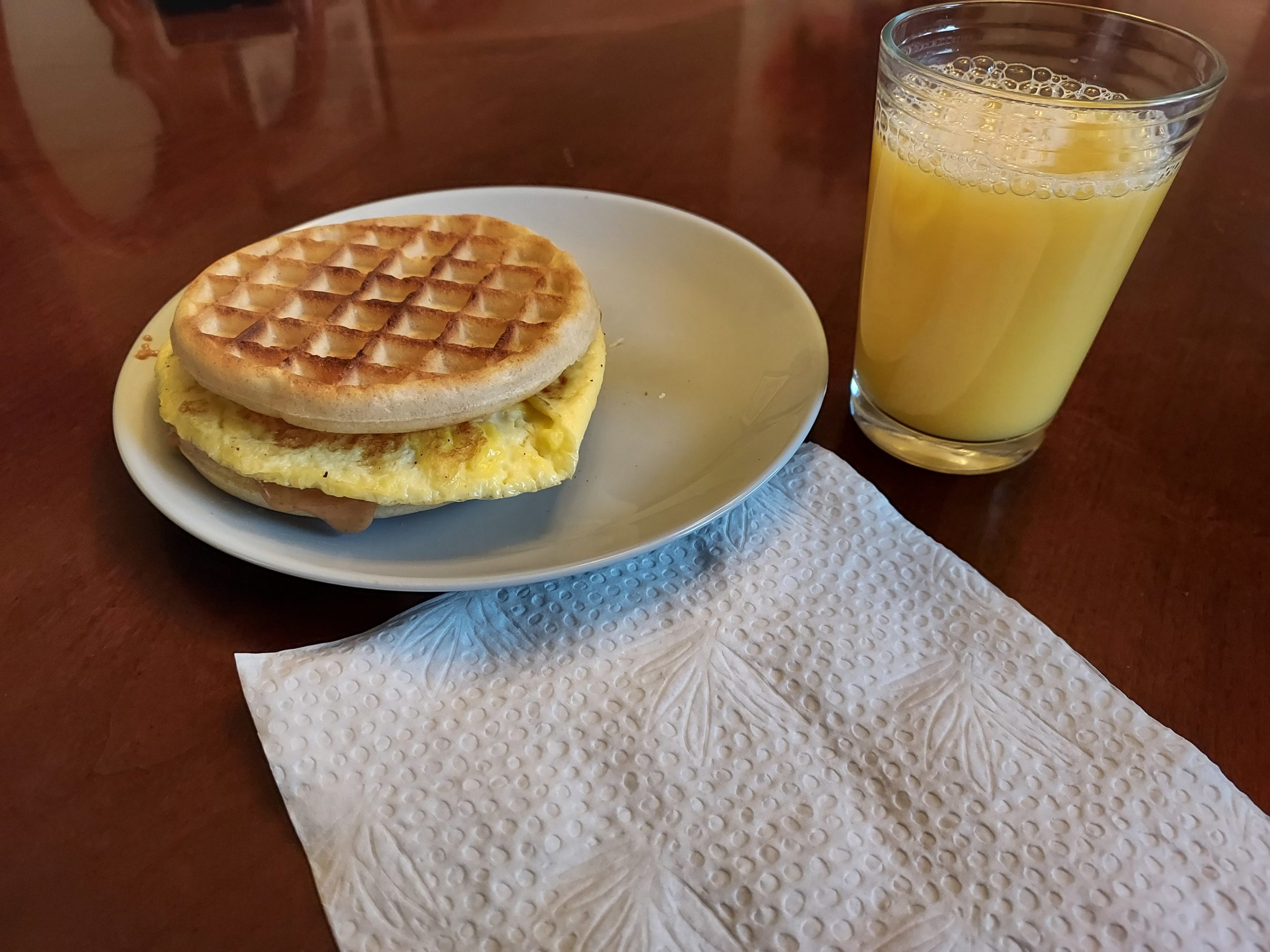
Then I made breakfast. I fried up some eggs, toasted some waffles, smeared them with peanut butter, sprinkled some cinnamon, put the eggs on top, and had a messy, drippy breakfast of game development champions.

Ludum Dare 50 breakfast: peanut butter, cinnamon, egg on waffles with a small glass of orange juice

I learned long ago that orange juice is basically full of sugar, so I no longer have a large glass and now make use of the juice glasses that I thought were ridiculously small when we got them shortly after getting married almost 10 years ago.

Finally, I pulled out my Ludum Dare t-shirt from 2011, when I went to an Ludum Dare gathering at GDC. It’s fitting a little tighter around my midsection but otherwise seems to still fit.

My Ludum Dare t-shirt from 2011 still kinda fits!

I spent more time than I maybe should have reading through other people’s posts. We’re now past the first 12 hours of the compo, and my goal is to have something playable within the next 12 hours.

So, Disaster City. I think the “Delay the Inevitable” theme seems to push me to make the kinds of games I started out making, in which there is no victory condition, just a game in which you see how long you can last before you lose. I want to resist this tendency, so what’s inevitable that isn’t also an ending?

Or maybe it is fine for it to be an ending, and the focus is on what you do before then?

Originally, my thought was that Disaster City would constantly be hit with multiple disasters, and you have limited resources to repair and restore what’s happening. Your efforts never make it 100% better, so it’s more about reducing the impact rather than eliminating it. And eventually it all comes crumbling down.

But now I’m sad. What’s the point?

Instead, what if there was a way to achieve victory?

I’m thinking that you are part of the city council. There is a meteor heading towards the planet, and you need to fund R&D and eventually a mission to divert it.

Unfortunately, Disaster City earned its name. You also need to deal with disasters such as monster attacks, floods, fires, etc. These disasters damage and eventually destroy homes, roads, utilities, commercial centers, entertainment options like stadiums, etc. As you lose those things, you lose people, income sources, and your capabilities to prevent and repair the damage.

So it’s a balancing act. You have an ultimate big bad thing coming, but you also have the more immediate things to worry about. You need to decide when to let go of the immediate consequences to focus on the long-term without letting the short-term consequences prevent your long-term goal from being achieved. The game ends when you manage to prevent the meteor from hitting the planet, or when it hits the planet, or when your city’s population disappears.

It feels overscoped at the moment.

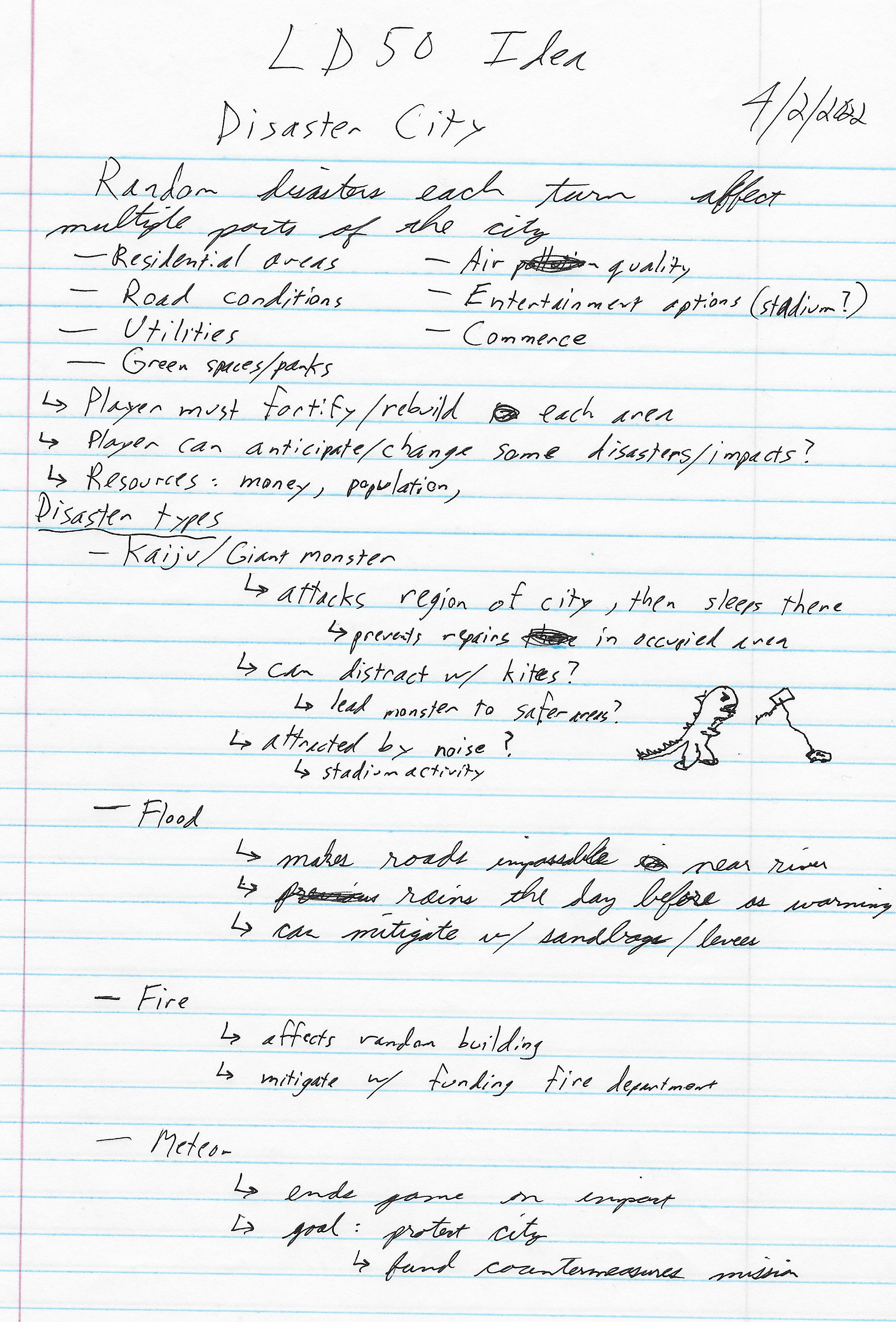
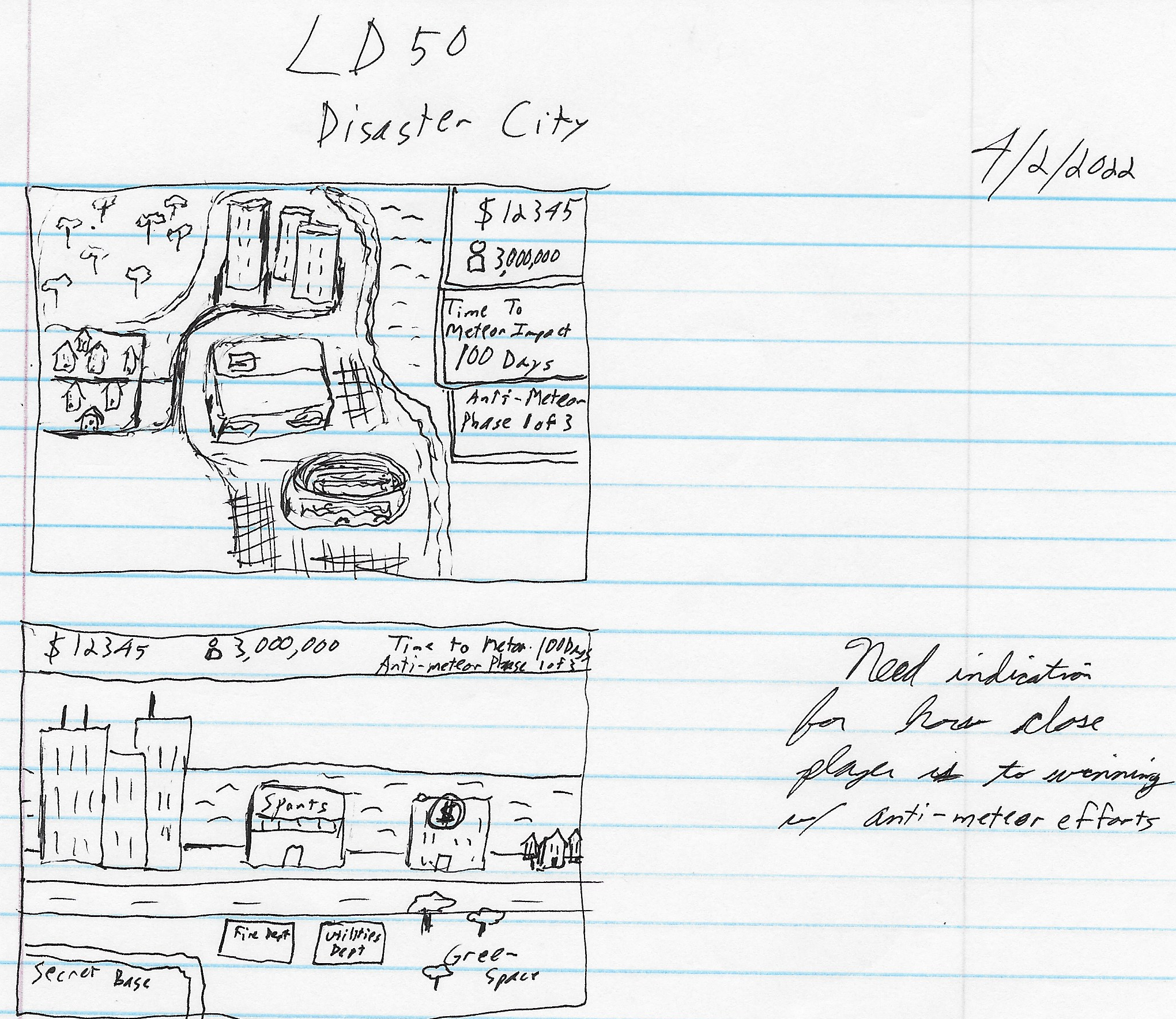
I jotted down some notes and started trying to come up with a screen layout.

LD50 notes

LD50 notes

I think I still need to do some prototyping on paper to get a feel for how the game will actually work instead of hand-wavy vagueness,m but otherwise, I think this direction might work.

Categories
Game Design Game Development Geek / Technical

LD50: A Game about Urban Decay? #LDJam #LD50

Ok, so after I published my first round of ideas for the theme Delay the Inevitable, I started to really like the idea of a game about urban decay.

A reverse city builder?

I thought about a city block that would slowly get potholes in its streets, broken windows, crumbling building foundations, etc. You need to fix things, and you have to prioritize what gets fixed because there aren’t enough resources to go around.

On top of it all, your fixes won’t restore things beyond a certain point, so everything gets worse, but you can at least slow it down.

But as I looked up urban decay to see if there was anything I could use to inspire the mechanics or theme, I realized that a lot of urban decay is the direct result of white supremacy, systemic racism, and redlining.

I think it would make for an excellent educational game topic, but I don’t think I have the ability to gain enough expertise on this topic to treat it with the justice and sensitivity it deserves in 48 hours.

I tweeted about it, and Jayenkai suggested I could still use the urban decay concept in a non-realistic world:

So now I am thinking about where else urban decay could apply. An ant hill? A rabbit burrow? A castle dealing with dragons, wizards, and angry villagers? An open office space?

I’m about 2 hours into the compo, and it is getting late. I think I’ll draw some concept art and then go to bed.

Categories
Game Design Game Development Games Geek / Technical Linux Game Development

LD50: The Theme is Delay the Inevitable #LDJam

The Ludum Dare compo has started, and the theme has been announced.

I am trying to remember if “Delay the Inevitable” was a theme I submitted, but I can’t seem to determine if that information is available.

My plan is to spend the first hour or so coming up with ideas. During Ludum Dare, there is usually an obvious idea that many people might try to pursue, so digging a little bit deeper should result in something more unique.

I just finished watching West Side Story (2021), so the inevitable violence and death that prevents two lovers from being together is top of mind.

Death is inevitable for all of us, and so delaying death might be one of the obvious ideas, but even so it seems like it could be a rich vein.

Taxes are also inevitable, but meh.

And in some areas people might argue that construction is inevitable. A game about constantly fixing roads? So are you delaying the construction, or is the construction delaying the entropy?

“Curse your sudden but inevitable betrayal!” That line from Firefly is classic, and perhaps a game could be built around the idea of joining forces with an enemy that you know is going to target you once your common foe has been defeated or problem has been solved.

Climate change is feeling inevitable. Perhaps a game about being a representative of a corporation trying to convince people that climate change is a personal responsibility despite that corporation being directly responsible for most of the greenhouse gases.

The expansion of the universe seems unending and ultimately results in heat death. I remember learning that Newton’s math, pre-relativity, didn’t actually work, as it predicted that the planets would spin out of orbit. Or was it Kepler? Either way, he suggested that it was God’s hand that was keeping everything in place. So perhaps a game about keeping celestial bodies in place by manually (and frantically) putting them back when they go where they aren’t supposed to. Maybe you start with the Earth-Moon system, then branch out into the solar system, then into the galaxy, etc. Might be a math/physics heavy project. But maybe it will be more enjoyable if the physics was a hand-rolled hack job anyway.

Looking at the time, I see almost an hour has passed. Eep! I want to think a bit more before deciding.

Categories
Game Design Game Development Geek / Technical Linux Game Development

Ludum Dare 50 Is Here: 20 years of #LDJam

Ludum Dare, the 48 hour game jam, is celebrating 20 years today with its 50th main event.

Or 51st, since LD#0 was a thing.

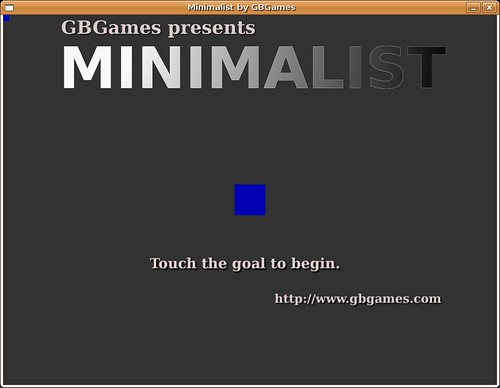
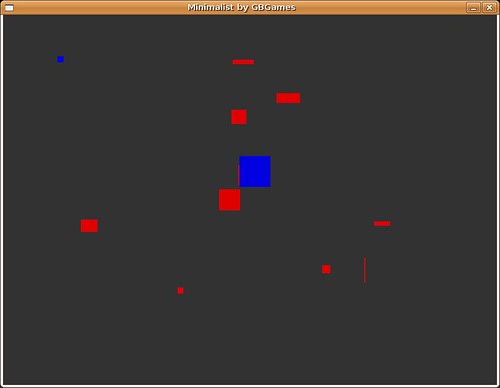
In 2008, I joined my first Ludum Dare. LD11’s theme was Minimalist, and I was very proud of the game I put together. It even had sound effects, which is more than I could say for some of my later Ludum Dare submissions. You can read the post-mortem here: https://www.gbgames.com/2008/04/29/ld11-minimalist-post-mortem/

LD11 Minimalist by GBGames

LD11 Minimalist by GBGames

My cats were there for my first Ludum Dare: Gizmo prevents me from game programming

Back then, there were a lot fewer participants, and it naturally felt a bit more intimate. Since then, it has grown quite a bit. There were MiniLDs, including #20 which I “hosted” (and got scolded by McFunkypants for not having ratings at the end). I remember meeting up with Ludum Dare colleagues at GDC 2011, putting faces to names and/or IRC handles. Instead of a hundred new games, there are thousands being made each event today. It has a dedicated website to call home instead of merely being on someone’s website. I miss my LD Trophy collection, though.

My last LD was #33 in 2015, and it was well-received and one I was very proud of (see the post-mortem here: https://www.gbgames.com/2015/11/30/ld33-free-me-you-idiots-post-mortem-ldjam/). Out of 1,199 entries, my game was rated in the top 36% overall and top 8% in innovation. Not bad.

I haven’t participated in recent years, partly because priorities made it difficult to dedicate a weekend to game development.

But thanks to my wife putting in herculean efforts to make it possible for me to focus more or less 100% on it this weekend, I will be participating in Ludum Dare 50.

I watched the LD 50 Keynote today, and it was nostalgic and inspirational. I’ve missed you all.

While her brother Diego died a few years ago, Gizmo is still alive and kicking at about 19 years old, and she’ll be next to me (or on top of my arms as I try to make a game) this LD, too

As always, I will participate in the Compo version of the event, in which I work by myself, create all of the code, art, and sound myself, and release the source at the end. I’ll be on IRC, and I’ll be blogging about my progress as I go. I will create a timelapse of my development. I will post pictures of my food. I will probably drink orange juice at some point.

In 2012, I wrote a Ludum Dare pre-compo checklist, and as I read it today, I realize it is pretty much still valid. I need to get groceries. I still need to prepare some of my tools. And we’re in the final hours before the theme is announced and the compo starts.

Are you participating? Good luck!

We’re all counting on you.

Categories
Games

Introducing the Free Toy Factory Fixer Player’s Guide

Toy Factory Fixer, the free, family-friendly game about managing a toy factory to repair toys before they ship, was released last December.

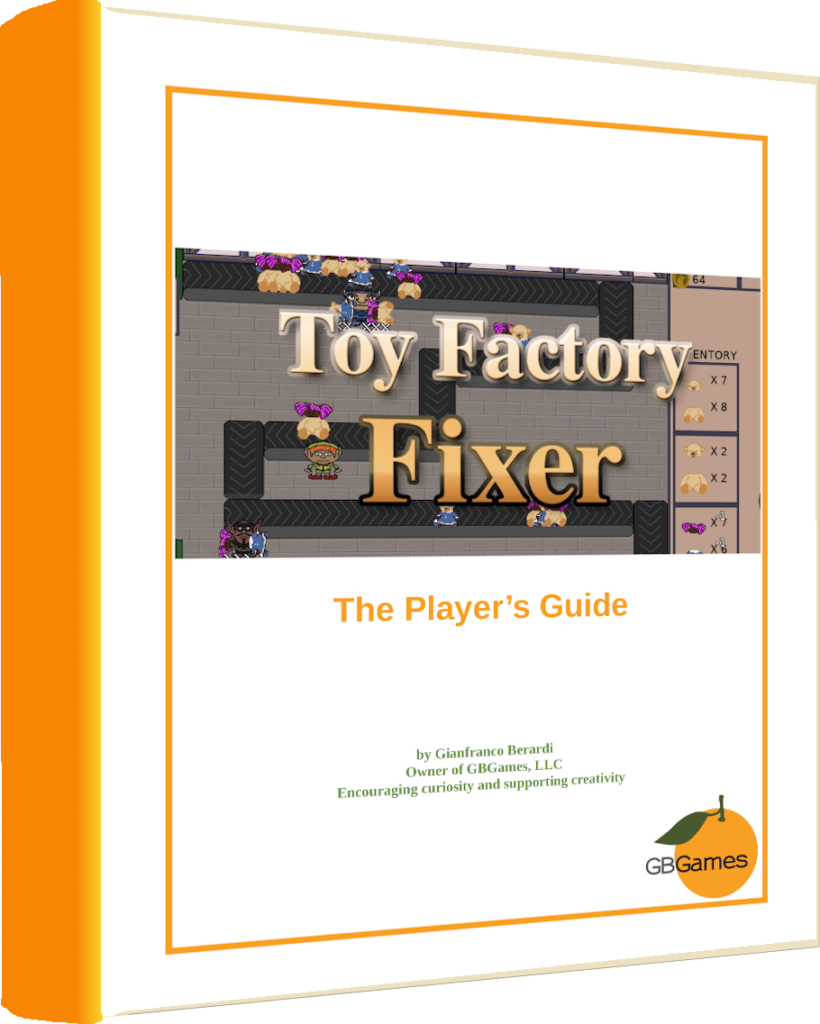
It can be challenging to play, but if you want inside-information on how the game works, then you’ll be pleased to know that the Toy Factory Fixer Player’s Guide is now available!

Toy Factory Fixer Player's Guide

The 19-page, full color PDF explains everything about how the game works, along with tips on how to play well. If you want to get the highest rating in each level, this guide will give you the edge you need to make it happen.

Sign up for the GBGames Curiosities newsletter, and get the 19-page, full color PDF of the Toy Factory Fixer Player’s Guide for free, as well as other free gifts.

Categories
Game Design Game Development Geek / Technical

Freshly Squeezed Progress Report – Some Final Post-Release Tasks

Over a month ago, I announced that Toy Factory Fixer was finally published.

A few weeks ago, I even published a post-mortem.

But I still have a few tasks I wanted to finish before moving on to another project.

Sprint 54: Post-release

Planned and Incomplete:

  • Create a strategy guide
  • Update Toy Factory Fixer web page

Between the holidays, taking time to play games, planning for 2022, and taking a week long vacation with my family, I’ve been slow to get back into the swing of things this past month.

I finished January with my first week of development, and it was primarily focused on writing.

Right now, if you sign up for the GBGames Curiosities Newsletter, you’ll get a free Toytles: Leaf Raking Player’s Guide.

I want to provide a similar incentive by creating a Player’s Guide for Toy Factory Fixer.

Unfortunately, I only had a few hours dedicated to the task, so I am maybe halfway through. I expect to finish the work this coming week, but I might find myself editing it for longer than I expect.

And I think I definitely need to think about how much time a future game’s Player’s Guide will take to write.

One simple task I haven’t gotten around to yet is to update the animated GIF on Toy Factory Fixer’s webpage. It’s outdated and doesn’t show the latest game play.

My current workflow for creating animated GIFs requires recording a video, then using ffmpeg to create the GIF. It’s not difficult to do, but it is a little time-consuming in terms of trying to capture the right moments to reflect in the game.

So, in summary, I took some time away from development, and I am slowly getting back to it.

After that, I get to decide what my next project is, and I have some ideas I’d like to explore in terms of how to display the world in a unique way.

Thanks for reading!

Want to learn when I release updates to Toytles: Leaf Raking, Toy Factory Fixer, or about future Freshly Squeezed games I am creating? Sign up for the GBGames Curiosities newsletter, and get the 24-page, full color PDF of the Toytles: Leaf Raking Player’s Guide for free, and eventually the Toy Factory Fixer Player’s Guide as well!

Categories
Marketing/Business Personal Development Politics/Government

A Review of My 2021, and Looking at 2022, Already In Progress

2021 ended weeks ago, and I’m only now getting around to having a retrospective about it.

We’re in our third year of a pandemic that a lot of us thought would be over within weeks or months at most.

Once again, my immediate family somehow managed to make it through the year unscathed as far as we know. I know a number of people who have tested positive for Covid, and we’ve lost a few people we knew.

I’m still employed and working the day job from home, and since I work in software consulting, it translates into a relatively comfortable income and life for my family.

We’re all fully vaccinated, and most of us have gotten a third vaccine. Recently with developments of variants, we’ve upgraded to KN95 and N95 masks.

And since our society in general seems interested in actually helping the pandemic, it seems like this is our foreseeable future.

That said, we’ve started venturing out of the house a bit more in the last year. My children participated in sports, and I even acted as unofficial assistant soccer coach for my daughter’s team. We’ve visited with family.

Some things felt normal, despite feeling weird, and despite knowing that some people are immunocompromised and most at risk as society prematurely decides the pandemic is over. It’s disappointing.

So with the pandemic as background music, how was 2021 for GBGames?

Goals from 2021

As I wrote last year in 2020 in Review and My 2021 Vision, my goals for 2021 were:

  • Go from ~0.146 sales per week to at least 1 sale per week by December 31st
  • Increase my newsletter audience to at least 100 subscribers by December 31st
  • Release at least 6 Freshly Squeezed Entertainment games by December 31st

Increasing sales and increasing my newsletter audience aren’t things I have direct control over. They are lagging metrics, the kinds of numbers I can look at after the fact.

The only one of those goals I had direct control over was publishing games. This is a leading metric. That is, my hypothesis is that if I quickly work on and publish playable, polished prototypes, that it will lead to people finding my games and eventually subscribing to my newsletter.

And what I hypothesize is that those subscribers have shown they like my games and are more likely than random strangers to pay for Toytles: Leaf Raking and future non-free games I publish.

So how did I do?

Sales (Target: 52) – 5

In 2020, I sold 7 copies of Toytles: Leaf Raking. So, selling less means I went backwards in terms of results.

If there’s a bright side, unlike in 2020, I only released one update for the game, and most of my focus was on my new development. So 71% of the previous year’s sales despite a near-complete lack of me talking about the game?

Maybe that’s not bad, but it was clearly not anywhere near the increase I wanted.

GBGames Curiosities Newsletter subscribers net increase (Target: 84) – 6

I went from 16 subscribers to 22, about a 38% increase. Considering how the next goal’s results went, I’m taking it as a minor win, despite not hitting my goal of what now seems like a ridiculous expectation of a 525% increase.

And, no one has unsubscribed, so that’s another win in my book.

As this was probably the most important goal in terms of how much it will impact the future of GBGames, it is a bit disappointing, but again, it is a lagging metric. I can’t control it directly. Which leads me to what I could control.

Published Freshly Squeezed Games (Target: 6) – 1

Toy Factory Fixer was the only game I published last year, and it didn’t get released until mid-December.

So on the one hand, I am disappointed that I fell so far short of my original goal. Having such a late release meant that I spent most of the year not knowing how my Product Development Strategy was going to work out experimentally, which made me worry about the risk of taking so long to release something to get that feedback even more.

On the other hand, I finished and released a game I’m proud of, people are still downloading it and playing it, and I have already received some nice reviews.

And I think my regular posting about development progress has led to people signing up for the newsletter, so there is a direct connection happening there.

Analysis

Now, I think much like my arbitrary one month deadline for Toy Factory Fixer, these goals were more wishes than anything. I had no solid plan in place to make them happen, and any plan I did have was a bit vague and untested.

Literally, my plan was to release free games, hope some of the players signed up for my newsletter, and hope those subscribers eventually became paying customers.

And I think it isn’t a bad strategy overall, but in retrospect I was deluding myself with the fixed numbers I made up without anything to justify them.

I mean, I’ve made games in a weekend before, so taking two months instead of one month to make a game sounded like I was right-sizing that goal, but my experience with Toy Factory Fixer showed me that I was going to need to do something different if I wanted to make games anywhere near that fast that I would still feel good about releasing to the public. And everything else hinged one me releasing Freshly Squeezed Entertainment.

I wrote a post-mortem for Toy Factory Fixer, so you can read that post if you want to see my analysis of what I think went well and what went wrong and what I learned from it.

Otherwise, I think in general my specific goals were unrealistic. Which is frustrating because they feel like they shouldn’t be. In fact, I thought 100 subscribers was something I would hit much earlier in the year, and that what I was really hoping for was 12 games in a year.

Imagine if I made a game of the quality of Toy Factory Fixer every two or three months. Is it so unrealistic that I would have had 100 subscribers to my mailing list by the end of the year?

By my math, if I only gain 6 subscribers a year for some reason, am I really looking at 13 more years before I hit that number? That’s ridiculous.

But clearly something has to change if I want different results.

What else?

Well, I tracked 299 hours of game development, which is pretty close to almost twice what I did the previous year. 300 hours in a year might not sound like much, as it amounts to a little less than two months of full-time effort, but since I am part-time and have a family and other obligations, it represents the fact that I made it a priority to put in effort week after week.

I published 60 blog posts, slightly more than the 58 from the year before, and it was mostly weekly sprint reports. Those reports functioned almost like a combination sprint retro and demo, in which I demonstrated what I got accomplished. I got into the habit of writing the report, then planning the next sprint once I had taken time to think about how things went. Plus, people responded positively, especially when I had animated GIFs or videos to share, and since I love reading about behind-the-scenes of games, I thought others might, too.

I created an update for Toytles: Leaf Raking. It’s more compatible with modern Android and iOS systems. Otherwise, I haven’t changed anything about the game since the previous year. My expectation was that I would work on a Freshly Squeezed game, then work on a Toytles: Leaf Raking update, then work on another Freshly Squeezed game, but obviously I had no concept about how I was going to make that work.

Without contract work and with very few sales, it was very easy to have a lot more expenses than revenue. I can’t control my income, but I can manage my expenses a lot better going forward.

My personal goals for the last year were similar to the year before:

  • Do a minimum number of walking hours, push-ups, squats, and planking
  • Read a book per week
  • Create at least one doodle per day
  • Do 15 minutes of focused learning a day

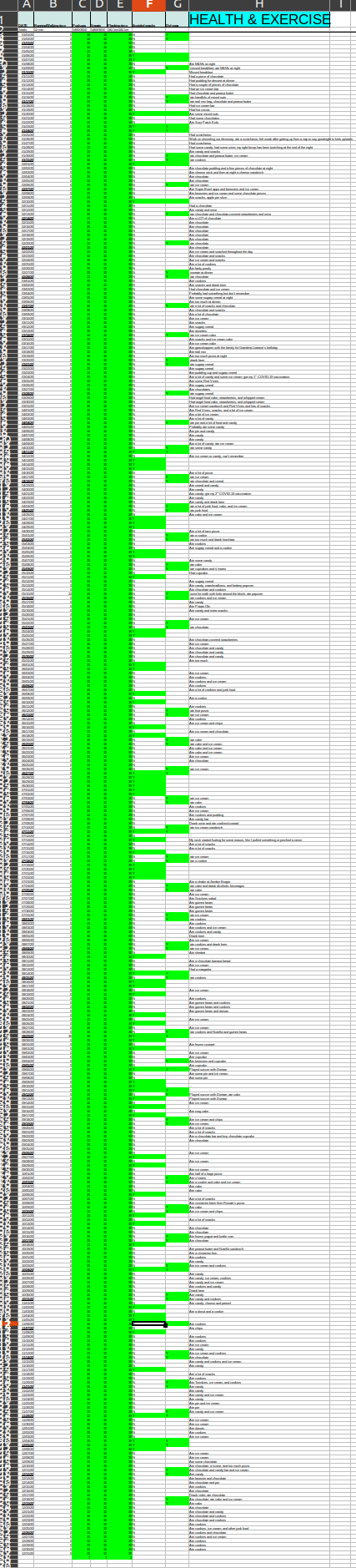
I successfully did 15 push-ups, 15 squats, and 30 seconds of planks every day of 2021. Look at all that green in those columns!

Morning Exercise Routine In 2021

Technically, my daily exercise streak goes back to October 19th of the previous year.

I also did yoga on most weekends, and I think my body feels more physically capable than it has in a long time. In the past I would sometimes hurt my back or side, but I’ve been able to avoid seeing a medical professional for a long time.

Unfortunately, I rarely did anything cardio-related. Once again, the best of intentions doesn’t mean much, and my goal of walking everyday was hampered by the lack of habit, the broken treadmill I’ve been meaning to repair, and a lack of commitment. I sit too much, especially since I have my day job work and then put in even more time for my business.

I read a total of 33 books last year, the most in a given year since I stopped listening to audiobooks and switched to podcasts in my car a few years ago. I count 11 books related to games, including a bunch from Ian Bogost and a couple about making games with deeper meaning. Another 10 books were productivity or business-related.

I only read four fiction books, including Seveneves and A Game of Thrones, each of which took up a significant amount of my before-bedtime reading. I also greatly enjoyed Redwall, which was seemingly even more brutal than A Game of Thrones was.

Other books were related to history, parenting, comics, or DIY renewable energy.

I continued to do a daily doodle, alternating between drawing faces, drawing objects, and body parts like hands, legs, and feet. Sometimes I did cartoony drawings, and sometimes I tried to make it as realistic as I could. Once in a great while, I would look up a tutorial online, but I felt like I was in a holding pattern of putting in the time to make the doodle but not really growing in skill.

The new thing I tried to do was make explicit time for learning. I value learning and growth, and in the past I have invested in books, conferences, online courses, and such, but I never made an explicit plan to take advantage of those investments. So I made it a daily habit. 15 minutes a day adds up over time. I tracked 137.75 hours of learning, on topics as varied as game programming, game art, game production, creativity, and various personal development and technical things. I have had a Pluralsight subscription for the past couple of years, and this goal allowed me to take advantage of it more than I have in the past.

Goals for 2022

If the last year has shown me anything, it’s that even if I were to write down all of the outcomes I would like, it means nothing without a plan and without my capacity to work on that plan.

In 2010, I quit my job and became a full-time indie game developer. After running out of cash, I went back on “corporate welfare” in 2012. My expectation then was that I would build up some savings and quit again, but I didn’t take into account how being married and having a family would affect my risk assessment (or how much my family’s risk tolerance would inform my decisions), and I have had a day job ever since.

Clearly I wasn’t going to accidentally make GBGames my main employment, so last summer I started writing a “Full-time Indie Plan.” I wrote down how much money I was currently earning from my day job and how much money our family budget currently is vs what it would look like cut to its essentials. I documented details about platforms, revenue sources, challenges, risks, what I wanted to accomplish and what I explicitly didn’t want to do (such as spy on customers or bombard them with ads) and more. And the most important part of it is answering questions about how I was going to make it happen, such as identifying exactly what needs to happen in terms of sales, marketing.

This document isn’t finished, and while I expect it to be a living document, I recognize that I am repeating mistakes I’ve made before when I’ve done similar exercises in the past. Namely, I can come up with a lot of questions or categories, but then I don’t actually address them.

So while I have documented what I value, such as privacy, encouraging curiosity, supporting creativity, and others, and while I have done a SWOT analysis (although maybe I can iterate on it some), I haven’t answered questions about who my audience is and how I can reach them. I haven’t made a solid plan for actually marketing my games besides blogging and sharing on social media. It’s a 13 page document that has a lot of TODOs and headings without content in it.

But of course, I only have so many hours in a day. Even if I could identify 100 marketing activities, if I can’t actually make time to do them or manage someone else doing them, it does me no good.

My current lack of capacity should inform my goals more than they have in the past. Any marketing I would do would be inbound in nature rather than outbound, as it is less expensive and takes advantage of doing something once, such as publishing a blog post, and distributing it multiple times for near free.

So here are my goals for 2022:

  • Release at least 2 Freshly Squeezed Entertainment games by December 31st
  • Increase my newsletter audience from 22 to at least 34 subscribers by December 31st
  • Earn at least 1 sale per month by December 31st

I still think my overall Product Development Strategy is still sound. Create free value, ask for permission to talk with people who have shown they like my games, and then use their feedback to help me make deluxe games that are more likely to sell.

Creating two games in a year should be doable if I put on my game producer hat more often. I would love to try for four games, giving each one on average about three months, but I’m already worried that I’m still overestimating my capacity with two.

My newsletter went up by 6 subscribers last year. Now that I have one Freshly Squeezed Entertainment game out and expect to have at least one more by the middle of the year, can I find 12 more fans who are interested enough in my games to sign up?

I don’t have a sales plan in place, and clearly one sale a week was too ambitious. Still, one sale a month sounds like a ridiculously small amount, but then again, it is clearly a difficult goal for me at this time. It works out to a little more than double the sales I made in 2021, which was slightly fewer than sales from 2020. Making that trend go back up will be huge.

Besides those overall goals, I do want to spend some time porting my existing games to desktop platforms, and I’ll need time for that effort that isn’t going to be going into new development. I already develop on my Ubuntu system, so creating a Linux-based release shouldn’t be difficult, but since both Windows and Mac OS are trying to be walled gardens, I need to figure out how I can create free games for them without it costing me a ridiculous amount of money.

I also want to make time to actually play games. Between all of my old consoles, Steam, Humble Bundle, GOG, and Itch, I have a lot of games, many of which I’ve paid for, that I never enjoy or even learn from. Last year I played Castles I, Sunless Sea, To the Moon, Minecraft, and Super Crate Box, and shortly after I released Toy Factory Fixer, I allowed myself to play The Legend of Zelda: The Wind Waker during my week off from the day job near the holidays.

But much like my 15 minutes of learning each day habit, I’d like to make regular time to play games, even if it isn’t daily, even if it is a dedicated part of a day once a month.

Ok, so maybe two games in a year is starting to sound ambitious…

Anyway, I hope you have a safe and healthy 2022! Happy New Year!