Categories
Game Development Marketing/Business Personal Development Politics/Government

The Mixed Bag of 2025 & Planning 2026

Despite making a note to myself to do so, I didn’t spend as much time in December reviewing the past year and planning the next year, which is why my new year post is so late into the new year.

Last year, I set the following actionable goals for 2025:

  • Publish at least 1 free game by June 30th
  • Publish major Toytles:Leaf Raking quality improvement update (including demo) by December 31st

I also had the following aspirations (that is, goals I didn’t have control over so I don’t call them goals):

  • Earn 2 sales per month (+24 sales) by December 31st
  • Increase newsletter subscribers by 1 per month (+12) by December 31st

How did it go?

My Goals

Published Freshly Squeezed Entertainment Game – DONE

I did it! You can play my second Freshly Squeezed Entertainment project Clown Alley Creator, a family-friendly creativity tool for creating your own fun and zany clowns!

Well, technically it wasn’t done by June 30th. It was published on July 5th.

But I will count it as a win because the game was ready to be published, and I had to wait for reviewers at a couple of app stores. Next time, I should anticipate that kind of lead time.

What was intended to be a six month project took about nine months, from initial design to publication.

Why the difference? Well, I will create a post-mortem for the project soon, and I’ll share what lessons I’ve learned then.

But for now, I will say that I was fairly happy with how the project progressed, and it seemed well-received by players.

Published Toytles: Leaf Raking update and demo – NOT DONE

Toytles: Leaf Raking is my current flagship title, originally published in 2016.

Which means that 2026 is going to be its 10 year anniversary!

As I said multiple times last year, I wanted to celebrate by updating it with better visuals, audio, and game play. I started to call it a Major Update(tm).

After I finished Clown Alley Creator, I spent time trying to promote it, and I didn’t get started on Toytles: Leaf Raking right away.

In fact, I felt a bit unfocused, and it took me many weeks to get back into my game development routine.

When I finally had a new plan, it coincided with getting into the end of the year holidays, a notoriously unproductive time. I decided to set my sights a bit lower to at least have a significant internal update.

So before the end of the year, I wanted to release a new version of Toytles: Leaf Raking that should otherwise look and feel the same, but it will have an upgrade of libSDL from v2 to v3. I use libSDL as a cross-platform library that lets me make my games and have them play on many platforms. It is how all of my games currently support desktop and mobile across five operating systems without requiring a lot of effort to support it.

Most of the porting work was relatively easy thanks to the fairly well-written libSDL migration guide, and I had the game running with libSDL3 fairly quickly.

Well, without audio.

I used the audio management library libSDL_mixer for my audio, and the change to libSDL3 meant that libSDL_mixer was completely overhauled, which meant that my own code needed to be overhauled when it came to audio.

Between not putting in many hours of work into it and not having a clean design for the new audio code, I floundered, and the end of the year came and went without a new Toytles: Leaf Raking release.

My Aspirational Outcomes

Earn at least 2 sales per month by December 31st (Target: 24) – 9

I definitely fell short here, and it was mainly because I didn’t have much of a promotion strategy. I didn’t want to do a bunch of random social media posts or pay for ads without those tactics being grounded in something bigger.

In fact, early in the year I had planned to create a free booklet about games and online safety, but I switched focus and spent time trying to figure out what that bigger promotion strategy would be. I didn’t expect to find a universal perfect solution (or else everyone would already be doing it), but I did want to have something to inform the tactics I might employ.

For instance, if I wanted to establish GBGames as an expert for parents who care about privacy and ensuring that their kids are not bombarded with invasive advertising, perhaps that means I focus a lot on writing for that audience. Maybe I still create that free booklet, but now I have much better idea of what I am trying to accomplish with that booklet.

But as usual, I found myself focusing most of my available time on game development. Even when I did finish Clown Alley Creator, I spent most of my promotion time creating social media posts and sending out press releases for the next couple of months.

What’s kind of annoying is that most of those 9 sales of Toytles: Leaf Raking most likely can’t be attributed directly to my own efforts. It turned out a somewhat viral incremental game about raking leaves was released, and coinciding with its release was a spike in traffic and a few purchases of my game.

That’s right. I probably can’t even feel good about the low sales numbers I did get.

I mean, I’ll take the sales, and to be fair, I kept the game alive and working all these years to be available for those customers, but I don’t want to hope I get lucky that something like this will happen again and frequently enough to earn any significant amount of money.

GBGames Curiosities Newsletter subscribers net increase (Target: 12) — net 2

I gained 3 subscribers and lost one of them for a net gain of 2 new newsletter subscribers. Positive numbers are good, but it is still a very low number compared to where I wanted to be.

Once again, my lack of promotion is primarily the problem. However, there was a technical problem that I didn’t know about for months that could have also impacted things.

See, my Freshly Squeezed Entertainment line of games is part of my product development strategy.

The general idea is to quickly create relatively polished prototypes as complete playable experiences, release them for free to make it easier for them to find an audience, and hope that if enough people love them that they’ll be willing to sign up for the newsletter and give me feedback, and if enough people really love a particular game, I can then decide to make a “deluxe” version for sale with the expectation that I’ll have an audience already willing to pay for it.

And you know what? After Clown Alley Creator was released, I could see that people were visiting the newsletter sign-up form on my website from the game.

Now to be clear, I do NOT track anyone’s data in my games. I don’t want to do anything creepy like that, no matter how normalized it is in the industry as a whole.

But my website does track visitors the way almost any website does, and so the links in my games append a little information to the URL to let me know what game is sending the traffic, for instance.

And I can see that I got hundreds of visitors from Clown Alley Creator whereas I got way, way fewer visitors from my first Freshly Squeezed Entertainment, Toy Factory Fixer.

Unfortunately, it wasn’t translating into people actually signing up. I chalked it up to perhaps not offering a strong enough incentive to do so. Ah, well. Maybe the next game might do even better.

But then near the end of the year, I was checking some very, very old messages somewhere, most of which were spam (which is why I never check them), when I saw one person in August said that my newsletter signup form was broken.

And sure enough, it was!

I fixed it (it turned out that I had the same MailChimp signup form for many years and for some reason it stopped working relatively recently, but creating a new signup form seemed to do the trick), but it does mean I had months in which potential visitors interested in signing up for my newsletter couldn’t!

So I’m hoping that people continue to play the game and visit the site over the next few months, and with the working signup forms, I’m hoping that I get way more than 2 signups.

Speaking of, do YOU want to signup for the free GBGames Curiosities newsletter? You get free Player’s Guides to my existing and future games for free!

Analysis

I successfully worked my plan and got a third game published. I feel confident that I can do it again in a similar amount of time, and I think I learned some things about managing the project and prioritization that should help me deliver games faster.

I did not, however, get a major update for Toytles: Leaf Raking out. I didn’t even get a minor update out, unless you count the update I did to comply with ever-changing app store requirements, which I don’t. The libSDL3 update started out well, but it feels bad that I somehow spent a couple of months of calendar time and still didn’t get the audio part finished.

Despite tracking time for promotion, I am not sure how much good it did. Most of my early effort wasn’t actually DOING promotion so much as figuring out a strategy, and later when I was actively trying to promote Clown Alley Creator, I started to wonder just how impactful it was to spend time on my daily social media posting and sending out press releases.

But Clown Alley Creator seemed to be one of my more popular games, and it seems like people are playing it. Too bad I was oblivious to my mailing list signup form being broken for months to take advantage of the people potentially interested in signing up for it.

In the time between working on Clown Alley Creator and working on Toytles: Leaf Raking, I found myself updating all of my games for compliance with app stores before a deadline, which took some time away that I didn’t anticipate. I somehow need to find a way to be more productive AND allow for slack in my schedule to allow me to attend to things like this.

Also during that time, I found myself a bit knocked off course. I was steadily working on Clown Alley Creator, with a daily habit that often added up to 5-15 hour weeks, and then when I was done working on it, I felt like I didn’t know what to do without my regular development work there to keep me focused. Even when I had a list, and I knew what I could be working on, whether related to promotion or planning the next project, I just didn’t seem to be able to do so.

It was somewhat of an unplanned hiatus, one in which I felt like I should be doing something but wasn’t. I think the lesson is that I need to plan some deliberate downtime for the end of a project. I once had a very intense month-long project that took me months to recover enough to work on the next project, so maybe this isn’t a new insight. But I need the break, I need to recharge, and I need to make sure I am purposeful about it.

I have found that I can do the work indefinitely after I set myself on a particular trajectory. That is, after doing the hard work of planning, I can work the plan. I can even adapt the plan, sometimes significantly, and still continue on.

But momentum changes seem to be challenging for me, even if ostensibly the day to day should be the same. Switching from one project to another, I went from being slow and steady and consistent to just being slow and inconsistent.

It would be one thing if I can claim that the reason I was struggling was that I was bored of the older project or didn’t find it compelling, but I don’t think either of those statements are true. I’m pretty excited about the new Toytles: Leaf Raking updates, in fact.

What might impact things is that the country I live in has had a very, very rapid slide towards authoritarianism in the last year, so maybe my struggle comes more from struggling to justify my time working on games when I could be doing something to connect with my neighbors and friends more often.

Some numbers

I spent 252 hours on game development, at least 100 fewer hours than each of the last couple of years.

For comparison, a full-time developer working 40-hour weeks would have accomplished the same thing in 1.5 months.

I’ll try not to think about those numbers too hard.

I did 34.75 hours of writing and published 51 blog posts and 11 newsletters.

I did 1.75 hours of video development and published 0 videos, unless you count the trailers I created for Clown Alley Creator. I just didn’t focus on video creation at all.

I spent 67.50 hours on promotion efforts. I sent out a press release to 95 outlets and content creators over the course of four months. Most of them never replied or reported anything that I am aware of. I didn’t track how many published social media posts I created.

I earned less than $25, most of which I won’t see until this year due to how the app stores don’t pay out until a month or two after the sale.

I spent almost $4,000, about twice as much as last year, but most of the cost is due to getting myself a new computer to replace my main machine that I’ve had for over 10 years, plus getting a new LED printer to replace the one that used to complain about the ink not being legitimate even if it was.

These numbers are obviously not very sustainable.

As for personal goals, I think I am doing a good job maintaining a healthy-ish body.

I kept up my walking routine from the previous year, and I walked a total of 62 hours. Aside from a couple of instances when my lower back was bothering me slightly, I found my morning stretching routine seemed to keep me in fit enough shape to handle day to day life.

In fact, a few times I found that I was able to shovel snow or even carry heavy logs to help my wife’s family when they were cutting down trees, and I felt great afterwards.

While the last half of 2024 ended with me not doing any push-ups due to my wrist hurting, I started the year at 5 push-ups a day and then a couple of weeks later I was doing 10 push-ups a day. I think I intended to eventually go to 20 or more push-ups per day, but I decided not to push it, and I ended up doing them almost every day. I ended the year with 3,500 push-ups total.

Similarly, I had started doing squats again after not doing them for a long time, and I ended the year with 3,500 squats as well.

I had a goal to lose some significant weight, and while I lost a couple of pounds, my weight was fairly stable throughout the year. I suppose that’s better than losing a bunch and gaining everything back?

I read a total of 62 books, of which 31 were audiobooks. Some favorites include:

  • Feeding the Machine by James Muldoon, Mark Graham, and Callum Cant
  • Let This Radicalize You by Kelly Hayes and Mariame Kaba
  • Poisoning the Well: How Forever Chemicals Contaminated America by Sharon Udasin and Rachel Frazen
  • The Splendid and the Vile by Erik Larson
  • Her Fearful Symmetry by Audrey Niffenegger
  • The Field Guide to Citizen Science by Catherine Hoffman and Caren Cooper
  • The Last Archer by S. D. Smith
  • Don’t Talk About Politics by Sarah Stein Lubrano
  • The Age of Surveillance Capitalism by Shoshana Zuboff
  • The Extended Mind by Annie Murphy Paul
  • Subtract by Leidy Klotz
  • How Big Things Get Done by Bent Flyvbjerg and Dan Gardner
  • Recursion by Blake Crouch
  • Tears in Rain by Rosa Montero

As for games, please realize that I almost never find myself playing new games. I don’t tend to let myself play games that often, especially when I am barely making the games I want to make, so if I do play games, it is usually a game in my existing collection.

I played quite a bit of eFootball early on. I enjoyed it, especially if I ignore all of the weird card collecting things and just focused on playing games against the CPU to get my soccer fix. Unfortunately, at some point I found the somewhat consistent crash bug on the main menu to be too annoying for me to bother fighting past, and I uninstalled it from my Steam Deck. I am still looking for a good soccer game, and I’m a bit turned off from free-to-play monetization. I have my eye on getting Pixel Cup Soccer one day, but I am going to miss the high fidelity of eFootball.

I also played games on the PlayDate, such as Pick Pack Pup, Shadowgate PD, Tiny Turnip, and Battleship Godios. I really enjoyed both Saturday Edition and The Whiteout. Blippo+ was an obsession for a hot minute.

Since I built a new, more powerful desktop computer, I played Kerbal Space Program and found myself periodically checking on the status of Kitten Space Agency, the spiritual successor that is currently in pre-alpha.

I finally got around to playing Monaco: What’s Yours Is Mine, and I love the atmosphere and heist tropes.

After reading Recursion by Blake Crouch, I read another one of his books, Run. It is gruesome and harrowing…and it made me want to play Overland. I remember not doing so great the last time I played it years ago, but this time I managed to get pretty far before accidentally losing my dog and another member of my party to a weird teleporting thingie and suddenly finding my party surrounded by monsters.

I was listening to the audiobook The Stardust Grail by Yume Kitasei at the end of the year (it was the 2nd book I finished in 2026, and it will be a highlight then), and someone had just gifted me the game Outer Wilds, and I couldn’t have asked for a better pairing. My very first attempt as space travel in Outer Wilds didn’t go so well. I was so used to Kerbal Space Program’s relatively realistic rocketry that the more arcade-y space travel in Outer Wilds meant that I didn’t realize how close everything was. While I was trying to get my bearings and figure out how to fly towards one of the other planets, I noticed some reentry burn around the edges of the screen, and I turned around just in time to discover and flown directly into the sun. Whoops.

But the game I have been telling everyone about since I got it? Dice the Demiurge, the single-player incremental dice game. I love this game. It’s compelling, it does neat things with a wide variety of dice, it’s funny, and it has a lot of variety. It even has some demands on the real world that I really like.

I found myself playing one session of Dice the Demiurge each day, which allowed me to take just a few minutes to get some game play in with a game that was rich and engaging. I fell behind during the holidays, so I’ve been playing multiple sessions each day to try to catch up.

Goals for 2026

My goals for 2026 are very similar to the goals I had for 2025:

  • Publish major Toytles:Leaf Raking quality improvement update (including demo) by December June 30th
  • Publish at least 1 free game by December 31st

Both of these goals boil down to development/production goals with a definite output.

What I want to do is figure out at least one more goal that is focused on promotion that would similarly have an output I can control.

Unfortunately, I’m now weeks into the new year, and while I feel like I’ve got a better handle on what a promotion strategy might involve, I’m frustrated that I don’t something more solid in place despite spending a lot of time last year on trying to figure this out.

Most of the advice out there is probably fine if you are trying to make a big splash upon launch of a new game on Steam or if you are monetizing people’s attention on mobile with ads or in-app purchases. Based on the sheer amount of discussion related to this kind of hit-driven business, you’d think that it was the only way people know how to run a game development business.

I’m fine with slowly growing an audience who appreciates entertainment that doesn’t come with strings attached, that likes their privacy and doesn’t like feeling worried about whether they can trust their games. I want to make games for families who can feel peace of mind that my games are not spying on them, selling their data, or trying to convince their kids that maybe fascism and white supremacy is fine actually. I want to make games that encourage the player to be curious and to support their creativity.

So it sounds easy: I just need to talk more about the kinds of things that this kind of audience would care for.

I look forward to figuring out the how.

Happy New Year!

Thanks for reading, and stay curious!

Want to learn about future Freshly Squeezed games I am creating? Sign up for the GBGames Curiosities newsletter, and download the full color Player’s Guides to my existing and future games for free!
Categories
Game Development Marketing/Business Personal Development

15 Years After Going Full-time Indie

Today is my Indie Day.

It’s a personal holiday that I observe, as I remember having quit my day job in 2010 to go full-time indie. Here’s my announcement blog post from that period:

Going Full-Time Indie

Unfortunately, even with all of the optimism and well-wishes, I found myself back on “corporate welfare” as I found myself in a day job again in 2012:

I Have a Day Job Again

My original plan, after licking my wounds, was to save up some money and try again within a year or two, but I didn’t anticipate how different such plans look when you’re married and making plans for a bigger family. Priorities shift, and the stability of a regular job, even if it is merely an illusion, starts to look good.

But I didn’t want to give up on my indie game development goals. My new plan was to try to slowly and surely build up my business until it made no sense to keep a day job.

Unfortunately, 15 years after my first time quitting my job and going full-time indie, I haven’t had a second time yet.

There’s lots of reasons for it, although I think a big part of it is not being prolific enough with my part-time game development efforts. On any given day, there are a ton of games getting released, and in any given year, I don’t have one of my own released to join them.

But each year, I take time off from the day job for my Indie Day to focus my time on my business. It’s a weird working holiday, in a sense, but it makes sense to me.

It is frankly more than a little disheartening that 15 years later I haven’t been able to build up a second runway yet. I can take solace that I had tried, once, in the past, but it can’t be enough, right?

For years I’ve been trying to figure out how to do it again, as an indie, as someone who is doing it his own way. I’m making plans, figuring out things that I never even thought of back then, and working, if slowly, towards moving things forward.

Today is the day I allow myself to give my business a little shove. Maybe it is just a bit of needed momentum, or maybe any benefit dissipates too quickly to matter since I can’t keep turning the flywheel.

But today is my Indie Day, and I’m celebrating it by acting as if I am once again a full-time indie game developer.

Categories
Personal Development Politics/Government

Are We Invested Or Just Watching?

I subscribe to the great newsletter Reimagined by Nicole Cardoza (who, by the way, turns out to be a magician and now I hope to see her whenever she tours next), formerly Anti-Racism Daily, and the latest piece was about the weird publicity stunt of Blue Origin sending Katy Perry and an all-women group up into to space, presumably to promote and normalize space tourism.

Cardoza points out that while many people think that the science that NASA does is important, space tourism isn’t exactly a priority.

Yet, the current Republican administration seems focused on doing the opposite of what we, the people, want, and the marketing campaign to send an all-women crew seems to be out of step with the demolishing of DEI and erasure of women astronauts, among other prominent women in other industries and in history in general.

These private companies need public dollars to achieve their goals – including their hopes to scale their own commercial flights. That means that for this to work, the government will have to cultivate awe – not just for space exploration, but the billionaires that now govern it. It doesn’t help that Bezos and Musk, the new faces of space exploration that own Blue Origin and SpaceX, respectively, aren’t exactly media darlings. We deserve to be treated as active investors in this endeavor, not just people in the audience.

I liked this part. I think it captures some of what bothers me so much in tech and in politics. Many years ago, I remember Microsoft was going to invest a lot of money into schools to teach copyright to the youth.

That sounds kinda great, except when I read that it was geared towards teaching them to respect the creative works of major companies such as Microsoft, instead of teaching them that they, too, can create and enjoy the protections of copyright.

Basically, instead of teaching how copyright is for everyone, they just wanted to train everyone to be good consumers.

It was gross then, and it is gross now.

The destruction of the American government that has occurred over the last few months can be summarized roughly as the incredibly filthy rich thinking that they should control the fate of everyone else. The rule of law, equality before the law, checks and balances, regulations, etc … all of that just gets in their way.

And they strongly believe that they have the right and duty to get rid of it, and that your role is to be subservient to them, to be good consumers.

They expect everyone else to passively accept it.

As Cardoza says, we deserve to be treated as investors. But the rich and powerful are moving fast, because breaking everything quickly before everyone realizes how invested they were in the existing system means it is harder to recover.

I’m not sure how many people have come to the realization that there is no reversal of course, that we can’t go back. Our reputation in the world is in tatters, our systems are broken, and the only options are to dream up a new world order that is more in line with what we, all of us, want rather than what a handful of incredibly wealthy people had come up with.

Categories
Game Development Marketing/Business Personal Development Politics/Government

2024 Wasn’t Great, but Perhaps 2025 Can Be Better?

I’ve taken some time at the end of December to look back on the previous year and think about what I want for the coming year.

In 2024, I wanted to build upon the success of 2023, a year that saw me hitting a sales goal for the first time.

One sale per month is barely pizza money, but it is a start, especially since I had never earned that many sales before in the years I’ve been trying to run my indie game development business.

However, I decided that metrics like the number of sales isn’t really an actionable goal. It is more of a lagging metric.

So for 2024, I have the following outcomes I am aiming for:

Increase my newsletter audience from 30 to at least 42 subscribers by December 31st
Earn at least 2 sales per month by December 31st

As for actionable goals:

Release at least 2 Freshly Squeezed Entertainment games by December 31st
Perform at least 2 SEO activities per month by December 31st

My thoughts were that if I make and publish games AND do things to make my website more effective and easier for people to find what they want, then I can increase my audience and my sales.

So, how did I do?

My Goals

Published Freshly Squeezed Entertainment Games (Target: 2) — 0

Two games a year for someone to work on alone very, very part-time is technically doable, but I haven’t been able to do it yet.

In fact, I didn’t do it last year, either:

That’s two years in a row in which I did not publish a new game.

Much of my current business strategy depends on releasing games in my Freshly Squeezed Entertainment line, which are polished, playable prototypes that provide complete entertainment experiences and are given away for free. The general idea is that the games are supposed to be quick to develop and have a low barrier to entry so that they are more likely to find an audience. I hope to get feedback from that audience, and if enough interest exists, I can always create a “deluxe” version of the game that I can sell.

So not releasing a game isn’t great, because there cannot be an audience for a game that doesn’t exist.

At the end of 2023, I had put in a year of game development effort into a family-friendly, non-violent party-based role-playing game called The Dungeon Under My House, and it wasn’t anywhere near done yet. I didn’t have any reason to be optimistic that I could complete it within six months of 2024, but I moved forward as if I could.

About 20 months into the six month project, I decided to put it on hold. I finally sat down and scoped out what I thought the rest of the project looked like, and an optimistic estimate said I still had at least another year of development. Oof.

So I made the hard decision to put the project on hold. I published a post-mortem for The Dungeon Under My House, and I hope one day to publish a second one after I return to the project and truly finish it.

For now, I started work on a project with a much smaller scope. I normally try not to plan everything upfront and instead let the project build up in iterations.

This approach works fine. I’ve built and published games this way. But it clashed with my goal of releasing games quickly. I had to recognize that there was a difference between publishing a game eventually and publishing a game on a more or less predictable schedule, and that only the latter was going to help me satisfy my business goals.

Thanks to some advice I got from Dora Breckinridge (you should hire Dora, by the way), I decided to try to truly capture as much of the scope of my new project as I could, plan on working on features and technical infrastructure for only part of the project’s schedule, and leave the lion’s share of the schedule for leveraging what I had built to fill in the content of the game.

As of this writing, I am finishing up the first phase of work, and thanks to a realization I had about how to arrange the work in a more Agile way, I am incredibly confident that I will ship this project in six months easily, mainly because the project will always be in a shippable state long before then.

Basically, I went from a project with no end in sight to a project that could potentially be done early if I really want it to be.

However, it won’t be released in 2024. I can’t work miracles.

Perform at least 2 SEO activities per month by December 31st (Target: 24) – 2

Ok, so I abandoned this one fairly quickly. SEO felt like a solution that might not make sense in a world where search engines are getting less useful and almost actively hostile towards websites that aren’t in the top results, plus a world where genAI is allowing people to churn out garbage so cheaply that the search results are polluted anyway.

Also, my website barely gets any traffic. Not like it used to when I had more time to blog more frequently about a variety of topics, anyway. Much of that existing traffic is from game developers interested in my blog posts about project management and copyright for indies, and so not necessarily people who would be in the target audience for my games.

But just having this goal, even if I did give up on it, did get me to make some important changes.

I felt like I didn’t have a good baseline to know if my SEO was actually doing anything positive. I didn’t want to make a bunch of changes without any concern about how effective they were. A change could produce a negative outcome, and I would want to revert that change right away. But how would I know?

So I started creating automated metrics reports from my website, plus I started grabbing page visit and download data from the various app stores my games are in and throwing them in a combined spreadsheet. It’s a bit more manual of an effort, but it is worth it to know this data, and I can probably figure out how to automate some of it.

These metrics came in handy when I decided to experiment with ads for part of the year, giving me a good insight into whether or not a particular ad was moving the needle for my games in any particular app store.

I think I might revisit this goal for 2025, not because I want to improve my search engine rankings but because there are things I could do to make my website look and feel better to people who actually visit it. If I optimize the site for real people and their goals as opposed to trying to appease some search engine algorithm, I think things will work out better for everyone.

My Outcomes

GBGames Curiosities Newsletter subscribers net increase (Target: 12) — net 4

My current business strategy has my GBGames Curiosities Newsletter at its core. I want to cultivate an audience of people who specifically said that they wanted to hear from me and are fans of the kinds of games I make.

I don’t have many subscribers yet, and this is the second year in a row in which I was aiming for a net increase of one subscriber per month and didn’t make it.

Unfortunately, I didn’t do anything specifically to try to grow the list, so any efforts to do so were one-offs and not consistent at all. Still, I gained 4 subscribers and lost 0, which is a positive trajectory.

Clearly if I want this number to be higher, something needs to change in terms of my approach.

Earn at least 2 sales per month by December 31st (Target: 24) – 16

Last year I sold 13 copies of my games, beating my 1 sale per month goal by one. I was sure that doubling the goal was both ambitious and doable, especially if I kept up my promotion efforts.

Unfortunately I did not, as I spent much of my capacity trying to make progress on game development.

Now you might think that at least 16 sales is more than 13 sales. And it is true.

But the reason most of those sales appeared is because I spent money on Facebook ads, and unfortunately I spent more on ads than I earned in sales income.

On top of that, this is the first year I have put my game Toytles: Leaf Raking on sale. I was experimenting with the price to see if it might encourage more purchases at a lower price point, or if the act of being on sale made it show up more easily in various app stores. In the end, I think it just served to earn me less money for each sale.

To compare, in 2023 I sold 13 copies of my games and made a total of $103, much of it because of people contributing more than the minimum amount on itch.io. Despite selling 16 copies of my games in 2024, I only made $76 from those sales, and 0 came from itch.io.

Analysis

I sold more copies of my games but made less money, as I said above.

I didn’t take advantage of itch.io sales as much as I maybe should have. I think I was disappointed in the amount of work I put into some sales at the end of the previous year that resulted in nothing, and I am also wondering why I don’t always get advance notice from itch.io about joining an upcoming sale so I can prepare.

But frankly, most of my effort went into game development and not promotion, and so it is no wonder I didn’t see more success in terms of sales.

Last year, I said that my megaphone is tiny, and it still is.

My website has very little organic traffic, and my social media accounts all have limited ability to get awareness out.

I said then:

Basically, the more I rely on social media to promote my game, the more effort and/or money I need to expend for at best a temporary boost in potential traffic.

Focusing on social media isn’t sustainable, and it is partly why I wanted to focus on SEO. However, I worry that the days of useful search engines and a useful Internet in general are behind us.

So should I focus on advertising some more? Maybe. In my experiments this year, I basically proved to myself that if I could get my game in front of the right people that some of those people do, in fact, purchase the game.

That’s good!

But ads are too expensive to run for one-time sales, and I don’t have enough of a backlog of games to cross-sell and make it worth it.

However, if I focused on promoting my mailing list rather than any one particular game, then perhaps the calculus changes significantly. One purchase of a game today doesn’t necessarily mean more purchases in the future, but one mailing list signup today means being able to promote my games indefinitely.

On the other hand, it is entirely possible that people are finding that their inboxes are getting more and more useless the same way that search engines and the Internet as a whole are getting worse. Maybe all the data about how mailing lists are still very effective isn’t accurate anymore?

Or maybe they are, but most game developers are so tied to the app stores and Steam that they don’t find mailing lists useful for THEIR business models.

And I think my target audience doesn’t necessarily even know what Steam is, let alone uses it for finding and playing games.

Relying on Apple and Google to sell my games is therefore a bit risky because I have no way to contact the players who play my games unless they specifically sign up for my mailing list.

Some numbers

I did a total of 359 hours of game development for the year.

For comparison, a full-time game developer working 40-hour weeks would have accomplished that number in a little over 2 months.

I did 62 hours of writing and published 59 blog posts and 12 newsletters.

I did 23.75 hours of video development and published 12 videos.

The above mostly represents a weekly development log, plus the occasional video update, as well as some one-off blog posts and sale announcements.

I originally continued the weekly devlog videos, but the amount of work that went into each video took away from development work. After a couple of months of this pace, I decided to release videos once a month or so. It meant more details in each video, making them more compelling for viewers, plus an easier work schedule for me.

I wanted to focus on my health. In 2022 I had horrible back pain due to an unknown reason, and I think my regular morning exercises are keeping me strong enough to keep it at bay, but I felt like missing a day of exercises was enough to make day to day living feel risky.

So I started doing more exercises meant to help build up strength and stability. I used to do yoga, but I think I was doing something to cause problems. Instead, I started doing weight/resistance exercises.

Unfortunately, I couldn’t keep things up. My knees were hurting until I stopped doing squats only a couple of months after I started doing them, which is too bad because they were supposed to be a great all-around exercise. I did 780 squats total.

Also, my wrists were bothering me from doing push-ups. I stopped doing them in May, so I ended the year with only 1,230 push-ups.

The good news is that I added regular walking, slowly building up from 10 minutes a day to 25 minutes a day and from 2 mph to now warming up at 2.4 mph and increasing to 3.2 mph before cooling down at 2.4 mph again. I have done about 50 hours of walking for the year.

As for losing weight, I didn’t want to count calories or anything too onerous, so I simply cut snacks. I now eat three meals a day and if I have a snack it is once in awhile. I probably still have dessert too often. But I ended the year down a few pounds, despite heading into the holidays to potentially gain them all back.

I read a total of 60 books, of which 26 were audiobooks. Some favorites include:

  • Creativity Inc by Ed Catmull and Amy Wallace
  • The Impact of Iwata by Lucas M. Thomas
  • Secret Iowa by Megan Bannister
  • Black AF History by Michael Harriot
  • What I Talk About When I Talk About Running by Haruki Murakami
  • One Day in the Life of Ivan Denisovich by Alexander Solzhenitsyn (first time reading it since it was assigned reading in high school)
  • Useful Delusions by Shankar Vedantam
  • Killing Commandatore by Haruki Murakami
  • Hunter by Val Gale
  • Natural Beauty by Ling Ling Huang
  • Procedural Generation in Game Design by Tanya X. Short and Tarn Adams
  • Tomorrow and Tomorrow and Tomorrow by Gabrielle Zevin
  • LAN Party by Merritt K
  • Braiding Sweetgrass by Robin Wall Kimmerer
  • Zero by Charles Seife
  • Finna by Nino Cipri
  • This Is What It Sounds Like by Susan Rogers and Ogi Ogas
  • To Sleep in a Sea of Stars by Christopher Paolini
  • Mindful Games by Susan Kaiser Greenland

I was playing Minecraft heavily in the beginning of the year. I played in Hardcore mode, but each time I died, I would create a new world with the same seed and play again. It was like Groundhog Day in that I can’t keep anything I made except the memory of where resources and landmarks were located, and I found it quite compelling.

But otherwise I wasn’t playing games regularly. Steam says I only played 3 games, but most of the games I do play tend to be through GOG or Humble or itch so that’s not representative.

I found out that Flatspace, a game I reviewed a long time ago for GameTunnel.com, is available on Steam, so I played that game quite a bit. I played a little Tooth and Tail as well as Gods Will Be Watching. None are recent games.

More recent games included Once Upon a Jester, which I really enjoyed.

But the game I probably played even more was Kitsune Tails, a fun Super Mario Bros 3-inspired platformer, which did release in 2024, so I’m still hip and with it.

Goals for 2025

Once again, my goals will focus on game development efforts and promotion efforts.

I ended the year feeling very positive about being able to ship my next game in a few months, and I think it has given me confidence that I can repeat this feat.

But I also want to revisit Toytles: Leaf Raking, partly to improve it, which I know will take up some time. While I’m proud of the game and think it is still a good one, I can tell that it is rough around the edges and might not appeal to more people because of it, especially from screenshots.

So two actionable goals are:

  • Publish at least 1 free game by June 30th
  • Publish major Toytles:Leaf Raking quality improvement update (including demo) by December 31st

I think I’ll easily accomplish the first one early. I already have almost two of months of effort in, so I should be able to finish this six month project by the end of April. Still, I’m one person and very, very part-time at that. I could get sick, my day job could take up more of my time, or there might be family emergencies. So between April and June, expect my next Freshly Squeezed Entertainment game.

Meanwhile, I clearly need to do something more proactive and consistent in terms of getting my games in front of people.

I don’t know if I can capture it in a goal by quantifying specific activities such as SEO or ad campaigns, though.

In fact, those are tactics, and while they might be useful and important, I find that I struggle because I don’t have an overarching strategy for them to fit into. I’ve put the cart before the horse.

There are some fundamentals to marketing and selling a particular game, but I also want to promote GBGames as a whole.

Specifically, I want more people to think of GBGames when they think of compelling entertainment that encourages curiosity and supports creativity. I want people to think of GBGames when they think about family-friendly, LGBTQ+-affirming entertainment. I want people to think of GBGames when they want to play games that respect their time and their privacy.

And I’m still figuring out the how for making it happen.

Happy New Year!

Thanks for reading, and stay curious!

Want to learn about future Freshly Squeezed games I am creating? Sign up for the GBGames Curiosities newsletter, and download the full color Player’s Guides to my existing and future games for free!
Categories
Game Design Game Development Geek / Technical Personal Development Post-mortem

Freshly Squeezed Post-mortem Presentation: The Dungeon Under My House

Recently I conducted a post-mortem of The Dungeon Under My House, my unfinished non-violent, first-person dungeon crawler that was meant to be the next Freshly Squeezed Entertainment project.

Now I’ve created a presentation based on that post-mortem, so if you prefer videos, you’re welcome:

Want to learn when I release updates to Toytles: Leaf Raking, Toy Factory Fixer, or about future Freshly Squeezed games I am creating? Sign up for the GBGames Curiosities newsletter, and get full color PDFs of the Toytles: Leaf Raking and Toy Factory Fixer Player’s Guides for free!

Categories
Game Design Game Development Geek / Technical Personal Development Post-mortem

Freshly Squeezed Post-mortem: The Dungeon Under My House

After 20 months of development, I’ve decided to put on hold further work on my non-violent, first-person role-playing game The Dungeon Under My House, what was supposed to be my second Freshly Squeezed Entertainment project.

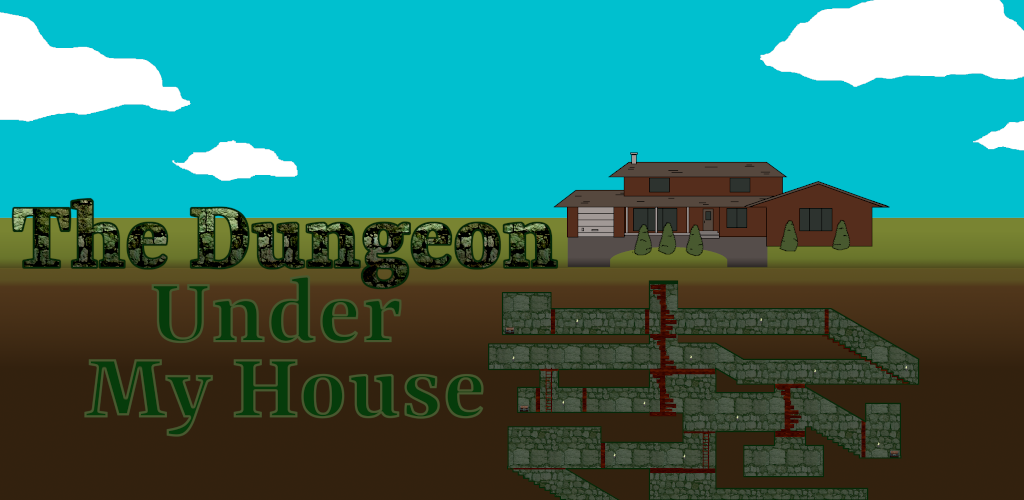
The Dungeon Under My House

It’s a decision that makes me both sad and glad. I really liked this project and I enjoyed working on it and the idea of what it could become when it is finished, but as a solo indie game developer who is working very, very part-time, it is taking me too long, and from my very rough estimates that are probably very optimistic, I’d have at least a year of work left.

That’s a long time, and I need to be more prolific if I want to succeed. Maybe in the future if my capacity increases, I’ll return to it. I hope so. I think it was going to be a neat game.

Still, just because the project isn’t going to be finished and released (for now), it doesn’t mean there aren’t lessons that could be learned from it, which is why I’ve decided to write this post-mortem for it!

I hope one day in the not-too-distant future a second post-mortem of the project links back to this one.

EDIT: I have also created a presentation version of the post-mortem.

Information about the Project

The Dungeon Under My House started out as just an idea that I had at the end of October 2022. Now, ideas are a dime a dozen and all, but this idea wouldn’t let me go. I got excited about making a non-violent Wizardry-like first-person dungeon crawler in which you are a child hanging out with friends in your modern day home, only to discover a secret door in your basement that leads to a multilevel dungeon. It turns out that your family comes from a long line of explorers and adventurers.

So each day after school, you pick a subset of your friends (with unique strengths/weaknesses) to go into the dungeon for adventures. Adventures might take multiple days (you are children with bedtimes, after all, so you can only explore for so long), and you can prepare for adventures by raiding the house for supplies.

Encounters require you to use your skills and tools to distract, befriend, scare away, bribe, help, etc the creatures, monsters, or other adventurers you find in the dungeons.

In my head, The Dungeon Under My House would be a cross between Wizardry and The Goonies, in which your friends and your friendships play a huge role. It would also be a Freshly Squeezed Entertainment project, which as a reminder are games meant to be quickly created and given away for free.

The idea behind giving away free games is that I want my games to have as little friction finding their audience as possible, and if enough demand exists for a particular game, perhaps I will create a “deluxe” version for sale. In other words, rather than guess at what random strangers might want based on trends and fads, I’m trying to find and get faster feedback from the people who would be interested in playing the kinds of games I am creating.

I started working on the project in earnest in November of 2022, with the hope that it would be a six month project, but anticipating that it might take me as long as a year.

Ha. Haha.

I don’t know why I was so optimistic. This was a big project, and I’ve never worked on and completed an RPG before, nor did I sit down to scope out the project to figure out how to fit it all within six to 12 months. But more on that later.

What Went Right

  1. Creating a design document gave the project a North Star

    Obviously I’m not a believer in creating 1,000 page tomes as a game design document, but I found that not creating a game design document at all for Toy Factory Fixer resulted in a lot of wasted time.

    So I created a document that is mostly based off of Rosa Carbó-Mascarell’s Game Design template, which you can find here: https://rosacarbo.notion.site/Game-design-template-0132383574dd4c2dbff5d14e3a90761c

    I found it very helpful to identify the core design pillars, the theme and mood I was looking for, and general activities the player would participate in.

    I anticipated that the design might change a bit. For instance, I originally thought the idea of designing your own adventure plans and then executing them was going to be a key part of the game play. I envisioned being at the titular house marking up the map with objectives, then entering the dungeon trying to achieve those objectives. As the project progressed, I could drop this set of features easily as it wasn’t strictly core to what the game needed to be.

    But other things stayed the same. The game was always set in a sleepy modern-day suburb, so I never had to waste any time wondering about medieval or fantasy themes fitting in.

    And the core pillar of non-violence helped me steer away from having any sense of a threat to the physical safety of the characters in the game. In my document, I wrote:

    There should be no attacking or threat of attacks, no abuse, no physical or psychological danger, and no killing.
    – So can there be threats that aren’t related to physical/bodily harm?

    And then I listed out ideas of threats to property (theft, vandalism, etc), relationships (break-ups, loneliness, hurt feelings), and information (secrets, lies, incomplete knowledge).

    The document got updated periodically as I needed to jot down parts of the design I hadn’t anticipated, so it wasn’t like I wrote the design once and forgot about it or pretended that I needed to stick strictly to it. It was a living document that I kept open on my computer any time I was working on the game.

    And having all of my design notes and decisions in one place definitely helped me know what forward progress looked like.

  2. Creating cheap prototypes and mock-ups sped up decision-making

    The beginning of a project is always exciting, when anything and everything can be possible, but at some point I need to make decisions that take the project in a certain direction and necessarily cut off other options.

    The design doc helped make some decisions quite easy as mentioned above, but other decisions involved choices that weren’t necessarily right or wrong for the project.

    For instance, knowing that I wanted the game to have a 1st-person view in the dungeon, the question came up: what angle should the camera be at?

    A simple solution is: centered! It would be simple, but it might look boring and uninteresting. Having the imaginary camera higher up and looking down more would show more of the current dungeon tile while also giving the impression that the ceiling is lower or that the player is taller. And having the camera lower would maybe be a more appropriate vantage point for the young children who would be the main characters in the game, but it might prevent the player from being able to see as much.

    At the time, I was planning on using old-style tiles to simulate the three-dimensionality of the dungeon, so creating mock-up art for each angle sounded quite tedious.

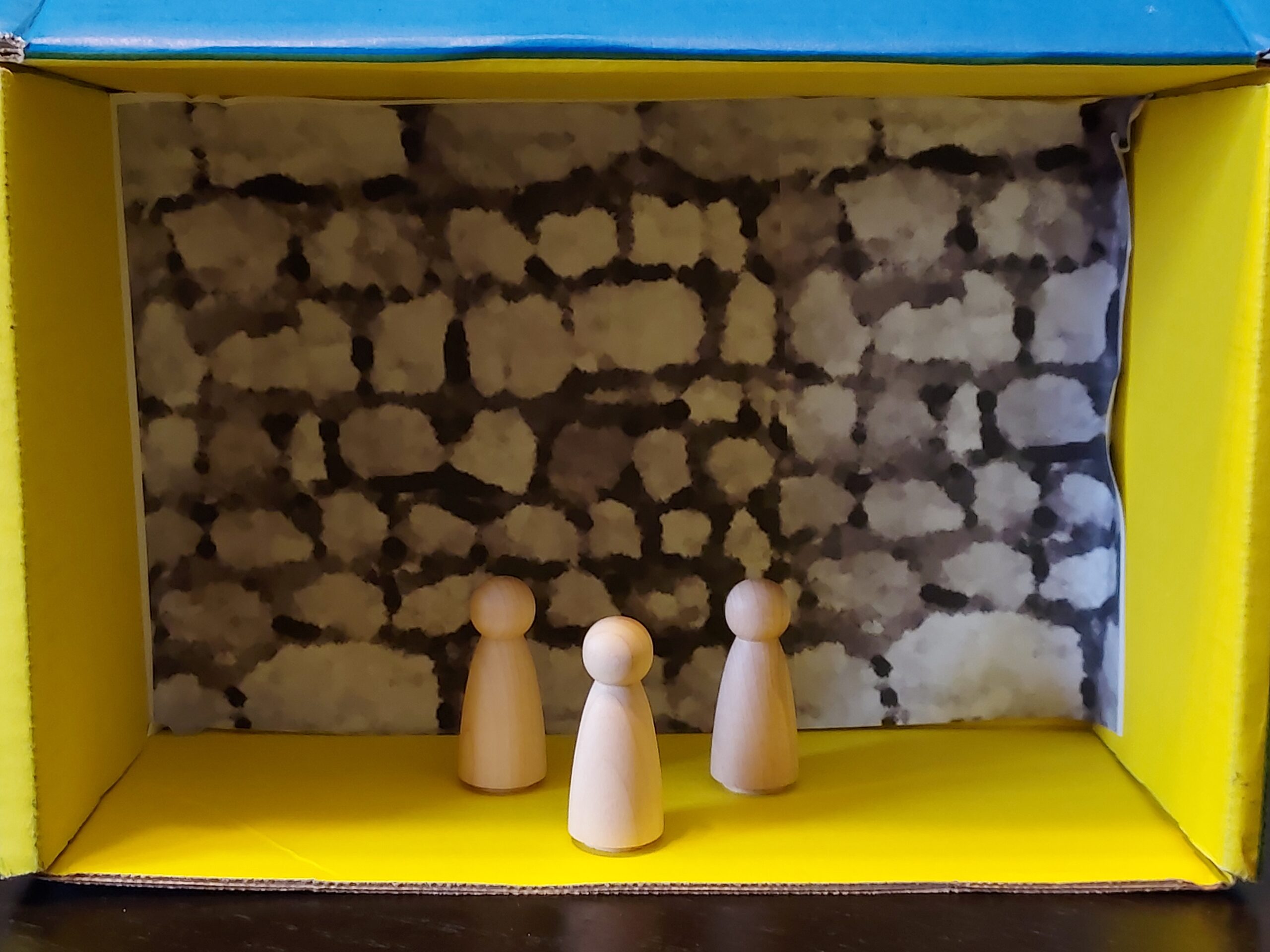
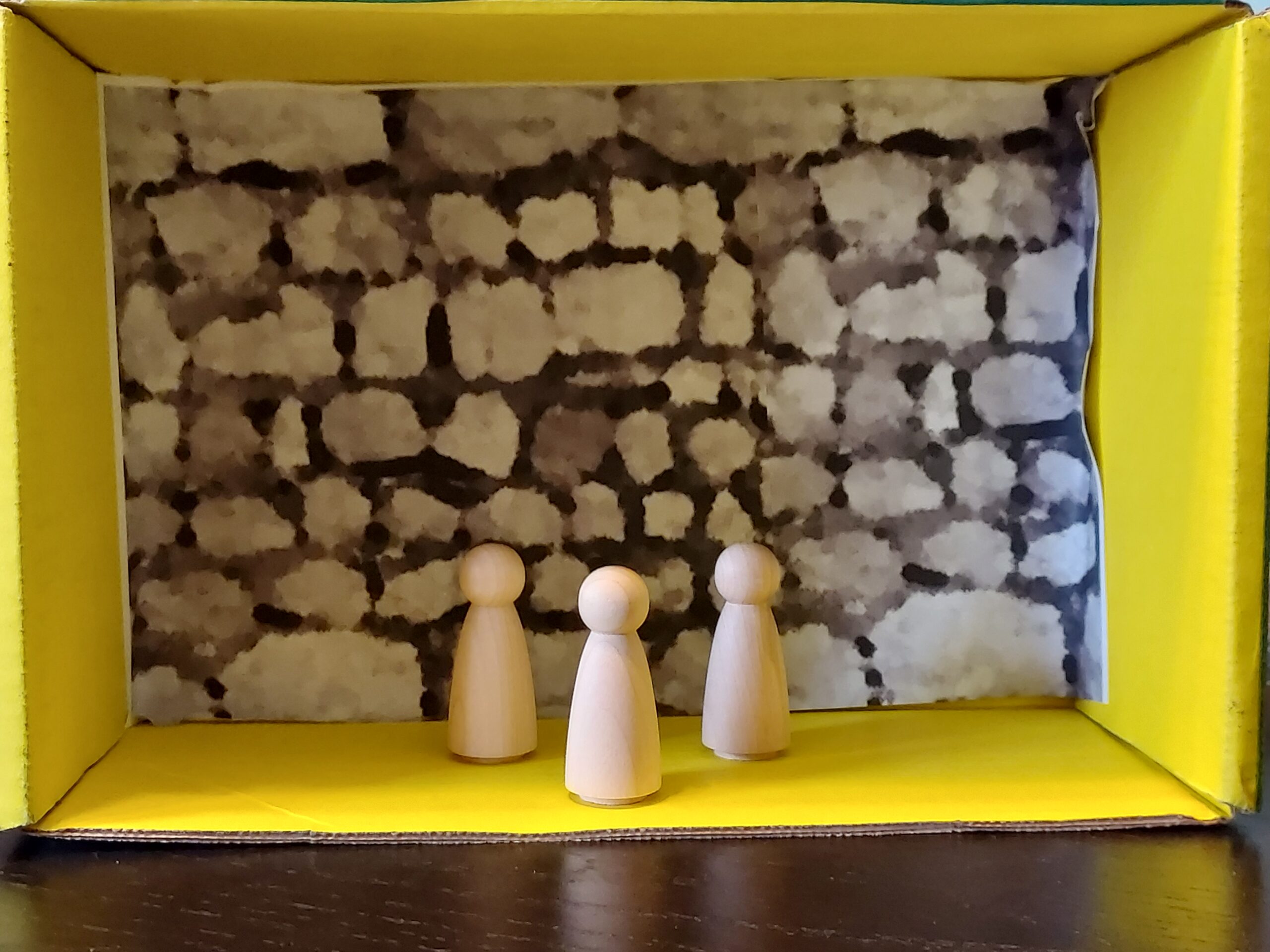
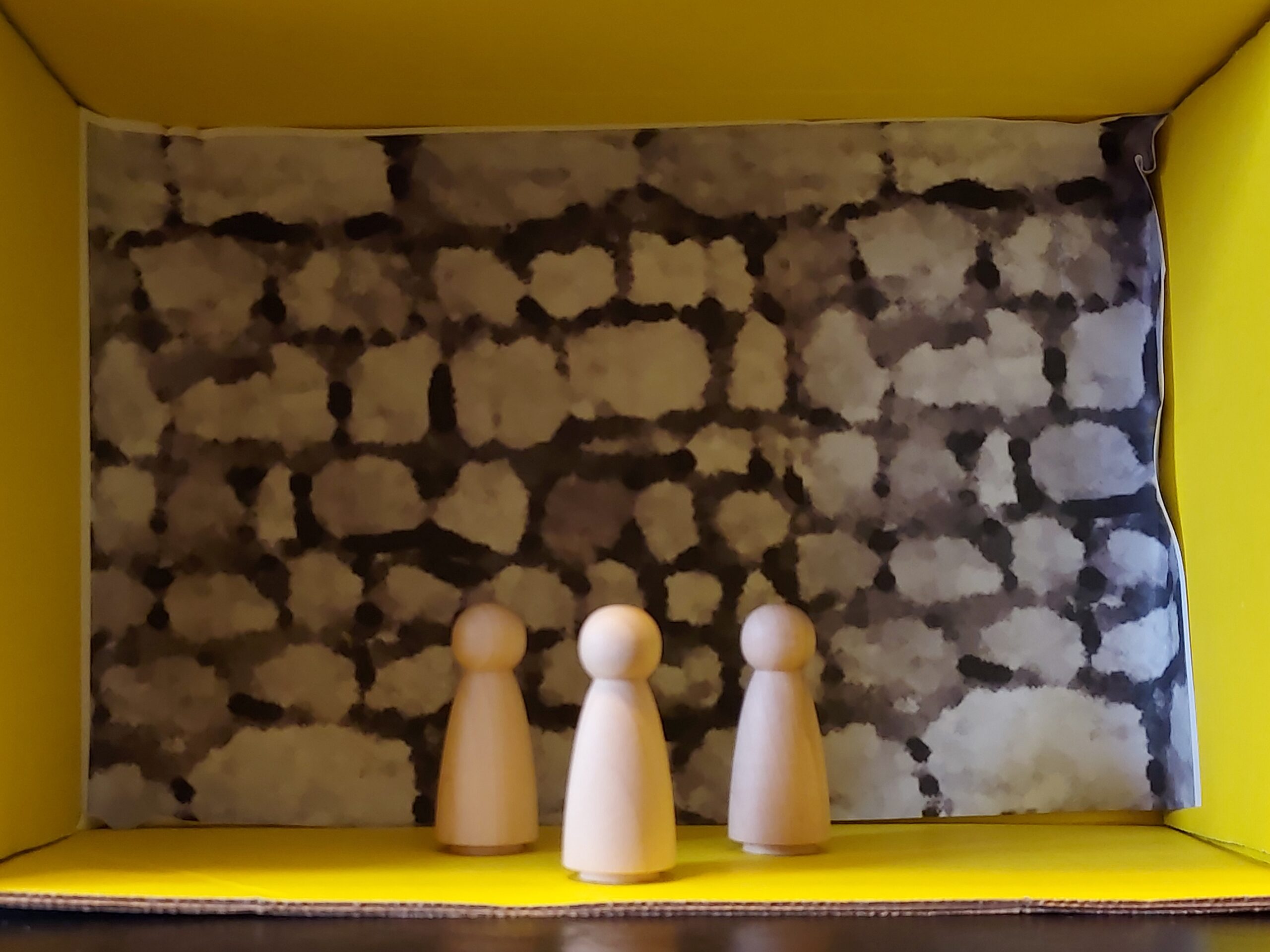
    Instead, I used a physical prototype. I took an old shoe box, printed out some dungeon wall image and taped it to the back of the box, then placed some wooden figures in it. Then I took pictures from various angles to get a sense of how it would feel.

    The Dungeon Under My House - cheap and fast prototyping

    The Dungeon Under My House - cheap and fast prototyping

    The Dungeon Under My House - cheap and fast prototyping

    It took me only a few minutes to create, and I learned right away which one I liked best.

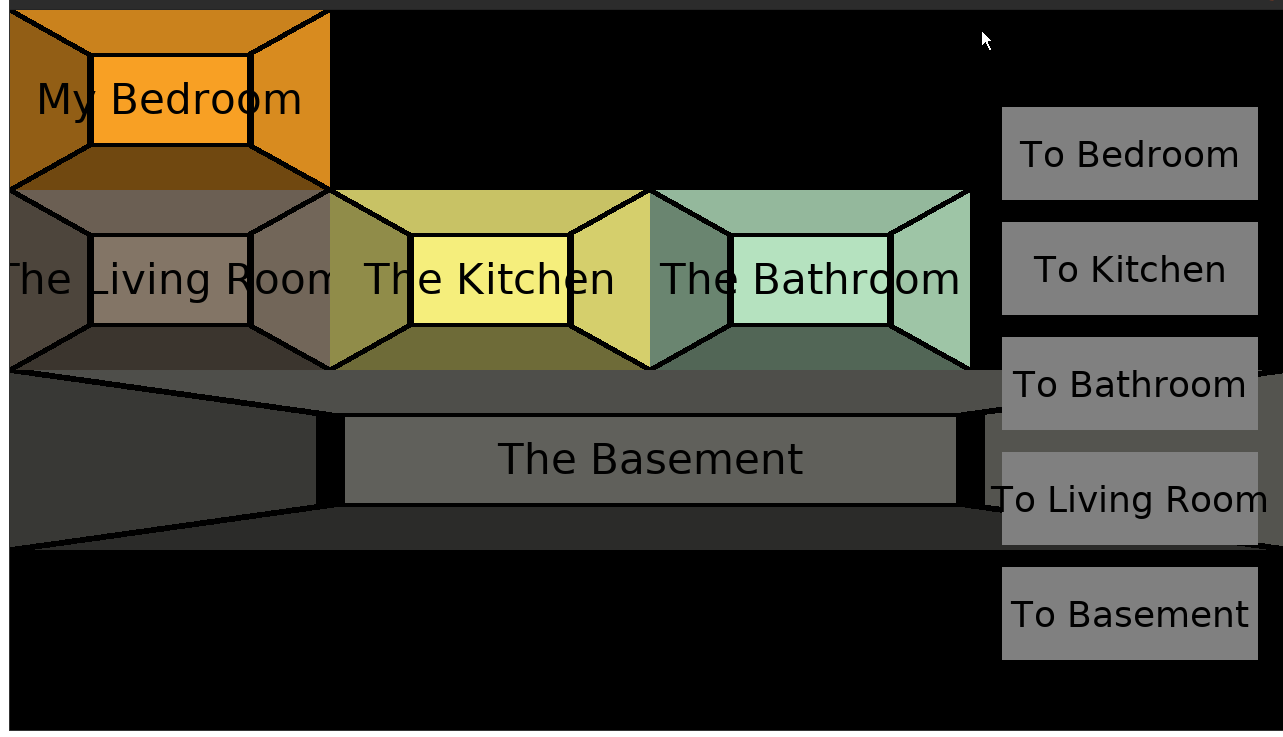
    There were also many ways I could show things on the screen, and even if I didn’t know what might be eventually on the screen in the end, I could at least start somewhere. So I created this mockup:

    The Dungeon Under My House - preproduction mock-up

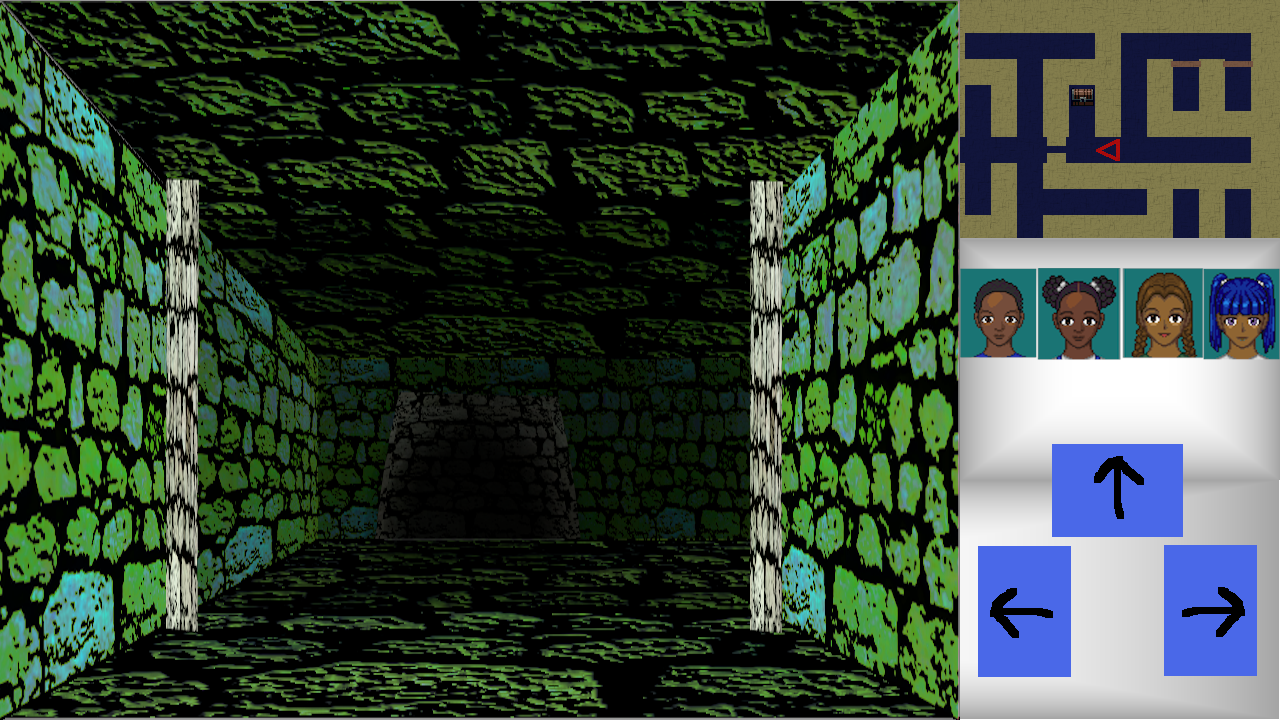
    And I found that doing so helped me figure out where I thought some UI elements would work best. The downside is that I realized very quickly that my mock-up didn’t anticipate the on-screen controls that would be necessary for the mobile version, so I tried another mock-up:

    The Dungeon Under My House - preproduction mock-up

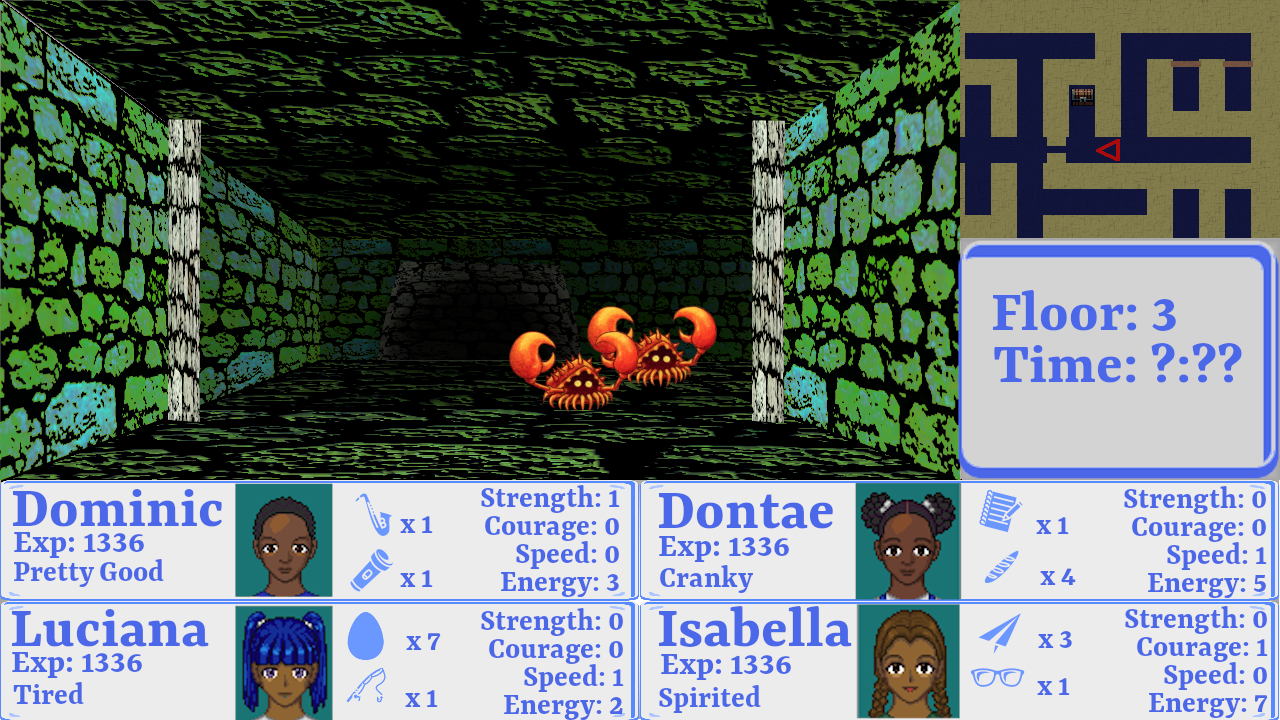
    The latest actual in-game shot shows that I tried a combination approach in the end:

    The Dungeon Under My House - latest dungeon view

    One of the next features I would have worked on would have been the in-game map on the HUD, and so I was already anticipating needing to rearrange and resize various controls, but I know exactly where I want that map to live.

  3. Looking for reference art helped me create a cohesive, “real” world.

    I knew I wanted the game to feel light-hearted and family-friendly. I wanted to have stylized, cartoony art, so photorealistic art wasn’t what I wanted at all, nor did I want a gritty and dark theme.

    I’m primarily a software developer, but I know enough about art that having good reference material helps a lot.

    So I spent time looking into dungeons, sewers, caves, coal mines, and all sorts of things that could act as a dungeon hidden under a sleepy suburb.

    I was disappointed to learn that most real world dungeons were not much more than pits to keep prisoners in, but I was delighted to learn that the Paris has a sewer museum! I even learned that here in Iowa the Wastewater Reclamation Authority has a website that describes how their facilities work AND THAT YOU CAN REQUEST A TOUR!

    And I was very interested to learn of Derinkuyu, Türkiye’s underground city that was rediscovered when someone found a tunnel behind a wall in his home a few decades ago.

    Meanwhile, the other part of the game would take place in the house, so I tried finding art related to various rooms: bathrooms, dining rooms, living rooms. A website about the living rooms of various 90s television sitcoms helped. The living room in my game has a staircase leading up because of course it did: that’s how the rooms on TV look!

    When I found a neat cross-view of a house that had a dollhouse look to it, I knew that I wanted that look for my game.

    Simple house view

    Besides looking for environment art references, I also spent time looking for character art references. Various cartoons, comics, anime, video games, and even clipart examples of children that I thought seemed promising ended up in a large document. I even had some animals, because I hadn’t quite figured out whether or not all of the characters in the game would be human.

    And with a game featuring people, I needed them to look distinct. Clothing store websites feature all sorts of child models, so I found quite a few neat looking outfits, which helped inform the clothing customization options that I added to the game.

    Now, I could have done whatever I wanted. The existence of games featuring sprawling dungeons despite the lack of a real-world equivalent means that it is already OK not to stick to reality. But having a basis for the “reality” of my game’s environments and characters helps sell the reality better than if I used my untrained artistic abilities to freehand everything with no good rhyme or reason.

    Something non-artists might not know: it’s not cheating to use references to inform your art. Use them!

  4. Planning only one thing upfront to work on each week

    This one is kind of a mental health thing for me, but it is a deliberate change from how I ran my previous projects that I think worked out well.

    I ran my project on a weekly cadence. Each Sunday, I would write a blog post about the previous week as a development update, then I would plan the coming week’s sprint.

    In the past, I would kind of mix up my sprint plan with my larger planning, and so I would pick a collection of features to work on, usually features that I think go well together. That is, once all of these are done, I would feel like a significant piece of the game would be done.

    The problem was that sometimes one of those features big quite a lot to work on. Breaking it down into tasks, I’d maybe get a small subset of the tasks done.

    So when I would write my weekly devlog blog post, I would report my progress by saying something like the following from the Freshly Squeezed report of Sprint 42 of Toy Factory Fixer:

    Sprint 42: Training levels

    Planned and Completed:

    • Make sewing worker unique

    Planned and Incomplete:

    • Show tooltips during game based on triggers
    • Create floor training levels/tutorial

    Imagine weeks of saying “I planned to do X, Y, and Z, and I only did X” and you can see why I said it was kind of a mental health thing for me.

    Even if I didn’t mean to say I would get all of these things done in a single week, it still looked like I wasn’t getting things done, and it can be demoralizing.

    And of course, it is hard to predict when things would get done if I kept lying to myself. Not finishing these items means I can’t start working on the next items, and if I do this for weeks in a row, then if I was hoping to get the next item after Z finished by a certain date, well, I can’t even promise I’ll have capacity to start it by then.

    So for this project, I made sure to only plan one feature. Then, I either finish the feature and start unplanned work next before the end of the sprint, or I have only the planned work that is incomplete.

    By and large, it felt better. I no longer felt like I was behind, which is weird because I am my own boss and the feeling came from the accidental promise I was making by listing a bunch of planned work that I wasn’t actually trying to meet. It also helped me avoid deluding myself that a bunch of work would suddenly occur in a single week.

  5. Creating devlog videos to attract more potential fans

    I’ve always written about my game development. This blog started in 2005, after all.

    But sharing my weekly devlog blog posts on social media only gets so much traction these days. Adding devlog videos might increase the likelihood that someone finds out about the games I am working on. It’s another opportunity for someone to discover GBGames and TDUMH.

    So I started making a weekly devlog video. Here’s my first one, published on October 3rd of 2023:

    Oh, that’s rough. You don’t have to watch it.

    YouTube said it has 20 views total.

    In fact, for the next few months, my videos would get about 6 to 35 views each. That’s not a lot, but you know, YouTube is very algorithm-heavy, there’s a lot of other videos being made continuously, my own videos don’t have amazing production values, etc.

    So I spent some time looking into best practices. I started creating custom thumbnails instead of using a random frame from the video that YouTube chose, and I even bought a new microphone to replace the ancient one I’ve had since forever (I think I got it when Windows 95 was the latest thing).

    With catchier thumbnails (I refuse to do a “stupid YouTube face” thumbnail no matter how effective) and a less tinny, much sexier voice, my videos started getting a couple hundred views as well as regular comments.

    Creating the videos each and every week was hard work, even with the low production values. I would write a script, create some video clips of various new features or progress I’ve made on the project, then record myself talking through the update. In the end, I would produce a video that is only a few minutes long.

    While I always tracked how long it took to write a blog post, one day I decided to track how long it took me to create a video from start to end, and I realized that it could take me about 1.5 hours.

    Remember how I said that I am working very, very part-time? I don’t have 1.5 hours to create a video each week! It eats into the time to actually make something for me to show off in the video in the first place!

    So I cut back to only creating a video once a month or two. One benefit is that I have more to show in a given video. Here’s the most recent one that I published at the beginning of this month, and you can tell that is definitely smoother, as I have gotten into a groove creating them in a consistent way:

    And another benefit is that while it takes me longer to make each new video, I feel more comfortable with batching all of that time together once in awhile.

    Obviously the videos are not bringing in thousands of customers, but I do think that it has helped me to increase awareness with a few people about what I am doing, much more than my blog and social media posts alone. As a bonus, it gives me practice with using tools such as OBS Studio, and I can also create animated GIFs more easily.

What Went Wrong

  1. Not creating a real schedule resulted in a non-stop treadmill of development.

    Definitely my biggest mistake was not creating a schedule for this project.

    When I made Toytles: Leaf Raking, I created a road map. It was an optimistic road map in that I anticipated creating the initial release of the game in three months but the actual release didn’t occur until the eighth month of development.

    But the road map was still helpful to create as it helped me nail down as much of the project as I could upfront. I knew that estimates are likely to be way off, but I don’t think I appreciated knowing as much as I did about my project.

    When I worked on Toy Factory Fixer, I didn’t create a road map. I think I had read something about how road maps are awkward in modern development because it implies being able to believe in accurate estimates and also believing that you could know exactly what a project would look like at the end from the beginning.

    In Agile software development, you expect to be able to adapt to changing market conditions, changing stakeholder demands, and changing realities. The road map is a relic of old-style plans that presume you can nail down requirements up front.

    So I skipped the roadmap, and that project lasted a year. What I remember was that it was supposed to be a one month project, and each month I “hoped” that I would finally be finished with it.

    In hindsight, I don’t know why I ever expected to be finished each month because I do not remember doing any work to figure out the full scope of the project until near the end. Maybe it was because I believed my feature backlog was exhaustive and was always surprised as I added to it?

    For TDUMH, I once again skipped the road map, and I didn’t even pretend my backlog was complete. I basically came up with what I thought was a good first pass, and I fully expected that I would learn about the nature of the project as I worked on it.

    I could be responsive, changing and updating my plan regularly.

    And frankly? This works just fine. I could work on the project at the pace I am at indefinitely, and eventually the game would be finished.

    At the same time, I did nothing to try to figure out how to fit this project into a six month period, which is what I wanted it to be. But merely wanting Toy Factory Fixer to be a one month project wasn’t enough, either.

    So I had a conflict that I wasn’t addressing: my business expected me to release games more frequently, and my management of the project had me working as if I could take forever to release the project if I wanted to.

    At some point in the last few months I realized that I needed to figure out how much work was left on the project, and with my very rough estimates, I’ve decided what was left was way too long.

    And I think if I knew it upfront, I might have tried to make a smaller version of the game.

  2. Not prioritizing the work well wasted my time.

    Even early on I knew that by making the game non-violent, I would need to replace all of the compelling combat-related mechanics such as health, weapons, armor, attacks, etc with something equally or more compelling. My goal was to emphasize conversation and knowledge-acquisition.

    The thing is, I didn’t know what it would look like.

    A branching dialogue tree wasn’t going to cut it. I didn’t want to make a rigid story or a visual novel. I wanted something more dynamic and flexible, that required the player to make more interesting decisions than choosing between a handful of pre-written options.

    In short, I wanted the conversations to BE the main game play.

    And yet, instead of spending time prototyping conversation systems and UIs and researching existing games that do interesting things with conversation mechanics, I worked on character customization.

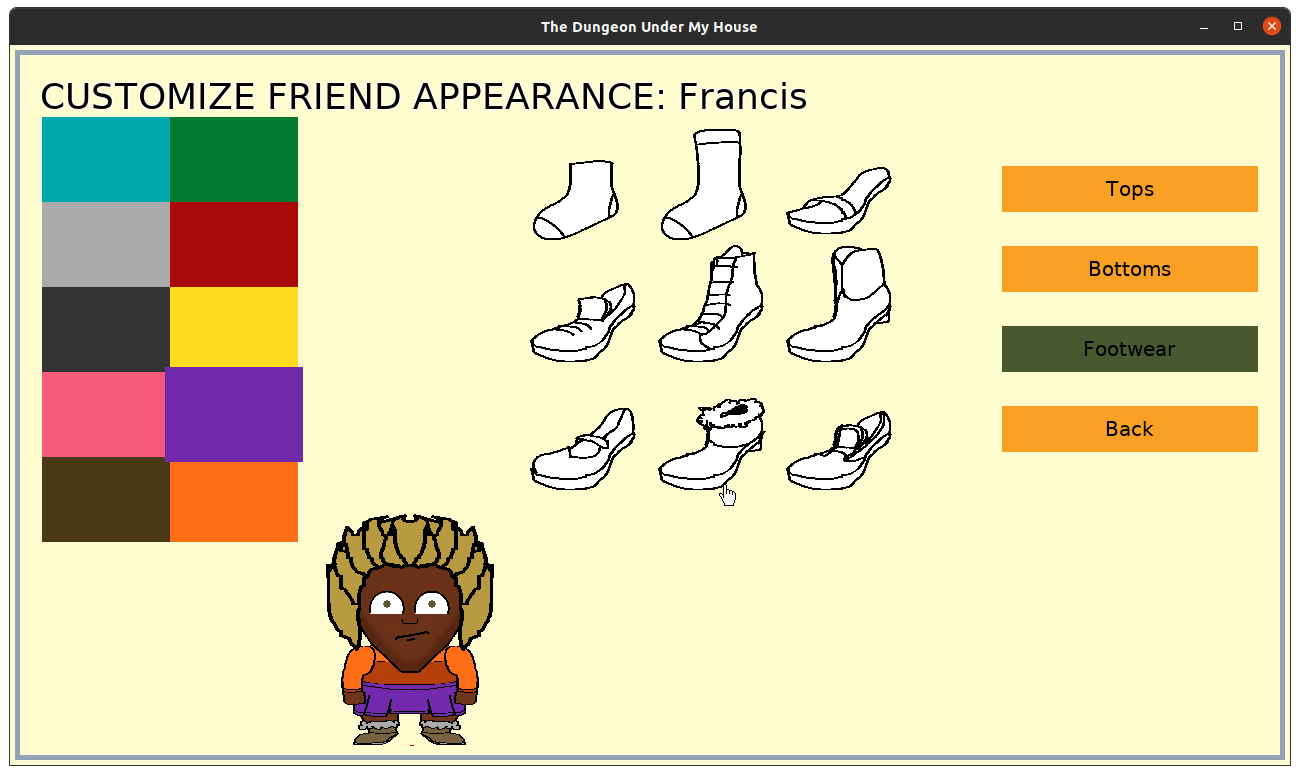
    The Dungeon Under My House - new character customization

    The Dungeon Under My House - character customization

    I justified it to myself. I really, really wanted the player to feel like they could see their friends and family, or maybe a fantasy version of who they wish their friends and family were, in the game. It seemed important at the time.

    And I worked on creating the first person dungeon view, first by trying to create tiles, and then creating a raycasting renderer, and then profiling it and debugging it to see if I can get it to be performant each time I made a change that slowed it down.

    In hindsight, I should have realized that the first-person aspect of the game, as nice a thrown-back as it was to the kinds of old-school RPGs I wanted to remind the player of, was not necessary or fundamental. A top-down overhead view would have been faster and easier to implement. Character customization turned out to be tedious work, which I didn’t anticipate when I started, and perhaps for this project I should have created concrete, unchangeable characters if only because it would have been faster.

    And the main reason I wish I had done those parts of the game so much faster is so I could focus the bulk of my time on the more interesting game play that I was trying to create with conversations and personalities and knowledge acquisition. Instead, after 20 months, the systems in place feel clunky and limited, and I knew I still needed to expect to spend considerable time on experimenting and figuring out this core part of the game.

    It would be one thing if I spent only a little time on non-core things. Spending 20 months on a project might have been more palatable if I had spent a large amount of that time coming up with new game play, but as it is, I feel like I could have used my time better.

  3. Not quitting earlier meant missing opportunities to publish more frequently.

    This one is kind of related to the previous points. If my goal is to release a game in six months, I should hear alarm bells in my head when I hit the six month point and not have a game anywhere near finished.

    In fact, those alarm bells should have been heard long before six months passed, because I should have an idea how much of the game was finished versus how much is left to do and be able to figure out how confident I felt about getting the remainder of the work completed in the time left.

    Instead, as I said before, I could work indefinitely on my project, inspecting and adapting as I go, and given my limited capacity, I wasn’t investing time to inspect the health of the project as a whole. I did not treat the six month deadline as a real deadline so much as a soft suggestion, which didn’t help give me a sense of urgency or a reason to worry.

    Toy Factory Fixer’s initial release was in 2021. I didn’t start TDUMH until 2022 with an expectation that I would release it in 2023. Even if I had succeeded, that is already a long time between game releases, at least for my business goals. Taking longer than six months means even more delays for accomplishing those goals.

    Maybe if I would have put the project on hold or canceled it in 2023, I could have used the time since then to figure out a smaller scoped game. Maybe by now I would have released at least one, perhaps two or even three more games.

    Better late than never, but I should be more protective of my time. I am getting too old too fast, so it isn’t just my business goals I’m worried about.

  4. Waiting so long to use freely available UI elements made my game look amateurish

    When I started working on the project, I slapped art together to get something on the screen as quickly as possible.

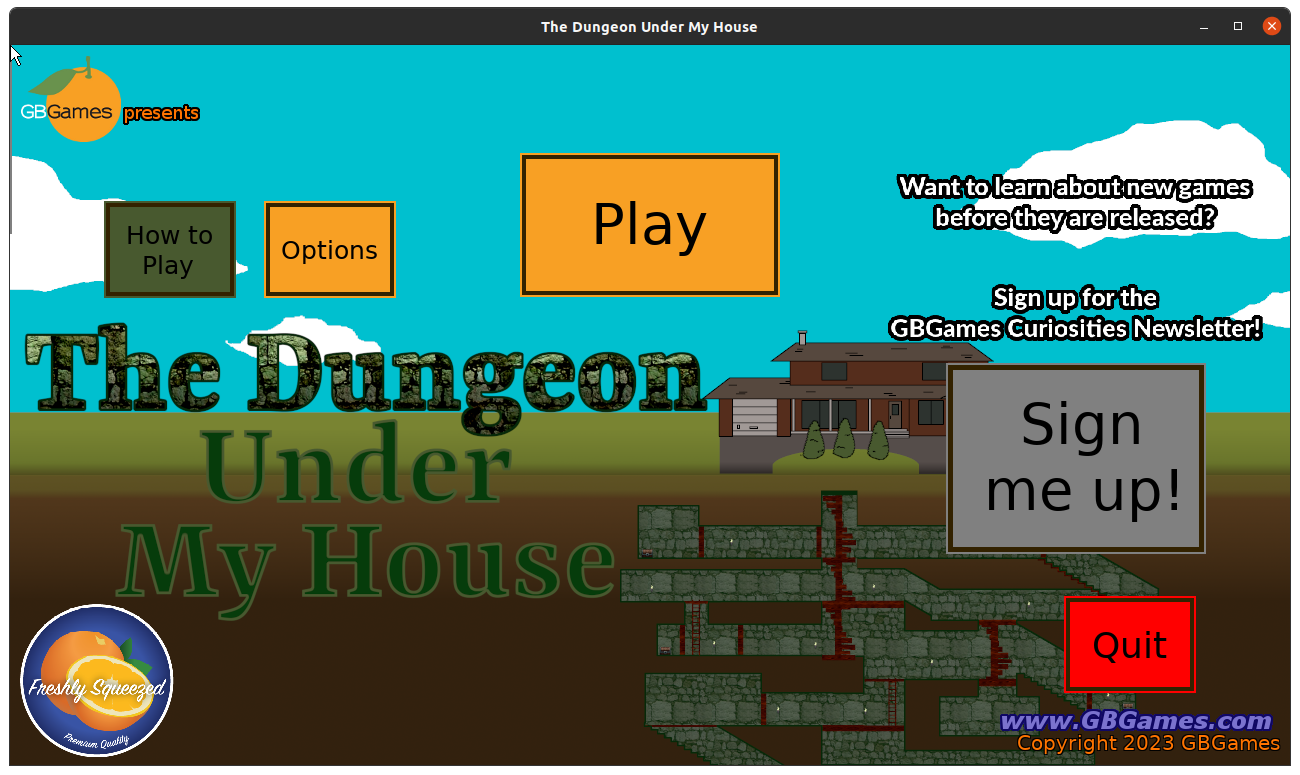
    The main menu’s buttons, for instance, looked like this:

    Freshly Squeezed Entertainment game #2's title screen mock-up

    Just colored rectangles. They are functional and easy to create.

    I also tried to add a little bit of detail to them to make them better, but it was still very basic:

    The Dungeon Under My House - old title screen with placeholder buttons

    Between taking screenshots and making videos, I had a lot of footage of the game with these placeholder UI elements.

    Which is unfortunate, because the entire point of publishing footage of the game was to get people interested, and I was basically saying, “Here’s this ugly amateur thing for you to not waste your time with.”

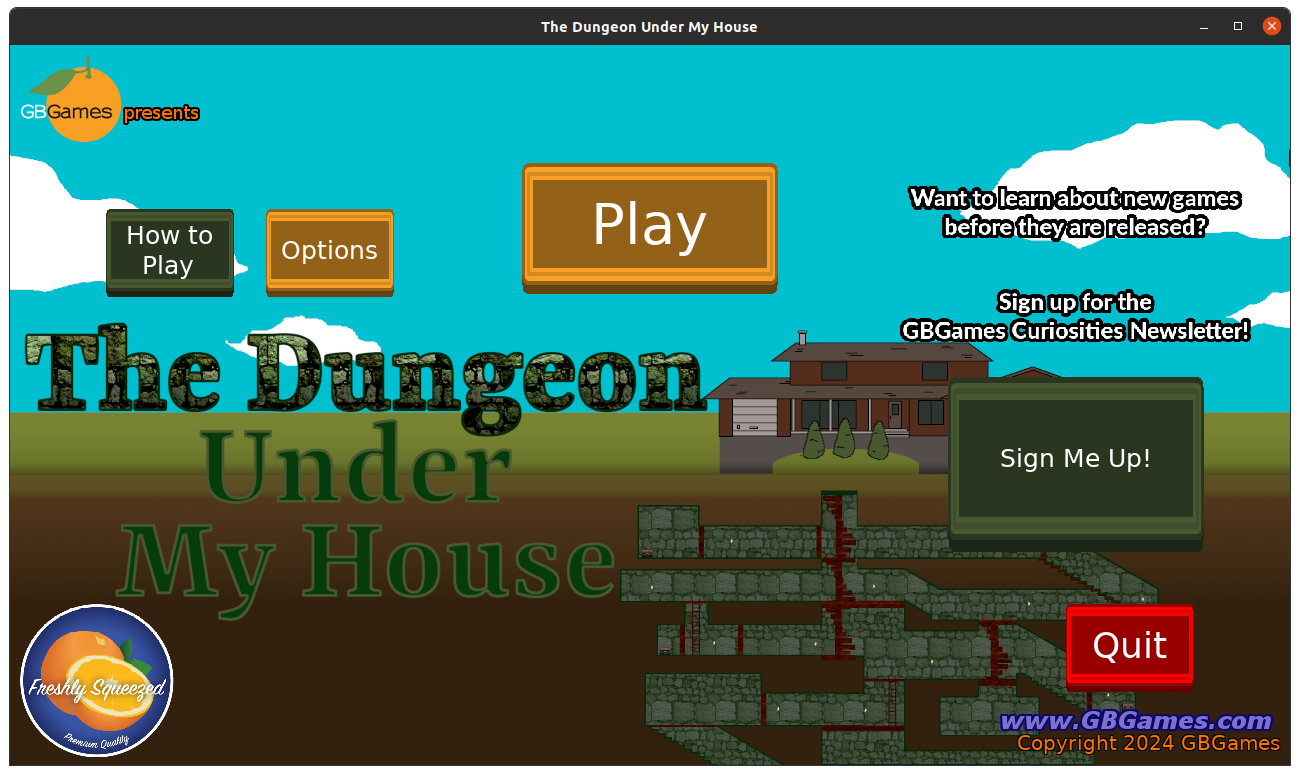
    It was only recently that I decided to use buttons from the free Kenney UI Pack, and after adjusting some font colors and sizes, the buttons on the screen looked way better.

    The Dungeon Under My House - title screen with new buttons

    What’s weird is that I had no problem using existing UI art. I already used icons from Game-icons.net in various places, and I already knew about free assets from Kenney.

    So I’m not sure what took me so long to get around to it other than a sense that other things were more important to work on.

Lessons Learned

  1. I should take advantage of good art assets earlier.

    I should definitely start my next project with great looking icons and buttons, especially if they are going to be displayed on the screen a lot and they’ll be some of the first things seen in screenshots and videos.

    While I still like providing my own art in general, and I don’t think I should fill my game entirely with free sprites and icons, using fantastic, ready-made resources such the Kenney UI Pack makes the game look way better than I could on my own and in a much faster time period. I should really need to justify not using them rather than the other way around.

    And if game UI icons and assets make sense to bring in early, what about sound effects and music? I usually leave those until late in the project, and perhaps it makes sense to have placeholder audio at least.

  2. If I want to release more frequently, then I need to make a schedule.

    Open ended projects are a luxury I can’t afford.

    As I said above, it isn’t as if I couldn’t keep working on my project the way I have been. I know each week I make a little progress, I can inspect and adapt as I go, and one day I’ll work on the last bit of progress and call it done.

    But my business strategy ostensibly requires me to release my games much, much more quickly. Until I can increase my capacity to work on my projects, my projects will need to be scoped much, much smaller so that I can get them done in a reasonable time.

    I still expect that I’ll need to inspect and adapt, that I can’t possibly anticipate everything, but I’ll have a better idea of what needs to go into a project plan for a small game than a big one.

    So simultaneously knowing as much about a project as I can will help me create a realistic schedule, and a schedule with deadlines should help me limit how much a project can be.

  3. With my limited capacity, I need to ruthlessly prioritize the work.

    I like to be purposeful, which means that each project I work on isn’t just a random collection of cool-sounding features. When I create a game, I like to identify some core part of it that is the reason it needs to exist now instead of some other project.

    For TDUMH, I wanted to make a non-violent dungeon crawler, and what I should have done was figure out exactly what I needed to focus on to make it work. I already mentioned above that not having combat in the game isn’t enough, as I needed some compelling game play to replace it.

    If I were to start again today, I think I would realize that I need to prioritize prototypes related to conversation and knowledge-acquisition mechanics as early as I could. Maybe I could have decided then that a party-based RPG would be too big of a project, but what if I applied the same focus on conversation and knowledge-acquisition to a game that consisted of nothing but a small room and two or three people, and maybe a few objects?

    I might have been able to put together a game in a much shorter period of time, and I could always use it as a building block for my next project.

    Since I instead worked on things that shouldn’t have been prioritized, I still need to figure out compelling game play because right now I just have customizable characters and a dungeon to traverse but not a whole lot else.

    Even if I had more capacity, I still would want to prioritize my time much better, if only to make sure that I am releasing games sooner than later.

    For the early stages of my next project, I should spend time trying to identify the dependencies between different features and systems. I did a light list for TDUMH, in fact, but it wasn’t something I paid much attention to, and well, here I am wishing I had done more.

  4. I should continue to seek out opportunities to promote my work.

    People have asked me why I still try to sell Toytles: Leaf Raking after all these years. Why don’t I just drop it and forget it and move on?

    And my main objection to that reasoning is that it isn’t as if lots of people saw the game and thought, “Nah.”

    So I try to promote it and sell it because people by and large haven’t had a chance to reject it yet.

    Like most indies, obscurity is my main obstacle to success.

    For TDUMH, I found that sharing screenshots, posting weekly progress reports, and publishing videos means I am giving more potential fans a chance to find out that my games exist.

    Some of those people become fans who start to ask about details, but I don’t know where the next fan will come from. Maybe they’ll find my blog post because someone shared it. Maybe they will be perusing YouTube and the algorithms will manage to place my video in their feed at the right time. Maybe they’ll see one of my screenshots posted on social media.

    Most of my time is spent on game development, but it doesn’t take much time at all to capture in-development screenshots that I can then easily use in blog posts, videos, and posts on social media. There’s no excuse to not tell people what I am working on more frequently and in more ways.

    Plus, making games with an audience is a bit more motivating than listening to crickets.

  5. It’s easy for me to keep my nose to the grindstone.

    Each week, I plan the work for the next sprint, and then each day I succeed more often than not to make steady progress.

    On average last year I worked about 7.5 hours per week, and this year I’ve been trying to hit 7 hours per week as well.

    As much as I would love to make more time for development, given my life priorities and obligations, this pace is doable for me. I rarely find myself exhausted or burnt out by it.

    Maybe that sounds silly, but the hours add up, and each hour I work on my game is an hour I’m not spending time with my family. Until I quit my day job and free up a significant source of hours, this pace is my reality.

    That said, I have shown that if I set myself in a direction, I can continue plodding along until I’m finished. I stick with things, and I can keep focused on the same task. These are good things!

    The challenge is to make sure I check in on myself to ensure that direction is still a good one and course-correct as needed.

    I’m used to focusing on the current sprint’s tasks, then planning the next sprint. I’ll need to start looking at any given sprint as part of a whole, asking myself how far along do I think I am and how much more is there to do. And I’ll need to be honest. If I already have X tasks to do in Y weeks, and I discover an X+1th task, it very likely means I’m working for more than Y weeks if I think it needs to be done. Which means I’ll need to be sure that it is something that “needs” to be done and not just a really appealing nice-to-have.

    These frequent project health check-ins should help me lift my nose up from the grindstone periodically, mainly to make sure I’m using the right grindstone.

Conclusion

As excited as I was about The Dungeon Under My House, it ended up being too big of a project for me at this time.

I’m not new to game development. I’ve been creating games for many years. Still, this project reminded me of my limits, and if I am honest, it humbled me a bit.

I do believe that if I kept going the way I had been going, the game would eventually be finished, but it would take me way too long to get there. At least, too long for my overall business goals.

The opportunity cost is too great when I could be releasing smaller games and building an audience during that same time. So as painful as it might be to have to part ways with this project for now (and potentially forever? I hope not), it’s not a hard decision to make.

After 20 months of development, even though I won’t be shipping this project, I am glad I can take stock and glean some insights from it.

I know this analysis will help me greatly with my next project. If I could sum up the lessons, it would be that it isn’t enough to keep moving forward because I also need to ensure the destination isn’t too far away.

I hope this post-mortem helps you, too. Let me know if it did!

Stay curious!

Want to learn when I release updates to Toytles: Leaf Raking, Toy Factory Fixer, or about future Freshly Squeezed games I am creating? Sign up for the GBGames Curiosities newsletter, and get full color PDFs of the Toytles: Leaf Raking and Toy Factory Fixer Player’s Guides for free!

Categories
Game Design Game Development Games Geek / Technical Personal Development Post-mortem

Toy Factory Fixer Post-mortem: Game Development in an Hour a Day!

In 2020, despite having a day job and having limited time to work on game development, I set out to make a game in a month.

A year later, my first Freshly Squeezed Entertainment project, Toy Factory Fixer, got published.

How did I do it? Slowly but surely in an hour a day! Watch this video to learn more about it.

Also, here’s a link to the blog post of the Toy Factory Fixer post-mortem with more details about the game project itself: Freshly Squeezed Post-mortem #1: Toy Factory Fixer https://www.gbgames.com/2022/01/11/freshly-squeezed-post-mortem-1-toy-factory-fixer/

Want to learn about future Freshly Squeezed games I am creating? Sign up for the GBGames Curiosities newsletter, and download the full color Player’s Guides to Toy Factory Fixer and other games for free!

Categories
Games Personal Development

Books I’ve Read: The Beauty of Games

I don’t remember how I came across this book’s existence, but I put in a request for it at my local library at some point, and then one day I got notification that my book was ready to be picked up.

And it was a delight to read!

The Beauty of Games by Frank Lantz

The Beauty of Games by Frank Lantz, part of the Playful Thinking series from MIT, starts out by ignoring the “Are games art?” question, but then the argument being put forth is still a large undertaking: a grand unified theory of what games are and how they are important.

Lantz argues that games are an aesthetic form, on par with other aesthetic forms such as music, film, and literature. He argues that while “art” implies certain claims, “aesthetic” merely describes. “The aesthetic is a domain, not of a certain kind of objects but of a certain type of activity, an ongoing process of dialogue and discussion, a series of conversations in which we ask ourselves and each other – what is interesting? What is beautiful? What is meaningful? What is important?”

By talking about games as an aesthetic, Lantz avoids needing to worry about needing to define which kinds of games might be considered art, where the borders are. He makes the claim that all games, not just modern computer games or a subset of them, including chess and tennis, belong in the domain of aesthetics.

I’m no academic, and so I wasn’t familiar with any similar arguments about painting, sculpture, dance, music, literature, film, etc. So perhaps The Beauty of Games was a nice intro to the concept of aesthetics, the idea that an aesthetic experience is for its own sake. Lantz compares the work of looking, the need we have to identify threats in the world, recognize familiar people and locations, and notice changes, to the activity of looking at a painting. We don’t need to look at a painting. We don’t look at paintings in service of some other goal. We do it because the purpose of looking at a painting is looking at a painting.

I loved this concept: that an activity, such as looking or listening, that often has a real-world, beneficial purpose, gets applied for its own sake in certain contexts. We do these activities to better understand these activities.

Looking at artworks. Hearing music. Moving our bodies in the form of a dance.

And playing games, which Lantz argues is about thinking and doing for their own sake.

The turn of phrase that I particularly loved was the idea that “games are thought made visible to itself.” Most of our life, we spend it by thinking in order to accomplish something. We think to earn money, we plan our groceries so we can eat during the week, we win arguments, we budget, we schedule our time. But with games, our thinking and our awareness of our thinking is done for its own sake, and it can be entertaining, and it can also be insightful.

I liked that Lantz focused on not just what games could aspire to but also what they currently are. He compared games such as Go and poker, QWOP and Wipeout, and pointed out that these games already help us see the world differently, help us navigate our own minds with new appreciation for how we do it.

It never occurred to me that the probabilistic thinking of poker was so tied to game theory and to contributing to how someone might understand something like quantum mechanics better, but also to understanding how to model the day to day world we navigate.

At one point, Lantz talked about what impact games could have, specifically in terms of systems literacy. Games are very closely related to systems and to software, and so they can help us understand complex systems that exist in our real world.

Systems are dynamic, and they sometimes have side-effects, which are sometimes unintended. Our criminal justice systems, or our political systems, or our economic systems, all need nuanced understanding.

Playing games is about understanding complex systems. Knowing how to balance all of the mechanics in a farming sim doesn’t mean you know how to work on a real farm, but it might help you to understand a little better how the economy works.

Sounds good, but then he points out that if it is true, and if all games have this capacity, then we should already see these kinds of benefits in the world. Instead, he highlights how “in its most prominent forms, gamer culture often seems to demonstrate exactly the opposite – a way of engaging with the world that is stridently anti-intellectual, stubbornly literal-minded, completely inflexible, combining extreme naivete with massive over-confidence, and willfully deaf to the subtleties of systems thinking even as it exhibits a highly effective practical mastery of actual, real-world networked systems.”

It’s a sober passage about how, even if games COULD have so much potential to help us navigate the complex systems in our lives, so far we haven’t taken advantage of them in that way.

And of course, games don’t NEED to teach us. They are for their own sake, after all. But it definitely feels like a miss for our society if we have this amazing capacity to help improve society, to improve our creativity around approaching our society’s various and interlocking systems, and instead we acted like games are only meant to be frivolous (see how the mainstream media treated Willis Gibson after his amazing accomplishment of doing what was once thought of as impossible, getting the killscreen in Tetris) and so our society’s systems are also treated simplistically and suboptimally, that “the most advanced forms of systems literacy in games are ones being applied by product managers and marketing engineers to maximize engagement and not the kind we would want players to develop for themselves.”

Lantz points out evidence of gamer intelligence, ways that games change how we think, can be positive. Game players learn about randomness and statistics not in a classroom but by actually practicing it when they participate in MMO raids and when choosing how to bet before the river is revealed in Texas Hold ’em. They can understand the concept of state machines when they kite an AI-controlled enemy or need to lay low to avoid the cops for awhile in Grand Theft Auto games. I especially loved the passage about how game theory came about due to John von Neumann’s fascination with poker’s uncertainty in the face of multiple players all trying to anticipate each other’s moves.

Game theory, while it had far reaching impact, also led to the concept of Mutually Assured Destruction, the idea that nuclear powers probably don’t want to launch a nuclear strike first because opposing sides will have enough retaliation capability that everyone suffers unacceptable losses. Lantz points out that the film Dr. Strangelove pokes fun at the idea of game theory, its disconnection from reality and sensibility.

But then he says one of my favorite parts of the book, “But consider for a moment that the opposite might be true. It is possible that, without the cognitive toolset of game theory and its capacity to coldly calculate the unthinkable, humans might have destroyed the planet with nuclear weapons.

Maybe, just maybe, a field of knowledge that came out of a close analysis of Poker saved the world.”

I’m happy that I had access to this book thanks to my local library (did you know you can often request new books, and they will sometimes get them for you?), but I’m sad that the book is due back. I want to add this one to my collection.

Categories
Game Development Marketing/Business Personal Development Politics/Government

Planning 2024: Building on the Successes of 2023

It is time for my annual review of the previous year and preview of the coming year!

How did 2023 go for me?

Well, it was a mixed bag, but I am very excited about my successes.

Last year, I wrote in “Reviewing an Underwhelming 2022, Previewing a Better 2023”:

I normally would right-size my goals based on the previous year’s results, but I think last year was an off-year for me. I think those goals are still doable despite the fact that I didn’t get them done.

So, I’m keeping them as my goals for 2023:

  • Release at least 2 Freshly Squeezed Entertainment games by December 31st
  • Increase my newsletter audience from 25 to at least 37 subscribers by December 31st
  • Earn at least 1 sale per month by December 31st

That’s at least one new subscriber and at least one new sale each month, and I’ll need to focus on shipping as quickly as possible to get two games out.

To hit my goals, I had two priorities: game creation/development and game promotion/awareness building.

Published Freshly Squeezed Entertainment Games (Target: 2) — 0

Despite putting in significantly more game development hours than I have ever tracked before (averaging over 7 hours a week, which still isn’t much in the grand scheme of things), I released 0 new games.

That’s two years in a row in which I did not publish a new game.

Much of my current business strategy depends on releasing games in my Freshly Squeezed Entertainment line, which are polished, playable prototypes that provide complete entertainment experiences and are given away for free. The general idea is that the games are supposed to be quick to develop and have a low barrier to entry so that they are more likely to find an audience. I hope to get feedback from that audience, and if enough interest exists, I can always create a “deluxe” version of the game that I can sell.

So not releasing a game isn’t great, because there cannot be an audience for a game that doesn’t exist.

My current project, The Dungeon Under My House, is perhaps too ambitious for my goals. Or maybe the scope of it is. For example, I spent a significant amount of time developing a way to customize the main characters in the game, and perhaps if I had my producer hat or my product development hat on, I could have decided that such work was a nice-to-have that could go into a potential deluxe version of the game so I could focus on the core of the project.

I am going to continue working on it because I like the concept (a non-violent 1st-person dungeon crawler focused on conversation and relationships) and I want to see it through, but I am really going to need to identify exactly what I want in the game and be strict about recognizing nice-to-haves vs enhancements that help make the game playable.

GBGames Curiosities Newsletter subscribers net increase (Target: 12) — net 5 (+8, -3)

My goal was to increase my GBGames Curiosities Newsletter subscribers to a total of at least 37, up by 12 from the previous year. In last year’s review, I lamented that I only increased the number by 3, which was only half as much as I gained the previous year and a far cry from 12.

My newsletter (have you subscribed and gotten your free player’s guides yet?) is the core of my business strategy. As such, it is very important that I grow my audience of people who are interested enough to hear from me that they give me permission to reach out to them.

I started the year with only 25 subscribers, and I ended the year at 30.

I gained 8 subscribers, which is more than I have gained in any one year since I rebooted the newsletter in 2020, so that’s good.

But for the first time since then, I had 3 people either unsubscribe or otherwise get removed from my newsletter.

So, this goal’s metrics had a positive trend, but I didn’t hit my goal and while I expect that over time people might unsubscribe or drop from my newsletter subscribers, I hope it doesn’t become a trend itself.

Sales (Target: 12) — 13

Ok, I am seriously excited about this one!

In the past, I’ve set sales goals such as “$10,000 in sales” or “$10/month in sales” or “1 sale per week” but I’ve always fallen short. They never really motivated me to take the drastic action needed to make them happen.

In 2022, I set a goal to sell at least one game per month, which I considered both a doable yet challenging goal. I figured that if I could hit this goal, I could build upon it, and maybe I should try to hit this seemingly small goal before worrying about making enough in sales to get anywhere near full-time indie status.

But 2022 was kind of a bust, and I had only 4 sales, which I guess was good despite my lack of promotion efforts.

In 2023, I took advantage of itch.io’s various sales and Creator Days throughout the year. Things seemed promising early on when I sold 4 copies of Toytles: Leaf Raking in March through itch.io’s Creator Day sale. I had done a little promotion on social media, and it seemed to be working out well! Add to those sales the two mobile sales I got, and the first quarter of the year was telling me that I was going to make my sales target early!

And then months went by with no sales, until itch.io had a Summer Sale followed by a Creator Day sale in August. I sold one copy of my game in each sale, plus someone donated money to get my free game Toy Factory Fixer. Mathematically, I was still on track for 1 sale per month, but it was disappointing that sales had slowed down.

My biggest disappointment was the combination of the Halloween Sale and the Black Friday Creator Day sale. Despite the time and effort I put into promoting my games then, including the creation of videos, I sold no copies of my game at all.

Luckily, for some reason, I sold three copies of Toytles: Leaf Raking for mobile between November and December, bringing my total to 13 sales for the year.

So on the bright side, I not only hit my target but exceeded it!

But I wish I knew why suddenly people decided to buy my game at the end of the year. Half of my sales came from itch.io, and as that’s where my promotion efforts were aimed at, it is clear that those sales came from my efforts.

But I don’t have any way to determine how customers found the game on the other app stores, and I would much rather have a good idea for how to reproduce these results.

Analysis

I had more sales in 2023 than I had in any of the previous 11 years. In 2011 I had sold 23 copies of my first commercial game Stop That Hero! totaling $91.25 in take-home money, which includes pre-orders as well as actual sales, but ever since, I’ve had very inconsistent and much lower sales numbers.

In 2023 I earned earned $103.91 from my 13 sales. That’s what I get after the various stores take their cut (which is why Creator Day sales are so nice, as itch.io allows me to keep all proceeds from sales on those days). That’s more than I’ve earned in the past six years combined and more than I have ever earned in sales from a single year.

So, relatively speaking, 2023 was a great sales year for GBGames! I mean, I know this is barely pizza money, and I’m not quitting my day job yet, but I set a new baseline for myself and my business!

How did I do so much better than previous years? I spent more time on promotion than before.

I think a big part of my early success was taking advantage of my Facebook page for GBGames. While I always shared my blog posts on that page, I otherwise didn’t do much with it.

At the beginning of the year, I decided to post daily on it. Monday through Friday, I would make sure I had at least one post on my Facebook page. While I still had my blog post link on Mondays, I also started sharing images of my past games, with links to their pages. I also would ask people to sign up for my newsletter weekly.

I didn’t expect miracles, but I thought things would grow, if slowly. I quickly got frustrated with Facebook’s algorithms because I was in a catch-22 of Facebook not showing my posts to people because people weren’t seeing my posts.

They’ll gladly take my money to help promote it, though, or at least the promise of doing so. I paid to promote my Black Friday sale event and got way, way fewer than the estimated number of people reached, so that wasn’t great, but on top of it Facebook said that they’ll show it to more people for real this time if I spend more.

Anyway, I suspect the reason why my sales figures dropped after the initial few months was because I tapped out my friends and family, the only people who Facebook was showing my posts to.

I also have Twitter and LinkedIn accounts, but my company’s Facebook page seemed the most likely social media account I had that could target actual potential customers rather than other game developers.

Recently I had asked a colleague of mine, someone who has had great success with his game sales going back almost 30 years, how he does promotion these days. He used to do a lot of search engine optimization, but in his response he said that “Search engines don’t seem to be the main driver of traffic anymore. Everyone is on social media” and so that is a bit disappointing.

Partly because the dynamics of social media mean that instead of having something out on the web that others can find on their own time, as Cory Doctorow said in The (open) web is good, actually, “The social media bias towards a river of content that can’t be easily reversed is one in which the only ideas that get to spread are those the algorithm boosts.”

Basically, the more I rely on social media to promote my game, the more effort and/or money I need to expend for at best a temporary boost in potential traffic.

If I think of my options for promotion as part of my megaphone, I have my website, blog, newsletter, and various social media accounts, including a YouTube channel that I started using earnestly at the end of the year. None of these have a large number of followers or subscribers. My megaphone is tiny.

Which means that even when I do expend a lot of effort, my megaphone only reaches a small number of people.

As I mentioned in my 2023 Black Friday Creator Day post mortem, even though I had put in more effort than ever before, and even though the metrics showed that the result was more views of my games than ever before, it still amounted to a total of only 50 views. And none of those views turned into a sale.

I go into more in that post mortem, but my overall promotion strategy has been to leverage my own megaphone as much as possible, and to supplement things, sometimes pay small amounts to unreliably leverage the much larger megaphone of a company such as Facebook or Google.

Clearly, this strategy has its limits, or at least my available megaphone has its limits at the moment.

Some numbers

I did a total of 397 hours of game development for the year, a new record for me since I started tracking my hours in 2013 (I was a full-time indie who didn’t track my game development time between 2010 and 2012). My previous record was 299 hours in 2021.

For someone working full-time, that amounts to less than 2.5 months, assuming a 40-hour work week. So it is not a lot of time, but it’s an improvement over not even doing 2 months of full-time game development in a year. You can see why I refer to myself as a very, very part-time indie game developer.

I wrote for a total of 75 hours, which resulted in 76 blog posts published and 18 newsletter emails sent.

My weekly development blog post got paired with a second blog post sharing my new video companion devlog. I published 13 Freshly Squeezed Progress Report videos in the final three months of the year.

I try to send out a monthly newsletter, but in my last few sales I sent out multiple newsletters for the beginning, duration, and end of a sale, which accounts for the relatively large number.

As for my budget, I mentioned my earnings from sales earlier. I also earned some money from a short contract job. While I haven’t been paid for all of my sales yet, I can say that I’ve taken home over $570. Again, not quite pizza money.

I spent slightly more than the previous year, but I still kept my expenses down by resisting games, books, and other purchases. My major expense categories were web hosting (a three year plan), educational subscriptions (Pluralsight and a book club membership), and the Apple App Developer Program annual fee, something that auto-renewed on me when I was still contemplating whether or not to drop it since I wasn’t earning enough to justify the expense. All told, I spent over $2,000.

Eventually I would like to report that I’ve made more than I’ve spent, but this isn’t the year.

I pulled back on some personal goals. I used to try to do a doodle a day and do 15 minutes of focused learning a day, mainly to take advantage of my Pluralsight subscription. But I found it was stressful trying to fit everything in, so I ended up dropping a lot of them. I fantasize about getting back to full-time indie status and being able to spend more of my time on these kinds of things.

In 2022 I had hurt myself badly enough to stop doing my regular exercises. After some physical therapy, I was back to exercising regularly in the morning, but partway through 2023 I had to stop again due to leg and back pain.

Around July, I started regularly doing push-ups again, but I ended the year weighing the most I’ve ever weighed.

I read a total of 64 books. Well, some were audiobooks, and 11 were trade paperback comic books. My favorites for the year were:

  • How to Write One Song by Jeff Tweed
  • Perennial Seller by Ryan Holiday
  • This Is How They Tell Me the World Ends by Nicole Perlroth
  • A Memory Called Empire by Arkady Martine
  • We Were Dreamers by Simu Liu
  • The Long Way to a Small, Angry Planet by Becky Chambers
  • The Lies of the Ajungo by Moses Ose Utomi
  • Good Arguments by Bo Seo
  • Sandy Hook by Elizabeth Williamson
  • Magical Mathematics by Persi Diaconis and Ron Graham
  • The Name of the Rose and The Role of the Reader by Umberto Eco
  • The Making of Another Major Motion Picture Masterpiece by Tom Hanks
  • Time Travel by James Gleick
  • Collaborative Worldbuilding for Video Games by Kaitlin Tremblay
  • Y: The Last Man (the entire series)
  • and Sweat the Technique by Rakim
  • I still haven’t figured out a regular game-playing schedule for myself. As I’ve said before, since I give myself so little time to work on game development, if I find myself with time to play a game, more often than not I treat it as time to develop.

    Steam shows I only played 4 games: Homeworld: Remastered, Etrian Odyssey HD, Nowhere Prophet, and Skatebird. I also played a Etrian Odyssey II on my Nintendo DS, plus Signs of the Sojourner, Oxenfree, Battletech, AI War Collection, Pontifex, and Baba Is You.

    The last two I played a lot while I was recovering from COVID.

    Oh, yeah, I tested positive right before my holiday break and was out of commission for a couple of weeks. I caught up on a lot of TV and played some games, but mostly I slept. It was a forced break that prevented me from finishing the year strong.

    Overall, last year I focused on game development and game promotion, and in both cases I can see room for improvement. My game development focus needs to drive towards shipping sooner rather than having a continuously open ended development. My game promotion revealed to me the need for some more baseline analytics data so I know how to make better decisions and can see whether or not my efforts are effective.

    Goals for 2024

    For years I was setting goals that I thought were right-sized and could be a jumping off point for bigger and better goals.

    But I kept failing to hit them.

    So I find myself in a new position when it comes to my sales goals. I hit my target, and now I can improve! Normally, I would take my 1 sale per month goal and double it. Can I sell at least 2 games per month in 2024?

    And since I haven’t increased my subscriber count by 12 in a single year, I would just keep that goal until I manage to accomplish it.

    But as my colleague Tim Beaudet likes to point out, “goals should be things you can control.” And I can’t control sales or subscriber numbers.

    Those are lagging metrics. They are the results that might get influenced by my actions, but I can’t influence them directly.

    And frankly, I think I struggled throughout the year with these as my goals. The only goal I could control was how many games I released, and even though I didn’t accomplish it, I knew that the thing I needed to do was make a game and publish it.

    But whenever I saw my other goals, there was a vague sense of “Ok, so?” A lagging metric is one that I can look at and see what already happened, but it didn’t by itself indicate actions I should take, and I think seeing those goals always put me in a position of needing to figure out what those actions are.

    So while I like to keep those lagging metrics as outcomes that I am aiming for, they can’t be my actual goals.

    So for 2024, I have the following outcomes I am aiming for:

    • Increase my newsletter audience from 30 to at least 42 subscribers by December 31st
    • Earn at least 2 sales per month by December 31st

    As for actionable goals:

    • Release at least 2 Freshly Squeezed Entertainment games by December 31st
    • Perform at least 2 SEO activities per month by December 31st

    Ok, so make and release games is a pretty straightforward goal. I just need to focus on the shipping part.

    But SEO activities? The benefits of search engine optimization would be more traffic to my site, which means more potential customers turning into actual customers and/or subscribing to my newsletter.

    What’s risky is that the major search engines are, well, becoming worse for people. They seemed to be doubling down on AI and making the search experience kind of awful. Google used to let me see results for multiple pages, but now it seems very interested in showing me videos after the first few results, and if I don’t want videos, there doesn’t seem to be a way to avoid it. Plus, lots of websites are now dominating the search listings with poorly generated content, which makes it hard to find good stuff.

    And as my colleague above said, most people are on social media these days, so what’s the point of SEO?

    Well, I can always stand to make my website better, more effective, and easier for people to find what they want. I can do keyword research, ensure my pages are optimized, and keep my site speedy and responsive.

    More importantly, I can control my website, while I can’t control how Facebook or YouTube algorithms impact whether or not people even see my content even when they like or subscribe to do so.

    I plan to continue my weekly devlog and companion videos, my daily social media posts, and more, but I didn’t think they made sense as annual goals. They are already something I’m doing, so “keep it up” seems the default. Plus, maybe I’ll find that some of these activities need to be changed or tweaked as I find out they are more or less effective or a good use of my time.

    2 SEO activities a month might seem low. If I think of my SEO work as experiments, I think one experiment a week would give me plenty of time to see if a particular change made a difference, and if I spend money to get more traffic, I can see the impacts much more quickly.

    But I am trying to keep in mind that I am not working on this full-time yet nor am I made of money, so giving myself a couple of weeks to make each dent seems reasonable, and if I find myself able to do so more quickly and easily, I can always do more.

    As for personal goals, I liked the ones I had for last year: make my physical health a bigger priority, invest time and money into learning, and give myself time to play.

    For all three, I need to be deliberate and make some habits. I already track my exercise and my reading habits, but perhaps 2024 is the year I start tracking which games I play.

    Well, happy new year! I hope 2024 is full of creativity and that you allow yourself to follow your curiosity wherever it leads you!

Categories
Game Development Marketing/Business Personal Development Politics/Government

Reviewing an Underwhelming 2022, Previewing a Better 2023

At the start of the year, I like to look back on the previous year to see how well reality matched up with my plans, and then, trying to incorporate any lessons and insights I’ve gained, I make new plans for the coming year.

In the past, I’ve found myself weeks (or even months?) into the new year before I get around to this work. I was not exactly hitting the ground running, partly because I was still finishing the previous year’s efforts up until the end of the year and didn’t give myself time to reflect before the new year.

But this time around, I took off the month of December from my day job with the intention of journaling, reviewing the past, and figuring out what I want out of the future. December tends to be my least productive month in terms of GBGames, and while there were still plenty of errands and holiday preparations to work on, I did manage to make some time for some serious thinking effort, especially thanks to an early Christmas present from my wife for a week-long solo retreat.

The short version: 2022 kinda sucked. I’m looking forward to making 2023 into what 2022 should have been.

Here’s the long version.

In A Review of My 2021, and Looking at 2022, Already In Progress, I was coming off of the success of finally publishing Toy Factory Fixer, my first one-month Freshly Squeezed Entertainment project, after about 12 months of development.

I had a goal of releasing 6 such games over the course of a year, and so I was recognizing that my capacity as a very, very part-time indie meant that I needed to be a LOT more realistic about what I could actually accomplish.

My overall strategy didn’t change, but the values were significantly smaller. My goals for 2022 were:

  • Release at least 2 Freshly Squeezed Entertainment games by December 31st
  • Increase my newsletter audience from 22 to at least 34 subscribers by December 31st
  • Earn at least 1 sale per month by December 31st

Maybe publishing 2 games was still too ambitious, but I figured at least one game with one in development was still an improvement. And maybe 1 sale per month sounds laughable, but I didn’t come anywhere close to 1 sale per week OR per month in the previous year. And if it is so laughable, it should be easy to get more than one sale a month even if all I do is post a plea on Facebook asking friends and family to buy the game.

I right-sized my goals for what I thought was simultaneously a small step and also a stretch from what I have so far been demonstrating.

So how did I do?

Not great, actually.

Published Freshly Squeezed Entertainment Games (Target: 2) — 0 (or maybe 1)

I’ll explain more below, but other than working on porting my existing games to the desktop and creating Disaster City, my Ludum Dare 50 game, in a weekend, I made no new games.

I don’t really count my Ludum Dare game, though, because it was conceived and developed for the compo and wasn’t really something I was planning to make into my next Freshly Squeezed Entertainment game. I thought about making it a full-fledged project after the compo, but I never got the energy behind it to do so, even though I liked the germ of the idea I had created. I wanted to be more deliberate than “Here’s a game I quickly threw together, so maybe I can make a bigger version of it?”

At the end of the year, I started putting together a design document for my next Freshly Squeezed Entertainment, but it isn’t ready enough yet for me to formally announce its existence yet.

I might be too hard on myself, as I did put in time and effort to create ports, so it wasn’t a complete blank of a year, but it is my most clear-cut failure for a major goal to not get addressed at all.

GBGames Curiosities Newsletter subscribers net increase (Target: 12) — 3

On the bright side, it’s above 0. I should be pleased about that fact at least. And no one unsubscribed, at least.

My newsletter grew by 6 subscribers the previous year, though, so I’m not happy with gaining fewer subscribers, especially since I have Toy Factory Fixer and Toytles: Leaf Raking released on the desktop and so had more exposure with more incentive (you can get a free player’s guide for each game) to join the newsletter.

I don’t know if I should take it as a refutation of my strategy to release free games and grow my audience through them, or if it is still too soon to tell.

Sales (Target: 12) — 3

I sold 7 copies of Toytles: Leaf Raking in 2020, 5 copies in 2021, and only 2 in 2022, with one person giving me an optional couple of bucks for my otherwise free Toy Factory Fixer to make for what I technically call a third sale.

I don’t like this downward trend, either.

On the other hand, due to one of the two sales happening on itch.io which allowed for one customer paying me significantly more than the asking price (thanks, Mike!), I actually made almost $1 more than the year before, and making more money is a trend that I like.

But obviously I can’t rely on such generosity for everything.

Analysis

My major goals are above, but I also had minor goals to port my existing games to the desktop, especially after Ludum Dare 50 and my efforts to port my game for it to get as many potential reviewers as possible.

But before all of that, there were two big tasks.

One was to finish some post-release efforts for Toy Factory Fixer, such as creating and uploading a player’s guide and updating my website for it.

Another was a presentation I meant to give early in the year that never happened. I was scheduled to give a Toy Factory Fixer post-mortem presentation at my local IGDA chapter in February, but that month the meeting never happened, and the chapter hasn’t scheduled another one since.

At the time, I thought it meant I had more time to polish my presentation before it was rescheduled, but I didn’t really track the time I worked on it, so I don’t know how much effort it took.

My vague plan was to finish the presentation, then switch gears to quickly port my games, then switch gears again to creating my next Freshly Squeezed Entertainment game. Basically, my major goals were on hold, and maybe they shouldn’t have been considered my major goals if that were the case?

I worked on my presentation on and off for a few months, finishing it in May, but then never actually presenting it or recording it myself, completely wasting the effort for this supposed priority.

After Ludum Dare in April, I finally put together a backlog of tasks to port my games, only to kick myself for having put off for so long the 5 minutes it took to do it.

What followed was a few months of development effort to do the ports. Frankly, getting the games onto the desktop was easy work, and while I spent weeks creating the Linux port despite the fact that my main development system is Linux-based, it was because I wanted to make it a one-button, reproducible build. The Windows port was fairly straightforward as well and was almost a one-button build that needed a few tweaks. The Mac port was a little troublesome, but I eventually figured out the arcane incantation Xcode required.

In August, I participated in 60 FPS Fest again, and it was insightful watching complete strangers try to play Toy Factory Fixer. A number of people struggled to figure out how to start, which I addressed through some hints and UI changes in an update I made in the following weeks.

And then, after my Toytles: Leaf Raking desktop ports were announced, for some reason, I did nothing.

Well, that’s not quite true. In September I tried an experiment in which I did a daily game design exercise based on the day’s news headlines, and while I enjoyed the experience and think I got a lot out of it, it required too much of my time, way more than I could justify spending on it.

But I didn’t have a product plan. At the very least, I didn’t have a next project ready to go, and apparently my theme for this year was to struggle with overcoming inertia.

I also had some health problems which impacted my ability to sit long enough to work on anything.

So basically, my major goals took a backseat until I could get what at the time looked like quick goals accomplished, which ended up either taking me longer to get around to or taking me longer to finish than I originally anticipated.

But it wasn’t like I vastly underestimated how much work there was to do. I think it came down to not getting myself to do the work consistently.

In 2021, I had habits that got me to slowly but surely publish a game. I did exercise every day. I dedicated regular time to learning, mostly to take advantage of my Pluralsight subscription.

I had set my course, and each day I executed part of a plan that moved me in that direction until I was at my destination.

But this past year? I found myself between plans often. It’s one thing to take a step forward with an existing project. It’s another to figure out what a new project should be.

I think I usually find that I need a major break after a game project is completed, but I felt like I couldn’t get back into the swing of things this past year, and I still can’t quite put my finger on why.

I was fine so long as I was tracking some effort, but for some reason if I wasn’t dedicating time to development or writing or learning, I found it harder to keep on task, or start a task in the first place, even if I knew what that task was. In fact, whenever I don’t know what I should be doing, I take that as a clue that what I should be doing is figuring out what I should be doing. Yet, I couldn’t muster up the effort.

Was it burnout? Was I questioning why I was trying to accomplish things I set out to do so long ago that I forgot why I was doing them? Was it frustration that the rest of society seems to be trying to get back to a pre-pandemic normal that doesn’t and shouldn’t exist anymore? I don’t know.

But as someone who aspires to one day get back to full-time indie status, this past year felt squandered and lost despite the accomplishments I can point to.

What else?

Compared to the previous year, I only put in a third as much game development, a total of 101 game development hours. I only had five months that were productive, and they weren’t full months.

I blogged a lot less, with only 35 published posts compared to last year’s 60. About 9 of the posts were for Ludum Dare 50 weekend, and I don’t think I tracked my writing time then. Since many of my posts are sprint reports, and I was doing less development, it makes sense that I had less to say, but there are other kinds of blog posts that I could have written. I put in about 53 hours for writing that I tracked which is surprisingly only a little less than the time I put in the year before and which doesn’t include when I wrote for the player guides. My newsletter is supposed to be a monthly one, but I only sent out 4 issues last year, mainly because the only things I had to announce were the ports and updates to existing apps.

I had managed to keep my expenses down significantly relative to previous years, mainly by resisting game and book sales (I have plenty already purchased I could play/read instead), but it was still a bit more than I had planned and a large multiple of my income.

My personal goals were:

  • Do a minimum number of walking hours, push-ups, squats, and planking
  • Read a book per week
  • Create at least one doodle per day
  • Do 15 minutes of focused learning a day

I wasn’t able to keep up with my 15 push-ups, 15 squats, and 30 seconds of planks, mainly because I hurt myself bad enough that I had to stop, only doing the exercises for about half of the year.

I continued to do my exercise and stretches more or less as I have always done it, which has kept my back strong and meant that I haven’t needed to see a doctor about it in a couple of years. Unfortunately, at some point I had a severe pain that was quite debilitating, and I couldn’t pinpoint exactly what might have caused it other than helping someone move a mattress or twisting under a bathroom sink trying to fix a leak.

People tell me that part of the fun of getting old is getting hurt for no reason, and I don’t like it.

So unfortunately I spent a chunk of my summer recovering and doing physical therapy. For some time it was not my favorite thing to stand, sit, or lie down. The latter two were especially tough because getting up would send my back into painful spasms, and working in my office for longer than I needed to for the day job was not happening much. The physical therapy helped, and these days I feel a lot more confident and way less self-aware of everyday movement.

Even when I was feeling well enough to exercise, I wasn’t doing cardio, something I keep saying I’ll prioritize but never make happen, but we just got a new treadmill and I’ve started walking on it daily, and when the weather is nicer I might start making a point of going out for a walk instead. I want to eventually build up to running and perhaps look into actually joining a recreational soccer team. I miss playing the game, and I loved helping to coach my daughter’s awesomely inclusive soccer team in the previous year.

I read a total of 28 books last year, none of which were related to game development. Whoops. That’s usually something I try to prioritize. One book was “I Have No Mouth and I Must Scream” by Harlan Ellison, which I read because I was playing the game around May, so does that count?

Only 4 of the books were fiction, including Ellison’s. One book was about advertising, another was about product management, and the rest were either about history, computer science, business, self-improvement, and a few other topics. My favorites for the year include The Profiteers by Sally Denton, You Look Like a Thing and I Love You by Janelle Shane, Between the World and Me by Ta-Nehisi Coates, Work by James Suzman, and Humankind: A Hopeful History by Rutger Bregman.

Compared to the previous year’s 137.75 hours, I only tracked 22.5 hours of dedicated learning. I was trying to keep a daily streak going, which normally is fine since that’s the point of a daily habit, but it was stressing me out to do so. The problem was that I was also aware that I was making enough time for learning but not enough for doing. Why was I stressing myself out to do one but not the other? So I dropped the habit after a few months, intending to pick it back up when I was ready.

In fact, at some point I wondered if it made sense to carry over my daily habits from the year before, especially as I kept finding new ones I wanted to add and wondered what to cut. I don’t have infinite time, and while I find a number of things valuable, I needed to prioritize. It didn’t help when I found myself stressed about trying to keep on top of some of them, such as my daily doodle, daily learning, and daily Duolingo Italian lessons, so I dropped a few of them early in the year.

I found it incredibly helpful trying to stop self-inflicted stress from happening. Much as how in the previous year I didn’t need to stress about an arbitrary game publishing deadline I created for myself, I found myself questioning why I was staying up late to catch up on missed doodles that week or finding myself annoyed that a meeting I was in meant I couldn’t finish a Pluralsight module that day. I instead was trying to live by the philosophy of “do more of what makes you happy” although I did find a lot of relief just removing things from my life rather than adding to it. Pluralsight isn’t cheap, so I have some incentive to actually make use of it, which is what my daily habit was helping me to do, but I need to find a more sustainable way to do it.

Last year I said I wanted to make more time to actually play games, something I usually don’t do because if I have time to play then I have time to do development. I wanted to be more deliberate and regular about playing games, though, because there are obvious benefits of learning from existing games but also because when I do play games I tend to play them obsessively for days or weeks, pushing out other things I need to do. Unfortunately I never did figure out a regular game playing schedule, and so I once again had spikes of play between many long lulls throughout the year.

There was more going on that I won’t recount here, both in terms of challenges at the day job and family health issues and a major death, but suffice it to say that it was a difficult year to feel motivated and inspired.

I think the theme last year was questioning whether or not the path my past self had set me on was still serving me, and in the absence of finding a new path, I stopped traversing it to give myself time and space to eventually figure out where I wanted to go next. Apparently I needed a lot more time and space than I expected.

I also found myself struggling with the fact that I was still a very, very part-time indie, that the day job takes up such a large chunk of my waking hours that I would love to put towards a variety of other activities, so I feel like I have to prioritize what’s left over, and I’m unsatisfied with this situation.

Goals for 2023

My goals for last year were not supposed to be overly challenging. I figured that all I had to do was make a concentrated effort to easily meet them. All I had to do was convince one person to buy a game in any given month. I should similarly be able to get one person interested enough to subscribe to my newsletter each month. If I could do it, I imagined that the next customers wouldn’t be far behind.

Maybe the hardest goal would be publishing two games in a year, but I imagined that it would have come down to project management, prioritization, and limiting scope. So, doable.

I normally would right-size my goals based on the previous year’s results, but I think last year was an off-year for me. I think those goals are still doable despite the fact that I didn’t get them done.

So, I’m keeping them as my goals for 2023:

  • Release at least 2 Freshly Squeezed Entertainment games by December 31st
  • Increase my newsletter audience from 25 to at least 37 subscribers by December 31st
  • Earn at least 1 sale per month by December 31st

That’s at least one new subscriber and at least one new sale each month, and I’ll need to focus on shipping as quickly as possible to get two games out.

My current strategy is that my free games will drive newsletter subscribers who eventually become paying customers, but I of course also have to deal with the fact that my games are quite obscure and off the radar of almost all potential players.

One major focus will be on actual creation and development, things I’ve done before and understand. I have demonstrated that I can design, plan, create, and publish a game, and I just need to put in the hours.

But another major focus will be solving my obscurity problem, to figure out how to get my games in front of more people, something I have long recognized as a problem but have yet to put in a similar amount of effort to solve. While I believe the kind of games I make aren’t meant for the kinds of players found on Steam (and so most typical and accessible indie game marketing literature is irrelevant), I don’t have a solid idea of just who my target players are, and I haven’t defined them for years despite recognizing this need.

I need to actually answer these questions rather than merely ask them like I do each time I think about marketing and sales: Where do they live? How do they spend their time? How specifically do I let them know about my game when they are looking for new games?

But not in a creepy, data-harvesting, privacy-violating kind of way. Just in a “you are clearly looking for the kind of family-friendly, privacy-respecting entertainment that I provide” kind of way.

My goal isn’t to try to make a random hit game. My goal is to grow an audience who cares about what I make. I’ve done a poor job of finding such an audience all these years, and so my work in the coming months is to figure out how.

Outside of my major goals, there are a few other areas of my life I focus on.

I want to make my physical health a bigger priority. For years, I’ve been doing just enough to keep my body flexible and capable. My morning exercise and stretching routine takes mere minutes, and while I do get benefits from it, I’m not satisfied. This past year showed me that just enough isn’t enough, that my body needs to be more capable of handling day to day life as well as the occasional heavy duty chore. I need to move more and challenge myself physically, while also not overdoing it and hurting myself.

I have been fairly happy with investing time and money into learning. Whether it is my daily habit of reading in the morning, paying for books and courses, or going to conferences, I don’t see changing much. For years, my goal has been to read a book per week, but when I stopped listening to audiobooks in my car in favor of listening to podcasts, my total book count dropped. And working from home, I don’t drive as much anyway, but if I take up daily walking or running, I could watch presentations on a TV or listen to audiobooks or podcasts more while also getting the mental benefits that come from cardio. I recently acquired a number of books on game design, plus I have a number of ebooks I never make time for, so I have plenty of content. It’s just a matter of prioritizing quality reading as opposed to allowing myself to jump into social media multiple times a day.

And I want to make sure I give myself time to play. Not just games, although getting back into hosting a monthly board game night or enjoying the occasional computer game in my collection would be good, but I want to give myself permission to not need to be accomplishing or completing or checking-off something. I want to do something for the sake of doing, for exploring, for wondering, and not worrying that I’m supposed to be doing something else to be productive. I want to get some quality work done, but I also want to enjoy the process more.

I hope you have a safe, healthy, curious, and playful 2023! Happy New Year!