Categories
Game Design

Probability for Game Designers

Dice

On Twitter, Chevy Ray complained about the use over simplifying terms in math that end up confusing him, and Sven Bergström provided a link to a useful resource.

Thanks, Sven!

Probability for Game Designers by Cheapass Games founder James Ernest takes you on a quick tour of probability theory to help game designers understand their own designs better.

We tend to use experimental and anecdotal evidence to decide whether random events are working or not. You can only playtest your game a limited number of times, but many of the random possibilities may be extremely rare. A practical analysis of the random events can give you a better understanding of whether your latest dice-rolling catastrophe was a fluke or a serious problem.

He explains odds, expected value, statistically independent events vs statistically dependent events, and more, and he provides examples from games and quick exercises to help drive the points home.

I’m also going to dig into Ernest’s other articles on game design, including the related Volatility in Game Design notes from GenCon 2012.

Categories
Game Design Game Development Personal Development

Anyone Can Create, and They Do: Your Design Choices Matter

I used to have a QBasic game review site, which meant I was part of a small group of sites dedicated to playing and reviewing games made by a small community on the relatively young Internet.

Surprisingly that effort translated into a little bit of paying work when I found out that Game Tunnel was looking for reviewers. I got a little bit of money each time I wrote up what I thought about a specific independent game, plus I usually got the game for free. It wasn’t enough to quit my job and live off of it, but it was enjoyable.

Over all that time, I saw a number of review sites come and go, and every so often one of them would get the idea to do a special write-up on “the worst games of [insert year here]”. Anyone could publish a review site,and sometimes that meant anyone did, and they decided it would be fun to write insults for laughs.

Now, I get it. In many creative industries, there’s always a “best of” list, and there are awards shows dedicated to highlighting the top efforts. So why not a “worst of” list? Why not highlight the terrible? People love to hate on things.

In fact, I didn’t know this, but the Razzies, which highlight the worst in film, have been around since 1981. It’s all in good fun, and it’s actually gotten relatively popular, with a few celebrities coming to accept their Golden Raspberry award in person.

If you search on YouTube, you’ll easily find lists of the worst games.

Worst Games Lists On YouTube

That’s unfortunate ad placement, huh?

People love to hate on E.T. for the Atari 2600, or John Romero’s Daikatana, or any number of games based on movies.

Ok, so people love to hear about failure. The popularity of reality television already tells you this fact.

I personally think this kind of tear-down is the stuff of tabloids. It’s never something you’ll find at the Academy Awards or The Academy of Interactive Arts and Sciences. And this isn’t a complaint about high-brow vs low-brow. I’m not above a good slapstick comedy or the occasional mindless action game.

It’s about ease.

In the modern age of citizen publishing media, with blogs, videos, and social network posts, anyone can write about how much they hated the latest stinker at the box office or a terribly-written-yet-popular novel or a disappointing offering from a major game publisher.

And many do.

But what a terrible way to spend your time! Dwelling on the negative, insulting people you don’t know, and kicking them when they are down? Ick.

It’s also easy. Someone could spend months or years writing and rewriting a novel only to find an online mob ready to hate it upon publication. One cleverly-worded Tweet of criticism, and it can start an avalanche of hate. Because of groupthink, these “Yeah, gee, it’s so awful!” comments can even come from people who have never read the work in the first place (again, see E.T. for the Atari 2600).

It’s one thing to critically analyze what makes something bad. You can comment on the inconsistent plot, or the dated graphics, or question the message. You can say it is derivative and unimaginative and compare it to earlier efforts, such as when my friend Ian Simmons wrote his review of Pacific Rim and compared it to Independence Day. It takes effort and experience to understand why something is bad and to be able to communicate it, and it comes from a desire for improvement. It’s a teacher giving a low grade on a creative writing assignment with the note, “I expected more from you.”

But it’s another thing entirely to slam something without giving much thought to it. At best, it’s a drive-by insult. At it’s worst, it’s bullying. It’s more about the humor of a good put-down than about seeking improvement. It’s the teacher who hates teaching because he despises the students and has to insult them to feel better about his miserable life.

When everyone has the ability to create, you are going to see a lot of terrible creations, and the ease of publishing means some of these creations get front-page status.

That top 10 worst games video on YouTube got over 2 million views. There was a choice made about what to focus on, and the creator of the video decided, “Yeah, let’s go for negativity.”

That’s 2 million people who got the subtle message that criticism is the same as complaining, who think that it’s normal to highlight what’s wrong with something, who shed at least one point of resistance to expressing an insult about someone or their creation because, hey, look at all those other people having fun at his/her expense.

I’ve been focusing on reviewers and critics, but the original purpose of this post was to focus on the act of creation itself, and specifically about game development.

With the wide availability of high-quality tools and resources, anyone can make a game, and many do.

Some people make great games, some people make mediocre games, and a lot of people make clones.

But some people make games with questionable designs. There was a choice about what to include in a game, and the creator decided that gratuitous violence, casual misogyny, and even downright hate was the way to go.

It’s one thing to make a game about shooting everything in sight when everything in sight is out to get you, like in Space Invaders or Doom.

It’s another to make a game in which the only motivation is death and destruction for its own sake. Here you’re just putting together game mechanics with perversity, and not in a good way.

You could simulate complex interpersonal relationships, or you could go the easy route of hypersexualization, stereotypes, and power fantasy.

There are legitimate arguments and positions to take, and there are careless (or careful) non-positions that do in fact take a position.

For instance, making a game about doing nothing but shooting civilians “just for fun” says something about your worldview and the worldview of your game’s fans, at least in what’s considered “fun”.

It’s a choice.

And with the increased availability of tools and publishing platforms, anyone can make these kinds of choices.

And many do. Sometimes without realizing that they are making important choices.

And some of these choices get front-page status, which means a lot of people get the subtle message that these choices are normal.

It’s why I prefer highlighting the best and get uncomfortable when it comes to tearing down the worst.

Because focusing on the worst is easy. Anyone can do it, and anyone can make horrible stuff so there is always fodder, but more importantly, it sends a message that focusing on the worst is a good use of time, that it’s innocent and fun to dogpile on someone after they dared to put themselves out there.

It can be petty and mean, and I like to think the wider community can do better.

And focusing on the best means that the creators of purposefully bad creations don’t get rewarded for being horrible or lazy. It means raising something up and saying to everyone, “See what amazing things can be done?”

It means inspiring people to make the choice to aspire to good work, to expect more from themselves.

Categories
Game Design

Do You Keep Design Notes on Games You Play?

Game Design Notes

It can be argued that being a good game designer requires exposure to a wide variety of games.

By playing, breaking down, and studying games, you learn what already exists, how well it seems to work, and what is available to borrow or steal from.

How people approach this study can vary. Some people are methodical, keeping detailed notes on each and every play session.

Others might bother to record their experiences, preferring to let those things that influence them more organically pop up into their consciousnesses as they work later.

Personally, I’ve occasionally written a blog post about the design of a game, but I think I would benefit from taking time to more deeply analyze games and recording my observations to refer to later so that I don’t forget or gloss over them.

How do you approach the study of existing game designs?

Categories
Game Design Games

What Games Teach Us About Relationships

The stereotype about video games is that they are played by loners, isolated in a basement somewhere.

It’s one person playing on a computer or a console, interacting with a machine instead of people.

And when you think about games such as Donkey Kong, Super Mario Bros, and the like, even if they allow multi-player, it’s usually just serial single-player, with one player waiting for the other player to lose or finish.

If a game is interactively multi-player, there tends to be an adversarial conflict. Pong pits one player’s skill against another, as do most sports games. The goal of many games is to defeat your opponent, whether you are talking Space War or Goldeneye. Your relationship to someone else is enemy vs enemy.

So games tend to lean heavily on the “you vs the world” narrative.

But games can also be cooperative. MMOs tend to have people band together. Star Trek Online has player-vs-player, but missions tend to be something you can take on with friends. Your relationship here is defined as allies, as teammates, or as guildmates.

But outside of MMOs, if there is a cooperative multiplayer, it seems to be notable. New Super Mario Bros Wii can be ridiculously fun and frustrating, but you’re all in it together. Most platformers weren’t simultaneously multiplayer in this way.

Board games and card games are often based on competition, but because they seem to be experiencing a surge in popularity and variety, it’s easy to find examples of cooperative games.

Arkham Horror by Fantasy Flight Games has players competing against the game system. While you might have one winner, everyone stands to lose if you try to go it alone.

Forbidden Island by Gamewright also has the players trying to collect all of the treasure and escape before the island sinks, and moves tend to be discussed before they are taken. “If you do XYZ, that would put us in a good position.”

Some games reinforce the idea that if you put your mind to it, you can accomplish anything. They are about private victories, as Stephen R. Covey would call it in The 7 Habits of Highly Effective People. You can be proactive. You can prioritize. You can keep your eye on the goal. It’s all about your independent thoughts and actions.

And some games reinforce the idea of interdependence, that we’re stronger together than we are apart. They are about public victories. You win together or you lose together.

I love competitive games, and I love a good solo game. Power fantasies can be fun, and there is nothing wrong with them. Saving the world on your own can be great.

That said, I do worry that if there are interpersonal lessons taught in some games, it is that other people are adversaries. If you treat life as a war, you versus the world, it can be very isolating and you’ll have a hard time working your way through reality which invariably involves other people.

In real life, you’d have allies, people who have their own agency and aren’t mere pawns in your game. You can accomplish more and do more in a team, and you’ll need to be able to interact with them as equals.

Some games remind you that you that there are other options than going it alone.

Categories
Game Design Games Geek / Technical

Learning New Old Games

Card Games

Last night, my wife taught me a card game she played with her grandmother earlier that day.

Hand and Foot is a Rummy game similar to Canasta, but it apparently has no standard rules. It was hard for us to look up what is allowed in certain situations. For instance, I was at the end of my Foot, and I had drawn two cards and now had an Ace and two Jokers. If I play them, I have no card left to discard. Am I allowed to do so, or do I have to discard at the end of a turn, meaning I can’t play my hand and must either give up a valuable Joker or an Ace.

It occurred to me that I’ve never played many card games. These days, I play Four Point Pitch and Up and Down the River with my in-laws, games I didn’t know a few years ago until they taught me. When I was younger, I played Solitaire, Kings in the Corner, and Thief with the Italian playing cards my parents always had on hand.

But as a game developer, shouldn’t I be more well played than I am? There are centuries of games out there, but if I limit myself to the popular video games of today, aren’t I also limiting my source for inspiration?

Granted, many are thinking that today is the Golden Age of Board Games. Between Kickstarter and popular cons, people are creating and playing games that aren’t the usual Scrabble and Monopoly. I’m participating in a few board game nights these days, whether it is at the day job or with friends, and I’m learning quite a few games.

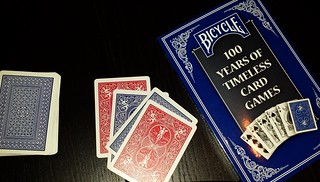
But I’m sure I can stand to learn a wide variety of card games. We even own a copy of the book Bicycle: 100 Years of Timeless Card Games, and I’ve never read it.

I’ve seen similar books on card games that are larger and probably more comprehensive, but 300+ pages of card games with their variations is a good starting point.

When playing Hand and Foot, I noticed a few self-regulating aspects of the game that were pretty clever. For instance, if you want to pick up the discard pile, you had to pick the entire pile up. If it was full, it meant you suddenly had a lot more cards in your hand, which means you can create melds more easily, but the discard pile might include multiple dangerous red 3s, and you can only get rid of each one once per turn. Have a red 3 in your hand reduces your score by hundreds of points. It’s a risk you might be willing to take if you have been struggling to complete melds, though.

Similarly, you might play all the cards in your hand until you have almost nothing left. That’s great, because you are close to getting rid of the cards in your hand, which allows you to pick up your foot (Oh! I get it now!), but it also means you have a harder chance of creating a meld and actually getting rid of those cards.

So just exposing myself to this one new old game got me thinking about game design. What if I spent time learning more such games in earnest? I wrote about consciously consuming information daily, and reading and listening to a variety of information is beneficial. I’ve been thinking about how important it is to also play a variety of games.

The great thing is, I already own a deck of cards. I’ve paid the expensive part. It can be quite the investment to get a new board game or video game, but a trip to the library might be all I need to do to find books on card games I could play with my existing deck.

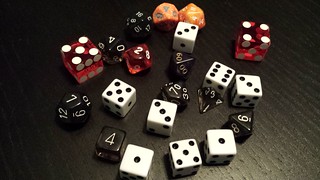
Heck, I also have a bunch of dice, and I’m sure there are plenty of dice games out there, too.

It’s time to make a conscious effort to learn some new games. Got any recommendations?

Categories
Game Design Game Development Geek / Technical Linux Game Development Personal Development

LD#32: A Giant Weapon Development Time Lapse #LDJam

I created a time lapse video of my development of “A Giant Weapon”:

Once again, you can find the game, albeit incomplete, at http://ludumdare.com/compo/ludum-dare-32/?action=preview&uid=251.

Categories
Game Design Game Development Geek / Technical Linux Game Development Personal Development

LD32: Submitted but Disappointed #LDJam

When I started this weekend, I thought, “I’m going to make a complete game that’s enjoyable to play.” I wanted the Button Masher Bros to play my game and enjoy themselves.

Towards the end of the deadline, I was thinking, “I might be able to get the bare minimum of something that could be called a game in.”

And by the end, I didn’t even have that.

I submitted my project, A Giant Weapon, which you can find at http://ludumdare.com/compo/ludum-dare-32/?action=preview&uid=251

LD #32 A Giant Weapon

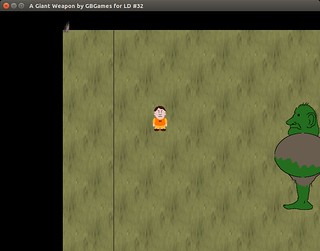
You click to tell your soldier to move, and you try to avoid the monster. There’s a game over screen when you get killed.

You can attract the monster’s attention by clicking on it.

Unfortunately, I didn’t add the reason why you would want to do so: to destroy your enemy’s camp.

Fighting bizarre and non-bizarre bugs slowed me down, but I did not do anywhere near as well as I would have liked.

I wanted to get something controllable by 12 hours in, and it took me almost 25 hours. Then I didn’t have anything resembling playability until the last couple of hours, and then I ran into trying to figure out what AI bugs and graphic offsets issues I had.

I watched my timelapse, and I can see that I didn’t take my own advice about not spending too much time on the art. I think the majority of my efforts involved getting the sprites right.

Oh, and the weird bug that caused bizarre issues with the buffer not updating? I think it turned out to be a glitchy system. Once the computer crashed, and yeah, I needed that to happen near the deadline, everything ran fine for the remainder of the compo. I should have rebooted right away. That problem cost me way too much in time and stress.

I’m pretty disappointed and deflated. It’s been two years since my last Ludum Dare compo, and I feel like I’m not any more capable as a game developer than I was then.

I know I have another 24 hours for a Jam entry, but I planned to dedicate only the past 48 hours to Ludum Dare and I will not be able to do much more.

All that pity aside, I did like my idea, and I think the game in my head would be enjoyable if I could have developed it. A bumbling giant monster that gets easily distracted is chasing the player who is trying to lead it to the enemy camp without getting killed in the process. Part of the game play was to get the giant to move in one direction while looking another, causing it to trip and fall. If it falls on top of a building or other enemy structures and units, they would get destroyed.

The monster and the player would each be able to pick things up and throw them. The player would throw things to attract the attention of the monster, while the monster would be aiming to kill. This feature got cut.

Towards the end, I even created quick art to create a building, including rubble, but it never made it into the game.

Categories
Game Design Game Development Geek / Technical Linux Game Development Personal Development

LD32: I’m 12 Hours Behind Schedule and Have Bugs #LDJam

I wanted to have something playable or at least controllable within 12 hours. I did it within 25.

LD #32 - Controllable Character

You can now click on the ground, and the soldier will move assign itself the goal of moving towards that point.

The monster is still just placeholder art with basic AI.

There are bugs, though.

For some reason, when I run my game, the loading screen gets inconsistent for me. The mouse cursor freezes on the screen on the main menu screen, in both of these cases, I see the screen look like it is locked, or flickering between two images that should not be on the screen. For instance, my loading screen says “Loading resource 8 of 14”, and it bounces back and forth between 8 and 9, which isn’t happening in my code, which makes me think that there is a problem with rendering.

Animation looks weird once I enter into the game, and so I have to restart the program and hope that I don’t see the issue again.

I tried it in another game which has more or less the same code, and it seems to work fine, so at least that rules out an expensive hardware issue.

But the bad news is that I have a ridiculously difficult to diagnose bug in my Ludum Dare project, and there is less than 24 hours left in the compo. There’s also a weird rendering issue in which my terrain is showing gaps behind it as I move about the world. B-(

And I still have a ton of work to do.

Also, I realized that with all of the struggles, I have been forgetting to commit my changes. Here’s the complete commit log:

$ git log
commit 35fabffff77407ce6a66a146ff297df254c5626e
Author: Gianfranco Berardi
Date: Sat Apr 18 20:29:47 2015 -0500

A lot happened; can control player character, have basic AI framework.

commit cc662aa500df16c01dae56ac3a419a64e0448c22
Author: Gianfranco Berardi
Date: Sat Apr 18 10:32:08 2015 -0500

Fixed camera; added grass, monster placeholder, and boulder.

commit 4656623ca6dfc9fc2e68620a7ec5056e171276e1
Author: Gianfranco Berardi
Date: Fri Apr 17 23:27:09 2015 -0500

Initial commit for LD#32.

Early on, I realized that my efforts were all over the place. I wanted to work on adding a playable character, and I ended up making some terrain instead. Nice, but not as important.

So I actually put together a quick design document, inspired by Hybrid Mind’s Ludum Dare 29 timelapse.

Holy cow, it made a huge difference! I was able to dump everything out of my head, realize there were some gaps, recognize that I had a scope issue, and also prioritize whenever I identified a new problem or bug to fix.

It also helps me see my progress. It’s easy to get demotivated when the clock keeps ticking, but seeing all of the completed work reminds me that I’ve made a dent, and it also helps me keep focused because I want to get more of those planned tasks crossed off my list.

Of course, I’m always realizing something that needs to be added, so the list will get larger. I’m not sure if more planning or more doing would have revealed that information to me sooner.

Categories
Game Design Game Development Geek / Technical Linux Game Development Personal Development

LD32: Breakfast and Even More Design #LDJam

Good morning!

I had some oatmeal with peanut butter and raisins, with some cinnamon and nutmeg. I also had a small glass of orange juice and the smoothie my wife made.

LD #32 - Breakfast the First

When I drank the smoothie, I noticed that the side of the glass had this very neat texture:

LD #32 -Potential Texture

I might tweak the color and turn it into the landscape in my game.

I decided that there will be a player character represented in the game. It adds risk, because if the monster catches up to you, you lose.

So, who are you? I originally envisioned some spoiled brat who wanted to get revenge on the people in his town. Maybe that cool neighbor with the better treehouse will think twice the next time he brags about how much better it is than yours.

But then I took a shower, where we often have our best ideas, and I thought of an outnumbered military unit desperately seeking a way to tip the balance in their favor. Finding a monster to do their fighting for them seems like a good alternative to dying and losing the war.

Which also gives the player a reason to worry about the monster getting killed before it can do its damage.

There’s 34 hours left in the compo. I better start planning.

Categories
Game Design Game Development Geek / Technical Linux Game Development Personal Development

LD32: Art for “A Giant Weapon” #LDJam

After I got a working build of my project, which didn’t take too long, I started doodling some monster faces.

LD #32 Giants And Ogres

I love how goofy the faces are. I want the monster’s face to be expressive so that it can give clues to the player about what it is thinking.

But just how giant is this character going to be? It can’t be so huge that you can only see its feet. I suppose it would cut down on asset creation, but I envision a very emotive monster which requires a visible face. I want it to be seen as a huge monster, so being merely a head taller than all of the other characters in the game isn’t enough.

But what if there is no player character? That is, the player can interact with the world without having a representative in the world. Then the monster can fit on the screen, and any characters can be incredibly tiny. After all, their faces aren’t as important as the fact that they are running from a marauding monster coming through town.

Maybe they are very tiny stick figures in comparison.

I’m not completely sold on the idea of having no player character. I like the idea of the player running around, trying to get the monster’s attention while avoiding the chaos and destruction.

LD #32  Moving Monster On Screen

That mock up image of the monster now moves about the screen on its own, although the AI is basically “bounce off the walls” and will need to be replaced.

I realized I was falling asleep as I was coding, so I think I’ll go to bed.