Categories
Games Marketing/Business

Clinical Trials for Games? Brain Games Based on Real Science

I normally listen to audiobooks in my car, but I had just finished one and hadn’t visited the library yet to check out another, so I had the radio on.

I caught the tail end of an NPR story about a game trying to get approved by the FDA, so I told my phone to remind me to look it up later.

Will Doctors Soon Be Prescribing Video Games for Mental Health? by April Dembosky was that story, and it talks about the many games that claim they are good for your brain but don’t have any real science to back it up.

I’m reminded of Nintendo’s Brain Age. In its official title is “Train your brain in minutes a day!”

In 2007, CNN’s Linnie Rawlinson wrote up her experience playing it, asking Can Nintendo’s ‘Brain Training’ really boost your little gray cells?. While she had fun playing it, she didn’t believe the claims. She asked a neuroscientist about it and was told that while it may help, it’s “hard to measure the impact that brain training could have.”

The NPR story refers to a very, very long letter signed by cognitive psychologists and neuroscientists rejecting the claims:

In summary: We object to the claim that brain games offer consumers a scientifically grounded avenue to reduce or reverse cognitive decline when there is no compelling scientific evidence to date that they do. The promise of a magic bullet detracts from the best evidence to date, which is that cognitive health in old age reflects the long-term effects of healthy, engaged lifestyles. In the judgment of the signatories, exaggerated and misleading claims exploit the anxiety of older adults about impending cognitive decline. We encourage continued careful research and validation in this field.

One of those scientists decided it wasn’t enough to admonish game marketers and decided to try to create a brain game that would stand up to scientific rigor.

Neuroracer was the research developed by a team of neuroscientists and was specifically targeted at training cognitive control abilities. While it’s not commercially available, it did demonstrate how a game could actually help with cognitive ability.

Neuroracer was made for scientists as a research tool. Based on this technology, Project:EVO is the clinical product being created by Akili Interactive Labs. It’s been covered in many mainstream media outlets, but hardly at all in game press. I found one reference to Akili at Gamasutra, and it was a blog post by Noah Falstein on general neuroscience in games.

From the Akili Interactive Labs website:

Project: EVO platform is currently being tested in a variety of clinical studies in multiple patient populations around the globe, including ADHD, autism, depression, and traumatic brain injury.

It’s quite an ambitious endeavor. Adam Gazzaley, co-founder of Akili Interactive Labs, claims he has four other games in development if Project:EVO makes it through the gauntlet.

And with what Neuroracer demonstrated, perhaps there will be a growing market of science-based brain games that actually do help who they claim to help.

Categories
Geek / Technical Marketing/Business Personal Development

I’m Going to the No Fluff Just Stuff Conference Today #NFJS

I’m not a Java developer, but I am going to the “The conference series for JVM software developers” called No Fluff Just Stuff today here in Des Moines, Iowa.

Why? My main tool has been C++ for years. I haven’t programmed in Java since college, and that was over a decade ago.

Partly because it’s a local conference. I don’t have to travel or get a hotel.

Partly because my day job is paying for it. When you are offered free training, you take it.

And partly because I didn’t actually know it was a Java-specific conference when I signed up for it. /me looks down at his shoes sheepishly.

The itinerary I put together for the next few days is geared towards the general talks about software architecture, metrics, and other topics that can translate well outside of a specific programming language or platform. I am especially interested in the microservices architecture session, ever since I first heard about it at an Agile Iowa presentation.

There’s even a magician among the speakers, so it should be entertaining.

And who knows? Maybe I’ll pick up some cool ideas from the Java practitioners.

I’m a bit disappointed that the Android tablet I’m bringing doesn’t seem to have as full-featured an app as the iOS version. Somehow at a Java conference the Java-oriented platform doesn’t let you download slides? One of the Play store’s reviews for the NFJS app complained about needing to carry around not only his own Android tablet but also the conference-provided iPad, which was awkward. I wonder if I’ll be doing the same today.

Anyone else going?

Categories
Game Development Games Marketing/Business

You Can Now Start Submitting Your Games to IGF 2016

The Independent Games Festival is now accepting submissions for next year’s awards.

The deadline to get your game submitted is October 26, 2015. Other key dates to pay attention to:

Early January, 2016 Finalists Announced
March 14 – March 18, 2016 Game Developers Conference 2016
March 14 – March 15, 2016 Indie Games Summit @ GDC
March 16 – March 18, 2016 IGF Pavilion @ GDC
March 16, 2016 IGF Awards Ceremony (Winners Announced!)

There are a few changes this year.

Brandon Boyer is stepping down as chairperson of the IGF, and Indie MEGABOOTH’s Kelly Wallick is stepping in.

The cost to entrants has changed in the interest of making the IGF more accessible. Instead of $95, the submission fee is now $75.

Similarly, now that student submissions are eligible for the main prizes as well as for the Best Student Game Prize, their fee is $25 instead of being free.

The other major change is in developer feedback.

Developer feedback has always been an optional part of the judging process and in general, having the game played in detail by multiple judges takes precedence over providing written feedback. While the feedback is well intentioned, without having a clear structure it is often inconsistent or on par with what a normal user playtest would provide.

So we’ll be removing written judge feedback – at least for this year – to concentrate on further optimizing the judging process, getting people playing as many games as possible and formalizing the feedback system.

The judging process had been under question in recent years. With the number of IGF submissions getting almost as popular as a Ludum Dare game jam, it was a lot of work for the judges to cover all of the games in a timely manner. But some developers found that their games weren’t even being played in the first place, and it wasn’t clear if everyone was getting a fair shot, especially after paying a submission fee for the privilege.

A more formal feedback system could only help.

How do you feel about the changes?

Categories
Marketing/Business

Creative Commons Has a Kickstarter Project to Create a Book About Open Business Models

There are always debates about business models. Years ago, everyone was saying that you should focus on Flash. Anyone who suggested Java was perfectly fine to use got pushback. When asked to justify Java for game development, people would say, “Look at how successful Runescape is!” and the Flash proponents would say, “But that’s the exception!”

Minecraft would come later.

Similarly, I recall talking to someone about a business model for making open source games, and I was told that you couldn’t make a living from it. I pointed out games such as Second Life and was told, “But that doesn’t count!”

Counterexamples in these kinds of arguments are always exceptions that don’t count for some reason.

Creative Commons, the nonprofit organization that enables the sharing and use of creativity and knowledge through free legal tools, decided to write a book on open business models to show how exceptional they really are.

We want to show the world the full spectrum of open business models made using Creative Commons. Our goal is to begin to answer what we consider one of the most important questions of the digital age: how do creators make money to sustain what they do when they are letting the world reuse their work?

As of this writing, the Kickstarter campaign has 20 days left and is almost halfway to its funding goal.

For the last couple of decades, people have questioned how you can make a living by giving away what has traditionally been protected by copyright, patent, and trademark law. And some of these people get animatedly threatened by the idea, as if it somehow smells too politically threatening.

While some websites have tried to list open business models in the past, I think an entire book on the topic would fill a void in the debate.

Categories
Game Development Marketing/Business

The Great Gatsby Was a Flop; How’s Your Game?

Yesterday while listening to an audiobook, I learned that F. Scott Fitzgerald died thinking that his greatest work was a failure.

He earned just $2,000 from The Great Gatsby. In today’s money, it represents a bit more, and he was in the top 1% of income earners in his time, but this was his major novel. He put a lot of blood, sweat, and tears into it, but he got paid the same as or less than he did for his short stories. How depressing!

Now, there are different definitions of success, and financial success isn’t everything. But Fitzgerald expected Gatsby to be a huge financial success and was disappointed.

Today, the work is taught in schools, which is how I became familiar with it. I had to write a paper on the novel as part of my high school English class, and I remember someone saying, “Hah, good luck! That’s the teacher’s favorite book.”

So I made sure to do my research well. I even read the book twice before writing my paper early enough to be able to edit it instead of trying to get it all done on the last day. I got an A, and I found I quite enjoyed the book as well.

Incidentally, I learned that The Great Gatsby is still not in the public domain, despite the author having been dead for three-quarters of a century.

The audiobook mentioned a number of Fitzgerald’s peers who are widely recognized today as geniuses as well, but when they actively published, they experienced modest financial success. The very financially successful literature was apparently kind of terrible and written by authors who are all but forgotten, but people couldn’t get enough of them.

So what’s the lesson here as an indie game developer?

No one has it easy. Fitzgerald was a popular figure, and his greatest work still couldn’t find traction with the public in his lifetime, despite the praise he got from fellow writers.

Most people look to the great successes for inspiration. What was Howard Schultz’s secret to success for Starbucks? How did Mark Zuckerberg make Facebook the juggernaut it is? See what Notch did with Minecraft?

They are all human. They all failed somewhere. Some found great financial success, while others didn’t.

We don’t often hear about the failures of successful people. We forget about the struggle and look for the glamorous.

Then we look at our own results and worry we don’t measure up. We think we’ll never be great ourselves, because we don’t recognize that our failures are exactly the same kinds of failures that the successful people had.

When you publish a game, it’s entirely possible that no one will find out about it. You pour your heart and soul into a game for months or years, and it could flop. Meanwhile, you see other games take over the world and hear that the developers made them in a few weeks in their spare time.

You see huge and successful indie games, games that get all the press and sales, and you compare your efforts to what you perceive as someone’s effortless genius. It can be heartbreaking and frustrating.

Some of us stop bothering to try.

But failure is part of the process of succeeding.

Ideally, you get to success while you can still enjoy it. You just need to make the attempt and get past the failure first.

Categories
Game Development Marketing/Business Personal Development

We’re Over Halfway Through 2015. How’s Your Scoreboard?

Did you notice that the year is half over?

That we’re in the 3rd quarter of the year, and also that the first week of it is already over?

Most people have long forgotten their New Year’s resolutions. Others have solid goals they’ve kept in front of them on a daily basis.

For some, the passage of time is terrifying. It’s a reminder of how much older we’re getting. Some people wait until the last minute to work on something important, cramming it all in at the end, and I’m sure it’s true on a larger scale as well.

For others, the passage of time is merely a constraint. They knew there would be a point in time when 2015 would be halfway over. The question was what they might accomplish by then. What would they learn? How healthy will they be? What kind of individuals will they be?

I’ve struggled with keeping an awareness of my goals in the past. I would set goals, and I would even be specific about them. I wanted to lose 20 lbs, or I wanted to earn a set amount of income from my business in a year.

And then it would be the end of the year, and I would find myself thinking about setting goals, which reminds me that I’ve already set goals.

I just forgot about them.

One problem is I didn’t make plans to accomplish those goals. A goal without an plan? It’s like saying “I’d like a million dollars” and never caring one way or another if I get it.

Even if I did make plans, they would be vague and easy to forget. No matter how detailed or lightweight a business plan is, it does you no good if you keep it in a drawer and never look at it.

Another problem is that the goals weren’t very inspiring on their own. They lacked context. Losing weight is OK, but it sounds like loss and pain. Being healthy and fit sounds exciting and inspiring. What could I do if I was fit enough to play a soccer game like I did when I was in high school? Or even better, if I could keep up with my nieces when we played together?

Making money from my business is OK, but I had no reason to expect the money. Why would people pay me? How can I even expect the rate of sales that it would require? Setting goals about the value I provide to players, on the other hand, is something that I can control. It keeps me customer-focused.

But I found that making the goal a daily part of my life was key to keeping my awareness up.

I have goals for my business. I have a few metrics I care about, and I used to have the same problem of forgetting about the goals I had set.

For instance, my higher level goals involve the number of games published and the number of new customers I find.

It doesn’t matter what number I set if I then go about my day to day ignoring them. Then if I do remember to check my status one day, I’ll find that nothing has changed.

So I made a rudimentary scoreboard out of a corkboard and some index cards.
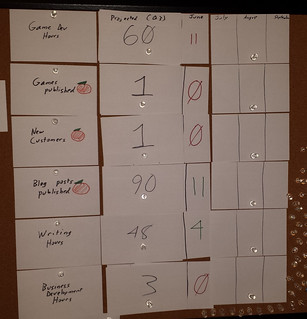
My Scoreboard

It’s on the wall across from my desk so I can look up and always see what my goals are and how I’m doing. I have a spreadsheet on my computer with similar data, but it requires me to open it and specifically look at it. This scoreboard, however, is easy to see at all times, which keeps my mind focused.

I have a day job, so finding time to work on my business is an important consideration, which is why I have a goal for the number of hours I spend doing game development, and I have another goal for time spent doing business development. If I don’t pay attention to my time, it’s easy for me to let opportunities to work on my business slip.

But just spending time on game development isn’t an end in itself. It’s meant to lead to the bigger goals, which are marked with a crude drawing of my logo.

I want to publish a game this year, and I want to gain at least one new customer from it. Why only one customer instead of a thousand? Because that first customer will be a major accomplishment, and I will move the goal posts once I do accomplish it.

I see my blog as a key part of my marketing, and so I have content goals for it, too. In the last two quarters I ignored my blog so I could focus on game development. I figured a post a month would be decent.

But for the next quarter, I want daily posts. My reason for the massive increase, which requires me to take precious time from game development?

It’s another way to keep my goals in front of me. I’ll write about my business, about my vision, mission, and purpose, on a daily basis, which means I’m consciously putting these things in front of me.

I used to do so by making a short post on my Google+ profile, but I thought, “Why am I giving my words to Google? Why not own the content myself?”

I don’t want half of the year to pass without me realizing it and without any change in my goals. My goals aren’t mere wishes. I know they require conscious effort to accomplish, which requires me to keep them in front of me, no matter how hard it gets or how many distractions there are.

I’ll adjust my scoreboard throughout the year. Each day is geared towards the week’s accomplishments, which are geared towards the monthly goals, which are in support of my quarterly goals. If I decide my goals need tweaking, such as the number of game development hours I spend, I’ll set a new target, and I’ll make plans accordingly.

For instance, last quarter I dedicated two evenings to game development in an effort to get to 100+ hours, but I found it was difficult to keep those evenings dedicated with a lawn that needed to be mowed and various other urgencies cropping up.

So I’ve scaled back to 60 hours because I believe it is doable while also giving me a reason to stretch. My productivity is very low compared to where I want to be, and even though 60 hours in a quarter isn’t very much at all, it’s more than I have been demonstrating. Last quarter I did about 48.5 hours, and the quarter before that was 43.25 hours.

It’s hard to accomplish much with so few hours. I’m aware that some people spend hours daily on their part-time businesses. For me, 5 hours a week would actually be an improvement, so that’s what I’m aiming for these days.

But if I didn’t keep these goals in front of me, it would be easy for my actual time spent to be near 0 hours a week because I wouldn’t realize the time was passing. I wouldn’t realize that half of the year had passed without much to show for it.

Instead, I’m able to look back and see what I accomplished in the last six months.

So how’s your scoreboard? Are your goals top of mind?
Categories
Marketing/Business

Depending on Personality vs Process

Recently I read the news that Reddit let go of their director of communications. As she was a key part of the popular Ask Me Anything interviews, which often featured major celebrities, the moderators of the /r/IAMA subreddit locked it down in protest, and a number of other subreddits did the same.

It’s back now, but the volunteer moderators are unhappy with the sudden change and lack of communication from Reddit’s staff. The good news is that the backlash seems to have resulted in efforts by the site’s staff to work with the moderators to make things work more smoothly.

I can appreciate how the removal of a key employee can change everything. People worry about Apple’s future with Steve Jobs gone now. It can be disappointing to go to a favorite restaurant and discover that they replaced the chef and now everything tastes and looks different. A high turnover can mean that each time you call your utility company you are never sure how helpful the staff member will be on the other end of the line.

But I found it strange how dependent organizations can be on one person. It sounded like Victoria Taylor was great at what she did for organizing interviews, but what happens if she gets sick? What if she for one reason or another is no longer available?

Tl;dr: for /r/IAMA to work the way it currently does, we need Victoria. Without her, we need to figure out a different way for it to work.

Personalities are great, and in some places they are key. Radio DJs, for instance, can seriously impact ratings.

But if you are dependent on one key person, and that person goes away, you’re left high and dry.

In management, the situation is described as getting hit by a bus. If it happens to you, what’s your organization’s contingency plan to carry on without you?

In a large organization, not having a way to function without some key individual probably means you don’t have your key processes documented. You are expecting one person to know how to do everything, and no one else needs to.

You have a single point of failure, and when it fails, it is catastrophic.

We have been really blindsided by all of this. As a result, we will need to go through our processes and see what can be done without her.

Yep.

If you are a lone wolf indie game developer, or any solo entrepreneur, then without you, there is no business.

But even so, take this situation as a warning that you should figure out the processes you depend upon. You might not always be available to personally handle things in a unique way each time. You want consistency.

If you ever get to the point where you want to hire help, for instance, you’ll need to know what that help should do. You don’t want to depend on someone to wing it and change how your business appears to function to your customers. You don’t want to accidentally give the appearance of changing chefs.

Categories
Game Development Marketing/Business

Treating Indie Game Development as a Business Isn’t News, Is It?

A couple of days ago, Mike “PoV” Kasprzak announced his retirement from game development.

He will still be working on Ludum Dare and isn’t going away, but he’s no longer going to try to make games for a living.

Part of the reason is because he’s not feeling any younger and is looking to settle down. So I won’t post that potentially embarrassing picture of him eating at the Ludum Dare meetup for GDC 2011.

But part of the reason is because he’s concerned about a lack of opportunity in game development:

…my point is that it’s no longer about just making games. It’s not about games that look good, games that play well, games that have a message, games that are different, games in a popular genre or theme; No, instead it’s all about games that stand out, and games people want. You can’t advertise or market your way to success. Those things help, but only if the game itself has that potential. Almost every successful indie you know has put multiple years in to their projects. And for every indie you know, there are hundreds you don’t. It’s not practical to just make games and hope to make a living.

This news came shortly after Tale of Tales announced they were giving up on commercial games:

We really did our best with Sunset, our very best. And we failed. So that’s one thing we never need to do again. Creativity still burns wildly in our hearts but we don’t think we will be making videogames after this. And if we do, definitely not commercial ones.

There was this excellent article on Destructoid the other day claiming that game development is getting crowded.

And the problem is that just making a good game is no longer enough. The job of the modern indie developer is to make a good game & put it in front of millions of people.

And I think that means that we need to change how we think of indie game developers. From basement coders to people who understand marketing & business. After all, what we’re doing is running small businesses.

It sounds like the easy days are behind us, and it is going to take real work from now on to not only make a good game but also to do the ugly, messy things that it takes to run a business, such as marketing and sales.

But wait…hasn’t this always been the case?

I remember reading about the swelling of the supply in games on the Indie Gamer forums ten years ago. Someone was nice enough to keep track of the releases from week to week, as well as the top games, and eventually a conclusion was reached: if so many games are getting released every day, and it takes you anywhere from months to years to make a game, that’s a lot of competition you have to wade through to get noticed, and that’s only if you don’t count the many games released AFTER you’ve released yours.

So marketing and promotion were seen as key differentiators. People dedicated to these roles popped up because there was a big opportunity. Game developers wanted to work on games and outsource their marketing.

And this was back during the popularity of Flash portals, before the modern mobile era.

Here’s an article in 1999 responding to a post about why game development sucks:

Talin says there are lots of reasons for failed products. Crappy products, crappy marketing, crappy distribution, crappy placement at the stores etc.

But, ultimately it usually comes down to the fact that not enough people wanted to play your game. Especially in this day and age when you can put your game up just by uploading it to some file website. If your game is truly something tons of people get addicted to it will spread around this new wired world. If on the other hand people don’t want your game nothing is going to make them want it.

People were still using shareware to market their games back then.

So, yes, the tools to make games today are easier to access than ever, which means anyone can make games, which means anyone is making games.

It’s crowded, and it is hard to stand out.

But it has always been a business, and most of the serious indie game developers knew this fact. It isn’t some new revelation. The tactics might change, but the understanding that you needed to do market research and get people to know your game even exists was always there.

I don’t like cliché, but “If you build it, they will come” isn’t a viable, sustainable strategy for a game developer. It hasn’t been one in a very, very long time. Maybe when the first personal computers were being released, and your competition was almost no one, then sure, just having the only game in town might work.

And if you are only interested in making games as a hobby, then go to town. Make the games you want to make and see if people might enjoy them. Maybe you’ll make some pizza and beer money as a bonus!

But if you are interested in a sustainable living making games on your own, it’s hard because you aren’t just making games anymore. You’re doing market research. You’re doing product management, which is different from product development, which is different from project management. You’re doing contract negotiation, hiring, firing, accounting, accounts receivable, accounts payable, and more.

And if you are doing it by yourself, you still wear all of those hats even if you neglect a number of them.

But none of this is really new. It’s just an awkward truth that has to be learned by each generation.

Categories
Marketing/Business

GBGames Will Forever Be Known As GBGames.ly

Today’s market is incredibly competitive. With so many platforms and environments, there are multiple alternatives for customers to choose from.

It’s no longer possible to stand out by blogging about the struggle to be an indie game developer. With social media such as Twitter, Facebook, and Google Plus, and blogging platforms such as WordPress, Blogger, Tumblr, and Medium, with millions of authors using them, how is any one indie supposed to reach an audience of players to let them know how difficult it has been to tweak a piece of their homemade game engine to produce a sound effect when an animation plays for the last week?

A good, catchy, and modern business name is how.

My current business name, GBGames, is boring. It doesn’t give off the vibe of a popular Internet company at all. Who would want to read about how my particle effects engine is almost done or that I can now do a neat fade-to-black effect when transitioning between levels I haven’t made yet for my game project?

I wouldn’t blame anyone for ignoring a poorly-named company’s blog.

And so it is with great pleasure that I announce GBGames.ly.

GBGamesly

Adding that -ly means that GBGames.ly will ride a trending wave of startups and businesses, allowing me to rise above the other indie game developers writing about how hard it is to come up with a good game idea.

GBGames is tired and worn. GBGames.ly is hip and modern.

It’s an exciting time, and I am happy for you to join me as I transition into this newer, more contemporary GBGames.ly.

I’ll update the logos on the rest of my website when I get some time. I’ve been really busy here trying to get double-clicking to work in my game engine, although I think that I might start over with a new engine because I learned a lot while writing this code, and I know I can do it a lot more efficiently.

Categories
Game Development Games Marketing/Business

GDC 2015 Starts Today

Four years ago, I attended my first and only Game Developers Conference.

While many people find the conference overrated or a pain to travel to, I miss the energy of so many game developers in one place, sharing their passion and experience with each other.

I miss the Independent Games Summit and the AI Summit. I learned quite a bit from the sessions I attended, and I met quite a few game developers I only ever knew online for the first time.

I miss the Expo floor, not only for playing demos of everyone’s games but also to see what new trends and technologies might be coming.

I would love to check out the GDC Education Summit.

I want to see who will win at the Indie Games Festival and how Nathan Vella compares to Andy Schatz as host. I’m sure he’ll be great, and he’ll say inspirational things we’ll all want to write about. No pressure.

I’ll be following this year’s action on Twitter and on Gamasutra, unless anyone has any better recommendations.

While my wife and I are still watching Oscar-nominated films, I’m surprised I haven’t been looking into playing Seumas McNally-nominated games. I’ll fix that now.

Congratulations to all of the finalists for the IGF! I see many of you have a GNU/Linux version of your game, and I’m looking forward to trying them out.