In the weeks leading up to Thanksgiving, I learned that itch.io was going to have another Creator Day sale for Black Friday, so I created a sale to join in.
While all previous itch.io sales had resulted in at least one purchase of my games, the last itch.io sale, the Halloween sale, resulted in 0 sales, which was disappointing but also led me to think that perhaps my promotion efforts have tapped out my friends and family and that I should try something different to reach even more potential customers.
So to avoid repeating that experience, I used the time leading up to the Black Friday sale to figure out a promotion plan with a goal of getting more than my friends and family to visit my game pages and buy a copy.
Since most of my game sales this year have come during a Creator Day sale on itch, it was a no brainer to participate. I get to keep 100% of any sales during the 24 hours of the Creator Day, and the publicity afterwards can result in more sales during the Black Friday weekend.
Skip below if you want to see what went wrong, what went right, and what lessons I think I’ve learned, but I think it helps to know how relevant my situation is to your own first.
Some context
I am a part-time, solo indie game developer, and I am NOT making much of anything in terms of my indie game development business. I am very much dealing with the problem of obscurity, and I am dealing with it very poorly.
I recently put together a spreadsheet with all of my sales data going back to 2011, which includes sales from three separate games across four different sales platforms, and so far my total earnings have been less than $400.
That’s total, not annual.
I’ve been operating my business formally since 2006, and while I’ve had more income from ads and from contract work in the past (but also nowhere near quit-your-day-job money), my game sales have never been where I wanted them to be.
For years, I have set annual goals of making some kind of serious income from my game sales. I’ve tried setting aggressive goals ($100,000/year) and “more realistic goals” ($1,000/year) and tried different kinds of goals ($10/month or 1 sale/week).
My intention was that these goals would push me to figure out how to accomplish them, but I didn’t really have much of a plan for making them happen. They were just aspirations that I could feel bad about getting nowhere near each year.
For 2023, my goal was to make at least one sale per month, which doesn’t sound like much, but for me, it was still something I’ve never accomplished before, and so it fit the bill as a challenging yet achievable goal. Coupled with my decision to make promotion a major priority for my business, and it seemed like a good stepping stone to bigger and better things.
If I can accomplish it, I can build on it. One sale a month can turn into one sale every two or three weeks, which can turn into one sale a week, and then one sale a day, and so on. If I just keep at it, figuring out what works, and continuing to turn the flywheel, I fully expect to be able to improve my results as I improve my efforts.
And I have actually been on track, as between itch, Google Play, and the App Store I had 10 sales so far for the year before the 2023 Black Friday Creator Day sale. It’s less than I would want. I mean, yes, the year isn’t over yet, but I was really hoping that selling one game a month would turn into one of those goals in which suddenly it became very easy to sell more than that. And it has not.
At the same time, I was clearly doing something better than I had in past years. For comparison, I’ve earned more this year from game sales than I have in the last six years combined (partly thanks to itch.io allowing people to pay more than the asking price), and I’ve sold more copies of my games this year than I have in any of the past 11 years. The majority of my sales this year were from itch.io sales.
If I could get one more sale in November, then I just needed one more in December to meet my goal for the year. And if I could get more than one sale, all the better. Meeting and surpassing my goal was something I was hoping would happen anyway.
My Tools and Tactics
My traffic and follower numbers are not great.
In a given week, my blog analytics claims I get around 100 unique visitors. I only have 9 followers for my itch.io developer profile. For my Facebook page I have 96 likes and 106 followers, and I still don’t know why those are two different things. With my Twitter account, a platform I’m using less these days, I have almost 2,000 followers, but who knows how many are active or bots or whatever. My account on Bluesky has only 37 followers, but I feel more confident those people are real. I have only 44 subscribers to my YouTube channel that I created in 2008, but that makes sense as I only really started regularly using it in the last couple of months. And my email newsletter has less than 30 people subscribed to it.
That’s not a very loud megaphone, but it is important to know what I had to work with.
What was I selling?
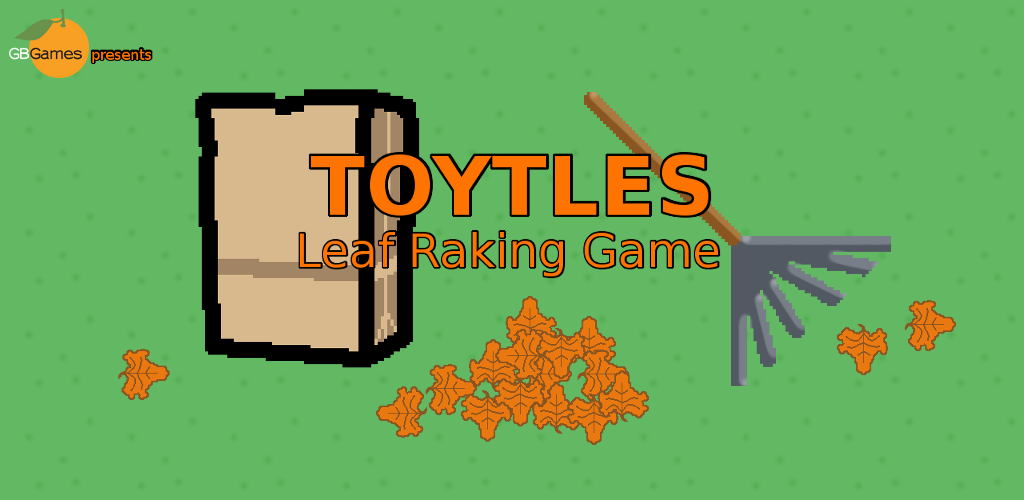
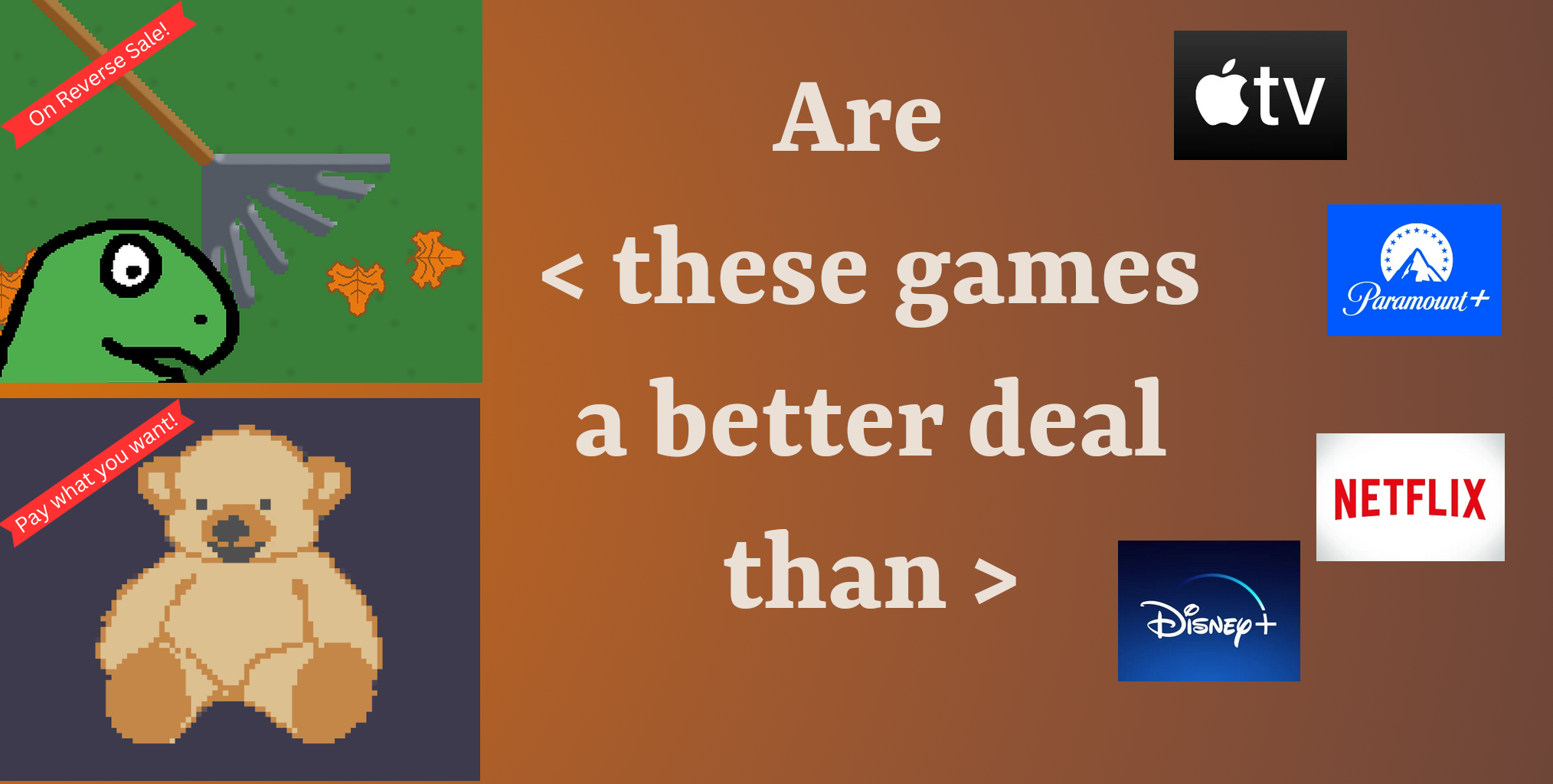
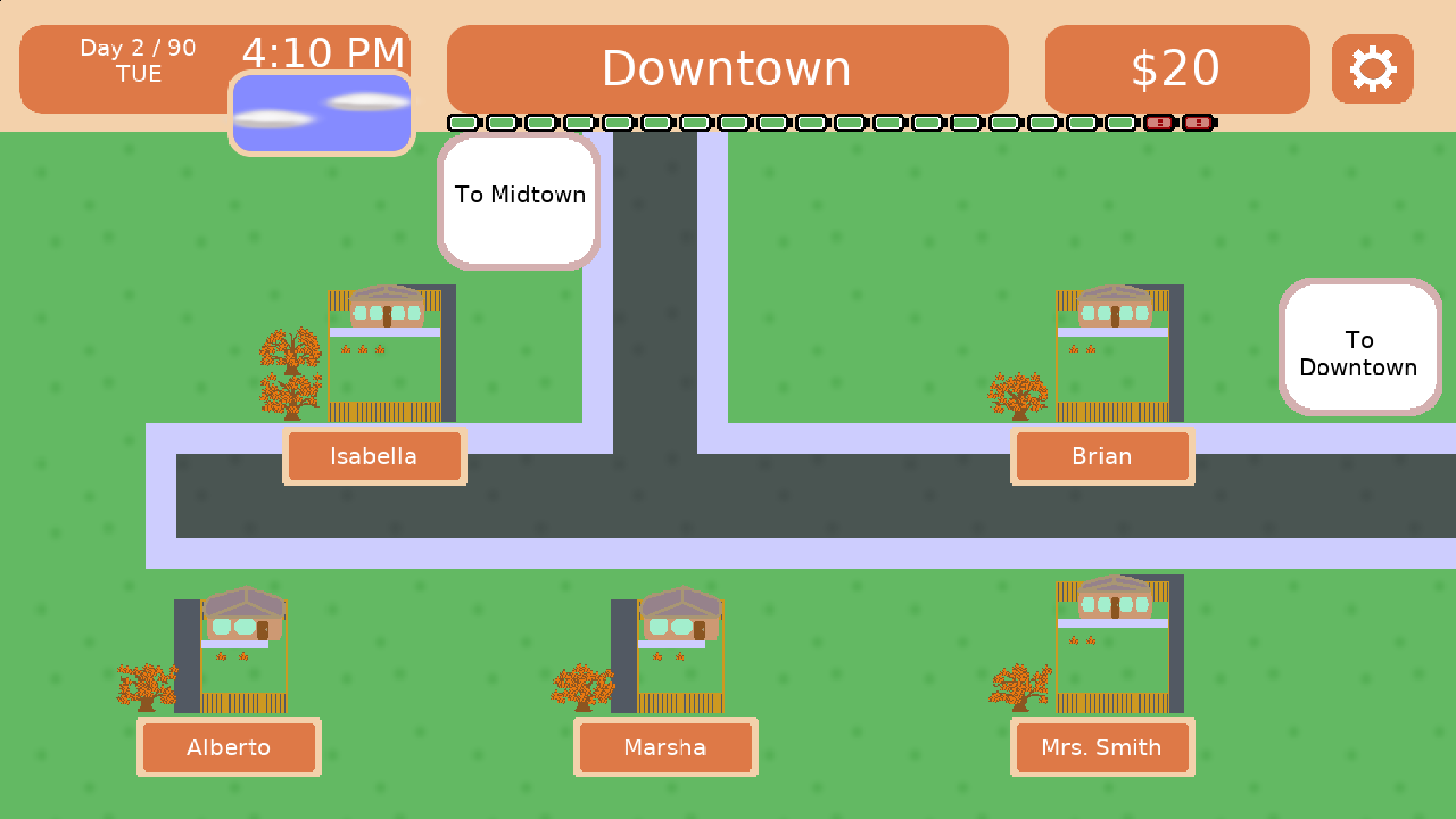
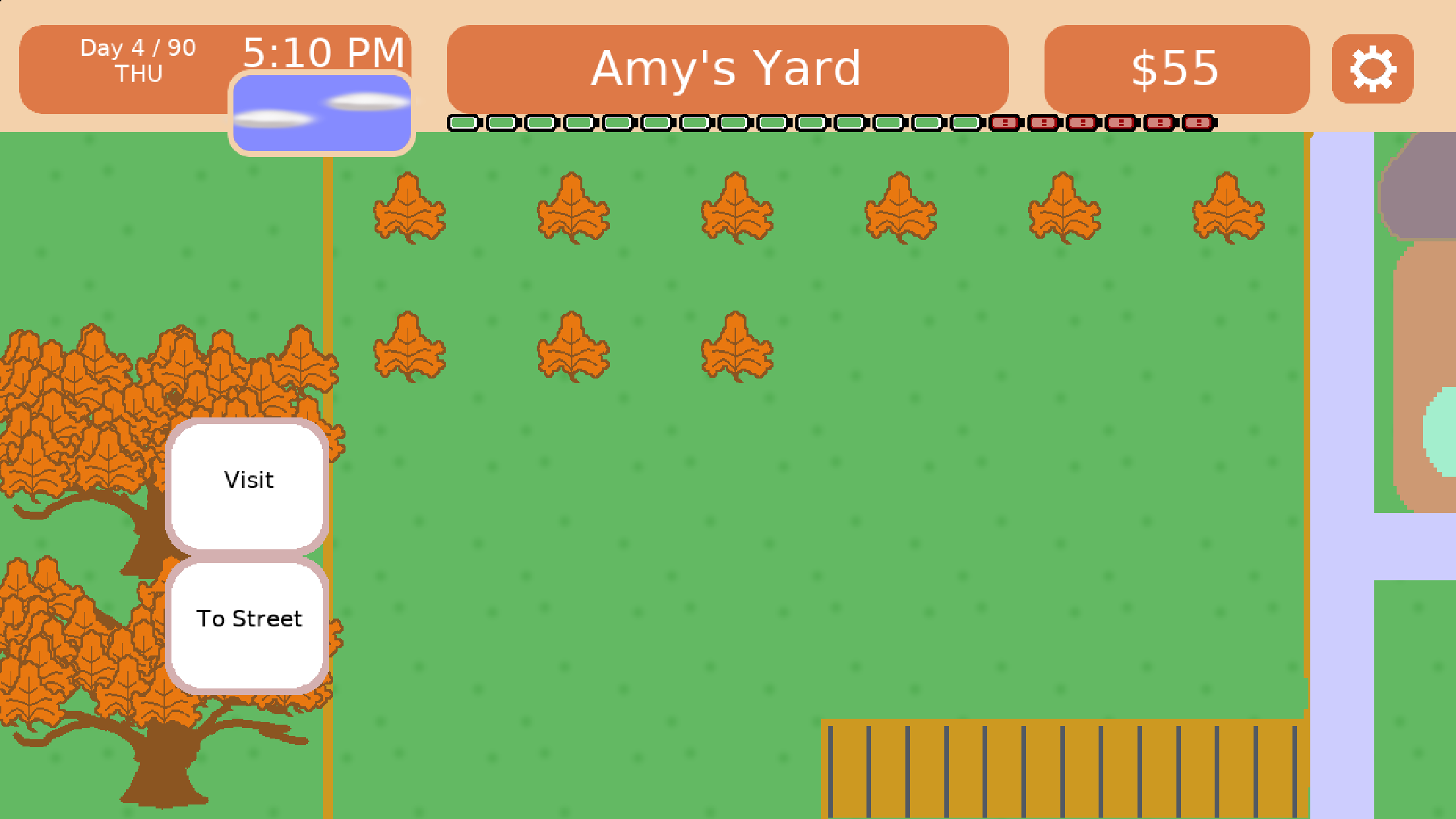
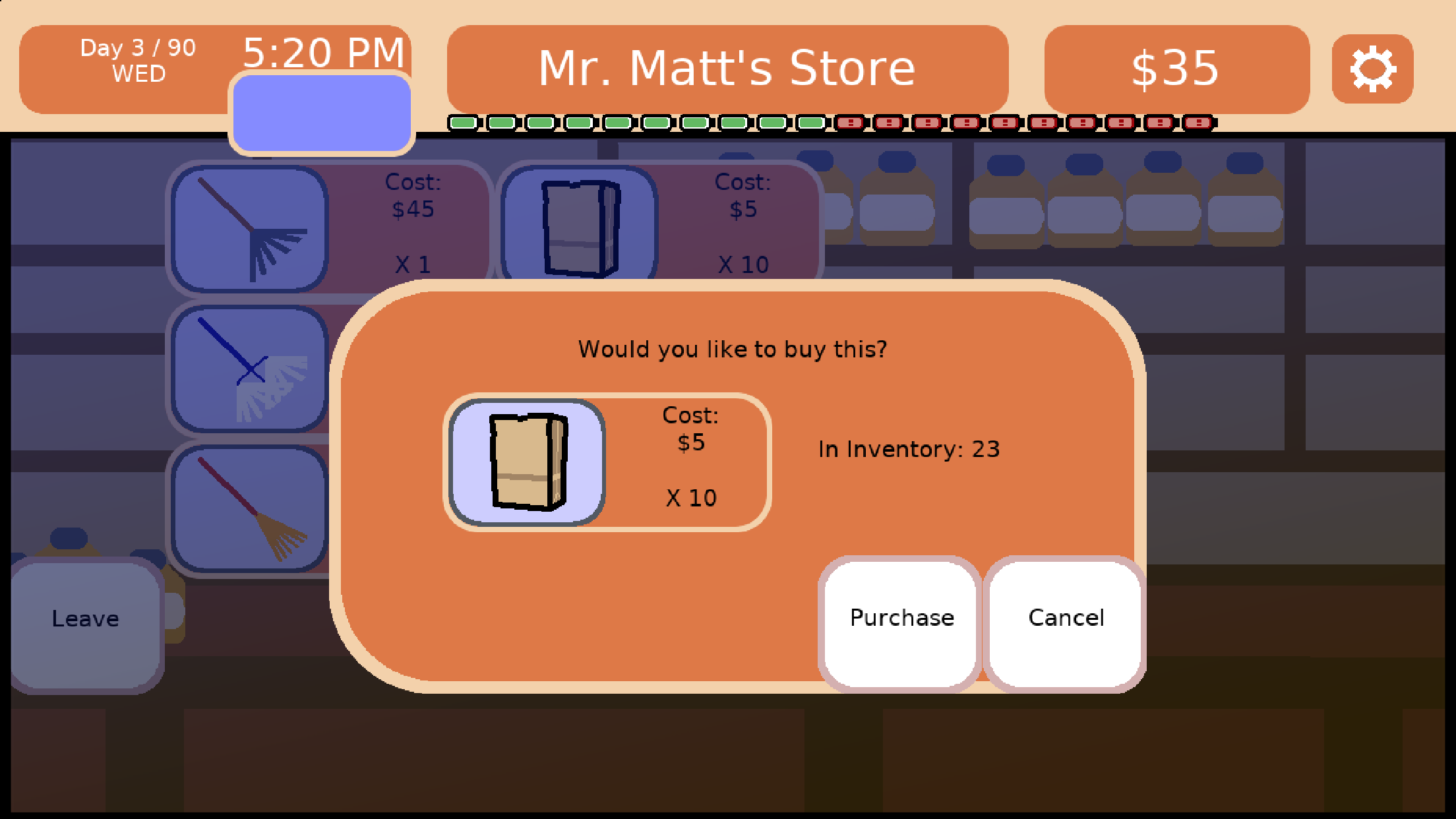
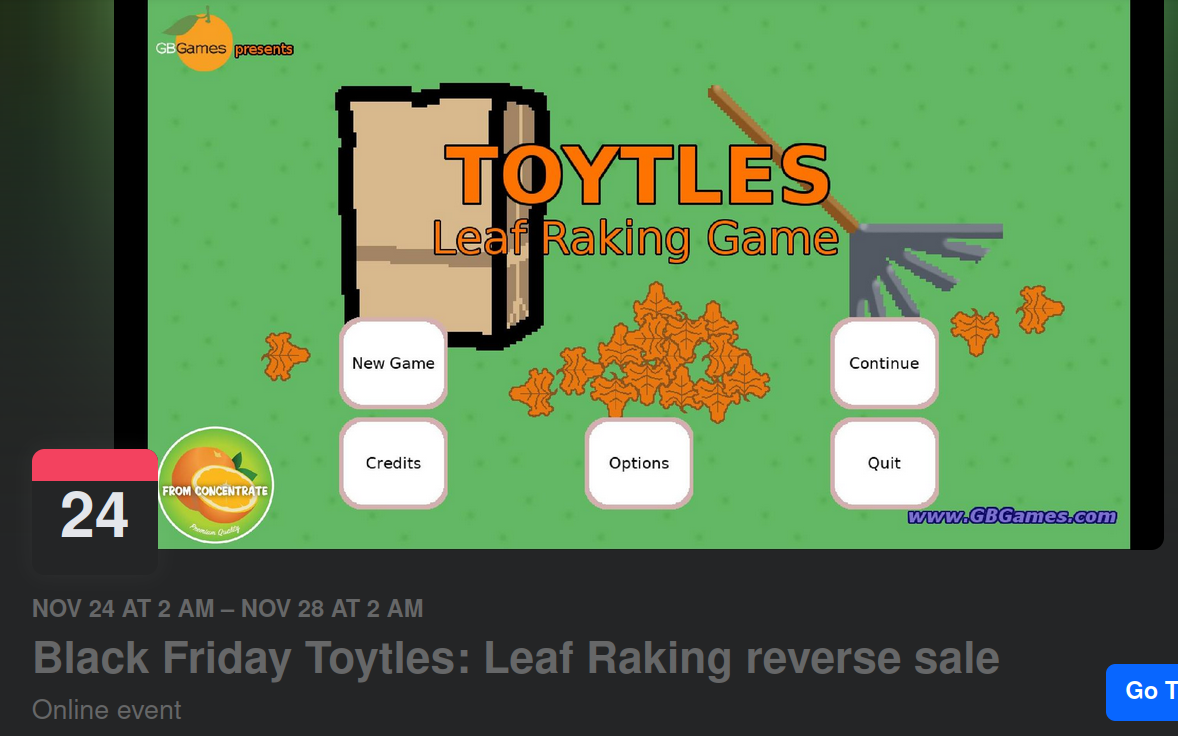
I have two games currently published on itch.io. My family-friendly leaf-raking business simulation, Toytles: Leaf Raking, has a price of $5.99, and I have never dropped the price for a sale, but itch.io does allow “reverse” sales, so whenever itch.io has a sale, I always increase the price by 50%. My argument is that it is still a very generous price that is less than the cost of a cup of coffee or streaming services, and if you would prefer to pay less, then you should buy it before or after the sale.
Now you might argue that I shouldn’t use a reverse sale, that no one is going to want to pay MORE for a game, but every sale of my game on itch without exception has earned me more than what I asked for even if you count past reverse sales. That is, people pay 50% more and then some each time. It’s very gratifying to know that people have been so supportive in the past. I suspect that as I reach more and more prospective customers, fewer of them will be so generous, but clearly reverse sales exist for a reason.
Plus, I really hate the idea of dropping a game’s price as your main marketing tool. I find it bizarre that Steam, for instance, allows you to wishlist a game, which is someone saying, “I want this, but not right now for whatever reason”, and the immediate notification that comes up is “Ok, we’ll tell you when you can pay less for it.”
I mean, it’s a handy feature to be notified of sales for games you expressed interest in, but it seems like a weird conflation of intent to me. I might wishlist a game just because I want to get it later, but Steam turns a wishlist into a “tell me when this game is on sale” list.
I mean, clearly this tactic of dropping your price to get attention works. I know I notice games when GOG and Humble Bundle send out newsletters saying they are on sale, but maybe I’d notice them more if they were also brought to my attention even without a sale? I’ve learned of some interesting projects from itch.io when I get the new development updates emails.
Anyway, for now, I have no interest in discounting my already pretty inexpensive game.
My other game is the family-friendly toy factory worker management game Toy Factory Fixer. As a part of my Freshly Squeezed Entertainment line of games, it is free. As such, it can’t be put into an official sale on itch.io, but again, the platform does allow for optional extra donations, and I have earned some money from this free game, which I count towards my total sales.
And so part of my promotion efforts was to highlight a “pay what you want” or “name your own price” idea for this free game. I figured that at the very least, people would pay $0, download and play the game, and maybe become a fan, potentially signing up for my newsletter, which is a separate win for me.
My plan involved sending out email newsletters, writing posts on my blog, creating videos on YouTube, posting images, videos, and text on Facebook, Twitter, Bluesky, and LinkedIn (because why not?), and sharing promotion-focused devlogs on my games on itch.io, including the devlog for my not-yet-published game The Dungeon Under My House, the family-friendly 1st person dungeon crawler RPG I’ve been working on this year.
I published posts frequently between the week leading up to the actual sale throughout the weekend and even the day after the sale ended. I was posting multiple times a day during the sale especially.
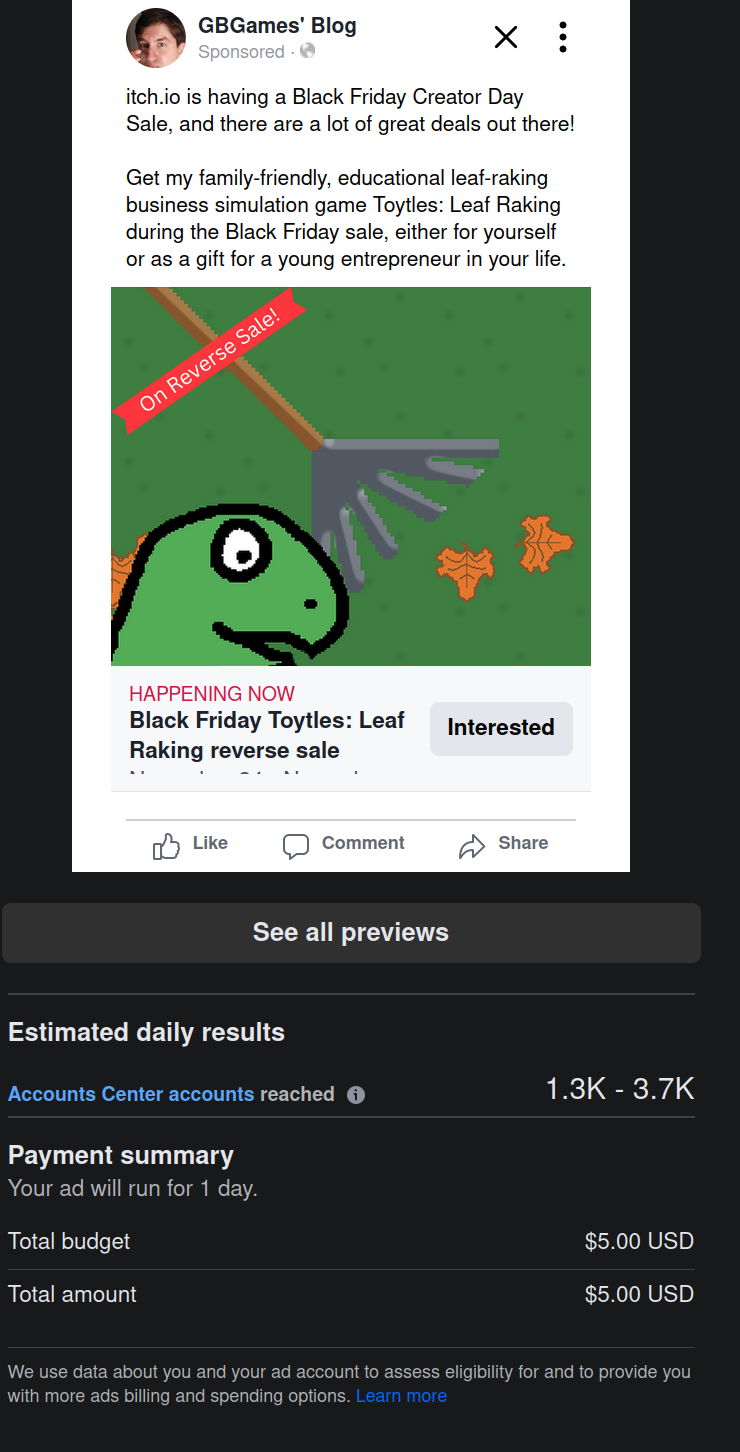
I even paid to boost a few things on Facebook, although even those ads were free because I was using a $20 ad credit. It wasn’t a lot to spend, but considering my reach is almost never in the double-digits, I figured getting a predicted 1,000-3,000 eyeballs on my promotion efforts would make a night and day difference.
It was the most effort I’ve put into promotion in such a concentrated period of time.
Results
In the end: I got roughly 50 views, 0 sales, and only 1 download of my free game.
So, quite disappointing and frustrating.
On the other hand, according to the few analytics built-in to itch.io, I saw more views for my games than I have ever seen before. As I concentrated my ads on Creator Day, I did see a lull on Sunday, which allowed me to definitely see how my own promotion efforts minus ads impacted my views on the following Monday, and it was still a noticeable spike compared to my normal traffic.
Even so, it felt like a lot of effort for very little gain. It merits some introspection and analysis, and I hope that by digging into what I did and how I did it, my future efforts can be more fruitful, and maybe it can be helpful to you.
What Went Right
- Incremental planning allowed me to prioritize and use my time effectively
I built up my plan incrementally. I’m a very, very part-time indie game developer, and I don’t necessarily have a lot of time to work on games, let alone do effective promotion for them.
So the start of my plan was to ensure a sale happened at all and that people knew it existed:
- Create the actual itch.io sale
- Create a Facebook event linking to the sale
- Announce the sale in my newsletter, blog, social media
Having the actual sale created means my game will get listed in itch.io’s sale page, which lots of people will be looking at over the Black Friday sale weekend, so that was done already.
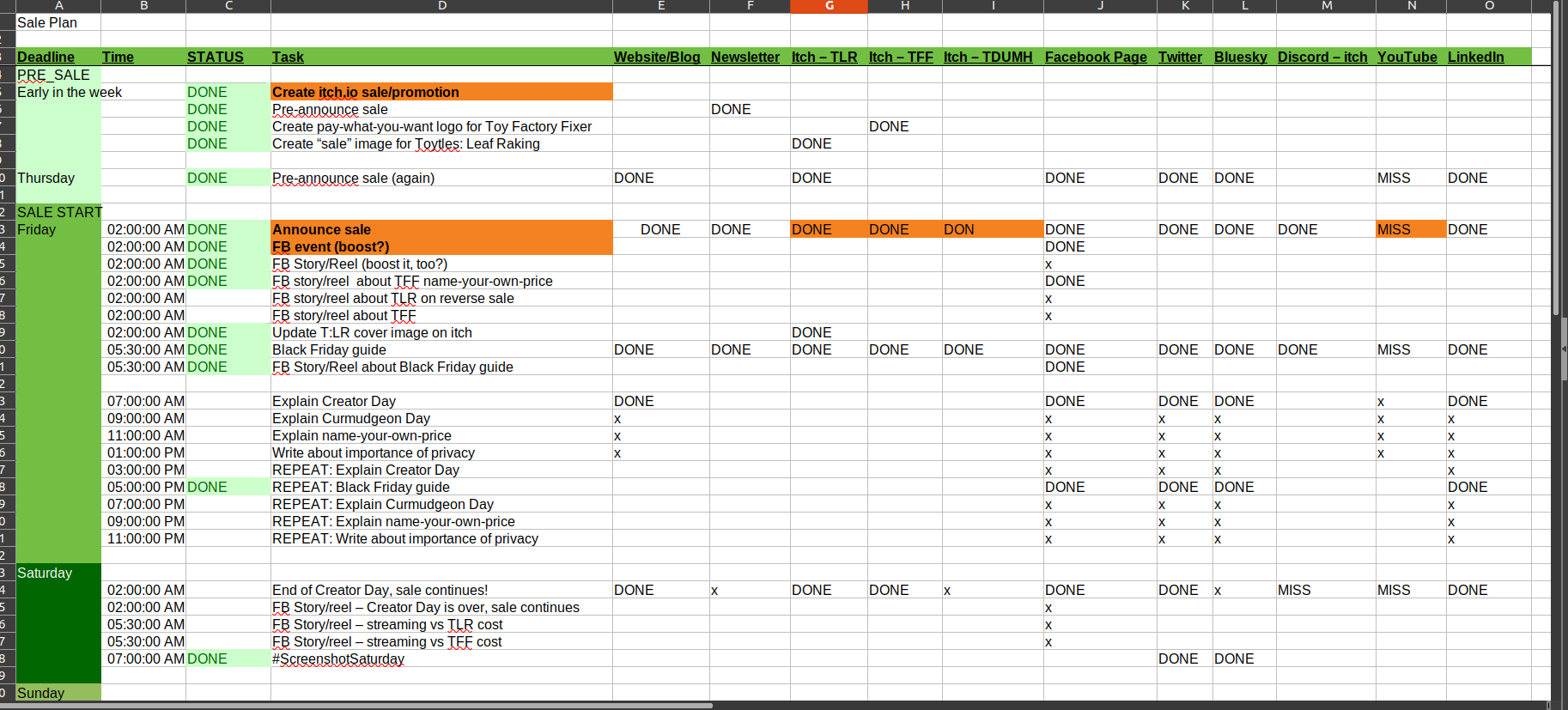
And announcing the sale involved a few pieces: an email newsletter, a blog post, social media posts to share that blog post, and itch.io devlog posts on my three game projects announcing the sale. All of these were written and, if possible, scheduled to go out at the start of the Black Friday sale, which for me was 2:00am on Friday.
Well, announcing the start of the sale was the bare minimum. What else could I do?
- Create the actual itch.io sale
- Create a Facebook event linking to the sale
- Pre-announce the sale the week prior in my newsletter, blog, social media, video
- Create new sale logos for the itch.io games
- Announce the sale in my newsletter, blog, social media, video
- Announce end of Creator Day in my newsletter, blog, social media, video
- Announce last day sale in my newsletter, blog, social media, video
- Announce end of sale in my newsletter, blog, social media, video
Ok, so we’re starting to put a spine together, and it gave me a good guide for my time and efforts.
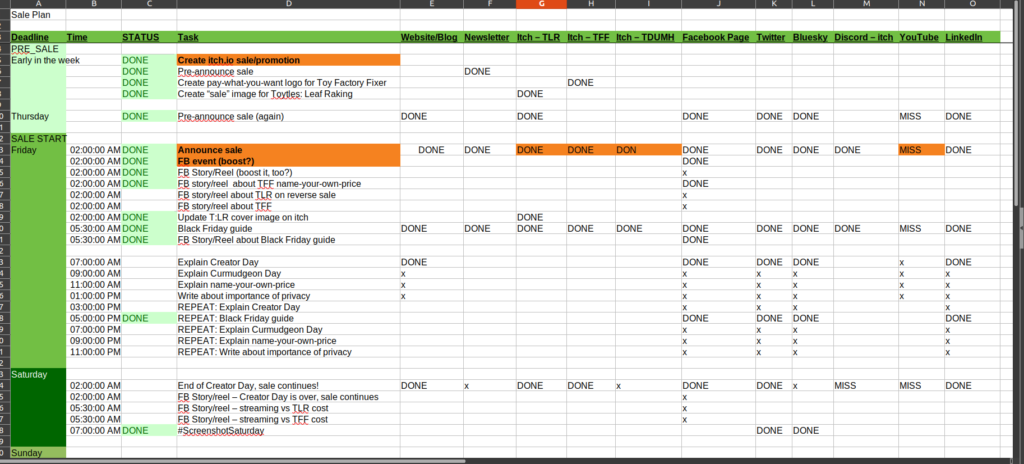
I didn’t know how much time I was going to be able to dedicate to writing, creating screenshots and videos, and such, but this plan allowed me to prioritize and drop things as I went.
For instance, all of the “Announce” items included me creating and publishing YouTube videos, but I did not make time to create many of those. I wish I could have, but I was able to write blog posts, share on social media, and do other things, and it just wasn’t possible to do everything on my list.
I had other marketing beats in my plan that I never got to. I created a post explaining Creator Day, but I never wrote one explaining my name-your-own-price idea or how important I think privacy is (my games are designed with privacy in mind and so don’t track any data or sell it to 3rd parties, something I like to emphasize). I wanted to emphasize how the cost of each of my games compares to streaming services, but instead I made a generic post about both of my games.
I even created a Black Friday sales guide, in which I highlighted not only my own games but also other family-friendly games. While it wasn’t as big of a guide as I would have liked (it only featured 5 games instead of the 10 I had intended), I was able to get something together, and I was even willing to making a mere list with links if that was all I had time to do.
My plan was ambitious, at least for my limited time, yet it was flexible and allowed me to drop or change things as I went, and I could even add things as I thought of them, such as some of the short videos I created and shared on Facebook and YouTube that I hadn’t originally planned on.
This flexibility kept things relatively low stress and allowed me to right-size my expectations of my capabilities as I went.
- Canva helped me create slick materials.
I’ve heard about Canva in the past, but my sister was the one who suggested I specifically use it to create some of my marketing materials.It aggressively wants you to sign up for their premium offering, and there is some nice looking stuff available if you do opt to pay for it, but I was impressed with how the free tier allowed me to create simple videos, perfect for Facebook Reels/Stories and YouTube Shorts.
Here’s something that took me 30 minutes using images that I already had, something I was able to upload to Facebook and YouTube and Twitter:
In contrast, when I opted to create something using the tools on my computer, it wasn’t nearly as nice.
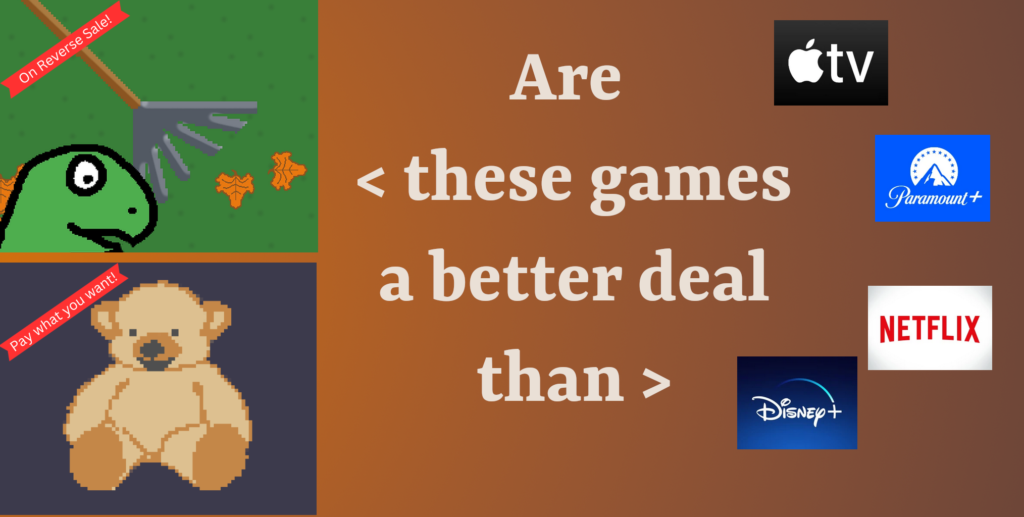
Now I was still learning how the website works, so I was a little slower to create things leading up to the sale. I wanted to create a vertical/portrait video but had selected the preset for a landscape view video, and apparently it won’t let you resize the canvas after you start, but I quickly learned to use the Custom Size button and avoid that problem.
Otherwise, I liked how the animation tooling was intuitive, how it allowed you to select colors already present in your image so it was easier to create matching elements, and how you can save multiple pages or each page separately to make variations faster.
I’ll definitely be using this tool in the future. Canva has a referral program, so if you are interested in signing up, doing so through this link supposedly gets us both some credits good for premium photos, illustrations, or icons: Canva referral link. Alternatively, you can use this non-referral link: Canva without a referral link.
- I had more views of my itch.io games than ever before!
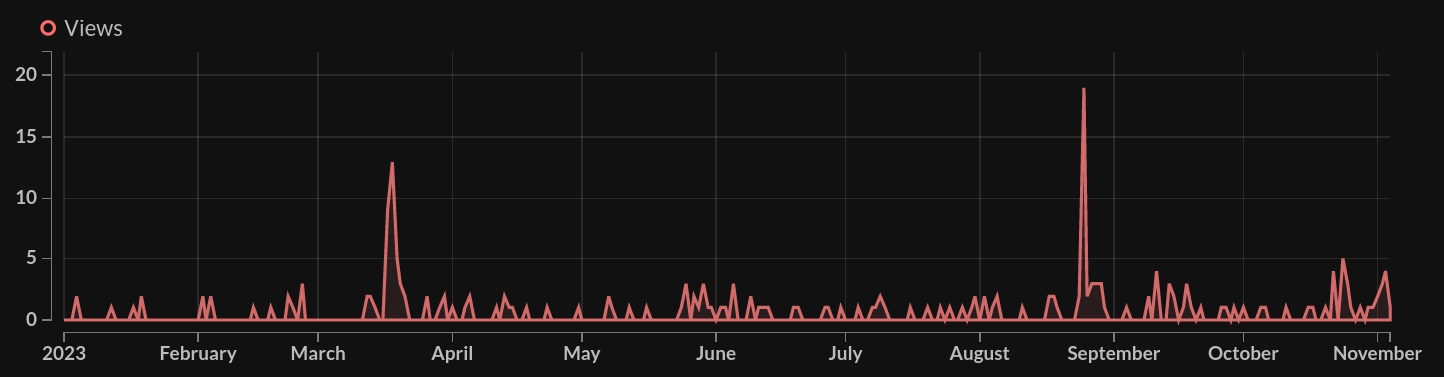
When I look at my regular, non-sale itch.io analytics, I see very low numbers. On any given day, I get anywhere from 0 to 2 views.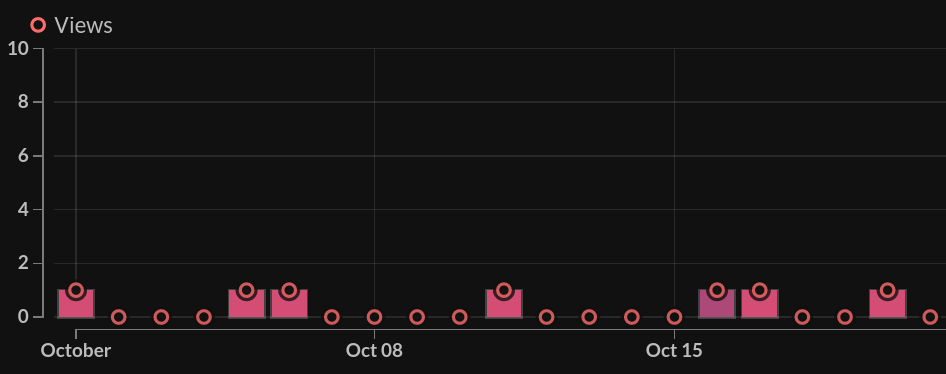
My biggest spikes in traffic this past year have come during sales, which makes sense since I talk about my games more during those periods of time, plus itch.io is also talking about my games (along with everyone else’s).
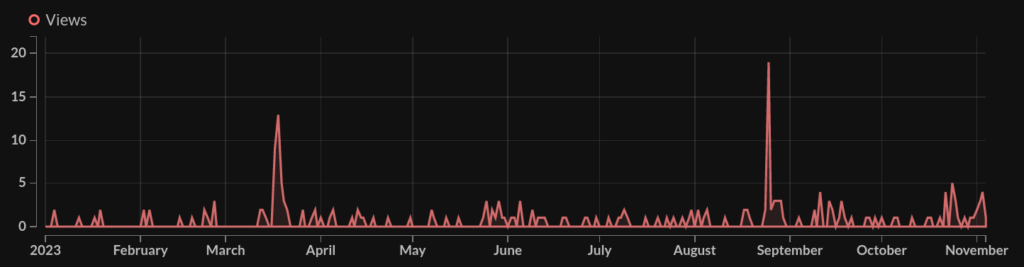
My best spike was in August for their Creator Day sale, when I got 19 views in one day, with 1 purchase and 4 downloads of my free game. The traffic before and after that day was fairly low, which meant the sale had very little residual effect in the days after.
To me, that was a nice baseline. If I put in some decent effort, can I do even better this time around?
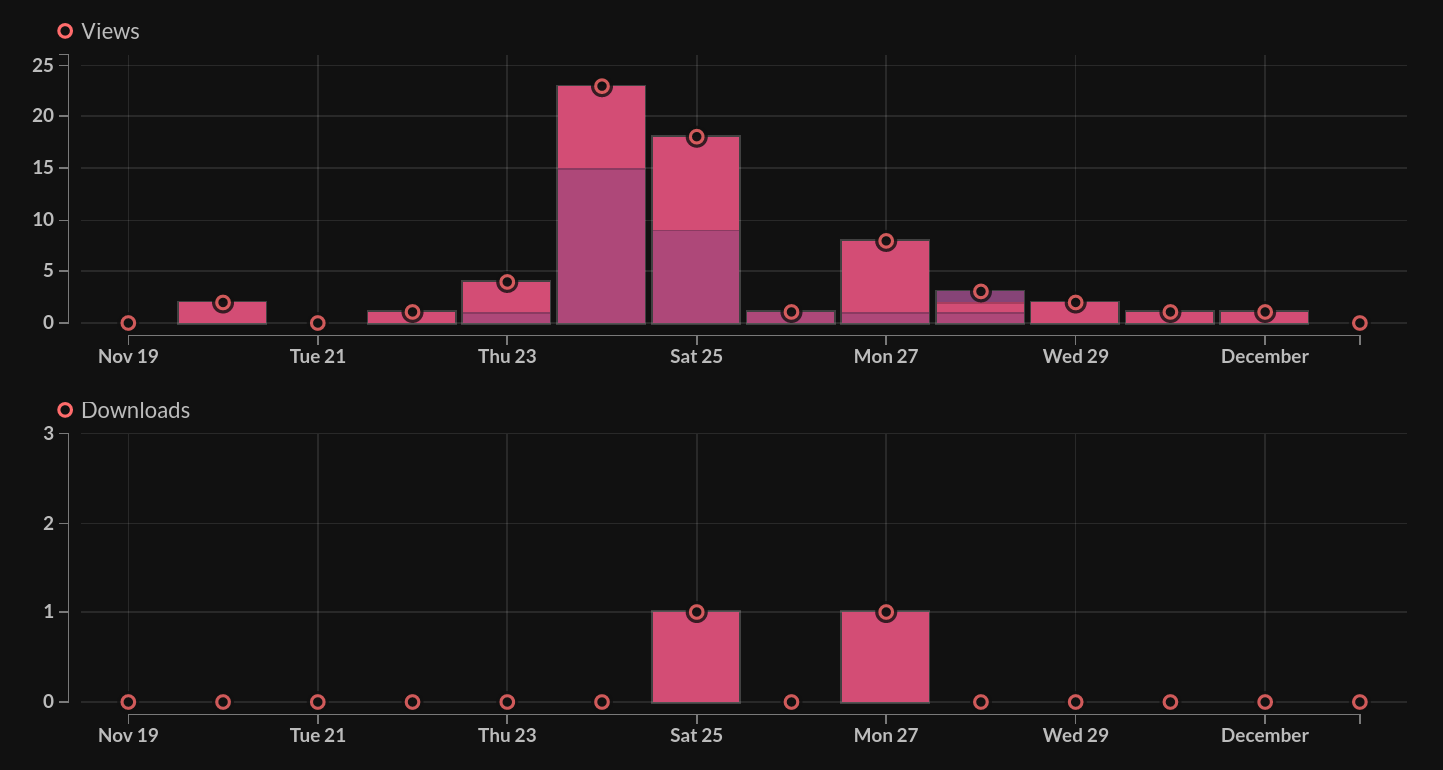
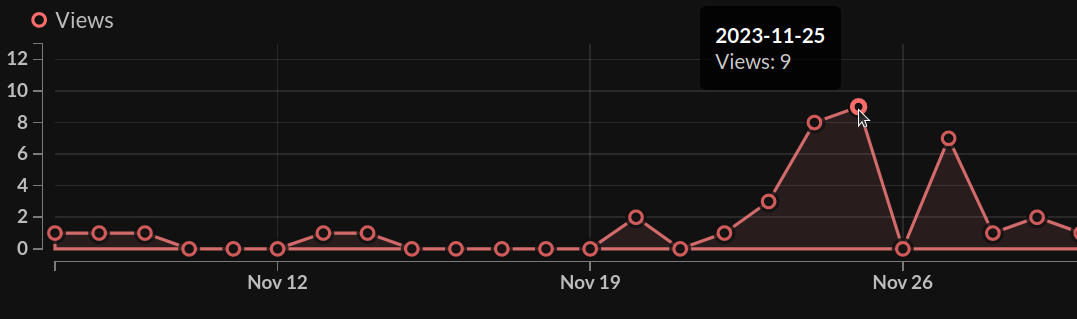
Well, I could. I counted about 50 views in the days of the sale, with 23 views in the first day, 18 views on the next (almost tying the August Creator Day!), and 8 on the last day of the sale.
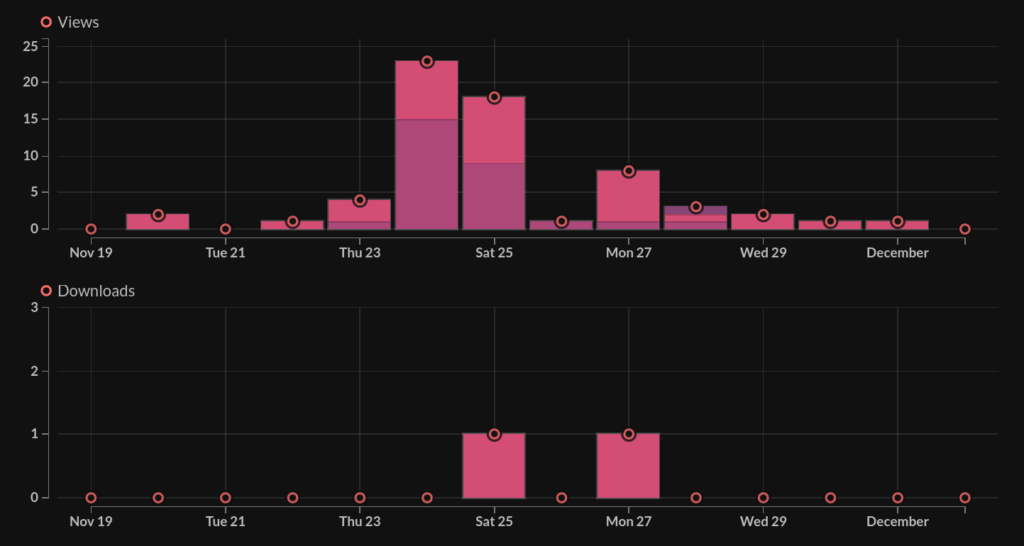
Now, I think (it is hard to tell based on the referrers in the analytics not being accurate) that much of those views on the first two days can probably be attributed to my Facebook ads (see below), but I did hardly anything on Sunday, and on Monday, the last day of the sale, I did a small blitz on social media, so those 8 views? I’m claiming credit for those.
Now, clearly we’re not talking big numbers here. I would have loved to have had thousands of views, or even hundreds like I had dared hope for, and I will say I was disappointed that I only did slightly better than my August sale, a sale that I didn’t do nearly as much to promote.
Actually, I’d be happy with this number of views if I had more downloads like in past sales. You might notice that it looks like I had 2 downloads on the 25th and 27th, but the first one was me testing out whether downloading a game would ask someone to sign up for an itch.io account and act as a barrier to entry (it does not).
itch.io has a LOT of games, and from what I can tell, horror games and visual novels are way more popular and trending. I do not see many games with specifically family-friendly-oriented messaging, and so maybe customers for those types of games aren’t looking for them on itch, or maybe I need to highlight some other aspect of my games that might generate more interest.
But my efforts made an impact. It may not be much better than nothing, but it wasn’t nothing.
I got more views on my games, however small of an increase, and I did it through my own efforts.
- Learning to use better hashtags.
I don’t normally worry about hashtags, but there is definitely a difference between posting something on social media and getting ignored and posting something and seeing it immediately get retweeted or shared because people or bots are paying attention to particular types of conversation.I try to participate in #ScreenshotSaturday because even though paying customers aren’t likely to be paying attention to it, it is still enjoyable to see what other developers are doing. The itch.io Discord also has a #work-in-progress channel which has a daily call for people to share what they are working on, and it’s great to support each other.
But I knew I needed better hashtags, ones that might be customer-facing. So I went searching for videos on YouTube and Facebook pages to try to find relevant ones.
I don’t know if they helped much (see below about analytics), but #itchio and #indiegame might be attracting more appropriate attention for a sale than #gamedev and #indiegamedev.
And in the case of Facebook Reels and Stories, I tried variations on #familyfriendly and #familygaming, among other hashtags.
I think experimenting here might help me find people who are looking for the kinds of things I’m making more easily.
- I created a regular marketing plan.
One thing that stood out to me was that my itch.io traffic is incredibly low most of the time.For the sale, I can focus on the spike, and I can look at past spikes for comparison, but once the sale is over, I was anticipating things getting back to a normal that I wasn’t happy with.
And as I write this and as you can see in the days following the Black Friday sale, my views have dropped back to the bottom.
My promotion efforts have been fairly spiky, since aside from creating daily posts on my Facebook page and creating a weekly devlog blog post that I also share on social media and on itch.io, I’m not really giving anyone anything to see or talk about most of the time.
So that needs to change, which means I need a plan to do things regularly and consistently.
So it wasn’t really something that helped me with this Black Friday sale, but it was the catalyst for me to actually put together a daily habit of promotion.
My plan is mostly cribbed off of the hour-a-day plan described by Michelle Lega in her 2023 Independent Games Summit talk No-Budget DIY Marketing for Indie Games, adjusting it for my own schedule preferences and my context (I don’t sell on Steam, but I can apply similar advice to my other store pages).
I already write a weekly devlog, but I publish it on Mondays. I haven’t done any kind of press list or reached out to reviewers or streamers, and so no one even knows to cover my games if they wanted to, but I can start my list with one person, knowing that each week I can grow and curate my list as I go. I can make regular time to make small changes to my website and itch.io and mobile app store pages, knowing those changes add up.
My hope is that by practicing regular daily and weekly promotion habits with a focus on content marketing, my regular organic traffic should improve over time. We’ll see how things look a year from now.
- Quality Issues?
Now, I’ve gotten compliments on the art for Toy Factory Fixer, and fewer on Toytles: Leaf Raking. The latter doesn’t even have music. You could argue that the perceived quality of these games just aren’t competitive, or at the very least that my screenshots and description aren’t compelling enough for people to get curious enough to want to play the games.And that’s…fine. My games don’t need to appeal to everyone, and there are some gorgeous, cozy-themed games out there that you would never mistake these games for.
But I guess I’m not sure if this is a real issue. There are very, very ugly games that get fans, and that ugliness is sometimes part of the charm. And I’m not talking about very popular games that merely seem like they would be considered “poor quality” when in fact they have very decent production values and are just different.
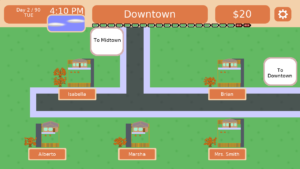
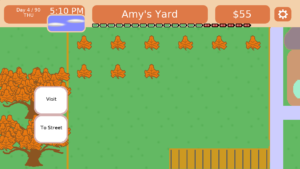
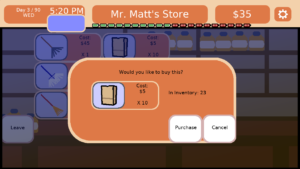
Sometimes I think about redoing the art of Toytles: Leaf Raking. When I made the game, I knew that I have gotten into trouble spending too much time on previous projects trying to create good art that in the end showed my lack of art skill. So my plan was to throw things together that are functional and move on as fast as I can. I figured that this slapdash art was perhaps going to be part of the charm, and I think some early playtesters found it refreshing in that way and told me so.
But maybe I should revisit the art. Can improving the game’s graphics turn into better-looking screenshots, which would turn into more views, which turns into more purchases?
It’s hard to guess, but maybe I can mock up some screenshots and do an A/B test somehow to see if one gets more interest than the other? It’s something to think about for next year.
Also, these two games aren’t fresh. Maybe it is worth making updates and tweaks to my older games while I also work on my next game, if only to have something else to highlight and talk about? I don’t like the idea of a development treadmill. A finished game can just be finished, right? But I suppose there is always a need for compatibility and I am sure I can find enhancements.
Even adding some music to Toytles: Leaf Raking would be something.
- My understanding of the dynamics of Black Friday is waaaay out of date.
Much of my promotion around Black Friday was based on my own personal preference to avoid going out on the day after Thanksgiving.I did not want anything to do with the crowds or the door-busters or camping outside of a store to get good deals.
So my messaging was built around insisting that you shouldn’t either. Stay home. Play indie games. Specifically, play MY indie games.
Well, it turns out that the days of people filling up stores and trampling each other to get a discount on some consumer electronics aren’t really around anymore.
Black Friday sales start earlier in the month and end later in December. People order things online.
The painful experience I was insisting that people avoid? It just isn’t a reality anymore, and, well, I was out of touch. So I imagine my appeals to get cozy, avoid the crowds, and play indie games weren’t hitting the same notes they would have if I was making such appeals maybe five or 10 years ago.
Ah, well. At least I got this very nice photo of me with my 20+-year-old cat that I tried to stage and it came out perfect.
- Facebook’s estimates for boosts aren’t very accurate.
Now, I can admit that I am new to Facebook ads, and so there is a lot I could stand to learn in terms of using them effectively (see below).I’ve generally avoided paying for traffic because I don’t know if my website does a good job of converting that traffic into sales. Why pay for people to bounce off your sales page when you can improve the sales page with organic traffic for free?
Except I have terrible organic traffic, so maybe I need to pay for traffic to find out how my sales pages do when there IS an influx of potential customers?
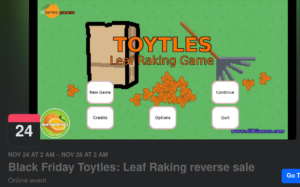
Well, I’d love to run experiments like that in the future, but for now what I did was boost my Facebook event for the sale.
Facebook estimated that by boosting my event with just $5, I could see a reach of about 1.3k to 3.7k accounts.
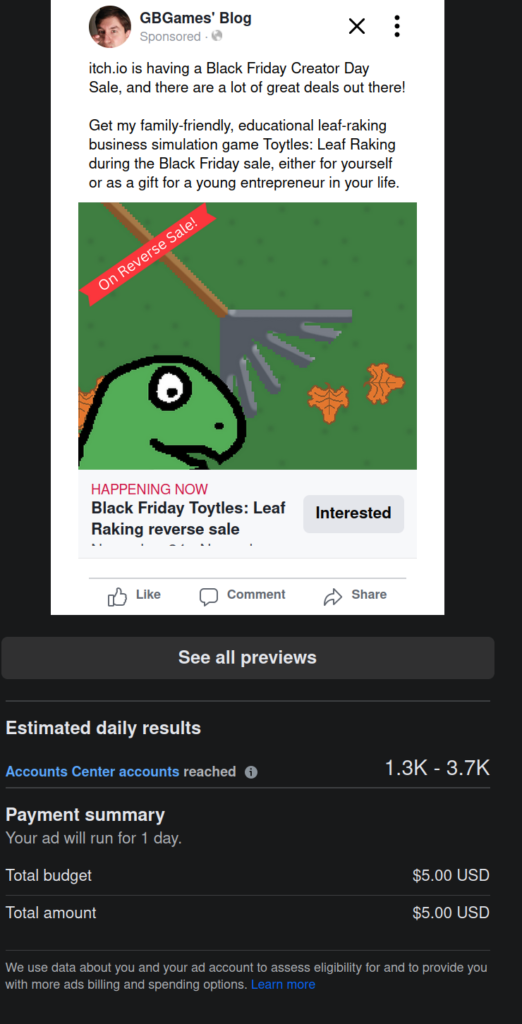
That’s WAY better than the handful of accounts my posts normally reach. This Black Friday sale was going to be a very nice experiment.
Except, the actual reach of this event was way, way less. It only reached 100 people by the end of Creator Day. And to make it worse, no one actually joined or express interest in the event.
Maybe I shouldn’t have expected the traffic to my Facebook event to do anything meaningful. Maybe my boost money should have gone to a better post.
But I was a bit frustrated that I paid (well, with free credits) for an ad with an expected amount of reach and got way less, and on top of it, Facebook kept trying to upsell me to spend more. “We didn’t show it to the number of people we said we would, but if you pay us more, we promise we’ll do it this time.”
It isn’t even that I spent a free $5, which isn’t much and so I shouldn’t expect much in results from it. It is that there was an opportunity cost here, and I wish I had spent that $5 on a different post with perhaps a better outcome. Or maybe on Google AdWords. I would have gotten more value if I had just bought someone else’s game during the sale.
I think with my current low traffic I am going to need to expect that I’ll pay for ads in the future, but I wish I knew how to predict whether or not Facebook was going to actually show my ads to the people they said they would.
- I don’t have a good idea of who to target when I create posts and ads.
When I noticed that the boosted event’s reach was growing way slower than I was led to believe, I decided to use the rest of my ad credit on boosting a different post, which was a Facebook Reel version of this short video that showed off Toy Factory Fixer’s game play:When you create an ad, Facebook lets you target people by geography, age, other demographic info, and interests.
My games were meant to appeal to people who want family-friendly media. If you watch family-friendly movies or TV shows, you probably also want family-friendly games.
People interested in creativity, in educational toys, and educational video games are also people likely to want to play my games.
So I targeted Americans (Thanksgiving and Black Friday aren’t really international) who are interested in the above, and it seemed like a good bet.
Now, perhaps boosting a video wasn’t the right move, or maybe the video that showed game play footage of Toy Factory Fixer wasn’t compelling enough. Maybe the video was too short, and even though it got played almost 2,000 times, there were only two clicks, and I don’t know if that is a good percentage or a low one. Maybe people clicking on ads get thrown off when the link takes them out of Facebook and so they bounce away quickly. Maybe there is some advanced setting for ads that would have optimized who saw it.
But the fundamental problem is that I don’t know what would be compelling to my target audience because my target audience is quite broad and vaguely defined at the moment. For an ideal customer of my games, what would they be looking for, or what would pique their interest?
I don’t know, and I should. As a solo indie game developer, I can’t depend on spending huge amounts of money on blasting ads at people in the hopes that some of them become paying customers. I need to figure out who they are first.
For me, I want to make games that are family-friendly, that are privacy-respecting, and that encourage curiosity and support creativity. What I haven’t done yet is the hard work of finding prospective customers who care about those things, too. Who are they? What else are they into?
Without that info, I’m shouting into the wind.
- itch.io’s analytics are a bit opaque and limited.
Remember how I said I paid for Facebook views? I KNOW some of those turned into itch.io game page views.But you wouldn’t know it looking at itch.io’s analytics. Facebook does not show up anywhere in the listing. Neither does Twitter, YouTube, or a few other places that I know should have shown up in the metrics.
Here’s itch.io claiming credit for all 6 views of Toytles: Leaf Raking on the 25th, a game which got 9 views that day according to a different view:
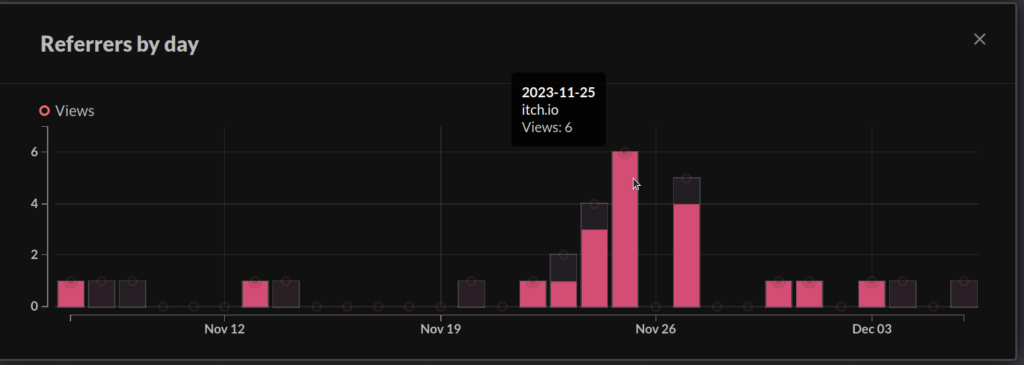
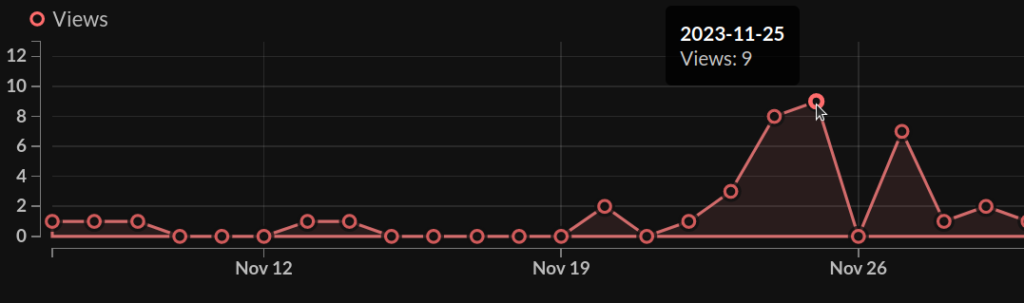
itch.io’s analytics also don’t really let me see things I want to see. I can see “Incoming visits from other sites over the last 30 days” and see what referrers I have (which, again, is clearly not an accurate picture), and I can see the “Graph by day…” option for a particular game’s traffic for the previous month, but it would be nice if I could see referrer data from arbitrary time periods.
Can I see who were the main referrers for my August Creator Day traffic? Not anymore. At least, not that I can find. If I wrote this post weeks from now, I wouldn’t be able to tell you what referrers I had during this Black Friday sale either.
I know itch.io allows Google Analytics to be embedded, but I don’t know if I’ll see better quality data or if it will similarly be filtered or missing data from referrers that I expect to be there. I suppose I can add it and find out.
I’m glad that I can view some data, but I’d be happy if I could export the data and look at it myself if that was the only thing available.
As it is, I feel like I’ve got to make decisions on where to spend my time and energy based an incomplete picture of what my previous time and energy investment produced.
What I’d also love to know is how many people clicked on the download button for my free game and abandoned once the modal popped up asking if they wanted to donate $2. Imagine the A/B test I could do to see if that modal was getting in the way of downloads. The money would be nice, but I’d rather people play Toy Factory Fixer than not. I’ve submitted the idea in the Discord’s #meta channel.
- I have a small megaphone, so putting in a significant amount of my limited time for promotion efforts results in a noticeable yet still small impact.
What would my views/sales/downloads have looked like if I had 10x as many followers on Facebook? 10x as many YouTube subscribers? How much more leverage would each of my posts have had?
I’m no content creator. I blog about my game development, and recently I started creating YouTube companion devlog videos, but I’m not going to try to be some zany personality with clickbait-y thumbnails and headlines. My videos aren’t high quality, as I’m currently using my laptop’s camera and a mic that picks up way too much ambient noise, but I hope by being authentic that I appeal to the kind of people who also aren’t fans of clickbait. But obviously YouTube isn’t going to be showing my videos as often.
This past year I started to post regularly on my Facebook page, but I only recently learned about the Meta Widely Viewed Content Report, and based on one analysis I read, I’ve been limiting my potential because I was adding links to my blog posts or mailing list sign up page or a store page to each Facebook post, and Facebook basically limits how far posts with links go dramatically compared to non-links. So I’m going to try to limit how often I add a link to a post and see if Facebook shares my content more often.
It’s a chicken and egg problem in which the social media algorithms won’t show your posts if they aren’t gaining traction, but they can’t gain traction if the algorithms won’t show your posts. But they’ll gladly take your money to maybe show your posts to more people. It’s a winning combination for them, and a very annoying problem for me. But hopefully not an insurmountable one.
Years ago, blogging regularly meant you were continually building a backlog of articles and posts for people to find. Today, a lot more people are in walled gardens of social media that focus on what is new and trending, and so more often I find that my articles effectively might as well not exist to most people.
But SEO is still a thing, even if it might not be as big as before. People still search for things. I plan to make my things more likely to be what they are looking for.
In the end, I really need to focus on what kind of megaphone I want and how to build it up.
- Before paying for someone’s much larger megaphone, I need to better define my target audience more and nail down my messaging better.
Otherwise, I can get a lot of eyeballs on my games but none interested in actually playing them.
And worse, some of my ad money might be spent on bots or clickbait rather than anyone who could potentially be a customer.
I can talk about making family-friendly games, but if hardly anyone is looking for “family-friendly games” and instead are looking for “family gaming” or “kid games” or “preteen games”, then I should find that out, and then I should tailor my marketing messages accordingly.
This is basic keyword research, content marketing kind of stuff, but in my limited time, it hasn’t been a priority, and in a year in which I have relatively kicked butt in terms of how much better I have done compared to previous years, I can clearly see the lack of results from not doing this kind of market research sooner.
But if yesterday was the best time to do it, today is the next best time.
What Went Wrong

Lessons Learned
Since I only learned about the Black Friday sale on November 15th (is there an itch.io calendar of such sales so I can prepare better for them?), and I didn’t have much of a playbook for operating such a sale, I needed to create one.
I had a few late nights and lost some sleep that took me time to recover from, but I created a plan, and I executed it as best I could with the resources I had. So maybe that’s another What Went Well to add to the list: I created a Sales Promotion Plan that I can build off of for next time.
Even though I didn’t see any purchases and only one download as a result, I think my plan still seemed pretty sound: using all of the channels I had available, make sure people were aware of my games, finding any way to talk about them.
You could argue that maybe I should be on more platforms, like TikTok or whatever, but I didn’t want to spread myself too thin, and I was hoping I could leverage my existing accounts better before worrying about being elsewhere.
I think my main lessons boiled down to:
I suppose that’s something I need to remind myself of. This sale was a bust for me, just like the Halloween sale, but there will be more opportunities to participate in sales. I will make more games. I can feel bad about the result of this one, but there will be another chance to do better soon enough, another chance to share the games I make with the world.
And I can always acknowledge that one person did, in fact, download my free game. That’s fantastic. I hope they played it and enjoyed it. In the grand scheme of things, I make these games for other people to enjoy, and that’s one more opportunity for someone to do so.