Categories
Game Design Game Development Games Marketing/Business

Making Your Game Accessible to People Who Are Color Blind

I’ve written in the past about designing games for color blind players because I believe accessibility is important. It doesn’t take too much effort, and a significant number of players will appreciate it.

Alan Zucconi wrote a multiple-page, interactive tutorial on making your game accessible to color blind players.

He provides a shader that simulates different types of blindness, such as Protanopia (red-green color blindness), in order to help a developer test a game to see how accessible it is.

While the download and tutorial itself is Unity-specific, he provides a good amount of background on the different types of color blindness. That information could be applied no matter what game development tools you use.

Even if you didn’t want to use the shader in question, the tutorial explains the theory behind it so you could always implement your own tool.

For example, I used SDL and a custom engine to create my casual strategy game Stop That Hero!, so adding shader support just to test colors seemed like a lot of work.

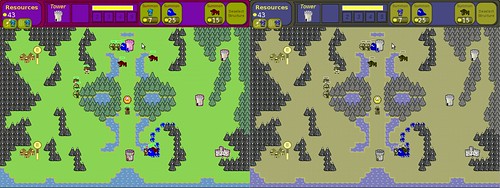
Instead, I took a screenshot and the RGB values Zucconi provided, then manually plugged those values into the Channel Mixer tool in GIMP to generate the following image:

Stop That Hero! with Protanopia

If you don’t have Protanopia, you can see the difference. The image on the right looks darker, and some of the colors aren’t discernible. I am pleased to see that my use of contrasting colors mostly worked, as the mountains and trees are easy to see compared to the ground.

On the other hand, key visual indicators are lost. My use of red to represent a depleted health bar is almost indistinguishable from the green part if you have red-green color blindness. Whoops. B-(

The images in Zucconi’s tutorial have a slider that lets you see how different kinds of color blindness may change how your game’s visual will be received. It’s amazing to see a gorgeous, colorful game like The Witness become washed out and almost monochromatic.

And for some people, it’s a permanent filter they can’t opt-out of, so if your game depends on color in order to play, you’ll want to make sure it doesn’t inadvertently leave these people out.

Categories
Games Politics/Government

How to Apologize Correctly

When I was a senior in high school, I was editor of the school paper. I wanted to publish more than fluff pieces. I couldn’t count how many times the formulaic headline “[insert school event here] a Success” showed up in that paper.

Some of the articles ended up quite controversial, and I got us in trouble quite a few times. I was the reason why future issues of the paper had to be approved by the principal.

And while I can be proud that, after years of people complaining, my paper resulted in actual changes to the cafeteria food quality and pricing, I did have one article that poked fun at past administrators that got me pulled into the principal’s office. I was told that I needed to write an apology for the next issue.

I remember writing the words, “We regret any offense we may have caused.” It sounded good and official, as if it was something in a real newspaper.

And I remember being told that my statement wasn’t good enough. It’s not an apology to “regret” that someone was offended. It’s basically saying that we’d do it again and that any offense is the responsibility of the offended.

So I had to rewrite it: “We apologize for the offense we caused.” It’s a lot more direct and lot less weaselly.

An apology isn’t something you say to make bad feelings go away. “I’m sorry” isn’t a magic phrase to get people who are upset with you to disappear. And you don’t apologize with a non-apology such as “I’m sorry if you were offended” because you’re basically saying that you’re not sorry you did someone something wrong because you don’t think you actually did.

According to Ars Technica, slave-Tetris mode was removed from Playing History 2: Slade Trade by Serious Games Interactive after a public outcry when the game became more well known due to a Steam sale.

Ugh. I did just type those words, didn’t I? Slave Tetris? Really? Someone thought it was a good idea?

I have no problem with a game being used to educate players about history. And no one else who understands how games aren’t just for kids has a problem with the concept either.

But Slave Tetris isn’t the most respectful way to teach how horrible the conditions of the slave ships were. This isn’t navigating the Dalles in The Oregon Trail. You can’t reduce the real experiences of millions of people to a mini-game and not expect people to feel that those lives themselves have been minimized.

Simon Egenfeldt-Nielsen of Serious Games Interactive had this non-apology:

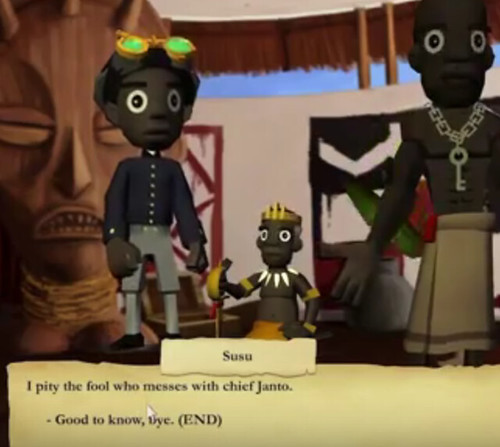
The phrase “as it was perceived to be extremely insensitive by some people” is very similar to “we regret any offense we may have caused.”

This phrase makes it sound like the Slave Tetris minigame is actually quite sensitive and perfectly fine, but because some people took offense, SGI decided to take it out to make the bad publicity and bad feelings magically go away.

I think Egenfeldt-Nielsen honestly believes that this is a good educational game that brings the horrors of the trans-Atlantic slave trade to life much better than any history book could do. And he may be right about the game as a whole, although having someone in the game talk like Mr. T seems to contradict his claims that “We are definitely not making it into a joke.”

Playing History 2: Slave Trade - Pity the Fool?

Furthermore, I have a feeling that many of the negative reactions in here are knee-jerk reactions and she eps following what other says. Please take time to look at the game before forming your opinion.

The problem with Egenfeldt-Nielsen’s commentary is that he says, “we are listening” but then in the same breath says, “I really don’t think that all the comments here are warranted.”

Oh.

People are offended, and it isn’t the Race Card or Political Correctness or people who are just looking to get offended professionally.

He made a mini-game about earning points by stacking human slaves efficiently in a slave ship. It’s offensive.

If there was a mini-game about slamming planes into the Twin Towers and scoring points for the number of people you force to jump to their deaths, people would be offended because it is offensive to take such a serious situation and try to pretend there’s a fun game out of it. There would be real lives being represented in a terrible way. The seriousness of that day would be missed, no matter how accurate or true it technically might be.

I agree with Egenfeldt-Nielsen that games have a lot of potential beyond being fun. In fact, there are plenty of serious games out there on a wide variety of topics that the casual game player might get surprised about. There are games about dealing with cancer, depression, and many other health issues. There are games about current events, war, and logistics for aid organizations, all of which treat the topic seriously and can bring awareness without making light of the situation.

But as I’m sure he has discovered, it’s not easy to work with serious subjects. You can’t separate the game from the people and events it is portraying. A game about slavery can’t just be game mechanics with a slavery backstory. To think otherwise is to betray the mindset that this serious issue is serious in the abstract but not serious enough to consider other people’s reactions to it as important.

Slavery is horrific. A game about slavery need not be, but Playing History: Slave Trade‘s Slave Tetris isn’t driving home the point that slave ships were actually like a Tetris board. In a subtle way, it’s minimizing the horror.

But I worry the lesson he learned isn’t to treat serious subjects with more respect and awareness. I worry the lesson he learned was that he needs to walk on eggshells to avoid having seemingly unreasonable people offended. His regret is that others were offended, not that he participated in the offending.

Categories
Game Design Games Geek / Technical

The Neat Little Experiments of Ludum Dare Entries #LDJam

Since I’m on vacation, I’ve had more time dedicated to playing and rating the entries from Ludum Dare #33, and it occurs to me that I’ve never played so many games from a compo before.

And apparently I’ve been missing out.

When over 1,200 people submit games within 48 hours for a single theme, you’re bound to see some really amazing, innovative, and bizarre takes on it. While many might be mediocre, even the poorer entries might have a glimmer of brilliance hidden in them. It’s like having hundreds of people doing research and development all at once.

Monster Mash by Budda allows you to create and customize your own monster. Using the bones of the adventurers you defeat, you can upgrade your body parts and weapons to get more powerful and deal with the stronger and deadlier adventurers.
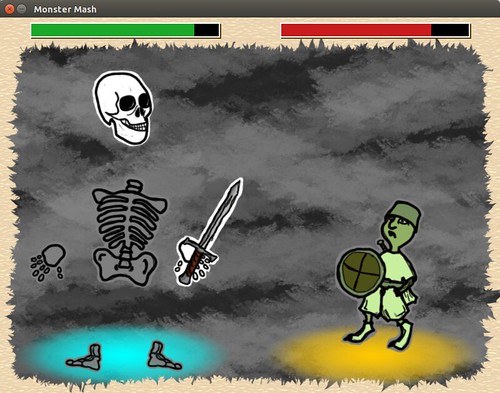
LD33 Monster Mash by BuddaT

The battle screen features your monster on the left and your enemy adventurer on the right. What I liked about it was how the interface was simple and abstract: click on the various body parts to attack and heal. When your enemy hurts you enough, you might lose the ability to use one of your body parts. It’s bizarre to see your head turn red to indicate it is disabled when the rest of your body is fine, but I bet it is terrifying to the adventurers as well.

I can see this experiment result in a genre of simple yet tactical mobile games.

Goloumo by HippGame is a quick platformer. While you can move about and jump, the way to make it through the game is to use your ability to manipulate other objects in space. Click and dragging a table or an elevator when you’re on it, and you can get to areas that would otherwise be impassable.

LD33 Goloumo by HippGame

It’s a rough experiment, but I can see this mechanic being used to great effect in a Nintendo DS game.

Sirens by miotatsu has you sing to lure ships towards your rocks. It’s art is a bit crude and the audio shows how little polish was expected, but it works well.
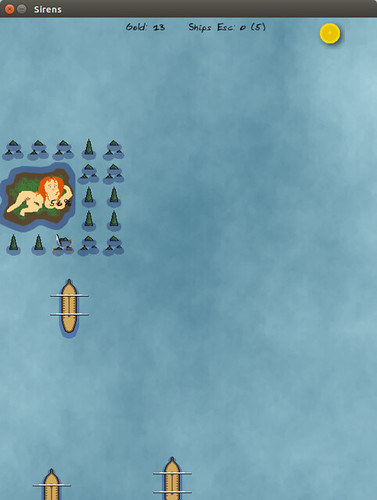
LD33 Sirens by miotatsu

It’s essentially a tower defense game in which the stationary rocks are both your weapons and your defense. Still, combined with the singing ability to lure ships in on purpose, I think Sirens has a bit more to it than might be expected.

Hydra Confusion by concalf has you controlling a hydra’s many heads, ensuring each one is fed and happy. If you mess up, a new head appears, which makes it more difficult for you to manage.
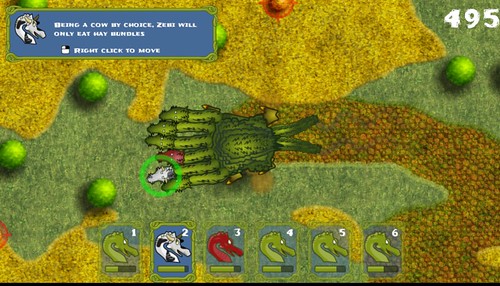
LD33 Hydra Confusion by concalf

Hydras were always cool, and I’ve never seen a game that featured one you could play! Moving about and controlling the individual heads isn’t terribly challenging, but managing them all at once is.

Fear Me by joe has you in the role of a monster trying to scare someone who is trying to sleep. You need to be just visible enough to scare without being too visible and caught.
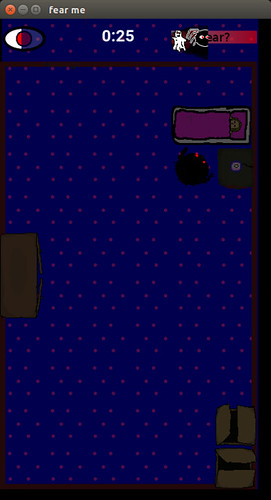
LD33 Fear Me by joe

It’s kind of like playing a character in Monsters, Inc. You can hide under the bed or in a box, but it takes up precious time. While I suppose Metal Gear did similar stealth mechanics, this is the first time I’ve seen you in the role of a scary monster.

What’s funny is how each Ludum Dare starts with the announcement of a theme that many people will vocally hate. When “Roads” was announced for Ludum Dare #13, I remember people complaining that everyone was going to make a racing game and it was going to be a boring theme. But like most LDs, there was quite a bit of variety present.

Similarly, people whined about “You Are the Monster” for LD #33, citing how hard it was to come up with an idea, and yet in just a handful of games I found that no two are alike, and they sometimes bear little resemblance to professionally-created games, but in a good way. It’s mind-boggling how much creativity Ludum Dare unleashed.

Years ago, I was given a jazz album to listen to while I worked, but it was so bizarre and jarring that I couldn’t concentrate. I looked up the artists, and it turns out that they combine “modern avant-garde jazz with rock and pop influences.” Ok, sounds great, but it sounded like random noise to me.

The thing is, I figured that it must sound good to a more practiced ear, and so I wondered what I was missing. When I asked a friend who is more of a music expert, he explained that avant-garde music is meant to be experimental. Often what someone discovers with avant-garde finds its way into the mainstream eventually.

Now, there is a lot more to avant-garde art. It’s not about being a proving grounds for new work but is instead meant to push boundaries and challenge traditional social values. It’s more political than commercial.

But the experiments do get leveraged to create commercial works.

And playing Ludum Dare entries, I’m reminded of this idea. The game mechanics might be rough and unbalanced, but there’s often a spark of cleverness.

Have you seen any interesting Ludum Dare entries worth noting?

Categories
Games

People Play Games in Ways We May Not Anticipate

Sometime back I had recommended Spryfox’s Alphabear to a coworker.

Yesterday he told me that his children love the game. Apparently they get 30 minutes of screen time, and instead of coding, they now play the word game.

He told me that it is very educational, and his son especially seems to be expanding his vocabulary by randomly picking letters until the game accepts a word as an input.

Now, I’ll admit, especially on the timed levels, I have also picked random letters if I’ve been stuck, but here was someone using it as his main strategy. He doesn’t need to know many long words because the game allows him to explore what’s possible on his own.

Maybe a player takes a strategy game and continually pauses it to make tactical decisions, effectively turning a real-time game into a pseudo-turn-based one.

Perhaps someone figures out how to use rockets to jump farther or higher in Marathon or does infinite bomb jumps in Super Metroid.

Or in this case, instead of someone using their extensive knowledge of obscure words to play a word game, they let the game teach them some.

Categories
Games Marketing/Business

Clinical Trials for Games? Brain Games Based on Real Science

I normally listen to audiobooks in my car, but I had just finished one and hadn’t visited the library yet to check out another, so I had the radio on.

I caught the tail end of an NPR story about a game trying to get approved by the FDA, so I told my phone to remind me to look it up later.

Will Doctors Soon Be Prescribing Video Games for Mental Health? by April Dembosky was that story, and it talks about the many games that claim they are good for your brain but don’t have any real science to back it up.

I’m reminded of Nintendo’s Brain Age. In its official title is “Train your brain in minutes a day!”

In 2007, CNN’s Linnie Rawlinson wrote up her experience playing it, asking Can Nintendo’s ‘Brain Training’ really boost your little gray cells?. While she had fun playing it, she didn’t believe the claims. She asked a neuroscientist about it and was told that while it may help, it’s “hard to measure the impact that brain training could have.”

The NPR story refers to a very, very long letter signed by cognitive psychologists and neuroscientists rejecting the claims:

In summary: We object to the claim that brain games offer consumers a scientifically grounded avenue to reduce or reverse cognitive decline when there is no compelling scientific evidence to date that they do. The promise of a magic bullet detracts from the best evidence to date, which is that cognitive health in old age reflects the long-term effects of healthy, engaged lifestyles. In the judgment of the signatories, exaggerated and misleading claims exploit the anxiety of older adults about impending cognitive decline. We encourage continued careful research and validation in this field.

One of those scientists decided it wasn’t enough to admonish game marketers and decided to try to create a brain game that would stand up to scientific rigor.

Neuroracer was the research developed by a team of neuroscientists and was specifically targeted at training cognitive control abilities. While it’s not commercially available, it did demonstrate how a game could actually help with cognitive ability.

Neuroracer was made for scientists as a research tool. Based on this technology, Project:EVO is the clinical product being created by Akili Interactive Labs. It’s been covered in many mainstream media outlets, but hardly at all in game press. I found one reference to Akili at Gamasutra, and it was a blog post by Noah Falstein on general neuroscience in games.

From the Akili Interactive Labs website:

Project: EVO platform is currently being tested in a variety of clinical studies in multiple patient populations around the globe, including ADHD, autism, depression, and traumatic brain injury.

It’s quite an ambitious endeavor. Adam Gazzaley, co-founder of Akili Interactive Labs, claims he has four other games in development if Project:EVO makes it through the gauntlet.

And with what Neuroracer demonstrated, perhaps there will be a growing market of science-based brain games that actually do help who they claim to help.

Categories
Game Development Games Marketing/Business

You Can Now Start Submitting Your Games to IGF 2016

The Independent Games Festival is now accepting submissions for next year’s awards.

The deadline to get your game submitted is October 26, 2015. Other key dates to pay attention to:

Early January, 2016 Finalists Announced
March 14 – March 18, 2016 Game Developers Conference 2016
March 14 – March 15, 2016 Indie Games Summit @ GDC
March 16 – March 18, 2016 IGF Pavilion @ GDC
March 16, 2016 IGF Awards Ceremony (Winners Announced!)

There are a few changes this year.

Brandon Boyer is stepping down as chairperson of the IGF, and Indie MEGABOOTH’s Kelly Wallick is stepping in.

The cost to entrants has changed in the interest of making the IGF more accessible. Instead of $95, the submission fee is now $75.

Similarly, now that student submissions are eligible for the main prizes as well as for the Best Student Game Prize, their fee is $25 instead of being free.

The other major change is in developer feedback.

Developer feedback has always been an optional part of the judging process and in general, having the game played in detail by multiple judges takes precedence over providing written feedback. While the feedback is well intentioned, without having a clear structure it is often inconsistent or on par with what a normal user playtest would provide.

So we’ll be removing written judge feedback – at least for this year – to concentrate on further optimizing the judging process, getting people playing as many games as possible and formalizing the feedback system.

The judging process had been under question in recent years. With the number of IGF submissions getting almost as popular as a Ludum Dare game jam, it was a lot of work for the judges to cover all of the games in a timely manner. But some developers found that their games weren’t even being played in the first place, and it wasn’t clear if everyone was getting a fair shot, especially after paying a submission fee for the privilege.

A more formal feedback system could only help.

How do you feel about the changes?

Categories
Games Personal Development

Five Nights at Freddy’s Creator Has Constructive Criticism for His Critics

In a post on the Five Nights at Freddy’s 4 Steam page, Scott Cawthon asked his more hateful critics to focus on something more productive.

After previous unsuccessful games, Cawthon has found a cult hit in his series about terrifying animatronics in a kid’s themed restaurant. And when you get some success, there will always be critics.

They’ll tell you that there are problems with the games. They are too simple, or the designs are imperfect. That’s fine. Feedback about games means someone is going to hate what someone else loves, and maybe some of that feedback will give you an idea for how to improve things next time.

But some people get personal, accusing Cawthon of milking his success and they spew plenty of vitriol as they do so. Success unfortunately also comes with people ready to tear you down lest you get too proud or comfortable.

Cawthon patted them on the head and dismissed them while simultaneously imploring them to do something with their lives.

But something more important that I want to convey to all of you, is that you should never listen to people who criticize success simply because it’s success. Being good at something is something to strive for, not something to demonize.

“Haters gonna hate.” –as they say, but I want you to know that focusing on someone else’s failure or success is the wrong way to live. People who make videos bashing other people are like people who run into a public square and scream into a pillow. They’ll get attention, but they won’t change anything. If you strive to be like them, then you’ll spend your life screaming into a pillow as well, and your life won’t mean anything.

He asked people to go out and make their own games, to contribute, rather than to spend their time putting down others.

Now that’s a role model.

Categories
Games

Can Games Address the Vocabulary Gap?

I didn’t know that vocabulary is hugely important in someone’s development. Children from poorer families tend to know fewer words than children from wealthier families.

And according to the 1995 study by Betty Hart and Todd R. Risly called The Early Catastrophe: The 30 Million Word Gap, it’s an enormous difference that would take a lot of time and effort to address.

What’s more, the exposure to words by children in poverty tends to be negative in nature. Silence means you aren’t in trouble, but it also means you aren’t growing your vocabulary.

As you can imagine, being behind by millions of words means you can’t build upon those words. You don’t read as much, which means you don’t grow your vocabulary on your own time. Advanced lessons can essentially become meaningless gibberish, and you fall further behind your peers as you get older.

Education Week recently published an article that mentioned the benefits of technology regarding vocabulary skills:

With the right technology, struggling students can gain not only more word experiences per unit of time than they can from traditional instruction; they can also gain the right word experiences to prevent them from falling behind, giving them a real shot at excelling and achieving their potential.

Games are all about learning. I recall playing Lemonade Stand and learning the word “advertising”. I didn’t know it, and then I encountered it in the context of the game, and I had to learn what it meant in order to play. Today’s games can feature positive audio and speech, and speech-recognition means the player can talk to someone in-game in a safe environment.

But I was also privileged to have a computer in my home, as well as a dictionary and the know-how to look it up. Not everyone has access to smartphones and tablets and consoles and computers.

Many schools are trying to address the technology gap by ensuring there are computers in the classroom, and some schools have programs to assign a laptop or tablet to each student. But is it enough to address the technology gap?

And where children have access to such technology, do they have the games geared towards helping them with their vocabulary, and as a result, the trajectory of their lives?

Categories
Game Design Games

What Games Teach Us About Relationships

The stereotype about video games is that they are played by loners, isolated in a basement somewhere.

It’s one person playing on a computer or a console, interacting with a machine instead of people.

And when you think about games such as Donkey Kong, Super Mario Bros, and the like, even if they allow multi-player, it’s usually just serial single-player, with one player waiting for the other player to lose or finish.

If a game is interactively multi-player, there tends to be an adversarial conflict. Pong pits one player’s skill against another, as do most sports games. The goal of many games is to defeat your opponent, whether you are talking Space War or Goldeneye. Your relationship to someone else is enemy vs enemy.

So games tend to lean heavily on the “you vs the world” narrative.

But games can also be cooperative. MMOs tend to have people band together. Star Trek Online has player-vs-player, but missions tend to be something you can take on with friends. Your relationship here is defined as allies, as teammates, or as guildmates.

But outside of MMOs, if there is a cooperative multiplayer, it seems to be notable. New Super Mario Bros Wii can be ridiculously fun and frustrating, but you’re all in it together. Most platformers weren’t simultaneously multiplayer in this way.

Board games and card games are often based on competition, but because they seem to be experiencing a surge in popularity and variety, it’s easy to find examples of cooperative games.

Arkham Horror by Fantasy Flight Games has players competing against the game system. While you might have one winner, everyone stands to lose if you try to go it alone.

Forbidden Island by Gamewright also has the players trying to collect all of the treasure and escape before the island sinks, and moves tend to be discussed before they are taken. “If you do XYZ, that would put us in a good position.”

Some games reinforce the idea that if you put your mind to it, you can accomplish anything. They are about private victories, as Stephen R. Covey would call it in The 7 Habits of Highly Effective People. You can be proactive. You can prioritize. You can keep your eye on the goal. It’s all about your independent thoughts and actions.

And some games reinforce the idea of interdependence, that we’re stronger together than we are apart. They are about public victories. You win together or you lose together.

I love competitive games, and I love a good solo game. Power fantasies can be fun, and there is nothing wrong with them. Saving the world on your own can be great.

That said, I do worry that if there are interpersonal lessons taught in some games, it is that other people are adversaries. If you treat life as a war, you versus the world, it can be very isolating and you’ll have a hard time working your way through reality which invariably involves other people.

In real life, you’d have allies, people who have their own agency and aren’t mere pawns in your game. You can accomplish more and do more in a team, and you’ll need to be able to interact with them as equals.

Some games remind you that you that there are other options than going it alone.

Categories
Game Design Games Geek / Technical

Learning New Old Games

Card Games

Last night, my wife taught me a card game she played with her grandmother earlier that day.

Hand and Foot is a Rummy game similar to Canasta, but it apparently has no standard rules. It was hard for us to look up what is allowed in certain situations. For instance, I was at the end of my Foot, and I had drawn two cards and now had an Ace and two Jokers. If I play them, I have no card left to discard. Am I allowed to do so, or do I have to discard at the end of a turn, meaning I can’t play my hand and must either give up a valuable Joker or an Ace.

It occurred to me that I’ve never played many card games. These days, I play Four Point Pitch and Up and Down the River with my in-laws, games I didn’t know a few years ago until they taught me. When I was younger, I played Solitaire, Kings in the Corner, and Thief with the Italian playing cards my parents always had on hand.

But as a game developer, shouldn’t I be more well played than I am? There are centuries of games out there, but if I limit myself to the popular video games of today, aren’t I also limiting my source for inspiration?

Granted, many are thinking that today is the Golden Age of Board Games. Between Kickstarter and popular cons, people are creating and playing games that aren’t the usual Scrabble and Monopoly. I’m participating in a few board game nights these days, whether it is at the day job or with friends, and I’m learning quite a few games.

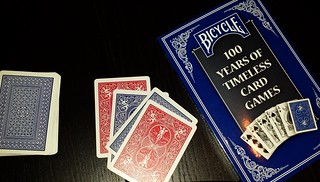
But I’m sure I can stand to learn a wide variety of card games. We even own a copy of the book Bicycle: 100 Years of Timeless Card Games, and I’ve never read it.

I’ve seen similar books on card games that are larger and probably more comprehensive, but 300+ pages of card games with their variations is a good starting point.

When playing Hand and Foot, I noticed a few self-regulating aspects of the game that were pretty clever. For instance, if you want to pick up the discard pile, you had to pick the entire pile up. If it was full, it meant you suddenly had a lot more cards in your hand, which means you can create melds more easily, but the discard pile might include multiple dangerous red 3s, and you can only get rid of each one once per turn. Have a red 3 in your hand reduces your score by hundreds of points. It’s a risk you might be willing to take if you have been struggling to complete melds, though.

Similarly, you might play all the cards in your hand until you have almost nothing left. That’s great, because you are close to getting rid of the cards in your hand, which allows you to pick up your foot (Oh! I get it now!), but it also means you have a harder chance of creating a meld and actually getting rid of those cards.

So just exposing myself to this one new old game got me thinking about game design. What if I spent time learning more such games in earnest? I wrote about consciously consuming information daily, and reading and listening to a variety of information is beneficial. I’ve been thinking about how important it is to also play a variety of games.

The great thing is, I already own a deck of cards. I’ve paid the expensive part. It can be quite the investment to get a new board game or video game, but a trip to the library might be all I need to do to find books on card games I could play with my existing deck.

Heck, I also have a bunch of dice, and I’m sure there are plenty of dice games out there, too.

It’s time to make a conscious effort to learn some new games. Got any recommendations?