Categories
Game Design Game Development Geek / Technical Linux Game Development Personal Development

LD#13: Breakfast!

I woke up this morning kind of groggy. I had to sleep on the couch because my cats left me a smelly surprise on my bed. I guess they didn’t like being locked out of the office. B-(

It snowed a lot last night. It’s very white out. I need to drop off my laundry at the laundromat, and I also want to go to the pet store to purchase Nature’s Miracle enzyme cleaner. Darn cats.

Anyway, breakfast!

Breakfast #1

I’m afraid I probably won’t do well in the food competition this time around, but we’ll see.

I’ve also been thinking about my project. Perhaps it won’t be a simple puzzle game because then I would need to design puzzles. I was thinking it could be an action game in which you play the role of the getaway car trying to outrun the police, but then I would need decent AI and it might end up being a clone of Pac-man. I’ll think a little bit more about this game.

Categories
Game Design Game Development Geek / Technical Linux Game Development Personal Development

LD#13: Road Lockdown Mock-up

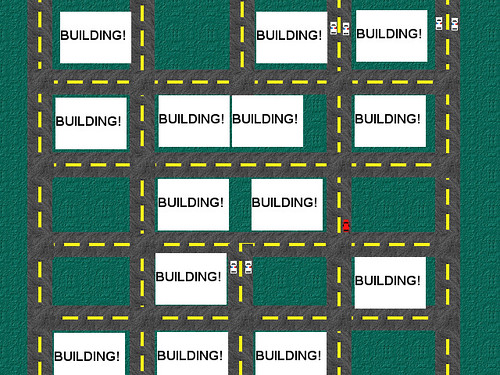
I liked the idea of the police strategically blocking certain roads so that the criminals can’t get away. Road Lockdown is my current name for the project, but it might change. B-)

Road-Mockup.png

From this mock-up, you can see the red getaway car of the criminals as well as the squad cars blocking the roads. I think I’ll keep the road images for the final game, and the cars seem to have come out fairly nice, I think.

I think I’ll go to sleep now. Tomorrow morning I have a lot of coding to do.

Categories
Game Design Game Development Geek / Technical Linux Game Development Personal Development

LD#13 Theme: ROADS

So the theme is Roads. According to the voting results, it was the only one with a positive number of votes overall, and yet the IRC channel is erupting with people surprised that it was the theme that won out.

What are some ideas?
– Building roads between cities to facilitate commerce.
– Managing traffic congestion.
– Planning/Acting on The Road Ahead for your life.
– Maintaining a small town’s roads.
– Transporting materials along a long road.
– Find your way without a map, searching for a lost road.
– Strategically shut down certain roads to guide a getaway car to the police.

There are plenty of ideas, and I’m sure I’ll come up with more.

Categories
Game Development Personal Development

Ludum Dare #13 Starts Tonight!

Ludum Dare, the 48-hour solo game development competition, will start tonight at 10PM CST. You can check all of the action at the main competition blog.

The theme voting had been separated into four rounds. The winning theme will be announced at the start of the competition, and we’ll have 48 hours to make a game based on that theme. There are currently 16 themes in the running.

As always, I’ll be cross-posting between the official Ludum Dare blog and my own blog. I’m looking forward to this weekend. It’s always fun, and it is easy to learn new things when you are focused so intently for two days straight. Be sure to check out my tips for participating in Ludum Dare if you plan on participating!

Last time I barely managed to put some game play into my submission, and while I got compliments for my approach, I got a lot of comments like, “Too bad it wasn’t a game.” My goal for this competition is to have the game play established within the first 6 hours of work. I’ll probably go to sleep at the start of the competition, so Saturday should see the basic game play before I stop for dinner if all goes well.

Good luck to everyone who enters! Let’s make games!

[tags] game development, game competition, ludum dare, indie [/tags]

Categories
Game Development Personal Development

Thousander Club Update: December 1st

For this week’s Thousander Club update:

Game Hours: 409.25(previous two years) + 130.5 (current year) = 539.75 / 1000
Game Ideas: 710 (previous two years) + 63 (current year) = 773 / 1000

I spent a lot less time working on game development than I wanted to over my vacation, but I hope a daily routine will help. Also, by Friday, Ludum Dare #13 will begin, so I will be working a significant number of hours this weekend.

I’m still working on cross-compilation scripts. I want the ability to build GNU/Linux AND Win32 versions of a game without the need to reboot into Windows.

[tags]game, game design, productivity, personal development, video game development, indie[/tags]

Categories
Game Development Personal Development

Thousander Club Update: November 3rd

For this week’s Thousander Club update:

Game Hours: 409.25(previous two years) + 126.5 (current year) = 535.75 / 1000
Game Ideas: 710 (previous two years) + 63 (current year) = 773 / 1000

It’s been over a month since my last Thousander Club update. Yeesh. I’m still in crunch at the day job, although it is winding down quite a bit. I keep expecting it to be over, but there is always one more issue found that I need to fix.

In the past week I’ve worked quite a bit on trying to cross-compile a single .cpp file for both GNU/Linux and Windows. And I’ve succeeded! It seems easy once you know what you’re doing, but if you don’t, good luck finding decent documentation on the topic. I keep finding information on building your own cross-compiler, even though most distros seem to have them available. I rarely find information on what you need to build an SDL app for Windows on your GNU/Linux system. The best documentation on the topic is currently at http://icculus.org/~dolson/sdl/, but even then I found most of the useful information is in the scripts rather than the documentation about the scripts.

As for testing it in Wine, I keep encountering problems, partly to do with the fact that I’m using an older version of Ubuntu and Wine. Wine still has some really weird issues. For example, there is a bug in Wine that prevents cout/cerr from being called more than once. WTF? This issue and the inability of the older version of Wine to work with SDL_mixer make it very hard to test my Win32 version of the app while I develop it.

And cross-compiling has its own issues. I found out that arguments to main() aren’t optional when cross-compiling with SDL. Otherwise, you get an undefined reference to SDL_main, which is a non-useful error message that is luckily easy to search for online.

Otherwise, I’ve been a little more productive in the past week. I also intend to learn to use mxmlc and other freely available Flash development tools. So far, ActionScript seems confusing. For instance, when you use the EMBED tag, you are telling it what resource to use. Let’s say you want to load an image called example.jpg. You would EMBED example.jpg, then create an Image object…but you never explicitly tell the Image object to use example.jpg. It just does. Weird.

For this coming week, I’m going to try to stay away from Flash/Flex, and try to get Walls closer to release. With what I’ve learned in my experiments with cross-compiling this past week, I think I should be able to release both GNU/Linux and Win32 binaries very soon. I’ll be writing up my own cross-compile documentation soon.

[tags]game, game design, productivity, personal development, video game development, indie[/tags]

Categories
Game Design Game Development Games Marketing/Business

Meaningful Play 2008

Gregg Seelhoff announced that he attended Meaningful Play 2008, an academic conference ” that explores the potential of games to entertain, inform, educate, and persuade in meaningful ways”, and he posted his notes.

  • Day 1: Want some good data on casual gamers and Flash game business models?
  • Day 2: Want some good data on 60+ year-old gamers as well as serious games?
  • Day 3: The wrap up, with some information about a panel on board games.

I’ve been thinking about the kind of games I wanted to make, and rather than create short-term sales product that will be thrown away within a week, I’d like to make games that matter. Games that stick around long after you’ve played them, like a good book or a good movie. I really liked the idea of an entire conference dedicated to meaningful play, and I hope I can attend the next one. There were some good nuggets of information that Gregg managed to report, such as who plays games at Pogo.com and for how long, but I especially liked reading the following on what kinds of serious games received good reviews:

An acceptable game (threshold 1) succeeded in the areas of technical capacity and game design. A good game (threshold 2) passed threshold 1 and, additionally, succeeded with aesthetics, visual and acoustic. For a game to be great (threshold 3), it had to pass both previous thresholds and also succeed in the final two areas of social experience and storyline (“narrativity and character development” is too long). Few games reached the final threshold.

Look at that! A prioritized list of what makes up a good game!

It’s unfortunate when you can’t play games because they are made for specific platforms, especially when there is always this emphasis on the ubiquity of Flash. Many of the games Gregg links to were Windows-specific, and they wouldn’t run in Wine. When so many of these games aren’t even meant to be commercially viable, is it still a valid argument that providing a port to other platforms such as Mac and Gnu/Linux would be pointless since having access to a few hundred thousand more players wouldn’t be worth it?

I would have liked to know more about Ian Bogost’s keynote, but Gregg provided some good notes for most of the rest of the conference. I have more than a few PDFs to download and read through.

[tags] meaningful play, game design, game development, serious games, casual games, conference [/tags]

Categories
Game Design Game Development Games Marketing/Business Personal Development

Now Is the Best Time to Make Games

Jeff Tunnell posts for the first time in a long time about how you shouldn’t fear the economy and should start your game business now. Yes, there is a lot of doom and gloom about how the economy is stagnating and people are worried about paying the bills.

But that just means there are less people willing to take the risk of starting their own businesses! Less competition means more opportunities for your business!

But how do you start? I wrote an article about Forming an LLC in Illinois, and running an LLC is much easier than running an S Corporation. If you don’t know the difference, there are plenty of resources online about the different types of business entities.

I also wrote about what an indie developer needs to know about copyright. Copyright laws can be quite complex, so it pays to know at least SOMETHING about them.

Not sure how to even start making games? I also wrote You Can Make Games, which describes how easy it is to get into game development, and the best part? It has gotten even easier since I wrote that article two years ago! With technology like PopCap’s framework (and TuxCap for people who want to recognize that there are people who use Mac and GNU/Linux), libSDL, and freely available Java and Flash web development tools, there should be nothing to stop someone with a computer, an idea, and a willingness to put some effort behind it from making a game.

There are great articles and other resources for running your game development business at GameDev.net. Advice can be found at the IndieGamer forums.

So what’s stopping you? And for that matter, what’s slowing me down?

[tags] indie, game development, video games, business [/tags]

Categories
Game Design Game Development Games

No Thousander Club Update for Two Weeks?!

These past two weeks have been very unproductive, so there just isn’t anything to report for the Thousander Club. Crunch at the day job isn’t over yet, and since it started getting a bit colder, I haven’t been feeling 100%.

Instead, how about a list of links to interesting indie-related things going on in the world today?

  • Jay Barnson continues writing about his first playthrough of Wizardry 8 in Swimming with Psi Sharks. I enjoy reading his design notes near the end of each post. I really need to break out my copy of the game and catch up to where he is, although Etrian Odyssey 2 does bring back memories of the Proving Grounds of the Mad Overlord.
  • He’s also written an update on the comedy RPG Frayed Knights in Dungeon Scrawls, in which he wrestles with the design of the dungeons so that each one stands out as memorable. I love behind-the-scenes stuff like this!
  • Anthony Salter continues his Let’s Play Starflight! series of videos in Quest for the Cloak. I have been watching him play this game, and it looks like a modern remake might be fun. I wonder how many older games would benefit from a remake that takes advantage of the state of the art in interface design and standardized control schemes.
  • He’s also posted a few updates of his Populous-like game Planitia. He’s added multiplayer capabilities, and there is even a video of it now! Watch Anthony get pwned by his daughter!
  • Cliffski has released Kudos 2! He also wrote about the post-release crush. Work doesn’t stop just because you’ve released your game.
  • Ludum Dare had a miniLD this weekend. The theme was very creative: MSPaint is the best level editor ever. All games made during this weekend have to be able to load the same levels, which are defined in 64×64 BMPs. Imagine a game like Rom Check Fail, only now imagine that a bunch of games can trade level data and they still run! Check out the entries at LudumDare.com!
  • EDIT: I just remembered that Keith Weatherby II has posted video of Hypno-Joe, and it’s looking pretty schnazzy!

What has everyone else been up to?

Categories
Game Design Game Development Games Marketing/Business

Is Casual Mutually Exclusive with Hardcore?

Years ago, Nintendo Power’s 100th issue listed the best 100 games of all time. Besides Mario and Zelda games, Final Fantasy and Dragon Warrior, there was the game listed at #3: Tetris.

I remember that a lot of people complained that there is no way that Tetris could be ranked so highly in such a list. In fact, people still complain when they see Tetris listed very highly in Nintendo Power’s most recent update of the list with the top 200 games.

Tetris is a great game. It was probably the first financially successful game that caused other game developers to say, “Wait, I’m crunching for years at a time, and I could have made THAT?” So why all the animosity? Oh, right. It’s a casual game. It’s too simplistic to be considered among the best.

But is casual really mutually exclusive with hardcore? Are these words really describing two different types of games?

Earlier this year, Corvus wrote that casual games can be identified as such by how forgiving they are. If you only have 5 minutes in your busy schedule to dedicate to a game, you’ll play Bejeweled sooner than you’d play Starcraft. Trying to play Starcraft in 5 minutes would be an exercise in stress management. You can’t just stop when you have to leave, so your choice is to keep playing the map you’re currently on, ruining your schedule, or quit and lose your progress. Bejeweled much more forgiving in this sense.

In this sense the GameBoy game Wario Land 2 was much more casual in nature than many other platformers. In this game, Wario was unkillable, a departure from the typical Mario-based platformers. If you can’t kill or harm Wario, what can you do? Solve puzzles! If you’re not very dexterous, the game doesn’t punish you the way Super Mario Bros would. Again, it’s very forgiving. Contrast Wario Land 2 with Super Mario Sunshine, which gives you a limited number of lives, requires you to restart a level if you fail, and features enemies and obstacles that can kill Mario. Super Mario Sunshine is very punishing. The challenge comes in punishment avoidance.

Contrast Strange Adventures in Infinite Space against Sins of a Solar Empire, two very different games. One lets you play multiple games within a matter of minutes, while the other one requires a much larger time commitment. Actually, if you’ve ever played SAiIS, you’ll know that the game also requires a larger time commitment simply because you won’t notice that an hour has passed and that you’ve played hundreds of sessions. Still, the interface for SAiIS is point and click and dead simple. SoaSE might have a good interface for strategy fans, it’s just hard to fathom someone fresh to video games getting it as easily as they would with SAiIS. And how about the difference in game play? If you lose a space battle or otherwise fail in SAiIS, it’s not so bad. Just start a new game, just like you would if you won. Try again. The sting of defeat isn’t harsh because you probably lost and won many games in the time it took you to read this post. Losing in SoaSE, on the other hand, is a bit more harsh.

So maybe there is a difference between casual and hardcore games, but I still think that there are steps that a game developer can take to make any game more accessible. Developers should take steps to make the complexity more manageable through the interface at the very least. And if your game is punishing the player for taking certain actions or for failing, ask if it is really necessary to punish him/her that badly. Hey, Nintendo! Do we really still need a limit on lives for Mario games?

[tags] indie, casual game, game design [/tags]