Categories
Game Design Game Development Linux Game Development Personal Development

October #1GAM Entry: Candypreneur

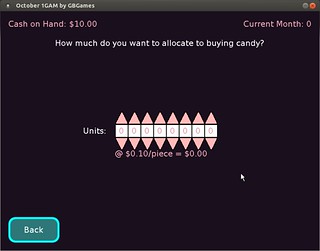
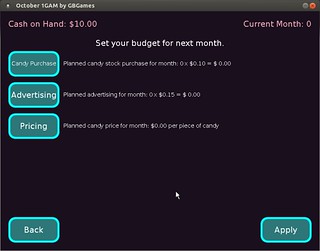
October’s One Game a Month entry is Candypreneur, a candy tycoon game inspired by the classic Apple II game Lemonade Stand.

Download Candypreneur for Linux 64-bit (432 kb tar.gz file)

I wish I had dedicated more time to this project. I had surgery and wasn’t able to work on it while I recuperated, and when I was able to spend time on it, I squandered it.

Still, I learned some things, such as that a best practice for representing money in software is by using integer values to represent cents rather than using doubles to represent dollars.

October #1GAM

October #1GAM

I wish I had time to theme it up a bit more. Some candy icons would have helped.

Also, the economics model is too simple. I managed to add random events that can impact the number of prospective customers, which you can sometimes prepare for if you check the reports screen for the upcoming month.

For this project, I had a much more complex simulation in mind. I wanted competitors, suppliers, customer moods, storefronts, candy ingredients, and research & development.

Even when I scaled down, I still didn’t put in things such as the rising cost of advertising or the ability to take out and pay back bank loans.

I’d say this is probably the project I’m least happiest with. I feel like there isn’t enough there, although some last minute additions make it less certain you’ll sell that candy.

Categories
Game Design Game Development Games Linux Game Development

September #1GAM: A Puzzle Game

For September’s One Game a Month project, I wanted to try to use the optional theme: hexagons.

I toyed with the idea of making a turn-based strategy game involving a hex map, but more and more I liked the idea of a hexagon-based puzzle game.

Long ago, I thought of a game involving hexagons that you can trap as they fell down shafts. The idea was that you controlled whether they continued down or got stuck at some point, but I never fleshed it out.

So I’ve been writing down ideas. Should the puzzle area be a grid that just happens to have hexagons? Do I make a hexagonal play area?

More importantly, what is the player doing in the play area? Do I make a match-3? I kind of liked the trapping mechanic, but I couldn’t think of a good way to make it fun.

Then I looked at the calendar and realized that over a week has gone by. So I thought I better steal some game play rather than try to create my own.

I recalled playing a QBasic game by Oren Bartal called Ultimate Super Stack. The point of the game was to trap stars between two objects, and I remember finding it very compelling. Maybe I can make a hexagon-based version of it.

I realized that there was a lot to the game, and I thought back to simpler puzzle games, such as Yoshi for the NES.

So I decided to try to mimic that game instead.

September #1GAM

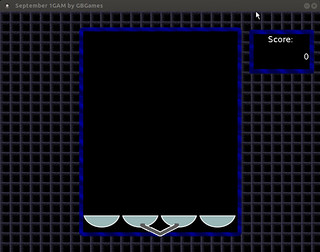
So far, I have four platforms in an empty play area, with a switcher at the bottom.

Eventually, I will add dropping objects, most likely shapes such as circles, triangles, and squares. If two objects match on top of each other, they’ll disappear. If a hexagon’s bottom piece appears, then it’s top piece can close it, along with any objects trapped inside of it.

The player will be able to move the switcher to one of three positions to swap the platforms and any objects sitting on top of them.

It’s a simple game, but I don’t anticipate having a lot of time to create it this month, what with me going to ISVCon 2013. We’ll see how it turns out.

Categories
Game Development Games

Aim for Purposeful Artistry, or “Just Be Games”?

Jay Barnson recently wrote Art. Or Not. He drew some parallels between science fiction and indie games. He talked about how older pulp fiction was how many great authors got their start, and some of their short stories became culturally relevant, and some of the authors became bigger names.

If I understand his argument correctly, he believes that they created art without specifically trying to do so, that the designation of artistry came later, after the authors tried to create good reads for the buying public.

The point is… many of the “classics” – the “masterpieces” that are held in such high regard today were simply yarns spun to pay the rent by these authors. Between a combination of good writing, good editing, a story that resonated with the audience, and possibly a healthy dose of good luck, these stories and serialized novels went on to become standards of excellence in their respective genres. The authors certainly did their best to make a great story, but I doubt they set forth with a prevailing desire to create “Art.”

Now, he separates “art” from capital-A “Art” without explaining too much about what he means, but I think it is safe to say that there’s a judgment call being made here on what he thinks counts as legitimate art versus art made out as more important than it really is.

In any case, while Barnson says he isn’t opposed to games having deeper meaning, he is concerned that indies are aiming to make games that are less like games and more like other, more traditionally accepted art as an attempt to make games relevant to critics, such as the late Roger Ebert, who is infamous for declaring that games can never be an art form unless they become more like movies.

Creating great art is difficult, no matter what the medium, but I don’t believe there are any problems with people trying to create art out of game mechanics.

I think one of the things that is difficult as an indie game developer trying to make culturally important works is that there is a perception that games are supposed to be fun, time-wasting playthings for children. To purposely make games that aren’t meant to be fun is hard for a lot of people to get their heads around. Games that aren’t fun sound like bad games to many players.

If you expect to play a game like Brenda Romero’s Train and think you’ll have the type of entertaining experience as when playing Ticket to Ride, you are going to be incredibly disappointed.

But the idea that video games can be more than merely fun is not a new one. Chris Crawford once gave a GDC talk about how, at a higher abstraction, entertainment is what games should aspire to. Fun is just one way to entertain.

As for aiming for art as opposed to letting “games be games”, why does it matter what purpose someone has for creating a game? Why does it matter who they try to please? If you’re an indie, who do you have to answer to but yourself?

F. Scott Fitzgerald was once quoted as saying “An author ought to write for the youth of his own generation, the critics of the next, and the schoolmasters of ever afterward.” He wasn’t writing to make money and leaving the question of his artistry to others.

So what about the idea that you don’t purposely try to create art, that it merely become so later? I don’t think it is necessarily the best way to go if you want to use the medium of games to create art. And some people specifically want to use the medium of games to create art. Or Art.

I’m with Jay on the idea that games are their own medium, that you don’t have to try to make them seem like other types of art. Games have their own strengths, and ignoring them would be much like how early filmmakers tried to record live theatre productions and not realizing how much more they could aspire to.

If you’re trying to make a commercially successful game, go ahead and try to please people, specifically your customers. But in most other endeavors, trying to please other people is a sure-fire way to kill what you’re trying to do with compromises.

If the creator of a game designs it to be art, it’s hard for me to argue that they are not trying to please their true audience.

Categories
Game Design Game Development Linux Game Development

August #1GAM Entry: Eye Contact

This month’s One Game a Month entry is probably the one I put the least effort toward. I worked around 7 hours on it.

Download Eye Contact for Linux 64-bit (362 kb tar.gz file)

August was a hectic month for me. My wife and I closed on a new house, which meant that most of my “spare” time was spent preparing the house and getting ready to move.

The theme for August was “Philosophy”, and I had originally envisioned a game about making eye contact with strangers.

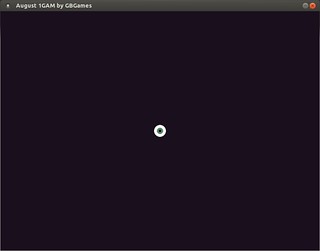
I wanted to have a very dark room, so you could only see yourself and your immediate surroundings. You can tell where the other people are because their eyes would be the only visible feature, similar to what cartoons did to show people walking around in dark rooms.

I wanted the eyes to be incredibly expressive. They should communicate attraction, danger, and sadness.

I thought that the goal of the game would be for the player to navigate a room, avoiding eye contact with dangerous and creepy strangers while trying to make eye contact with a potential romantic partner.

As you got closer to other people, you would see features besides their eyes: skin color, nose shapes, weight, etc.

And these other features wouldn’t matter at all.

That is, you might find that the potential romantic partner is not someone you might normally be attracted to in real life.

But with even less time to work on the game than normal, I had to scrap most of this design. I kept they eye contact idea, though, and I am pleased with what I came up with.

August #1GAM

I started with an eye that the player controlled, but eventually I realized that for the game I was creating, there was no reason for the player to be an eyeball. It was too confusing when you couldn’t easily tell your character apart.

August #1GAM

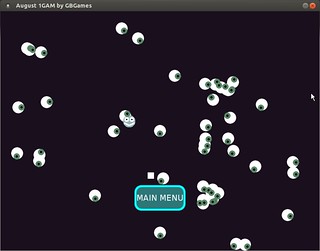
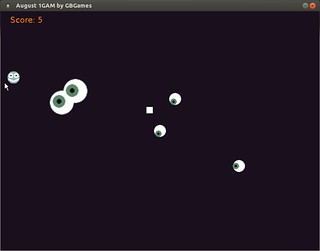
I made the eyeball a “guardian”, rotating around while the player tried to pick up squares in the area. When the guardian spotted the player, it would freeze for a second, then shoot towards the location. If the player touched a guardian, it was game over.

To add challenge, when a guardian shoots off toward the player, it would also leave behind a clone, so now there were two guardians looking for the player.

As you can see above, the game got exponentially difficult.

So I made one more change:

August #1GAM

August #1GAM

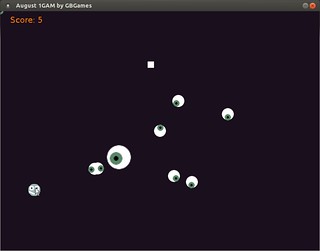
When smaller guardians touched, they combined into a larger guardian which constantly chased the player. This change solved the issue of too many multiplying guardians while also providing a different challenge to the player.

August #1GAM

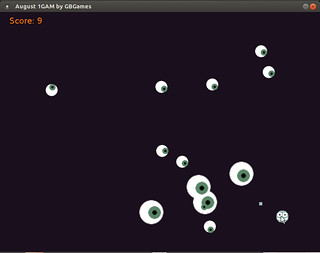
Finally, I made the pick up item look significantly different. A white box in a sea of eyeballs didn’t stand out enough, so I made it the same color as the player and also pulsated it. The animation made it stand out nicely.

I would have liked to have added a third type of challenging guardian, or added some way for the player to remove guardians. I would have also added sound effects and particle effects, but I ran out of time.

Despite not having a lot of time to dedicate to it, I really like Eye Contact. It’s one of my favorite #1GAM entries. There is something disconcerting about all of these eyes looking for you.

Categories
Game Design Game Development Linux Game Development

July #1GAM Entry: Shipwrecked

I’ve been working on Shipwrecked since June. Even then I realized that it was very ambitious, but rather that continue to work on it throughout the rest of the year, I’m going to call what I have done and move on.

Download Shipwrecked for Linux 64-bit (562 kb tar.gz file)

It’s amazing what a deadline can do to productivity, though. In the last few days of the month, I managed to add the ability to create objects, sleep, and go fishing.

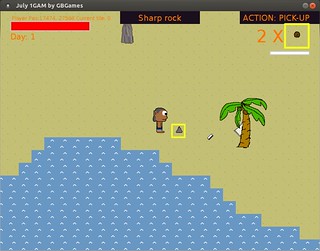
I created a number of new objects, including sharp rocks, fishing poles, and opened coconuts.
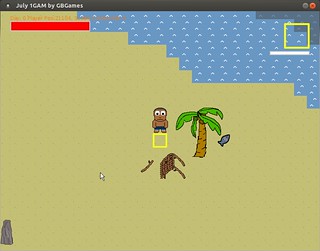
July #1GAM

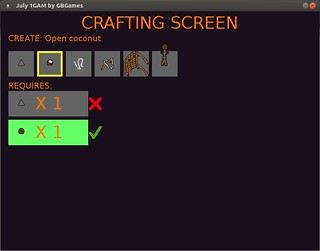
The crafting screen tells you what you can make and what you need in order to make it.
July #1GAM

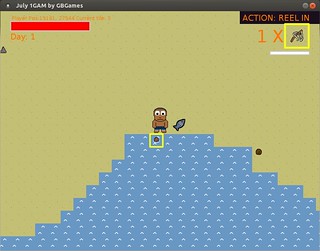
Fishing doesn’t work quite as well as I’d like.
July #1GAM

It’s too easy! Fish seem to sail onto shore for you, and I would rather it be more difficult, requiring patience and time.

If I had more time to develop this game, I know of a number of things I wanted to add:

  • Daily stamina, which reduces as you take actions, such as walking with heavy items or swimming, and requires rest to recover. Right now, sleeping simply fast-forwards time.
  • Food spoilage.
  • Encumbrance. I added weights to the objects, but the player can still carry an unlimited amount. I would like it if swimming was more difficult with too many items, for instance, so drowning is more likely.
  • Disease.
  • Weather, such as extreme heat, rain, and bad storms.
  • Other entities, such as sharks to pose as water hazards and crabs to be dangerous food sources.
  • Injuries.
  • Thirst.
  • Caves to explore.
  • Debris, such as crates floating to shore from presumably sunk ships. Suddenly life on the island is more interesting when combing the beach results in finding bottles of wine or magazines.
  • Morale and sanity. I had a vision of the player going insane the longer he/she survives. Insanity would manifest as coconuts being the heads of people walking around the island, for instance, or objects such as rocks suddenly being seen as edible.

I took cues from Harvest Moon and NetHack primarily, plus I always liked the book Robinson Crusoe.

I learned that surviving on a desert island is a very common theme in games. For example, Stranded by Unreal Software was released in 2003.

Most recently there is Wayward, and when I learned of it, I almost lost motivation to continue work. Here was a game that was a very in-depth, turn-based version of what I wanted to make, although I had no intentions of adding bears and giant spiders.

I also felt bad because I realized that I needed to provide a way to create objects, and adding a crafting element to the game made me feel like I was copying the big trend since Minecraft became famous. It seems as if every aspiring indie game developer is making a procedurally-generated world in which you have to use nearby resources to survive.

As for this game, despite working on it for almost 50 hours across two months, I’m afraid it doesn’t have a lot of depth. The island has its objects randomly generated within it, but it’s not a very interesting algorithm. I would have liked to have created an expansive island to explore, with jungles and cliffs, but for now, the island is populated with random trees, boulders, shells, branches (where are the trees that made those?), and empty nets.

Of course, it’s only 50 hours. I’m sure if I worked on it full time in a given month, I could have accomplished much more, and if I dedicate multiple months to working on it, I could have something richer.

So on that note, I got quite a bit accomplished for this project. B-)

What I learned, however, is that even if I have plans for a lot of inter-dependent systems in a game, I should implement one to completion before moving on to another. It took way too long after I coded in a system for hunger and starvation for the player to have a way to avoid such a death, for instance. If I added hunger, I should have added food right away. In a similar way, I created a lean-to because I had plans for a need for shelter, but I never did put in any reason for a shelter to exist. A number of items become merely ornamental as a result.

All that said, I really enjoyed making this project. I hope I come back to it in the future and flesh it out more fully.

Categories
Game Design Game Development Geek / Technical Linux Game Development Personal Development

July #1GAM: A Hundred Thousand Bottles Washed Up On the Shore

First, a reminder about my Stop That Hero! Birthday Sale that’s running all this week.

Get 40% off of my strategy game that puts you in the role of the villain by using coupon code BIRTHDAY2013 at http://www.StopThatHero.com to help me celebrate my birthday tomorrow!

Next, you can finally eat something in Shipwrecked, my July One Game a Month project.

While the game has let you starve to death slowly for some time, there’s been no way to avoid it until now.

I had a vision for an entire inventory system to manage, but in the interests of finishing this project, I’ve decided that pressing Tab is enough to cycle through any items you are carrying.

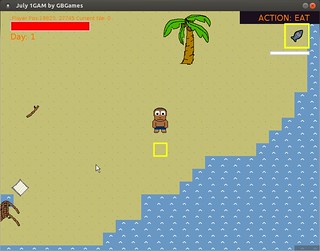
If you have an edible object in your inventory, and it is the currently equipped item, you can now use the Eat action.

July #1GAM

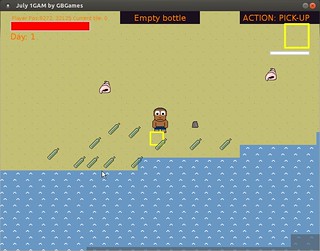
I also added a few more items to the game, such as bottles:

July #1GAM

My plan is allow you to fill bottles with liquids, but you shouldn’t fill it with sea water, which will actually dehydrate you. Which means I’ll need to make some fresh water somehow.

Which brings me to the problem I’ve been having with the creation of this game.

I have less than a week to get this project done by the end of the month, but there is still nothing really interesting to do yet in the game. I think if I learned anything from this project so far, it’s that you shouldn’t try to address an entire game’s features at once.

For example, when I added hunger to the game, I should have followed through with creating food, and then creating the ability to eat that food. Instead, I had various aspects of the game in various states of completion.

I have a lot of ideas and plans for this project, and I might be falling in love with it, which makes it hard to let go.

I’ll have to finish a minimal version of Shipwrecked for now so that I can come back to it another day.

No, no, Shipwrecked. Don’t speak. This thing is bigger than either of us.

Categories
Game Development Marketing/Business

My Sexy and Provocative Stop That Hero! Ad

What do you think of my new racy ad?

Stop That Hero! ad

Remember, Stop That Hero! is on sexy sale all this week because of my sexy birthday on sexy Friday. Use sexy coupon code BIRTHDAY2013 to get the game for Windows, Mac, and Linux for only a sexy $5.

Sexy.

Categories
Game Development Marketing/Business

The Stop That Hero! Birthday Sale

My birthday is on Friday.

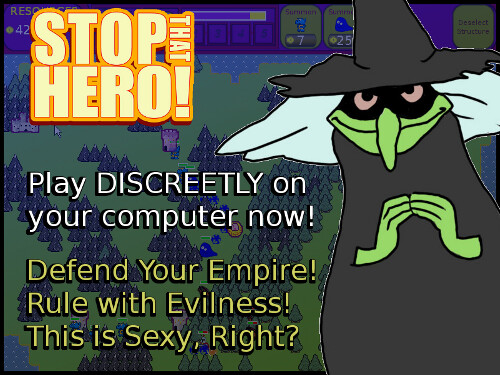
To celebrate, I think it would be great to spread the news about my strategy game that puts you in the role of the evil villain, Stop That Hero!.

Stop That Hero!  Bringing Evil Back

And so I’m having a sale all this week.

It’s still in alpha release, but if you’re interested in it, you can get early access to the game as well as support its development by purchasing it today.

Until Saturday, July 27th, the day after my birthday, you can get “Stop That Hero!” for only $5 using coupon code BIRTHDAY2013.

That’s 40% off the current price.

Currently, the game lets you summon minions such as slimes, warlocks, and dragons to fight the heroes who are trying to conquer your castle. The controls are simple since artificial intelligence manages who does what and where. You summon minions and manage your resources to do so by choosing when and whom to summon at structures you control, such as your castle, towers, and dragon nests.

Timing is important, and it can get frantic, especially when the heroes send powerful wizards and knights your way.

The next update will feature animations and more scenarios, and any current customers will get informed when it is released.

You can follow news about “Stop That Hero!” at the Stop That Hero! Facebook page and Stop That Hero! Google Plus page.

Thank you for helping me celebrate my birthday. I hope in return that I can entertain you with my work in progress so far, as well as with future updates.

Categories
Game Design Game Development Linux Game Development

July #1GAM: Keepin’ Up With the Joneses

In my last update, the player can pick up items.

Shortly after, I made it so you can also drop items arbitrarily, which means now players can properly propose with this game:

July #1GAM

Next on my task list was to create an inventory management system. I wanted the player to be able to equip arbitrary items and not just the one that was picked up first.

But of course, first I needed to create items to collect.

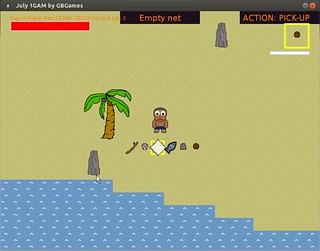
July #1GAM

That screenshot above shows a tree branch (clearly not from the coconut trees), a seashell, an empty net, a fish, a rock, and a coconut. Nearby are the coconut tree and boulder.

I want the player to be able to combine items together in useful ways. I don’t want a full-blown crafting system, but some way to fabricate useful tools out of other useful tools. An example of what I want is a lean-to made out of branches:

July #1GAM

Darn desert island IKEA furniture. There’s always one piece left over…

Another new part of the game is that you can shake coconut trees. If they have any coconuts, they fall out.

Well, they don’t animate yet, so a coconut appears wherever the player is.

What else can fall out of a coconut tree? Tarantulas, to add some risk?

Any bags or netting can also be shook to release items, although not yet.

What’s next? Eating would be nice. I can’t believe it is the middle of the month and there’s no nutritional content to this game yet.

And then the inventory system.

Categories
Game Design Game Development Geek / Technical Linux Game Development

July #1GAM: I’m Pickin’ Up What You’re Puttin’ Down

My last One Game a Month July project update mentioned updated exhaustion animation and more complex stamina and air supply systems, which I think added a bit of richness to the game.

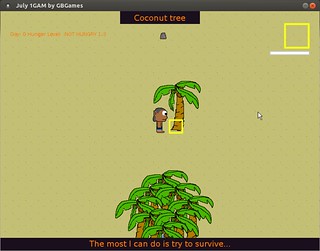
My most immediate goal was to be able to identify objects in front of the player.

July #1GAM

In the above screenshot, the player is facing a coconut tree, and a little bit of descriptive text appears.

July #1GAM

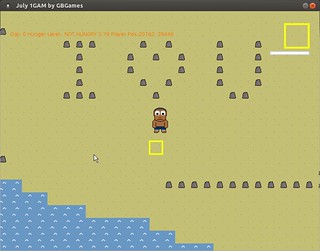
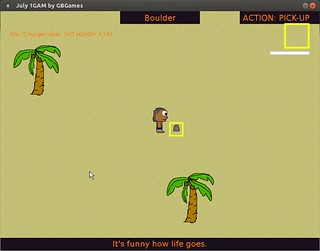
And as you can see, I shrunk the boulders. It’s temporary. I wanted to add rocks to the game, and rather than create a new object, I just changed how an old one is rendered.

You’ll also notice that standing in front of a rock results in an action becoming available. If you press the spacebar, you’ll pick it up:

July #1GAM

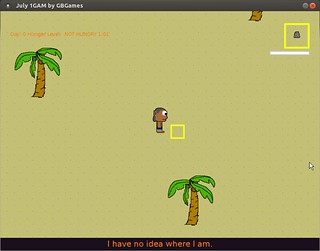
And that yellow box at the top right corner of the screen is your currently equipped item from your inventory.

Putting that box in required changing the UI slightly. I think it works out well enough:

July #1GAM

What happens when you want to change what’s equipped?

An inventory system is the next item on my list!

I want the player to be able to bring up an inventory menu to:

  • select and equip items
  • drop an item
  • eat/use/consume an item
  • combine items

That last one is how the resourceful Castaway will best be able to make the most of a life on a desert island. Combining tree branches would result in a lean-to, which the player can place to provide some shelter, for example.

As I think about all of the items and combinations, I realize that there’s a lot of systems to add to make them worthwhile. For instance, the lean-to is really only useful if I require the player to sleep and seek shelter from weather, which means I need some kind of per-day exhaustion mechanic and a weather system.

Also, can you combine sticks with rocks to make clubs? It would make sense to have a need for a club, such as attacking any wildlife you find for food.

Whoa, wait! What about the Low Violence Challenge? If you recall, I wanted to challenge myself to create games that were less about destruction and violence. I was inspired by Corvus Elrod’s Low Violence Challenge. It was surprisingly hard at first! I have a game idea file that was almost useless this year because so many of my one-line designs depended on “ATTACK” as the main mechanic.

While I think that adding combat mechanics necessarily adds violence to the game, it won’t represent the majority of the game play. Weapons and violence aren’t going to be the focus of this game. Yes, you can attack animals and eat their meat, but you can also opt to be a vegetarian. This game is about exploration and survival, and it is most definitely not about eliminating all other life on the island.

And besides, since it isn’t the core of the game, it’s probably not going to be the first thing I work on. I have less than three weeks to finish the game, after all.