Categories
Marketing/Business Politics/Government

GOG Galaxy: The DRM-Free Online Gaming Platform

I haven’t been following much of the news, but apparently GOG has an optional client to use that will automatically update your games and allow you to play online with friends.

They call it GOG Galaxy:

I found out about it because I just got an email offering me a free copy of Alien vs Predator Classic in exchange for joining their beta-test program. Oddly, for such a huge service, I am surprised I only just learned about it from them.

I’ve been a big fan of GOG’s DRM-free approach. I know Steam is now available for GNU/Linux, but I haven’t found myself too compelled to run it regularly. Most of the games I have purchased online came from the Humble Bundle or GOG, partly because they are DRM-free offerings I can play on my preferred system.

I know people like the convenience of Steam, but the concept of DRM, the idea that what I can do with the games I purchased is restricted in arbitrary ways, still bothers me. Single player games which require you to be online to play, or games that complain that I’ve installed them one too many times or on too many of my own systems? No thanks.

I’m interested in what GOG is offering, if only because it is optional and still allows me to play my games no matter what. I just wish that Alien vs Predator was available for GNU/Linux. As it is, I apparently signed up for the beta-test of the Windows version.

Categories
Game Design Game Design Workshop Wednesdays

Game Design Workshop Wednesday Exercise 2.8: Gripping Stories #GDWW

Each week, I’ll go through an exercise from Tracy Fullerton’s Game Design Workshop: A Playcentric Approach to Creating Innovative Games, Third Edition. Fullerton suggests treating the book less like a piece of text and more like a tool to guide you through the game design process, which is why the book is filled with so many exercises.

You can see the #GDWW introduction for a list of previous exercises.

This week’s exercise asks me to explain why any specific games might have moved me emotionally.

Story

I’ve written about the importance of stories years ago, arguing that games don’t need to dictate the story the way a book or a movie would. Games are interactive and allow for a variety of responses and developments, so I’m sometimes disappointed by games that can be reduced down to “Press the button to advance to the next page” because they don’t live up to the potential of the medium.

That said, story can be quite engaging. Like premise, it can give you context for what you do in a game, and discovering what happens next can be a motivating factor. I want to know how the Prince of Persia managed to stop the Sands of Time from spreading everywhere and consuming everything. I want to know if the Terran or the Protoss dominate. I want to know if this is finally the castle that Bowser has locked away the princess of the Mushroom Kingdom.

The exercise this week asks me if any stories within a game ever gripped me, moved me emotionally, or sparked my imagination.

In the past, I’ve written about great gaming moments, such as the Illusion of Gaia raft scene and the time I sent 30 pilots to their horrific deaths in Homeworld: Cataclysm. The second one is one of my favorite stories, which is a mixture of the story the game was telling and the story I created by playing it.

Throughout the war with The Beast, I never forgot those 30 ships. Technically, they weren’t more than digital bits running through memory on my computer, but the screams were terrible. The drama was real. The details of the names or types of ships involved in the above story might be remembered incorrectly, but the feeling of dread when I realized that I had just caused the deaths of 30 good people will stay with me. It wasn’t a cut-scene or a FMV movie to watch passively. I participated in it. Logically, it wasn’t my fault. I couldn’t have known what was going to happen without cheating. Technically I could have restarted the mission and tried again. I normally prefer the challenge in similar situations, but the reason for not restarting this time was different. I didn’t want to dishonor the memory of the loss. Oddly, those 30 fighters were identical clones of each other. It wasn’t like you normally would have a tie to any one of them.

Still, I had made a bad decision, and the consequences were very real to me. My fight wasn’t just to play a game anymore. It was for honor. It was for redemption. Neither of these ideals were communicated directly by the game. There was no “Honor Meter”, for instance. I simply had a strong desire to make things right again.

Ok, Past Self, you’re a little dramatic, but the point remains that the story in the game was a very engaging aspect of it. I internalized the story so that it was my own, and playing the game had new meaning for me.

Exercise Complete

Now I want to go back and play through all of the Homeworld games. I never did finish them. How does the fight with the Beast end in Cataclysm? And how do the original game and the sequel work out?

And how did I just find out that Gearbox Software has had the rights to the franchise and is working on Homeworld Remastered? I hope it is ported to Linux-based systems.

If you participated in this exercise on your own, please comment below to let me know, and if you wrote your own blog post or discuss it online, make sure to use the hashtag #GDWW.

Next week, I’ll wrap up chapter 2 by playing a simple game, then analyzing its formal and dramatic elements.

Categories
Game Design Game Design Workshop Wednesdays

Game Design Workshop Wednesday Exercise 2.7: Premise #GDWW

Each week, I’ll go through an exercise from Tracy Fullerton’s Game Design Workshop: A Playcentric Approach to Creating Innovative Games, Third Edition. Fullerton suggests treating the book less like a piece of text and more like a tool to guide you through the game design process, which is why the book is filled with so many exercises.

You can see the #GDWW introduction for a list of previous exercises.

This week, I’ll be identifying the premise of a handful of games.

Premise

This section of the book continues identifying ways to engage the player. Premise provides the context for the other elements in the game.

You can touch or avoid arbitrary positions in an area, or you can eat all the pellets while chasing or evading ghosts in a maze.

No one says, “I almost fulfilled the victory condition before I triggered the loss condition.” They say, “I almost ate all of the dots, but then the ghosts killed me.”

As games involve submitting yourself to constraints and trying to achieve some goal, the premise gives you the reason why.

This week’s exercise tasks us with identifying the premise of a few popular games.

  • Risk: each player is in charge of an army and fighting for world conquest.
  • Clue: each player is suspected of a murder and trying to identify who really did it.
  • Pit: it’s all about cornering the market in commodities
  • Guitar Hero: you’re struggling to become the next big rock star

Exercise Complete

You can see how a premise could make for a good starting point when trying to create a game, as it gives you a focus in terms of the player experience. The premise also lets your players know what to expect.

If you’re making a golf simulation, you want to mimic it as best as you can with wind speed and silence, but if you want to make a strange fighting golf game, you might have zany music and fast-paced action, with golf carts used as a means to quickly close in on opponents to strike them with your unrealistic and mechanized clubs in order to get the ball in the hole first. A fan of the first could be disappointed with the second.

If you participated in this exercise on your own, please comment below to let me know, and if you wrote your own blog post or discuss it online, make sure to use the hashtag #GDWW.

Next week, I’ll talk about games with gripping stories.

Categories
Marketing/Business Personal Development

RIP Saturday Morning Cartoons

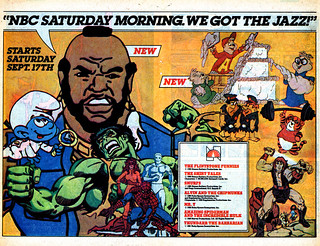
This past week, there has been talk about how the Saturday Morning Cartoon is dead. See NPR’s sendoff at ‘That’s All Folks:’ Saturday Morning Cartoons Bid Farewell. Last weekend was the first time in 50 years in which there wasn’t a block of cartoons broadcast on television.

Saturday Morning Cartoons Officially Dead

While cartoons were used to sell sugary cereal and toys to children, they were a great opportunity to teach a receptive audience.

Many of those shows were some of the only stories children heard, and they often featured public service announcements afterwards, which were little nuggets of education.

Popeye told you to wear your seatbelt even on short car rides. G.I. Joe told you that swimming during a thunderstorm is a bad idea. Inspector Gadget even demonstrated how to get a foreign particle out of your eye by allowing your own tears to wash it away. There were often anti-drug PSAs during the commercials.

Often the stories themselves were packaged lessons, a modern day Aesop’s fables. Even if you weren’t fighting ghosts with Slimer or writing home from Camp Candy, Saturday morning cartoons were arming us for life.

That said, I suppose when your cellphone is for all intents and purposes a Junior Woodchucks Guidebook, you might not need them anymore.

But I think we have a question to answer: what stories are today’s children hearing instead?

(Photo: Saturday Morning Cartoons Officially Dead | CC-BY-2.0)

Categories
Game Design Game Design Workshop Wednesdays

Game Design Workshop Wednesday Exercise 2.6: Challenging Games #GDWW

Each week, I’ll go through an exercise from Tracy Fullerton’s Game Design Workshop: A Playcentric Approach to Creating Innovative Games, Third Edition. Fullerton suggests treating the book less like a piece of text and more like a tool to guide you through the game design process, which is why the book is filled with so many exercises.

You can see the #GDWW introduction for a list of previous exercises.

For this week’s exercise, I’ll name three games I find particularly challenging and describe the reasons why.

Challenge vs Conflict

Last week, I published an exercise comparing and contrasting the conflict in poker and in American football. I touched on conflict as a core component of games. That is, without conflict, you don’t have a game.

Game rules and procedures tend to prevent a direct route to the objective of a game. For example, you can’t start playing in World 8-4 in Super Mario Bros. You must go through previous levels, dealing with obstacles and enemies, protecting your limited lives as you do.

Challenge is related to conflict. Challenge is one way to engage the player emotionally with the game.

If the conflict is too easy to overcome, that is, the challenge is too easy, it can be boring. Think of Tic-Tac-Toe and how young children find it enjoyable to play over and over again, yet grown-ups who know how the game is solved don’t need to play it anymore. Of course, a game which doesn’t adapt the challenge to a player who is learning how to play a game eventually feels similarly solved or mastered.

If the conflict generates a challenge that is too difficult, you have another reason why people stop playing a game. It becomes too frustrating to play.

A game designer has a tough job balancing the challenge in a game in order to keep players engaged.

What follows are three games I find challenging:

Pac-Man

I love Pac-Man. It’s one of my favorite games, despite growing up with the Atari 2600 version as my first experience with it. When I go to the local bar arcade, I tend to sink quite a few quarters into the Pac-Man upright there.

I haven’t memorized any patterns for it, so I play using my knowledge of the ghost AI.

I have yet to reach 50,000 points.

Each maze is identical, and the objective never changes, but, man, those four ghosts.

They have their individual personalities and maneuver the maze the same as always, yet the changing scatter and chase mode switch timings and the way they get just a little bit faster throws me off eventually. They usually get me when I’m being greedy and going for the fruit or trying to eat all four of them when it’s too late.

NetHack

NetHack

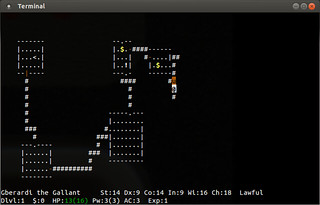
Every so often, I get the urge to play this game. I wrote about my stupid death by a shopkeeper in 2007 and my stupid death by lucky snake bites in 2008.

I have never recovered the amulet, and in fact haven’t made it much farther than a few levels down. I’ve been a fairly casual player of it.

That said, there is so much to do, and so much I learn each time. One of my favorite sessions involved freeing myself from a bear trap, then picking it up and taking it with me. Then I encountered a small band of gnomes. I was weak, and they were giving chase. I put down the bear trap, and wouldn’t you know it, NetHack allowed me to set it as a trap. I found out one of the gnomes got caught in it, giving me time to get away as bolts were raining down around me. It was a close one.

Between weird interactions like that and random events, each session always has at least one surprise. Usually, though, it’s death.

Wizardry 8

I had a few choices, between the RTS I struggle with or the RPG I never finished or the weird game I can’t wrap my head around. I decided to go with Wizardry 8.

I am apparently not very good at RPGs, because it took me a long time to have a total party kill and find that I didn’t get very far in the game. The game is incredibly hard to start with, since your party starts out fairly weak compared to the enemies you encounter.

When Jay Barnes did his Wizardry 8 commentary, I was impressed that he made it so quickly through. I had to stop reading it because I still have the delusion that I’ll finish the game myself and didn’t want any spoilers. I did learn that as polished as the game was, the balance wasn’t quite right, so yes, it is very difficult to fight enemies.

Besides the combat, there are the freestyle conversations, the lock picking, the magic, the strange mysteries, and more. I remember my last session years ago ending with a bomb blowing up before I could find a way to disarm it.

It’s not NetHack, but it was kind of punishing for the casual player. Yet, I will probably install it and give it another go one of these days.

Exercise Complete

Those are just three games that I find challenging, and I’m sure you can think of some more modern ones. As challenging as these games can be, I find that the sense of accomplishment I get is that much more enjoyable. When I passed 40,000 points on Pac-Man or made it one more level down in NetHack, it was progress that I found encouraging and satisfying.

If you participated in this exercise on your own, please comment below to let me know, and if you wrote your own blog post or discuss it online, make sure to use the hashtag #GDWW.

Next week, I’ll focus on the premise of games.

Categories
Game Design Game Design Workshop Wednesdays

Game Design Workshop Wednesday Exercise 2.5: Conflict #GDWW

Each week, I’ll go through an exercise from Tracy Fullerton’s Game Design Workshop: A Playcentric Approach to Creating Innovative Games, Third Edition. Fullerton suggests treating the book less like a piece of text and more like a tool to guide you through the game design process, which is why the book is filled with so many exercises.

You can see the #GDWW introduction for a list of previous exercises.

This week’s exercise: compare and contrast the conflict in football and in poker.

Conflict

Conflict is another core component of games.

A player asking for a card in Go Fish is also revealing to the other players what type of card is in his or her hand, making it easier for them to play, but not asking means a player can’t complete any piles.

In soccer, a team pushing forward on the attack risks the defenders launching a counter-attack if they lose the ball.

If you play a game such as Pac-man, your goal is to eat all of the dots in the level. Sounds easy, except the level is a maze, so it forces you to move through it by avoiding walls, and the maze features four monsters trying to kill you.

In all of these cases, the rules of the game ensure that the goal isn’t very easy to accomplish. A player’s actions tend to result in potential problems for themselves. Purchasing an upgrade in a strategy game means a lack of resources to spend on anything else, but not upgrading could mean a lost opportunity to win a decisive battle later on.

In American football, each side sets up their players at the line of scrimmage. When the play starts, the team in possession of the ball is trying to advance to the opponent’s end zone, while the defense is trying to stop them. The offense tends to have a variety of plays and formations to choose from, and the defense tries to anticipate the play as best as they can.

The offense can pass the ball up the field, run the ball up the field, toss the ball laterally, hand off the ball rather than throw it, or attempt to kick a field goal. There can be any number of plays and formations designed to succeed. For instance, while a formation might look as if…

…ok, you know what? I don’t know enough about American football to speak with any authority on it. Most of what I know comes from the movies Little Giants and The Replacements, and it turns out their plays are considered illegal in real life these days. The Annexation of Puerto Rico is actually known as the fumblerooski, which is even acknowledged in the film itself, but so long as you don’t actually put the ball on the ground as they do in the film, it can still work, as the Carolina Panthers demonstrated in 2011.

But the point is that each team is trying to anticipate the moves of the other. If a long pass is going to happen, you don’t want your defenders trying to deal with anyone closer to the quarterback, but at the same time, you don’t want to allow a short pass to turn into a first down of 70 yards because all of your defenders are at the far end of the field.

The Flop

In poker, each player knows the cards in his or her own hand, but no one else does. Keeping the quality of your hand a secret is a big part of the game. If you have a really good hand, you want your opponents to bet more money so you can win it, but if you inadvertently communicate how good the hand is, your opponents may fold, which renders your good hand useless.

Similarly, if you have a bad hand, you could fold, or you could try to make it seem as if your hand is much better than it is in order to get your opponents to fold in case their hands aren’t much stronger.

With poker hands, you don’t know what you’ll be dealt, but you can control how much you bid based on your own incomplete knowledge of the current state of the game. And of course, you can try to control your own facial tics and other body language that might give away what you know while simultaneously studying your opponents for their own tells.

While football is a game that runs in fits and starts, once a play is in motion, it’s a real-time situation. Lateral passes might move the ball around the field in ways that the defense didn’t anticipate, and fumbles result in quick scrambles to gain or regain possession as quickly as possible. Physical strength and dexterity plays a key role. A defender better have the ability to take down 300+ lbs of running muscle and armor.

Poker, however, is turn-based, and once a bid is made, it can’t be taken back. Playing a hand is very procedural and uses a regulated set of moves. The skill comes from decision-making and bluffing, not in physical dexterity.

But in both football and in poker, there are psychological games being played involving the hidden information inherent to the game.

Poker hands are secret, as are football offensive and defensive plays.

Sighing after looking at your cards can communicate that you think you have a terrible hand, or it could communicate that you’re merely trying to make your opponent think you have a terrible hand when in fact you have a good one. Bidding all-in when you have a two of diamonds and a three of clubs might force your opponent to fold, or it could be a really stupid gamble if your bluff is called.

Similarly, if your offensive formation is heavily unbalanced, it might indicate that you are trying to protect a runner on one side of the field, or it might be a ruse to force the defense to leave the other side of the field wide open for a pass or run. Faking a field goal attempt when you are actually making a run for the end zone or having your fastest defenders stay back farther to give the illusion of a gap that the offense will try to run through are ways in which you might try to anticipate how your opponent will react.

If you knew how the other players were going to act, you could choose the course of action that would be guaranteed to give you the advantage. Since you don’t know, your choices are made based on what you think will happen, and you and your opponents are both trying to be unpredictable while also trying to make the best moves.

Exercise Complete

While football has physical challenges that poker doesn’t, and poker has random draws of cards while football has no real randomness besides the coin flip at the start of the game, both games involve players trying to understand their opponents and predict what will happen next. And since the human mind is so complex, it’s not easy to figure out what other people are doing before they do it.

If you participated in this exercise on your own, please comment below to let me know, and if you wrote your own blog post or discuss it online, make sure to use the hashtag #GDWW.

Next week, I’ll focus on using challenge, which is related to conflict, to engage the player with the game.

Categories
Game Design Game Design Workshop Wednesdays

Game Design Workshop Wednesday Exercise 2.4: Rules #GDWW

Each week, I’ll go through an exercise from Tracy Fullerton’s Game Design Workshop: A Playcentric Approach to Creating Innovative Games, Third Edition. Fullerton suggests treating the book less like a piece of text and more like a tool to guide you through the game design process, which is why the book is filled with so many exercises.

You can see the #GDWW introduction for a list of previous exercises.

This week’s exercise: try to think of a game with no rules.

Rules

One key aspect of games is that they involve rules. These rules must be agreed to by all players.

rules

If you are playing Go Fish and refuse to give away your ace of spades even though another player asked if you had any aces, you are no longer playing Go Fish.

In basketball, you increase your score by putting the ball through the hoop from above.

However, you can’t stand on a ladder, moving the ball through the hoop constantly and rack up the points quickly.

Game rules describe what game objects exist, such as a basketball or a deck of cards, and also limit behavior. A golf ball is easy to put into a hole if you use your hands, but to play the actual game of golf, you need to agree that you’ll try to get the ball in the hole by hitting it with a club, which requires a lot more skill.

So, can a game have no rules?

Some games allow for more activity than others. Some games specify exactly how the players may act, such as describing how a knight may be moved in chess, others allow for more by not restricting actions. Basketball doesn’t require that you throw the ball into the basket to score. It simply specifies that the ball “enters the basket from above and remains within or passes through the basket.” So dunking the ball is just as valid a method as throwing it in terms of scoring, and while dunking is specified in the rules, it doesn’t necessarily have to be.

Games are varied, and some games are definitely more freeform than others. A game such as Fluxx actively modifies the rules as part of the rules of the game, but there are still rules.

Some games have hidden rules, such as the game of Mao, and part of the game is using inductive reasoning to learn how to play. By the way, playing with people who know two different variants but think they are playing the same version of the game is NOT FUN.

But a game with no rules? How would that work?

Even The Game (by the way, you just lost it) has rules.

Exercise Complete

A game without rules ceases to be a game. One can’t play such a game because participation is indistinguishable from living your life.

If you participated in this exercise on your own, please comment below to let me know, and if you wrote your own blog post or discuss it online, make sure to use the hashtag #GDWW.

Next week, I’ll compare conflict in a few games.

(Photo: rules by Joel Kramer | CC-BY-2.0)

Categories
Game Design Game Design Workshop Wednesdays

Game Design Workshop Wednesday Exercise 2.3: Objectives #GDWW

Each week, I’ll go through an exercise from Tracy Fullerton’s Game Design Workshop: A Playcentric Approach to Creating Innovative Games, Third Edition. Fullerton suggests treating the book less like a piece of text and more like a tool to guide you through the game design process, which is why the book is filled with so many exercises.

You can see the #GDWW introduction for a list of previous exercises.

This week, I’ll quickly describe the objective of five games.

Last week I wrote that we consider Go Fish and Quake 3 to be games despite their differences, specifically highlighting the fact that they are both designed for and played by players.

Continuing the comparison, both have objectives. The goal of Go Fish is to collect the most piles of cards, while the goal of Quake 3 is to fight your way through multiple tiers and defeat the AI-controlled bots.

As Fullerton states: “the objective is a key element without which the experience loses much of its structure, and our desire to work toward the objective is a measure of our involvement in the game.”

I like that description. I can think of times I was bored with a game I was playing, and at some point I didn’t care about finishing it. I can also think of my first time playing Minecraft, and hours passed without me realizing it as I built a large castle, complete with a minecart to take me up and down the mine for raw materials.

Objectives

Ok, let’s look at some games and try to identify their objectives.

Game Objectives

Mage Knight

Vlaada Chvatil’s Mage Knight is a very complex board game.

Very complex. There are a lot of moving parts in this game, and a lot of rules related to moving, attacking, hiring units, taking damage, exploring new tiles, revealing enemies and artifacts, leveling up your hero, raising and dropping your reputation, and more.

But ultimately, whether you are trying to find the city in the first scenario or liberating mines in a competitive scenario, the objective is to gain the most Fame, which represents how well you are doing and can be seen as victory points.

Monopoly

I used to be obsessed with Monopoly. I was never a fan of all of the [insert licensed brand here]-opoly derivatives, partly because they aren’t just themes but actually changed the rules.

A number of game designers might argue that Monopoly is broken game, and I know of a number of players who complain that it takes too long to play, but a lot of people get surprised when you tell them that there is a difference between what the rules actually say and the version of the game they probably played.

For instance, you don’t put money in the center whenever you pay the bank, and you don’t get to collect anything for landing on Free Parking.

Also, housing shortages are a tactic. The game has 32 houses and 12 hotels. If you want to buy a house, but all 32 are already being used by other players, too bad. You don’t get to use a scrap piece of paper to act as a placeholder. You just don’t get to buy a house.

It’s why I never buy hotels, because the fewer houses available for everyone else, the better off I am. It’s also why getting expensive properties might not be the best strategy because someone with cheaper properties can buy houses much more quickly than you can, leaving you with fewer or no houses, ruining your higher rent advantage.

The objective of Monopoly is to bankrupt your opponents, and without arbitrarily adding house rules to pump extra resources into the economy of the game, the negative feedback cycle is a lot quicker.

Council of Verona

Michael Eskue’s card game Council of Verona has a Romeo and Juliet theme.

It’s a quick game, and it’s easy to learn. People I’ve introduced it to picked it up within a game or two, and they seemed to enjoy it enough to keep playing.

In the game, you have the Council and Exile, and you take turns playing your cards, each of which has a character such as Prince Escalus or Lady Montague. Some characters allow you to play an action, such as moving a card from the Council to Exile or vice versa, and other characters have Agendas.

The cards with Agendas are the key. You bid your Influence tokens in the designated areas on these cards, and if the Agenda is met, the Influence tokens are counted and scored. Agenda examples are Romeo’s”Romeo and Juliet are together” or Lord Montague’s “More Montagues than Capulets on the Council.”

The objective of Council of Verona is to score the most Influence points.

Castle Keep

Castle Keep by Gamewright is another enjoyable and quick game.

It’s a turn-based game in which players draw and place tiles made up of castle keeps, towers, and walls. There are three colors possible for each type of tile, and towers and walls also come in three different shapes. You can place tiles next to each other if they match either in shape or color.

Instead of building your castle on your turn, you can attack one of an opponent’s walls. Any adjacent tiles of the same color as that wall are also destroyed, so there’s a danger to consistent interior design.

Castle Keep offers two objectives: to be the first to build a 3×3 castle or to destroy an opponent’s castle.

Liar’s Dice

Liar’s Dice is a dice game that should be familiar to anyone who has seen Pirates of the Caribbean: Dead Man’s Chest.

It’s a bluffing game. Each player starts with a set number of dice. All players roll their dice and peek at them in secret, and then each in turn makes a bid about how many dice are showing a specific number. For instance, you might bid that four dice show the number 3, and the next player might bid five dice showing the number 2.

After a bid is made, the next player can challenge the bidder, and everyone shows their dice. If the actual number of dice showing the number specified in the bid is equal to or greater than the bid, then the challenger loses one die from his or her collection.

If, however, the bid is not made, then the bidder loses one die from his or her collection.

The objective of Liar’s Dice is to be the last player in the game with any dice.

Exercise Complete

Clearly the objective has a huge impact on how a game is played and also how players are engaged. If you are low on dice in Liar’s Dice, you might be more conservative about bidding than if you had a full collection. If your opponent is closer to building a castle than you are in Castle Keep, you might be more interested in finding ways to knock down his or her walls than on trying to catch up.

If you take away the objectives of these games, there’s no point in playing anymore.

If you participated in exercise 2.3 on your own, please comment below to let me know, and if you wrote your own blog post or discuss it online, make sure to use the hashtag #GDWW.

Next week, we’ll focus on the rules of a game.

Categories
Game Design Game Design Workshop Wednesdays

Game Design Workshop Wednesday Exercise 2.2: Players #GDWW

Each week, I’ll go through an exercise from Tracy Fullerton’s Game Design Workshop: A Playcentric Approach to Creating Innovative Games, Third Edition. Fullerton suggests treating the book less like a piece of text and more like a tool to guide you through the game design process, which is why the book is filled with so many exercises.

You can see the #GDWW introduction for a list of previous exercises.

This week’s exercise: describe how players might join or start a game of Go Fish versus single-player Quake.

Quake 3 and Go Fish

Chapter 2 starts describing each of these games, which seem incredibly different, yet Fullerton points out that we all agree that these are both considered games and not two different types of entertainment.

So what do they have in common? What makes them both games?

An easy thing to point out is that each has players. Each game is designed for these players. A player is someone who voluntarily “accepts the rules and constraints of a game.”

Ok, but how does a player start a game of Go Fish?

It requires three to six players to agree to play at a specific time and place together. That place should also be available. You can’t play if you decided to meet at a park bench, only to arrive and discover that it is occupied by a family having a picnic.

Someone needs to bring a standard deck of playing cards, and someone has to be chosen as the dealer to deal out cards and determine who starts the game.

Depending on schedule conflicts, space availability, and how much any participant is willing to let someone be a dealer, it can be more or less difficult to arrange a game. Trying to play with two young children who are insistent that each should go first could derail the entire experience.

And Quake? Well, I’ll be honest. I’ve never played the original Quake. I’ve played Quake 3, however, and while it is best played in a multiplayer environment, it is possible to play it by yourself against the computer-controlled opponents.

To start a game of Quake 3, you need a computer with the hardware capable of playing the game. That computer obviously shouldn’t be in use by someone else, and we could dive deeply into the technical aspects, but here’s a summary:

  • the computer should be on
  • the right drivers should be installed
  • the game should be installed
  • the game should be launched
  • (optional) you should configure your controls
  • (optional) you should configure your avatar
  • click SINGLE PLAYER
  • choose your level
  • wait for the game to load the level

There are other requirements, such as needing your electric bill paid so you can power the computer in the first place. Or perhaps you are playing in an Internet cafe or at your college campus computer lab, which each require some level of payment at some point for you to gain access.

But in both cases, you needed to decide on a time to play the game. Playing the game requires a dedication of time beyond the start time. Whether you play for 30 minutes or three hours, it takes time that you aren’t spending on some other task.

Both games require your presence to play. Even if you are waiting your turn in Go Fish, you are an active participant, especially when someone asks you about your cards. In Quake 3, the game happens in real-time and requires your attention at all times.

Both required more than just the players. A deck of cards is much less expensive than an entire computer and the cost of a copy of Quake 3, but the point is that in each case you need materials to play.

Exercise Complete

This exercise was relatively short, but it still drives the point home: there is something about games, and specifically the nature of the need for games to have players participating, that makes them games.

If you participated in exercise 2.2 on your own, please comment below to let me know, and if you wrote your own blog post or discuss it online, make sure to use the hashtag #GDWW.

Next week, we’ll look at objectives in games.

Categories
Game Design Game Design Workshop Wednesdays

Game Design Workshop Wednesday Exercise 2.1: Think of a Game #GDWW

Each week, I’ll go through an exercise from Tracy Fullerton’s Game Design Workshop: A Playcentric Approach to Creating Innovative Games, Third Edition. Fullerton suggests treating the book less like a piece of text and more like a tool to guide you through the game design process, which is why the book is filled with so many exercises.

You can see the #GDWW introduction for a list of previous exercises.

This week’s exercise: describe a game as if your audience is someone who hasn’t played anything like it before, then do the same with a completely different game. Compare the descriptions.

Chapter 2 is all about the structure of games, and this exercise is meant to get you thinking about what makes a game a game.

Rune Factory and Iota

Rune Factory: A Fantasy Harvest Moon

I’m playing Rune Factory: A Fantasy Harvest Moon these days for the Nintendo DS, and since it is so fresh in my mind, I’ll describe it first. It’s a complex game, so brace yourself.

You play the role of a young man who can’t remember who he is or where he comes from, and after stumbling across a woman’s house, she puts you to work tending the farm in return for letting you stay on the land. After fighting a monster off, there’s a hint that perhaps you were a soldier, but for now, you’ll plow the land, plant and water seeds, and clear out weeds and rocks to make room for it all.

Time

Time matters. Each day begins at 6AM, and every 10 real life seconds you are playing, 10 minutes passes in the game. You can’t stay up 24 hours or you’ll collapse, so at some point you need to go to bed. There is a calendar system that is a bit unique: each week is five workdays and one holiday long, each season is five weeks long. The seasons dictate what crops can be grown on the farm. For instance, strawberries are a spring crop, and so they can only be grown during the spring season.

Time only passes when outside or in a cave. If you are inside a building, such as your house or a shop, time stands still, which means you can explore the indoors to your heart’s content. It makes exploring the library very unrealistic. B-)

Your Home
On your farm, you have a house, which is where you sleep and save your game. I’ll describe more about the house later.

Near your house is the shipping bin, which is where you can place harvested crops, fish, or any number of items in order to sell them. On non-holidays, you can expect Rosetta, one of the people from town, to pick up everything, and you’ll get paid the next day.

Near the shipping bin is your well, which allows you to refill your watering can. You can also fill your watering can at the nearby stream, which also allows you to fish if you have a fishing pole.

At the southwestern part of your land, there is a woodshed, which is where you store any chopped wood. You can collect wood to build fences on your fields, or you can save it to expand your house or build monster huts. The monster huts will be built to the east of your house in an area north of your field.

Your field is a large area of land that you’ll use to grow crops. Weeds and branches will appear in untilled areas, and there are large tree stumps and boulders. Some large rocks can be moved, but you’ll need upgraded tools to get rid of the rest to clear the way to maximize the size of your farm.

Farming and Fishing

The land is separated into tiles. You’ll use a hoe to till a tile in your field. It’s suggested you till a 3×3 area, then stand in the middle to plant seeds in all 9 tiles at once. Then, using your watering can, you can water each tile.

Each day you need to water your fields where you planted the seeds until they are mature crops you can harvest. If it is raining, you don’t need to water them. If your plants don’t get water, they stop growing.

It can take anywhere from a few days to a few weeks to mature depending on the type of seed. After they are fully grown, the crops can be picked and placed in your pack, or you can carry them over to the shipping bin.

Seeds can only be planted on your farm during certain seasons. They won’t grow if planted in the wrong season, and you won’t be able to harvest your crops if you enter a new season in the middle of growing the previous season’s plants.

There are caves in the world around your farm, and each one has a different permanent climate. That is, even if it is winter, you can grow summer crops in a cave with a summer climate. The trick, of course, is that you need to water those crops, which takes time.

When you have a fishing pole, you can fish anywhere there is a body of water. The stream near your house is one example, but there is the end of the dock on the beach, or even the water near the ruins.

There is a variety of fish you can catch. Some are more valuable than others, and they come in different sizes which also impacts the amount you can sell them for. Don’t be surprised to find the odd boot mixed in with your prize-winning sardines.

Village
To the north of the farm is the village of Kardia You can find most of the people there. Everyone has their own simulated life. Some people show up in town only on holidays. Stores are open only during certain hours, and people will arrive or leave areas depending on where they work or who they might be talking to.

The village has three streets featuring the shops and homes of the residents. The southern street has:

  • Library
  • Clinic
  • Parts Shop
  • Pub Spring Rabbit
  • Inn
  • Blacksmith

The middle street has:

  • Hot Springs
  • Neumann’s Farm
  • Camus’ Farm
  • Kardia Chapel

The northern street has:

  • Mayor Godwin’s Manor
  • Jasper’s Manor

To the east of the village is the beach, which features the Spearfish Shack, a dock to fish off of, and a giant shell which can be used to transfer screenshots and items to another player’s game using the Nintendo DS WiFi capability.

Each of the buildings has their own hours, which means if you try to go shopping too early or too late, you’ll be out of luck.

To the north of the village is the Town Square, which is where festivals are held.

In a house to the south of your farm is where the young woman who found you lives.

Relationships

There are 28 people who you can talk to, trade with, and give items to. 10 of them are potential love interests and brides for your character.

There is a Friendliness menu in the game which allows you to see the status of your relationships. You can see how your neighbors like you, as well as how your wooing of potential brides is going.

You can increase the friendliness levels by talking to people and giving them gifts. People have preferences, so giving them gifts they don’t care about has a similar effect as in real life.

Once your love interest cares enough, and if you’ve upgraded your house and bought the right furniture, you’re ready to settle down. In order to propose to her, you have to meet some criteria. Each woman has a different set of criteria you must meet, such as how many monsters you have on your farm or giving a specific gift.

When married, your wife will provide you food each morning to start your day, which you can treat as a snack to replenish your health and stamina after a hard day’s work, or you can sell it.

If you are married long enough, you’ll have a child. As far as I know, the child has no in-game purpose other than to mark the amount of time you’ve spent married.

Health and Stamina
You have two resources: health and rune points. Rune points, or RP, act as your stamina.

Every action you take uses up RP, and when you run out, your health starts to deteriorate.

If you run out of HP in your field, you’ll collapse and wake up in bed the next day, losing a good part of your morning.

If, however, you run out of HP in a cave, the game is over.

You can restore RP and HP by sleeping for the night, by relaxing in a hot spring bath in town, or eating food. RP can be replenished by picking up runes that appear after a crop is harvested, and HP can be restored with potions or medicine.

Tools and Items

Early on, you’ll receive a hoe, a watering can, and some seeds from Mist, the young woman who allowed you to stay on her farm. By talking to people and meeting certain criteria, you can gain access to other tools, such as the ax, fishing rod, and the sickle. Each tool allows you to perform a specific task. An ax lets you cut down the branches you find on your field, which converts to wood in your woodshed, while the Friendship Glove allows you to befriend monsters you find in caves.

There is a wide range of items in the game. Some aren’t very useful, such as the stones and weeds you find in your field. Crops, herbs, fish, and eggs are examples of basic items, and if you have the right machinery or tools, you can turn them into more advanced items. For example, if you have a cookbook and a kitchen, you can turn a fish into sushi, which is more valuable and can be sold or eaten for greater benefit.

You can give items to people, although most of the time you’ll sell items for profit. You can sell items by putting them in your shipping bin on your farm or by talking to shop owners in the village.

Caves

You won’t be allowed to enter the caves until you’ve gotten a pass from the mayor, who requires you to have tilled a number of tiles on your field first.

The caves have monsters and monster generators. You’ll be able to fight them with your tools such as the hoe or ax, but you’ll probably want weapons such as swords and spears. You can also defend yourself with shields.

Fighting happens in real time. Monsters will attack you, and you can either attack back or use the Friendship Glove to try to pet them until they like you. Befriended monsters teleport to your farm if you have a hut for them to live in, and depending on the type of monster, they can work your fields, allow you to harvest items from them, or help you fight in the caves.

You’ll learn magic to teleport yourself to safety, to heal yourself, and to attack monsters. Your monsters may use magic to fight for you as well. Magic costs rune points, even if your monsters are the ones casting the spells.

Caves also have fields, and since their climate is so stable, you can plant crops you normally couldn’t at any time of the year.

You can also use a hammer against certain rocks to collect ore, which allows you to upgrade your tools and weapons.

Enough!

There are a lot more details to explain, but I think this post is getting long enough. Let’s move on, and to a smaller and quicker to describe game, please.

Iota

Iota by Gamewright, “the great big game in the teeny-weeny tin,” is a card game for 2 to 4 players. The objective of the game is to score the most points by adding cards in lines connected to a grid.

A line is defined as 2, 3, or 4 cards in a straight row or column. There are specific rules for how such cards can be placed in lines.

There are 66 square cards. 64 cards have three properties:

  • color
  • shape
  • number

Each of these cards are unique. Two cards are wild and can substitute for any other card.

Setup

Each player is dealt four cards which can be looked at but should be kept a secret from other players. The other cards are stacked face-down to create a draw pile.

One card from the draw pile is placed face up in the center to act as the start of the grid.

Play

Each player takes turns and can either:

  • add cards in a single line, then record your score
  • pass

When passing, a player may discard any number of cards to the bottom of the draw pile.

At the end of your turn, you replenish your hand back to four cards.

Game Over

The game ends when the draw pile is empty and a player has played his or her last card, which gives double points for that turn.

The player with the highest score wins.

Adding Cards and Scoring

When adding cards to a line, there are certain rules to follow:

  • Cards must be added in a straight line. You can’t place cards anywhere you choose, and you can’t make right angles.
  • Added cards must connect to the grid.
  • In each line, all cards must either be the same or different in each property. You can’t have a 3-card line with two circles and a triangle because the shapes must be all different or all the same, for example, but you can have a 3-card line with three circles so long as the colors and/or numbers are different.
  • Creating a 4-card line forms a lot, which doubles your score for the turn.
  • Lines can only be four cards long.

After you place your cards, you add up the numbers on the face of all of the cards in the lines you either created or extended, counting cards twice if they are part of two lines.

Then double the points earned for each lot created.

If you used all four of your cards, double your points again.

Wild Cards

The wild cards can be used in place of any other card and are worth 0 points.

Before your turn, you can replace a played wild card with a card from your hand that matches. That is, if the wild card is part of a line of three green circles and is acting as a green circle with a value of 4, you would need a green circle with a value of 4 to replace it.

You can then play it on any turn.

Wild cards that are part of two lines must represent the same value on both lines.

Comparing Rune Factory and Iota

One is an involved story-based, single-player, farming simulation and role-playing game. The other is a family-friendly card game that can be played in about half an hour.

There are clearly a lot of differences, but what similarities are there?

While it wasn’t called out above, Rune Factory does have a setup. The player is initially told that his or her character is a young man with amnesia. He is given his first tools and an explanation of how to work the field. Combat ensues immediately to introduce the concept of monsters. Afterwards, the real game starts.

They both have rules. Iota says how cards can be placed, how scores can be tallied, and what can’t be done.

In Rune Factory, the rules are more complex and are enforced by the programming of the game. How time passes, and how various events occur based on the time, are just some of the interlocking rules.

They each have dynamics that occur as a result of playing. If you can’t place more than four cards in a line in Iota, and if you can’t place certain cards together in a line, then sometimes gaps will occur in the grid that cannot be filled. Sometimes a player will place a card on a line that prevents another player from placing his or hers.

In Rune Factory, seeds get planted in a 3×3 grid. If you till a 3×3 grid, all will get seeds, but if you till only part of it, either due to weeds or rocks being in the way or some other reason, then you are wasting some of the potential return on the cost of seeds. If radish seeds cost 200 gold, and you can sell each harvested radish for 60 gold, then you need to sell at least four radishes to make back your investment. If you can’t, you lose money, which prevents you from purchasing other supplies.

Each has a designed look and feel to it. Iota is colorful, and the cards are of a certain quality. The cards are all you need to play, which allows you to focus on them as the main elements. Rune Factory has a lot of music, sound effects, story, illustrated graphics and animations, and more to immerse the player in the game.

Iota has a very clear ending with a victor, but what about Rune Factory? Can you win it? While Rune Factory lets you play forever, the storyline can be completed.

Exercise Complete

I am sure I can compare them in many other ways, and chapter 2 does go into the structure of games for quite a bit, but we’ll consider this exercise finished. I already found enough accidental spoilers for Rune Factory during my research, and this post is way too long now.

If you participated in exercise 2.1 on your own, please comment below to let me know, and if you wrote your own blog post or discuss it online, make sure to use the hashtag #GDWW.

Next week, we’ll compare how players start games of two seemingly different games.