Categories
Game Development Marketing/Business

Indie Game Sales Guide Is Out

I just learned that The Indie Developer’s Guide to Selling Games is available to purchase. It comes in both PDF and dead-tree formats. The table of contents indicates that it is really a marketing book, although marketing and sales do go hand-in-hand.

I already enjoy reading Joseph Lieberman’s blog, so I imagine that the book will be a good read, too.

Categories
Games Geek / Technical General

The Name Everyone Is Talking About

Even Seth Godin had something to say about Nintendo’s Wii, so I felt that I should comment.

My first impression? I thought it was a terrible name. I get the concept of “togetherness” and all, but Wii? Seriously? I won’t try to make a bad pun with it because anyone who was on the world wide web after last week’s announcement would have read them all anyway.

Interestingly, I feel that now that everyone has gotten it out of their systems, we can all agree that Playstation and XBox were pretty bad names as well. We’ve gotten used to them though, so if Nintendo doesn’t make a new announcement admitting that they made a mistake, we’ll probably get used to Wii, too.

Still, I’m shaking my head. Does it make more sense in Japan at least? Are the Japanese wondering what the big deal is with the rest of the world’s reaction?

Categories
Game Development Personal Development

Thousander Club Update: May 1st

For this week’s Thousander Club update:

Game Hours: 76.5 / 1000
Game Ideas: 294 / 1000

Target: 294

w00t! I finally made it to 7%! In fact, I nearly made it to 8%! There were a number of times when I didn’t think I would be able to program, but somehow a few moments became 15 minutes or half an hour. Waiting for someone to show up to have dinner? An hour. The time was passing anyway, and I managed to use it productively. As for game ideas, I found that I could rattle off three easily as one of the first things I do in the morning.

I managed to finish the text-based board game I was working on. Actually, I’m still tracking down potential memory leaks, which gives me a good opportunity to learn how to use Valgrind. Still, all of the features are there, but I’ll go into more detail in a post later this week.

Categories
Game Development Geek / Technical

How to Survive Ludum Dare

mrfun has posted A Guide to LD48, aka, How to Not Crack Under the Incredible Pressure.

I thought it was a pretty humorous look at the intense preparation needed to succeed at Ludum Dare. Good luck!

Categories
Game Design

Interesting Game Ideas: Bird Fight

Game Idea:
Bird Fight

Premise:
A war between Pigeons, Doves, Ducks, Seagulls, and Humans.

Huh?:
I remember thinking about birds one day. My nickname in college was Pigeon, partly because I’ve had a fascination with these birds that wouldn’t fly away no matter how close you were to them. Even though most people call them rats with wings, they are doves, which almost everyone loves. In any case, I thought, “What if the pigeons and the doves also didn’t like each other?” Eventually I thought of the interaction between those birds and others, as well as with humans, and it wasn’t a stretch to think of a Bird War.

Possible Game Here?
Well, there is the obvious possibility of a strategy game. Whether turn-based or not, Bird War could place you in charge of one of the opposing armies. It would most likely have some comical elements, such as over-the-top weaponry for the Humans or Bird Dropping Cluster Bombs. For each of the birds, eggs would have to be protected at all costs to assure the survival of the species. Humans, of course, would want to eat them or destroy them. Statues could raise the morale of the Humans, but they could also be converted into makeshift bases for the pigeons if neglected. Doves might be able to use their high Adorability to infiltrate Human habitations for intelligence gathering. Ducks? They’ve decided to fight back against hunters and are now armed. The seagulls, on the other hand, are scavengers in parking lots, but they can be hired as mercenaries by the other birds.

What about other kinds of games? An action-adventure? Perhaps you’re a pigeon and you’ve learned of an evil Human plot against all birds. You’re the only one who can warn them. You’ll have to fly through the city to the park and warn the birds there. Birds in the neighboring cities are alerted, but the warning comes too late for one area. The birds nominate you their leader, and you must lead them to safety. Once there, you can regroup and fight back against the Humans.

Puzzle? The setting is a city park. There are certain Food Resources strewn about by people sitting on benches and litterers. You must pick the appropriate birds near the resources so that your side wins the food. Pigeons beat Doves, Doves beat Gulls, Gulls beat Pigeons. Or something. Maybe the birds also create alliances, so Pigeons and Ducks are on the same side. If there are more pigeons and ducks near the food, they get to share the spoils and chase out the doves and gulls.

Summary:
It’s interesting what you can come up with when you take 30 minutes to think about an idea. Bird War can any kind of game, but an inter-species rivalry can lead to some whacky thoughts.

Categories
Game Design

Interesting Game Ideas

In the Thousander Club, I have been posting both my hours and my ideas. I think a number of people think it is silly for me to list ideas since they are so easy to come up with. While I sometimes hit a kind of writer’s block, for the most part it is very easy to think of game ideas, especially as I don’t give myself any criteria. My goal isn’t to list only good ideas so much as to list as many ideas as possible. Admittedly, a lot are really bad. Still, some bad ones have led my thoughts to some that I think are good. And that’s the point: to come up with all possible ideas in order to get the few good ones.

Still, I’ve been asked to do a little more than simply list a number each week. So each week I’ll try to pick one idea and flesh it out a bit. I’ll basically describe how this game idea can result in an interesting game. They don’t have to be completely innovative ideas, and most aren’t. Still, there should be a creative aspect.

Like I said, most will probably be very bad. Perhaps I’ll mention an idea that has already been done before in a game that I’ve never played. Once in awhile, I might come up with a really cool sounding game. At the very least, I hope to get you thinking, too.

The first one will post tomorrow.

Categories
Marketing/Business

Startups Shouldn’t Worry About Copycats

Paul Graham’s Being Copied argues that startups shouldn’t worry too much about cloned competition in the market so much as making something worth copying.

On the Indie Gamer Forums and the ASP newsgroups, it isn’t uncommon for people to worry about competitors creating copies of their works and selling them. I’m not talking about large-scale copyright infringement in which people illegally sell your product. I’m talking about the difference between games like Luxor and Zuma. Legally, nothing is wrong as they are two different games as far as copyrighted materials are concerned.

Of course, if you’re an indie coming up with something new, you don’t want to work for months or years, prototyping the whole time to figure out what works and what doesn’t, only to have your best-selling product mimicked within weeks by multiple competitors. There are people who chase after money by going after where it already went. It’s demoralizing to know that you can’t do much to prevent someone from copying the good parts of your game. Essentially you went through a lot of research and hard work to make a great product, but once you actually release it, competitors will see it and copy it with little to no effort.

For someone just starting, however, Graham claims that copycats are not your prime concern. Until you create a product that is worth copying, you don’t have anything to speak of. When you do have a product worth copying, you’ll be ahead of the game. Your competitors will not only have to realize that you have a good idea and that it is possibly lucrative, but they then have to build their own versions and market them. Think about it. If you have a Space Invaders, Tetris, or Pac-man clone, you’d have a hard time marketing it. For one, you have all of the other clones competing. For another, the original is going to be more famous and well-known. So what’s the difference between those names and your game? Are Bejeweled clones doing better than Bejeweled? I doubt it.

You’ll have time to make initial sales and build up mindshare. Even though it is relatively quick and easy for competitors to create software, worry about the copycats later. For now, you need to build up a business to merit the worry.

Categories
Game Design Game Development

Can You Envision a Casual FPS?

At the Chicago Indie Game Developer Club meeting last Tuesday, Impossible mentioned the idea of making a casual first-person shooter. We both wondered how one would make such a game. What would it be like?

At first, I was just amused at the idea, but then I thought that it might make for a good thought experiment. So I started thinking about it.

Normal FPS
What’s makes a regular, normal first-person shooter? The industry-standard controls involve the use of WASD, although some players prefer the arrow keys. The mouse controls which way you are looking. One button controls shooting. The other can be used for jumping or alternate fire. Those are the basics, although some games allow you to use other keys on the keyboard to control whether you are running, walking, standing, or crawling. Other keys allow you to perform context-sensitive actions. You can switch weapons. You can taunt. You can send messages to everyone or limit them to teammates or enemies. Some keys correspond to launching flares or grenades. Some bring up different aspects of the HUD.

Now, I will admit that it just sounds complex. Most players don’t concentrate on using all the keys, after all. You can play Quake 3 Arena with just WASD/arrows and the mouse, ignoring the crouch key, for example. On the other hand, expert players will utilize whatever they can to play well. From changing the view radius to increasing the speed of mouse movement, they will simply be in a league of their own compared to completely new players. There are people who play often enough to memorize the order of player spawns and take advantage of this knowledge to kill opponents before they have a chance to move. It can be frustrating for regular players, but I can see it discouraging newbies completely.

Casual FPS
What would you change to make an first-person shooter more accessible to non-gamers? For one, change the default controls to the arrow keys. Maybe it is different for foreign keyboards, but I have yet to see a new computer gamer that hasn’t used the arrow keys and wondered why the game wasn’t responding. Harry Potter and the Chamber of Secrets even used WASD! Children are just supposed to pick up on this control scheme? It reminds me of playing games on the Apple II in which every game used IJKM. It took me a little getting used to, especially since the arrow keys were right there and made a heck of a lot more sense.

As for controls, I think simplification can only help. For example, in Alien vs Predator 2, you can turn on the shoulder lamp. The battery would drain, and it would recharge when you turn it off. Well, for a casual version of the game, I think that you would throw out the concept of draining and recharging. Maybe even have the lamp work in a context-sensitive manner or just have it always on. Let the player worry about maneuvering and shooting rather than which key to press to turn on a flashlight. “Oops, I accidentally launched a flare. Wait, that was the key to activate the hacking tool. I’ve almost got it…no, not Gadget Umbrella!” A casual FPS would allow the player to focus on the essential parts of the interface.

I think steps could be taken to prevent veterans from having an advantage over newbies just for knowing more. For example, there is a map in Quake 3 Arena that allows a player to stand in one spot and quickly shoot opponents with the rail gun as they are spawned. Shoot at one point, then aim at the new point and wait for the player to appear. Repeat. New players are still trying to get their bearings, and this specific level is one of the worst to play for the first time. Some people might grind through and try to fight back, but casual players will simply find a new server. I am not saying that veterans shouldn’t play better than newbies. I just think that it can be annoying to play against someone who is winning for no other reason than that you don’t know the level layout as well.

And what about the idea of a shooter in the first place? Does it have to involve guns, blood, and gore? Maybe a casual title might involve construction instead of destruction. Maybe it could feature a capture the flag type of game where the object is to grab resources from a central area and return to your base without dropping them. Cooperation could be encouraged, and it would be more than simply blasting through the campaign levels together.

Hmmm…
While the above are high-level ideas to think about, I know that I am leaving out and/or forgetting many more. What do you think would make a casual FPS?
Categories
Game Development Personal Development

Thousander Club Update: April 24th

For this week’s Thousander Club update:

Game Hours: 68.5 / 1000
Game Ideas: 273 / 1000

Target: 273

I had dedicated last Saturday to game development. I didn’t actually start until 2PM since I spent the morning reading a book. Even so, I should have been able to get quite a bit of work completed. The reality of it was that in an hour I would only get 15 to 30 minutes of actual work completed. In the end, my entire Saturday resulted in at most two hours.

Looking back, I noticed that I had spent part of my time working on other tasks. For instance, I noticed that I was 15 ideas behind for the week, so I changed focus and started reading Wikipedia entries for inspiration. I thought I would only do so for 15 minutes and then go back to development. It seemed like a productive break, but it was a Big Mistake. I also talked a number of people online at once. Another small break that ended up taking up over an hour. “Dedicated” should mean dedicated. I essentially wasted my dedicated Saturday, even though I can claim to have added a book to my list, learned about special relativity, and accomplished my quota for game ideas. The point is, those things could have been done on Sunday. Saturday was earmarked for development.

On the other hand, I managed to implement some key features of the text-based board game. Things are starting to fall into place, although I believe sections of code are terribly ugly. It’s better that it gets done, however, than not done at all.

What can I learn from this past week? I need to exercise more discipline. I’m doing fine when it comes to focusing on the important features. I need to use my timer more often AND actually listen to it.

Categories
Games Geek / Technical

Great Gaming Moments: Illusion of Gaia

The Illusion of Gaia was not exactly a popular game, but I loved it. I rented it, but after my three days (remember when you could only rent from Blockbuster for three days?!?) were up, I went out and bought it.

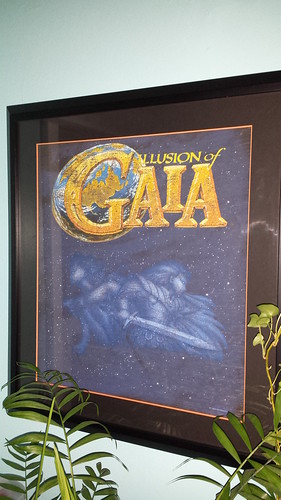
It even came with a free shirt, which I recently had framed.

Illusion Of Gaia Framed Shirt

A part that stood out in my mind was the raft.

At one point, the main character and Kara, the lead female character, are stranded on a makeshift raft. Unlike most video games, the point wasn’t to get off the raft. After all, you’re stranded. You can’t go anywhere. It is just you, the girl, the raft, and ocean as far as the eye can see. Most games would have you try to swim out to some secret area, or catch a ride on some passing dolphins, or something.

But you were stranded. And you wait. Maybe someone will save you?

At one point, there are fish jumping out of the water. When you hit them, she gets upset. She’s a vegetarian, you see. How could you hurt those innocent fish? I don’t remember if I felt guilty or annoyed at the time. All I know is that the scene changed. Actually, it was just another day on the raft. Another day of waiting.

On the other hand, you’re starving. She’s starving. As brutish as she thinks it is, maybe eating fish is ok because it is necessary? Ben Franklin was a vegetarian, but even he agreed that if it was ok for the fish to eat each other, it should be ok for him to eat them. So you eat.

And then the sharks came. They circled the raft. She freaked out. You’re ready for anything at this point. But they just leave. The sharks leave. When you think about it, the sharks would only attack if they were hungry. It gets you thinking about how humankind treats animals.

Unfortunately, you don’t have too much time to think about what happened. One day, your character faints. After your rescue, you later learn he had scurvy.

The scene lasted for 28 days. In real time it is of course only a few minutes, but for 28 days you are stuck on a raft. There wasn’t much to do, of course. What would you do if you were drifting in the ocean with nothing? You could only think. So I thought. I wasn’t just reading about someone else thinking. I wasn’t watching someone else in despair. I was there.

Apparently most people hated this scene. They wanted to get to the action, I suppose. I liked it. If anything, this scene is the one that shows what games are capable of becoming.