Categories
Games

We Own Our Art #GDC15

Nathan Vella, host of the 2015 Independent Games Festival, closed out the awards show with a plea to the better side of everyone:

This past year has exposed a lot of hatred and some significant unpleasantness in our industry. As of tonight, there continues to be women, people of color, and lesbian, gay, bisexual, trans, and queer artists who are being trolled, and spammed, and threatened, and doxxed, and hacked, and even driven from their homes.

It’s no longer possible for those of us in this room to ignore or minimize these issues with our industry or these issues with our art.

I know you all believe it. I know you do.

Pause for applause.

But just as this year has exposed all that ugliness, it’s also exposed a new generation of creators and activists who are fighting for video games and video game culture. They’re fighting for us, the independent games community.

I really don’t think they want our gratitude at all. I think they need our support.

I think they need us to work together as a community to show people a new way to engage with each other and play.

So let’s all fight back against this hate the best way we know how: through our games, and through our teams, and through our collaborations.

Let’s make sure our games aren’t embodying any stereotypes or caricatures.

Let’s make sure as a community we are supportive of one another, and we are as welcoming as possible to any and all new voices.

To me, this really gets to the core of what it’s about to be an independent developer.

We don’t have any stock prices to fret over. We don’t have any entrenched political dogmas.

We own our art.

This gives us a real opportunity to be the change that we all want to see in this industry.

And I think that we can change, for the better, together.

We own our art.

Four small words that lay down a huge challenge.

While a number of people think that games are just for fun or for kids or shouldn’t be subject to grown-up criticism, games are important.

They have meaning imbued in them by their designers. The mechanics and aesthetics are communicating something about the world, and since games are interactive, it means the player is not only learning how to play the game but also to interact with the greater world.

While I don’t believe playing violent video games turns innocent children into killers, I do think that if the only interaction they are exposed to is “attack”, then it shouldn’t be surprising that people grow up to have trouble resolving conflicts.

Instead of figuring out how to create solutions to arguments or disagreements, people learn that destroying the opposition is the way to get results.

All that said, violent shooters or games played “just for fun” aren’t bad games. They are thankfully just one facet of the entirety of games, and having a healthy, diverse set of experiences allows for more well-rounded play, which should translate into more well-rounded players.

Now, I’m not saying I think games will bring love and kindness to everyone.

But knowing that there is a game about people who aren’t like me, and learning about the creators who aren’t like me, means I have a chance at learning about them as more than a stereotype, so when I meet people in real life I’m more likely to treat them as human beings worthy of dignity.

We own our art. What we create is our uncompromised vision of what we want to bring out to the world for others to experience.

What kind of vision of the world are you delivering to your players?

Categories
Game Development Games Marketing/Business

GDC 2015 Starts Today

Four years ago, I attended my first and only Game Developers Conference.

While many people find the conference overrated or a pain to travel to, I miss the energy of so many game developers in one place, sharing their passion and experience with each other.

I miss the Independent Games Summit and the AI Summit. I learned quite a bit from the sessions I attended, and I met quite a few game developers I only ever knew online for the first time.

I miss the Expo floor, not only for playing demos of everyone’s games but also to see what new trends and technologies might be coming.

I would love to check out the GDC Education Summit.

I want to see who will win at the Indie Games Festival and how Nathan Vella compares to Andy Schatz as host. I’m sure he’ll be great, and he’ll say inspirational things we’ll all want to write about. No pressure.

I’ll be following this year’s action on Twitter and on Gamasutra, unless anyone has any better recommendations.

While my wife and I are still watching Oscar-nominated films, I’m surprised I haven’t been looking into playing Seumas McNally-nominated games. I’ll fix that now.

Congratulations to all of the finalists for the IGF! I see many of you have a GNU/Linux version of your game, and I’m looking forward to trying them out.

Categories
Games

I Just Wanted to Play a Game with my Friends

As someone with a full-time job and trying to work on a business on the side, I find that I don’t play as many games as a game developer probably should. Most of the games I have access to are many, many years old, so I’m a bit out of touch with the latest offerings from major publishers.

Most of the time, though, I don’t seem to miss it. There are plenty of indie and major publisher games that are available that I still haven’t played, so I’ve got quite the backlog to tide me over.

But some friends of mine were playing online regularly, so I thought it would be a good opportunity to spend some quality time with them and also join my first MMO since playing Runescape about a decade or so ago.

Unfortunately, Star Wars: The Old Republic isn’t available for Linux-based systems, and WINE support sounded like I could expect to install the game but not really find it playable.

What follows is basically me whining, so feel free to find a better use of your time.

I booted up Windows for the first time in over a year on my desktop system, and I start downloading the installer, which required setting up an account.

It turns out that it installs a launcher, which then patches itself by downloading for a bit. Soon, I’m able to…

…start retrieving the minimum download.

There is text that pops up to inform me that until the full game is downloaded, I can only play on the starter worlds. Ok, fine by me. I’m new to the game anyway.

Except, how do I start the game? The Play button is grayed out.

Then my system blue screens. I haven’t seen that color in a long time.

After rebooting, I find that the minimum download in progress is at negative 100%. After waiting and hoping it would resume from before, and after searching online for help, I found that rerunning the installer helped. I think it was downloading, but the progress percentage was displaying wrong, and reinstalling the launcher made it display correctly.

Then, I waited almost an hour before it finished downloading the basic client. Hey, the Play button is accessible now!

I texted a friend to ask what server they were playing on, but since they are probably having fun, I didn’t get a response right away, so I chose one that seemed probable, and I started creating a character.

Once the character was created, I had to “activate” the character, then I could play.

I saw a loading screen with some text about the smuggler’s activities when suddenly I was looking at my desktop.

Huh.

So I started the game again, and when I finally got back to that loading screen, it crashed to the desktop without so much as an error message again.

And then again.

So, a couple of hours later, and I still haven’t started the game, let alone been able to join in the fun with my friends.

And the best part?

My friend finally got back to me to say that he doesn’t remember selecting a server. He said they are part of Starfleet, and you can choose between Starfleet, Klingon, or Romulan.

Wait, what? I just spent the entire evening struggling to install and play the wrong game?!

At this point, I’m simultaneously happy that I don’t have to fight with Star Wars: The Old Republic anymore and frustrated that I now get to start the entire download-for-hours-without-playing experience again with Star Trek Online.

I understand that these are huge, expansive games with a lot of content, so I probably should have prepared my computer before the scheduled gaming session, but from what I read online, I’m not alone in needing to find time to play games only to discover that the time is spent downloading updates or patches or otherwise preventing game time from including game play.

For now, I’m going to bed.

Categories
Game Design Games

Does Your Game Instill a Sense of Wonder?

Alice In Wonderland

I recently came across this fantastic TEDx talk from June 2014 by Mac Barnett, an award-winning author of children’s books. Somehow, he managed to share some behind-the-scenes secrets for crafting experiences without ruining what makes those experiences feel so amazing.

Why a Good Book Is a Secret Door:

He talked about how art or fiction can take us to a place where we simultaneously know that what we are experiencing is not real yet believe it anyway.

I’m going to call it wonder. It’s what Coleridge called the willing suspension of disbelief or poetic faith, for those moments where a story, no matter how strange, has some semblance of the truth, and then you’re able to believe it. It’s not just kids who can get there. Adults can too, and we get there when we read.

There are some books from my childhood that stuck with me, and I still have them on my shelf. Aliens for Breakfast by Jonathan Era and Stephanie Spinner is the story of a boy who finds out he has mere days to save the world from the evil alien disguised as the charismatic new kid in his class. It’s about 60 pages long, but it was filled with strange ideas, like aliens traveling through freeze-dried cereal boxes, mixed in with familiar ones, such as dealing with the complex social interactions of childhood.

I loved every minute of reading it, and while I don’t remember much about the made-for-TV movie version starring Sinbad and Ben Savage, I just found out that the sequels Aliens for Lunch and Aliens for Dinner exist, so I’ll be right back.

Ok, I’m back.

As a grown-up now, I have other books that appeal to my sense of wonder. I just finished inhaling The Martian by Andy Weir faster than any Harry Potter book, which is about a man who finds himself stranded on Mars after his crew aborts a mission and leaves him behind because they thought he was dead. Things I take for granted, like being able to step outside without worrying about how much oxygen I have or whether I’ll be able to find food, the protagonist Mark Watney has to work to come up with ingenious ways using the limited resources he has. It’s not like he can have NASA beam him freeze-dried cereal. And if he makes a mistake, he’s dead. Mars is a harsh place.

A place I’ll probably never visit, so it is amazing to live vicariously through someone who did, even though he never existed.

We know these characters aren’t real, but we have real feelings about them, and we’re able to do that. We know these characters aren’t real, and yet we also know that they are.

Barnett went on to say that children get to the wonder a lot easier than adults do.

I’ll agree with my limited experience. My young nieces are the best audiences for my incredibly amateur magic shows. I can make a coin disappear, and even if they can see that it fell into my sleeve, they still aren’t sure if they did, especially when coins pop out from behind their ears.

I want to create that experience with games. I want children to play my games and think about what’s possible in a world they think they know.

Just as I thought about what would happen if the dinosaur at the museum came to life and became a pet for a day, or if it actually rained meatballs and hamburgers from the sky, or if my teachers were actually aliens ready to flunk the planet, I want my nieces to have that same sense of wonder.

Games can definitely do it.

I found it very compelling when Samus Aran lost her suit’s powers early on in Metroid Prime, forcing her to continue her mission without them. I liked how Ness was just a kid when he discovered something strange about that meteorite in Earthbound and had to save the world while also remembering to call his family regularly. Spiderweb Software‘s Geneforge and Avernum series tended to put you in the role of a character who discovers pieces of the truth about the world and must make important decisions about loyalties and goals.

A lot of my favorite games involved a protagonist who suddenly finds himself in the middle of a new situation and needs to figure a way out: The Illusion of Gaia, Chrono Trigger, Homeworld: Cataclysm, Don’t Starve, and yes, even E.T. for the Atari 2600. Beyond the idea of facing a challenge, these are characters who tend to find themselves suddenly confronted with a challenge when they were otherwise living their lives. The challenges intruded on them, and they had to step up and respond.

I want the games I create to put my nieces in the middle of fantastic and surprising experiences, figuring out what to do without limiting themselves to what they think is currently possible. I want them to finish a play session and have it stick with them in the real world.

It would be a fun way to prepare them for their weekend trips to Mars at the very least.

(Photo: Alice in Wonderland | CC BY-2.0)

Categories
Games

Snobbery in Gaming

Someone mentioned the word “games” at a party I was at, and my radar picked up on it. Unfortunately, I was really annoyed by the conversation that followed.

Me: “Did someone say games?”
The Other Person: “You wouldn’t have heard of it.”
Me: “Uh, ok. I’d LIKE to hear about it.”
The Other Person, dismissively: “It’s an indie game.”
Me: “…and I’m an indie game developer. Which game?”
The Other Person, still dismissive: “It’s an indie BOARD game.”

What a jerk.

Obviously this person decided I wasn’t cool enough to know about some new game, not knowing anything about me or my interests.

And the idea that somehow I would lose interest in the conversation if it was a board game versus a computer game? How ridiculous! I love games, no matter what medium I play them in. I almost wanted to continue pestering this person just to annoy them, but I decided to take the hint and stop trying.

There are people today who think that games grew up with them, that “The Past” consisted of Sony Playstation and the CDROM versions of The Oregon Trail.

I fall into this trap as well. My childhood was spent playing games on the Apple II c+, Atari 2600 and NES. When I say, “Remember when…”, I know I make some people feel old when they think about their childhoods being defined by games played on the PDP-1, at the arcade during the golden age, or hosting a BBS.

But even before, there were games. Games have been around for almost as long as humanity has existed.

That people decided to make games on computers as soon as the computers were capable shouldn’t have been a surprise.

But no one should pretend that video games or computer games are all there is or that they are somehow superior to board and card games.

My childhood was also spent playing card games and board games. Scrabble and Battleship and Monopoly were played regularly. Some games held my interest more than others, but video games always seemed more diverse and fascinating.

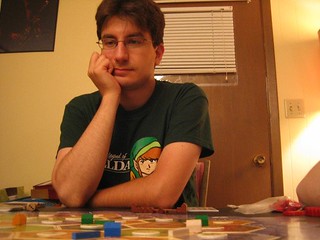
My Playing Settlers of Catan

When I was introduced to some very cool games in the last 10 years, I learned that it wasn’t just Uno and Monopoly, that there is a lot of entertainment to get in traditional, non-computer games. Settlers of Catan is typically seen as a gateway to Euro-style board games, and I was fortunate to have met people who could introduce me to it and to some of the other games in their collection.

I got a late start, but I’ve been really interested in playing card games and board games beyond the standards that Hasbro keeps publishing. I enjoy perusing the massive collection of games at my local comics and gaming shop, talking with the workers there and getting their recommendations. My most recent purchase was Mage Knight after someone tweeted about the game designer Vlaada Chvatil. After talking with someone at the shop, I got a few recommendations for some of Chvatil’s games, and walked away with this super complex game that also lets you play by yourself if you can’t find anyone willing to play it with you.

So, The Other Person, you can keep your snobby, secret conversation about a game I supposedly wouldn’t have heard about. There are plenty of games to go around, and I’m sure I won’t miss it.

Categories
Games

Chicks Dig Gaming: A Celebration of Gaming by the Women Who Love It

Chicks Dig Gaming: A Celebration of Gaming by the Women Who Love It is a book I have been waiting for ever since I first learned that my friend Lars Pearson was interested in publishing a book about women and games.

Mad Norwegian Press is known for their Doctor Who-related books, including the Hugo-award winning Chicks Dig Time Lords. Their “Chicks Dig” series features essays from female fans of Doctor Who, comics, Joss Whedon’s creations, and now games.

Lars didn’t ask me to write this post, but I wanted to let people know about this book because I think more women should have their voices heard in the game industry.

You can learn more details about the book at the Chicks Dig Gaming page at Mad Norwegian Press.

Categories
Games

I Want Tiny, Adorable Consoles to Play Slow Games for Christmas!

Wired reported on Ishac Bertran’s experimental game consoles that let you make only one move a day.

Slow Games from Ishac Bertran on Vimeo.

From his Slow Games page:

I’m using Slow Games as a platform to experiment with low pace, long lasting gameplays, and explore game mechanics that keep players engaged throughout weeks of play with simple rule variations

At first, I thought, “Apparently Bertran hasn’t played games such as Diplomacy or chess by mail.”

Recently I started playing Neptune’s Pride after a long break, and I was telling a coworker. He hates the idea of a game that doesn’t resolve for weeks. And he hates the idea of even slower action games such as what Bertran’s consoles provide.

So, as actual games, they’re not for everyone.

But this project is meant to explore our relationship with technology. We expect instant feedback, and if that feedback mechanism was slowed down dramatically, how would it change our interaction?

Focusing so intently on the technology only gets you so far for these games, so would we start paying attention to our surroundings more? Or would we get antsy?

No matter what, these consoles are tiny, can fit next to anything on my shelf or desk, and I want one for Christmas. I don’t see any indication that they are going to be for sale, though. B-(

Categories
Games

Back This Project: That Dragon, Cancer

I haven’t backed many projects on Kickstarter, but That Dragon, Cancer by Ryan and Amy Green is one of those projects I can’t see passing up.

We created That Dragon, Cancer to tell the story of our son Joel and his 4-year fight against cancer. Our desire is to craft an adventure game that is poetic, playful, full of imagination and of hope. This is how we choose to honor him and his memory.

– Ryan and Amy Green

That Dragon, Cancer is a heart-breaking game for any father to make. Ryan Green calls it a “love-letter to his son” with a goal of encouraging the people who play it to love one another.

God at Play‘s Josh Larson worked with the parents to create this game, which is fitting. Josh hosted the Meaningful Game Play Game Jam back in 2011, which had the purpose of developing prototypes to explore deeper experiences in games.

Ryan Green participated remotely and submitted Giga Wife, which explored the idea of being a good husband. I remember him reading the introduction and talking about how much he loves his wife, and you can tell he has a big heart. The game was humorous at times, but also deals with the very real complications that a relationship can have.

I know Josh personally, and he is a very deliberate and conscious person. He’s a game developer I admire because he is always pursuing impactful experiences. And now Josh and Ryan are working together on a game that is very meaningful to not only the Greens but anyone who has had to fight the battle against cancer.

Please consider backing the project. I backed That Dragon, Cancer on Kickstarter because I want to support their efforts and see them succeed.

I also support the idea that a game can be the chosen medium for something such as this tribute to a beloved child. A game with an agenda of love is something I want to say I helped make available.

As of this writing, they are 57% funded after an initial burst of media coverage, but most Kickstarter projects hit a slump soon after. I would hate for this project to miss its goal. Pledging even just a small amount helps.

Categories
Games Geek / Technical General Politics/Government

Why Does Your Game App Need My Browser History and Photos?

Years ago, I started paying attention to the usage of so-called digital rights management (DRM) in games and made my purchasing decisions accordingly. I might have missed out on some major cultural impacts, but I wasn’t going to passively accept what I thought was a draconian form of copy protection. A form of protection that, by the way, doesn’t even work most of the time, so only legitimate customers get punished.

In practice, it meant not buying many major games. Spore is one very famous example, and I wrote a bit about it in this post about it’s reception in the market. Reading it today, I can see I was a bit angry about the DRM:

Do I like the game? I haven’t played it. Apparently Spore has some crappy so-called DRM solution attached to it, and it’s definitely not available for Gnu/Linux, so my choice is to boot up Windows AND suffer this DRM crap, or play a different game on my preferred system. It’s too bad. If things were different, I’m sure I would have liked Spore, too, but I refuse to pay for a steak dinner delivered on a garbage can lid.

Ooh, burn!

It was my attitude, and it still is today, partly because DRM is fundamentally flawed and partly because it’s a system that makes it easier to be a criminal.

But this post isn’t really supposed to be about DRM. Today, I find myself concerned about downloading free-to-play games on my smartphone that require bizarre permissions.

Recently, I was looking for a good strategy or simulation game to play on my Android smartphone. I found some that seemed promising and popular, and I found myself stopped when I clicked the install button because the requested permissions were ridiculous.

Why does this game need access to my browser bookmarks and history? Or why does that game need access to my photos?

Actually, it seems that Google’s API just doesn’t allow very fine-grained control of what is and isn’t allowed to be accessed by an app. According to this What’s on Dave’s Droid? post, if an app needs access to the state of the phone to know when to minimize if a call is coming in, it has to get that information from the same permission that gives it access to the identity of who is calling.

And this isn’t a new story. I’ve just only become aware of the problem myself.

I get that the permissions section can’t be too complex for the user experience. People don’t read EULAs as it is, and I’m sure many apps are perfectly safe, but is it weird that we’re being so trusting of apps by hoping that they don’t cross a line we’ve given them permission to cross? Especially in a world where we know we’re being spied on?

For now, I feel that I need to treat some apps just as I treated games packaged with so-called DRM. I’ll ignore the ones that ask too much or that are made by someone I have no reason to trust. Maybe I miss out on a gem, but I’ve survived without Sony’s rootkits and the pain of not being able to install a game I’ve legally purchased in the past. I think I’ll survive not playing a game that may or may not be compiling a list of my contacts and recording my location.

Categories
Game Development Games Marketing/Business

Controversy over 2nd Mighty No. 9 Funding Campaign?

Outraged Gizmo

Last year, comcept USA, LLC raised over $4 million for their 2D platforming game Mighty No. 9. Over 60,000 backers plus whoever contributed through PayPal are looking forward to this Mega Man-inspired project to get completed, and the development team has been periodically releasing their work to show how much progress has been made, such as this Mighty No. 9 work-in-progress video released last month:

It’s generating quite a bit of excitement, and as the developers realize that this game has a large and dedicated following, they decided to capitalize on it.

Announced at the 2014 Anime Expo, there is a new funding campaign:

More details about the announcement are at the Mighty No. 9 website, but the general idea is that the original funding is enough to make the game and it will still be made, but this new campaign is to fund bonus content. The first announced stretch goal is full English voice acting.

Apparently some people are outraged about this second campaign. People are complaining that producer Keiji Inafune is greedy. “You’ve already got $4 million, and now you want even more money?!” Some people have compared it to Exploding Rabbit’s Super Retro Squad, which met its very conservative funding goal easily, yet the developers were inexperienced and realized during its development that making games is hard.

But Mighty No. 9 is getting made. The people behind it know what they are doing and are fully-funded. The new campaign isn’t to help finish the game. It’s to add more bonus content to the game.

There is a very strange entitlement issue that some vocal Internet denizens seem to share. Kickstarter is a way to invest in something, and it’s entirely possible that it will fail. You contributing $5 or $500 does not mean you will get what is being made. A project may also turn out completely different than originally planned.

And when Mighty No. 9 is looking like it is well on its way to being exactly as advertised, the hostility lobbed at the developers for what some people misunderstand as greed is even more bizarre.

Making games in full view of the public is like being an umpire at a Little League baseball game in which all of the parents watching are drunk and boisterous and occasionally violent. Oh, and they don’t know how the game is played, yet have no trouble telling you how you are doing a terrible job in very colorful language.

Is it just business, though? Are people merely getting insight into what it is really like, now that funding is crowd-sourced? Or is it the nature of business on the Internet?

I imagine Bill Gates long ago learned to put a filter on the content he reads to keep his sanity. It’s hard to keep your finger on the pulse of the industry if you are going to read about how you are the Devil incarnate on a regular basis. I suppose before the Internet you just had to worry about a harsh opinion piece in the newspaper because most publicly-available forums were professional in nature.

Being an indie developer has appeal for many partly because you are not beholden to someone else. You have no boss but yourself. You have no constraints on your vision but your own. You have no deadlines but the ones you impose.

Yet, crowd-sourced funding puts you in this strange place. It enables you to not only do market research and connect with fans, but it can also give those fans a sense of ownership in your independent venture. And if the expectations aren’t clear upfront, there can be a lot of pain.