Greg Costikyan posted a link to the NetHack song. You can find the lyrics and an mp3 of NetHack.
And, of course, the game is teh awesomes.
 GBGames
Greg Costikyan posted a link to the NetHack song. You can find the lyrics and an mp3 of NetHack.
And, of course, the game is teh awesomes.
Hackenslash had posted Is Linux Gaming Plausible?. It makes for a good read, although I felt it was light on details and didn’t provide much of a definitive answer.
However, a major disadvantage for Linux gamers is the availability of DirectX in Windows, a multimedia tool that allows developers to create applications easier for the Windows platform.
“Unless DirectX runs on a different platform, it (Linux game development) might not really take off,” Gotangco said, adding that Linux gaming and game development would most probably remain an “indie” or independent industry.
DirectX is a Windows technology, and as such it is platform-specific. I don’t see Microsoft opening up access to their API to other operating systems. Since some major games, notably Doom 3 and Unreal Tournament 2004, have been ported to Gnu/Linux without the “advantage” of DirectX, it shows that Gnu/Linux game development is entirely possible and doable. Like DRM, DirectX isn’t a requirement for game development.
Multiplayer game servers are almost always provided for Gnu/Linux, and so the porting effort shouldn’t be too difficult for the client software. Unfortunately, when a developer uses a platform-specific tool such as DirectX, the porting effort becomes difficult. To create a version of the game that runs on a different system, you essentially have to gut your game code to remove the DirectX-specific parts and replace them with something available on a the target platform. Most developers will decide that the rewards would be too little to justify the expense of making such drastic changes to the code.
Still, I don’t believe that game development will be so dreary on Gnu/Linux.
A few Linux gamers actually have ways of circumventing the cross-platform issue of playing an enticing Windows game to Linux, without having to port it. One answer is just emulating the game for Linux. But according to Zak Slater, this isn’t an accepted industry and he said it is better for users to buy Linux versions or directly create Linux-native games.
I am 100% in agreement with Slater. I am not a fan of technologies like Wine or Cedega. It’s great when it works, but I would rather have native support for my platform of choice.
While the Linux gaming industry would not certainly be able become as big as traditional PC gaming, both Slater and Gotangco agree that Linux gaming is there to stay. They suggest that Linux game developer-hopefuls can get their Linux game fix from Icculus, Pompom Games (www.pompomgames.com), Tux Games (www.tuxgames.com), among others.
I’ll also note that the Torque Engine from GarageGames is both inexpensive and cross-platform, so games like Orbz and Dark Horizons: Lore can have native Linux-based clients right out of the box. With more indie games like those, I don’t think that we’ll have a problem if game development on Gnu/Linux remained an indie industry.
Also, using open source engines will probably become more common in commercial games. The infrastructure of a game isn’t the game, yet developers always spend a lot of time on recreating it. Using existing tools just makes sense, and using open source tools gives you a number of advantages, including the ability of your more technical customers to give you more than a simple bug report.
I believe that gaming on Gnu/Linux is definitely plausible. It’s very difficult to tell how many Gnu/Linux gamers there are since there are hardly any games available for them and they’ll likely pay for their games on the Windows system for lack of a better choice. They WANT native games for their preferred OS, and so far there aren’t many options.
Action noted that the new Indie Game Developer’s podcast is up. This time there is an interview with Joe Lieberman of VG Smart. Joe recently published the book The Indie Developer’s Guide to Selling Games, which I hope to receive in the mail today. The interview features some excellent marketing advice, something every indie serious about business should have.
Also, Action requests that if anyone has finished a game or two, he’d like to interview you! To find out how to contact him, check out the link above. Perhaps we’ll hear your voice in the near future.
I believe I found this link through Gamasutra sometime ago: Breaking the Grip of Dominant Ideas In Games: What Serious Game Projects Have To Offer Entertainment Game Developers
It basically describes the positive impact serious games could have on general game development. One of the most interesting quotes challenged the prevailing theory that “ideas are a dime a dozen”.
The field of serious games – with its intrinsic creative encounter of game developer and non-game professional – the latter involved in the real strategies and “games†of business, military, medicine, education, science and so forth – could offer itself as a form of “outside help†to entertainment game creators, even if this is a secondary effect. We game developers would be smart to take advantage of the opportunity.
Many people today in the game development (and other) industries see ideas as cheap. You’ve heard it said “Ideas are a dime a dozen.†This is not true. In fact, the idea that ideas are a dime-a-dozen is itself a dominant idea. What is true is that gimmicks – or little ideas – are cheap. Gimmicks are what is a dime a dozen, and everyone can think them up. True ideas, though, are exceedingly rare and extremely valuable. True ideas are visionary.
At the beginning of March, I interviewed for a position at a company. I was asked to create a small text-based game to demonstrate how I would go about solving it. After a week, they asked to see my code even though it wasn’t finished yet. Apparently they liked it since I got the position.
Even though there was no need to complete the project, I kept working on it. Last Friday morning, I finally finished it.
It took almost two months of (admittedly inconsistent) part-time work, but I have finished a project. It was simultaneously simple and more complex than I thought it was going to be.
I used the tips from my previous post,Object-Oriented Game Design. I separated almost everything into Entity, State, and Action objects. In the beginning, I had to work on not only wrapping my head around the concepts but also code up the infrastructure to allow for it. By the end, adding a feature became as simple as creating the appropriate State or Action derived classes.
I’ll admit that I cheated a bit. For instance, when I create the game board from an XML file, I have a class that has no business populating the board with Space objects. I probably could have created a few Action classes to do it, though. PopulateBoard, AddSpace, etc.
Still, the game is finished. I spent a bit of time trying to match up each delete with its respective new. I fixed an off-by-one bug that would crash the game if you moved back three spaces and you were going to cross from the beginning of the board to the end of the board.
On the other hand, it isn’t really a “game” since there is no interaction to speak of. The players roll two dice and move according to the dice. There are no choices. Still, this simulation proves that it is easy to create games based on entities, components, and actions. I hope to translate what I learned into Oracle’s Eye and other games.
In the Sunday Chicago Sun-Times, Roger Ebert once again makes his beliefs known about the ability of games to be artistic. Someone asked about “Silent Hill” director Christophe Gans and his comments in an interview in EGM, and Ebert responded in his Movie Answer Man.
Ebert gave a bad review (1.5 stars) to “Silent Hill”, the latest movie-based-on-a-video-game that everyone will hope to be good but will almost always disappoint. I haven’t seen the movie, nor have I seen “Doom”, another movie that Ebert gave a low rating to. I figured that “Doom” would be a terrible movie adaptation, and I haven’t played any of the “Silent Hill” games so I had no urge to see something that might spoil the game for me. Besides, it would probably be bad as well. Most video game-based movies are. I liked “Super Mario Bros”, even though I was one of a handful of people in the theater, but I wouldn’t claim that it was a good movie by any stretch of the imagination. I was very young and a big fan of the game series, after all.
Anyway, “Silent Hill” got a bad review, and Gans had said that he thinks that video games can be a form of art. I read part of the interview, and the big quote is:
EGM: It certainly doesn’t help our industry when a major critic like Roger Ebert comes out and says that “games are not art”
CG: Fuck him. You know, I will say to this guy that only has to read the critiques against cinema at the beginning of the 20th century. It was seen as a degenerate version of live stage musicals. And this was a time when visionary directors like Griffith were working. That means that Ebert is wrong. It’s simple. Most people who despise a new medium are simply afraid to die, so they express their arrogance and fear like this. He will realize that he is wrong on his deathbed. Human beings are stupid, and we often become assholes when we get old. Each time some new medium appears, I feel that it’s important to respect it, even if it appears primitive or naive at first, simply because some people are finding important things in it. If you have one guy in the world who thinks that Silent Hill or Zelda is a beautiful, poetic work, then that games means something. Art only exists in the eye of the beholder. You know, I saw The Good, The Bad, and The Ugly when I was eight, and I thought it was a masterpiece. And at that time, I felt like I was alone thinking that. But now, it’s commonly accepted as being a classic, so I was right!
I will disagree with the assertation of the question. I think it does help when someone like Ebert says that games aren’t art because it gives us something to focus on. Do I believe games are art or could be art? Yes, and I’m not alone. Now we just need to show how. I don’t expect anyone in movies to point to very early film and claim those were masterpieces of theatre. “Citizen Kane” came out many years after the first motion picture was available. I don’t believe we’ve seen our “Citizen Kane” yet.
That said, I don’t believe that games are intrinsically incapable of being art. Ebert’s argument?
I am willing to agree that a video game could also be a serious work of art. It would become so by avoiding most of the things that make it a game, such as scoring, pointing and shooting, winning and losing, shallow characterizations, and action that is valued above motivation and ethical considerations. Oddly enough, when video games evolve far enough in that direction, they will not only be an art form, they will be the cinema.
Scoring makes a game. Pointing and shooting makes a game. Winning and losing makes a game. Shallow characterizations make a game. Action valued above motivation and ethical considerations makes a game. If you’re amazed, I understand. It was news to me, too.
Are there games that include scoring, shooting, winning and losing? Yes. What about games with stock characters? Action for the sake of action? Check, and check.
But if I remember correctly, there are quite a few movies about winning and losing. There are quite a few movies with terrible characters. There are action flicks that have no reason for a lot of the violence and explosions. We can point to films that have “evolved” past those, so they don’t count anymore, I guess. We could point to games that have evolved as well, but it would be similar to comparing very early film to modern theatrical performances. How would a motion picture about a bunch of people running and spinning around in dresses stack up to “Rent” or “Wicked” or even Shakespeare’s works in terms of artistic value?
Ebert is writing about video games as if he can really talk about them as an authority. To Gans he argues:
As David Bordwell has pointed out, it can take at least 100 hours to complete a video game. Do you really feel you have mastered the mature arts to such an extent that you have that kind of time to burn on a medium you think is primitive and naive?
Not all games are 100 hour marathons, and no one is expecting Ebert to play the games that are. What about the six or eight hour games? Two hours? The twenty minute ones? We can’t expect Ebert to know about them, let alone play them, but I’m sure he’ll still have something to say. After all, they are video games, and apparently all video games are just shallow action flicks.
Most games are just games. Most games are not meant to be artistic in any way. There are motion pictures that have no artistic value, and I’m sure that Ebert would agree. It took some time before movies were treated as anything more than a novelty, and even more time before film critic became a respected position. Video games are still being treated as children’s toys, even though most gamers are over 20 years old. It is hard to have serious discussions with people from other industries when they continue to get their best opinions from “our side” from a 13-year-old gamer who would think that “Super Mario Bros” was a great movie if it came out today.
I don’t care about the people who thought that the Doom movie was the greatest thing ever. I doubt anyone cared what I thought about “Super Mario Bros” when I was younger. I don’t go to the movies to watch video games, and I thought it was incredibly dumb to have a first-person perspective in a movie to try to mimic the game. 11-year-old Joey and 10-year-old Tommy might disagree with me, but who made them authorities on movies? So the headline “Ebert vs the gamers” is supposed to make it seem like there is a huge intellectual debate when in reality it betrays how the game industry is being perceived. It’s just for kids, after all.
Even Seth Godin had something to say about Nintendo’s Wii, so I felt that I should comment.
My first impression? I thought it was a terrible name. I get the concept of “togetherness” and all, but Wii? Seriously? I won’t try to make a bad pun with it because anyone who was on the world wide web after last week’s announcement would have read them all anyway.
Interestingly, I feel that now that everyone has gotten it out of their systems, we can all agree that Playstation and XBox were pretty bad names as well. We’ve gotten used to them though, so if Nintendo doesn’t make a new announcement admitting that they made a mistake, we’ll probably get used to Wii, too.
Still, I’m shaking my head. Does it make more sense in Japan at least? Are the Japanese wondering what the big deal is with the rest of the world’s reaction?
The Illusion of Gaia was not exactly a popular game, but I loved it. I rented it, but after my three days (remember when you could only rent from Blockbuster for three days?!?) were up, I went out and bought it.
It even came with a free shirt, which I recently had framed.
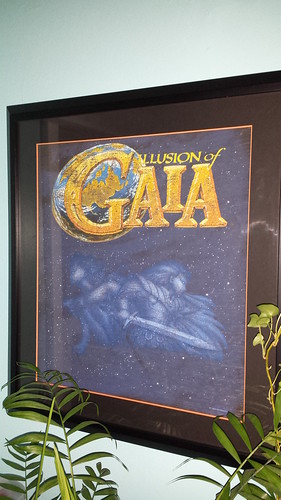
A part that stood out in my mind was the raft.
At one point, the main character and Kara, the lead female character, are stranded on a makeshift raft. Unlike most video games, the point wasn’t to get off the raft. After all, you’re stranded. You can’t go anywhere. It is just you, the girl, the raft, and ocean as far as the eye can see. Most games would have you try to swim out to some secret area, or catch a ride on some passing dolphins, or something.
But you were stranded. And you wait. Maybe someone will save you?
At one point, there are fish jumping out of the water. When you hit them, she gets upset. She’s a vegetarian, you see. How could you hurt those innocent fish? I don’t remember if I felt guilty or annoyed at the time. All I know is that the scene changed. Actually, it was just another day on the raft. Another day of waiting.
On the other hand, you’re starving. She’s starving. As brutish as she thinks it is, maybe eating fish is ok because it is necessary? Ben Franklin was a vegetarian, but even he agreed that if it was ok for the fish to eat each other, it should be ok for him to eat them. So you eat.
And then the sharks came. They circled the raft. She freaked out. You’re ready for anything at this point. But they just leave. The sharks leave. When you think about it, the sharks would only attack if they were hungry. It gets you thinking about how humankind treats animals.
Unfortunately, you don’t have too much time to think about what happened. One day, your character faints. After your rescue, you later learn he had scurvy.
The scene lasted for 28 days. In real time it is of course only a few minutes, but for 28 days you are stuck on a raft. There wasn’t much to do, of course. What would you do if you were drifting in the ocean with nothing? You could only think. So I thought. I wasn’t just reading about someone else thinking. I wasn’t watching someone else in despair. I was there.
Apparently most people hated this scene. They wanted to get to the action, I suppose. I liked it. If anything, this scene is the one that shows what games are capable of becoming.
Here is a Wired article from 2004 that talked about the “new” and popular casual game market.
The news this year:
Games industry revenues will double over the next five years: Study
Video Game Business to Double by 2011, Driven by Online and Mobile Gaming
Study: Women Gamers Outnumber Men in 25-34 Age Group
It’s interesting how much more information we have now. Of course, it really only helps MSN Games, Real Arcade, and the developers who rely on them. It doesn’t say much about what a company like Introversion Software or Positech Games can do.
Why We Need a Corporation for Public Gaming argues that we need a publicly funded organization dedicated to making high-quality, educational games for the public good.
The author, David Rejeski, made comparisons with the television industry, noting that noncommercial programming did not do very well without government involvement. A Corporation for Public Gaming would fund the educational games that aren’t as commercially viable as another FPS.
…The interactive nature of games, their ability to present complex and dynamic information, and, increasingly, to allow thousands of people to meet in sophisticated virtual environments means games can accomplish what TV never could in terms of addressing educational and social challenges.
However, serious games, like serious TV, are likely to remain a sidebar in the history of mass media. Non-commercial television floundered, despite millions of dollars of investment by the Ford Foundation, until the government stepped in and created a viable and long-lasting alternative. With similar vision and foresight, and a relatively small amount of funding, this could happen with video and computer games.
Some people complain that public television holds a political agenda, and so people might worry that games will be made that also express certain political viewpoints. “Not with my tax dollars!” is the cry. I haven’t really looked too much into public television’s supposed problems, but I believe that unpopular viewpoints need to be expressed. Unpopular pretty much means that it wouldn’t have funding from anyone.
If the industry is going to go where the money goes, then it isn’t likely that many serious games will get the funding they need. The CPG would also be an interesting development because it would also raise awareness in the general public about the nature of video games. Most people still believe that video games are just for kids, for example.