Categories
Game Design Game Development Geek / Technical Linux Game Development Personal Development

LD#14: More Design Notes

I tried asking specific questions about what I would like the player to actually DO in the game. What’s the goal? How does he/she achieve success? What challenges does the player face, and what tools do I provide him/her to deal with them?

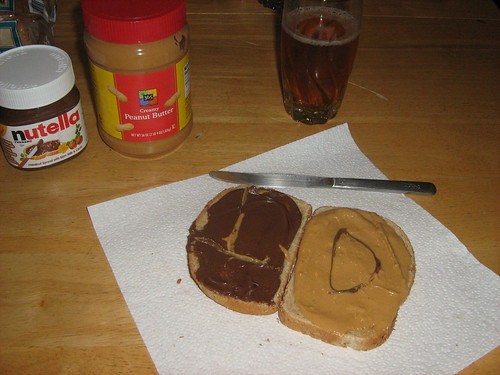
I had some baby carrots to tide me over until I’m ready to eat a meal again.
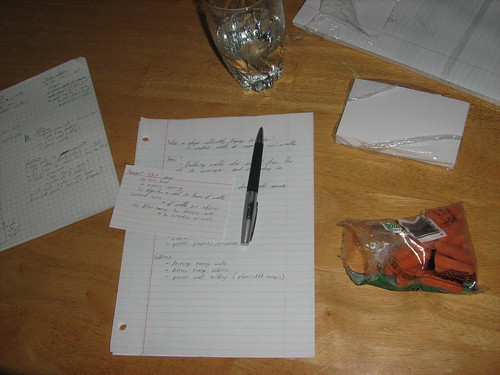
Design notes and baby carrots

In this image, you can see that I’ve started sketching some GUI components.

Design notes

When I start working on the game in earnest, I’m going to try to have the graphics ready before I write the code for them. And I need to remember not to worry about making them look fantastic. I waste too much time fiddling with each pixel.

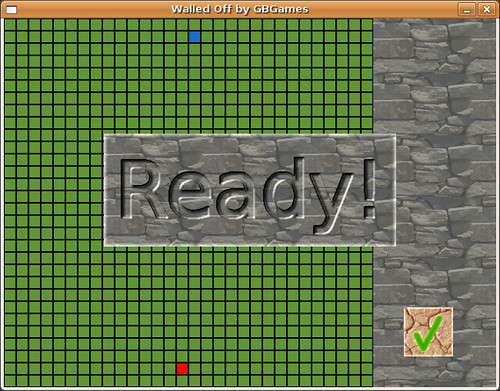
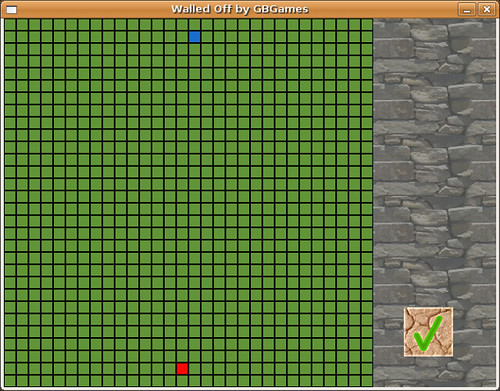
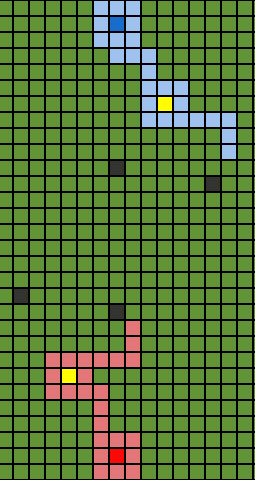
Here’s a mockup:
Mockup of Doom

In this image, you can see that Red and Blue just can’t seem to be peaceful in any game, and they are building walls to surround resources, claiming them. There will be a variety of resources, and those resources let you purchase more walls to build each turn and hire more soldiers.

Using 16×16 tiles means that there isn’t a lot of room for detail. Abstract is easier and faster for me, but it also provides the challenge of accurately conveying to the player what is happening. I’d like to get a game working as fast as possible. If the maps are too large, then I can try 32×32 tiles, which are much nicer for detail. But again, I’m not an artist, so I should focus on code and abstract art for now.

And I should get coding as soon as I can. The first day is almost over!

Categories
Game Design Game Development Geek / Technical Linux Game Development Personal Development

LD#14: Initial design

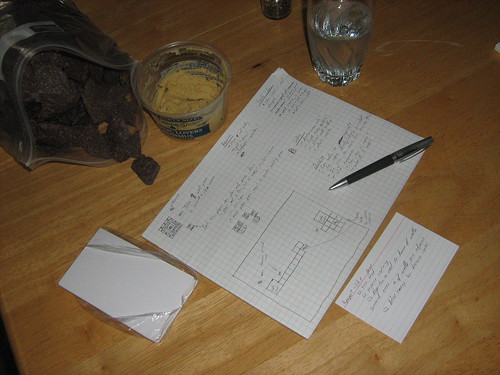
I was originally planning on sketching out some basic designs for each of my main ideas, but I had a lot of fun making the one I started with that I decided that it was the game I was going to make.

As you can see, I had some snacks while working on this one: blue corn chips with garlic lover’s hummus.

Design and chips

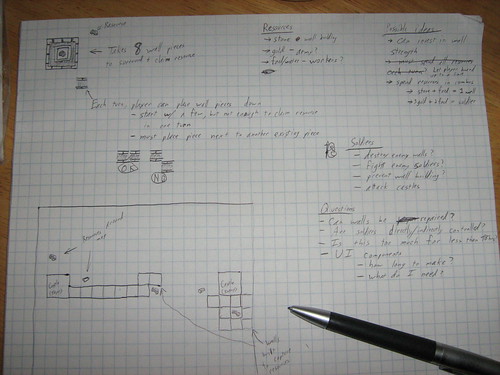
And here’s a close-up of the initial design:

A close up of the initial design

Categories
Game Development Geek / Technical Linux Game Development Personal Development

LD#14: Breakfast at Lunch

Breakfast at lunch

A healthy breakfast: a banana, a bowl of Trader Joe’s Twigs, Flakes, and Clusters (which sounds horrible, but tastes great actually!) covered with blackberries, and washed down with good ol’ orange juice.

Another idea came to me while eating: Remember the game Rampart? How about building walls to surround resources that you use to defeat your enemies instead? BRILLIANT! Maybe.

Categories
Game Development Geek / Technical Linux Game Development Personal Development

LD#14: Rough Start

So the first 12 hours is up, and what was I doing? Dancing. I went to a coworker’s birthday party (shout out to Andy!) and I didn’t get home until 6AM. Wasn’t expecting that. I woke up at 9:45AM, and I’m barely functional.

Now, it wasn’t a total loss of the first quarter of the competition. I had received a text shortly after the theme was announced with the theme: Advancing Walls of Doom.

Wow, that sounds so specific. And yet, I feel like there is a lot of potential with this one. I spent some time thinking about it and talking it over with other people at the party. I was pretty sure I was the only one there who was partying while working on developing a video game. B-)

Still, 12 hours, and only a few ideas in my head to show for it? I’m going to have to get cracking.

Ideas:

  • A wall is falling over, and you have to see how long you can prevent it from doing so.
  • An anthropomorphic army of walls is heading towards your town, and you need to stop them from settling in and dividing it.
  • You’re dancing with your partner, and the advancing wall of other dancers is threatening to separate you.
  • You have to create the wall of doom.

Yeah, some are kind of vague. The dance one is a bit more fleshed out in my mind, but I like the army of walls and the idea of creating a wall of doom…however you would do that.

But first, I need to pick up laundry, then have breakfast and take a shower.

Categories
Game Development Linux Game Development Personal Development

Ludum Dare #14 Is Here!

It’s time for another 48-hour solo game programming competition! Ludum Dare is fun, and you get to show off your game development hacking skills by producing a finished game at the end of a weekend!

My first LD was #11, and I produced Minimalist. I’ve since improved it to create Walls, and since then I’ve created a Facebook application based on the same game play called Sea Friends. And all of that happened because I spent a weekend in April last year creating a game in 48 hours!

The theme is announced tonight at 10:00 PM Central Time. Good luck to all who are participating!

As always, I’ll be live blogging here and on the official Ludum Dare blog, and this time around I’ll also be tweeting. Follow me @GBGames.

[tags] ludum dare, indie, game development [/tags]

Categories
Game Design Game Development Geek / Technical

How to Violate Facebook’s Policy On App Usage Incentives

One of the things I wanted to do to help market my Facebook game Sea Friends is get it in the Facebook Application Directory. This way, if people are searching for apps, they can add it. Until Facebook approves it for the directory, the only way people can add it is if people receive a challenge or if they go to the app’s URL directly.

When the app was submitted for inclusion in the directory, Facebook rejected it because it violated section 8.4 of the Platform Policy, which involves incentives for using or adding Application Integration Points. Basically, a Facebook application should not provide points, virtual or real currency, or any improved rankings just for sending out invites or sending out notifications.

Ok, that sounds pretty straightforward, but a huge part of Sea Friends is violating this part of the policy. The game allows you to protect real coral reefs, and while playing the game helps to do just that, sending out challenges to your friends also does so. That is, each time you challenge a friend, you protect 5 more square inches of coral reef.

Now, wait a minute. There are TONS of apps in the Facebook Application Directory that are based on giving things to people and earning points or unlocking items in exchange, aren’t there? Isn’t Sea Friends doing essentially the same thing?

It turns out that there is a subtle difference, and this question has come up before. These other apps don’t violate the policy because the points or unlocked items aren’t awarded until the recipient accepts the invite or virtual item. So to fix this issue for Sea Friends, I would need to make sure that the extra square inches of protected coral reef only get added after the recipient of the challenge actually accepts the challenge.

And there you have it. To violate the Platform Policy, your app needs to provide an incentive to send out invites. The proper way to do it, officially sanctioned by Facebook, is to only grant the benefit after the invitation has been accepted.

[tags] facebook, indie, game development [/tags]

Categories
Game Development Personal Development

Thousander Club Update: April 13th

For this week’s Thousander Club update:

Game Hours: 576 (previous three years) + 104.25 (current year) = 680.25 / 1000
Game Ideas: 775 (previous three years) + 10 (current year) = 785 / 1000

I spent some time getting acclimated to the PHP backend for my Facebook game, Sea Friends. I needed to make a modification, but I first had to find out how I could make that modification.

The bad news is: my modification won’t be good enough for what I wanted to do. The good news is: I know a lot more about how the backend works so that I can eventually make the modifications I need.

See? It’s nice to be able to modify your own code. I can’t say the same about the Flash component of my game. If I want to change it, I have to pay someone else to do it, or I have to pay Adobe hundreds of dollars for a program to give me the ability to read MY .fla file, and that program only works on Windows or Mac OS X. I found an old blog post that claims Flash source will be XML-based eventually, but the current .fla files are not well-documented and quite proprietary.

[tags]game, game design, productivity, personal development, video game development, indie[/tags]

Categories
Game Development Personal Development

Thousander Club Update: April 6th

For this week’s Thousander Club update:

Game Hours: 576 (previous three years) + 101.5 (current year) = 677.5 / 1000
Game Ideas: 775 (previous three years) + 10 (current year) = 785 / 1000

I broke 100 hours for this year! Around this time last year I was only at 40 hours, and two years ago I was around 75 hours. Compared to previous years, I’m doing well, although I still feel that I’ve been moving somewhat slowly. It seems I move in spurts, especially for Ludum Dare competitions, punctuated by long periods of little to no progress. I need to work on firing my cylinders a bit more evenly.

I have been working on marketing my Facebook game Sea Friends, but it seems that most people have lost interest in the game soon after finding it. If you have a Facebook account and wouldn’t mind checking out the game, let me know what you think of it. I’d love to get more feedback from players.

[tags]game, game design, productivity, personal development, video game development, indie[/tags]

Categories
Game Development Geek / Technical General

Tim Schafer Opens Comedy Club

Everyone knows Tim Schafer is a pretty funny guy. From The Secret of Monkey Island to Psychonauts, his writing has left many happy players smiling. What many people don’t know is how much Schafer loves to do stand-up comedy:

“Sometimes, out of nowhere, you’d hear Tim say things in a showman’s voice like, ‘It’s great to be here tonight! Not that I have a choice in the matter'”, says Ron Gilbert, creator of the Monkey Island series. “He made us all laugh, especially during particularly difficult times in the development of the first Monkey Island game. It didn’t surprise me when he said he was going to be opening The Tentacle Lounge.”

Schafer, founder of Double Fine Productions and former director of the eagerly anticipated Brutal Legend, has left video game development to pursue his new interest. While fans might appreciate the naming of his comedy club after one of his more famous games (Day of the Tentacle), many more will probably be outraged that Brutal Legend will be put on indefinite hold. This will not be the first time that the game’s development was threatened. It was dropped from the lineup after Activision Blizzard merged, only to be picked up by EA. This time, however, with the main creative force running his own comedy club, will someone else take the reins? And even if the game does see the light of day, will the game suffer from the lack of Schafer’s leadership?

I suppose things like this happen. Some of the best video game developers might find that they have other interests. Players can’t claim any kind of rights to the minds of these people. For instance, if Shigeru Miyamoto decided to stop making video games to pursue his music career, it would be a major loss for the game industry, but it’s not like we can force him to continue making games for us.

I wish Tim the best of luck on his new venture. The video game industry will miss you, but I’m sure we can always stop in at The Tentacle Lounge whenever we’re in L.A.

Categories
Game Development Personal Development

Thousander Club Update: March 30th

For this week’s Thousander Club update:

Game Hours: 576 (previous three years) + 98.75 (current year) = 674.75 / 1000
Game Ideas: 775 (previous three years) + 3 (current year) = 778 / 1000

I’ve been sick, to the point where I have been home from the Day Job as well. I tried to get a little work in this week, but it was unrelated to Sea Friends.

[tags]game, game design, productivity, personal development, video game development, indie[/tags]