So I finally have a scrolling background:
It’s that 1600×600 image from my previous post, seamlessly scrolling.
Next up: putting interesting things on it.
So I finally have a scrolling background:
It’s that 1600×600 image from my previous post, seamlessly scrolling.
Next up: putting interesting things on it.
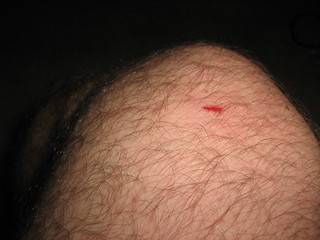
I went to take a shower, and in my haste to dry off and get back to work as quickly as possible, I hit my knee against the counter. Apparently not the first injury of this LD, and probably not the last.
Wanna see? Warning: I was naked when I took this picture.
It hurt a lot when it happened. It’s not bleeding profusely, but I see it is going to leave a bruise.
But it won’t stop me. I will carry on. I will develop a game.
But I worry how much of a mess I’ll be by the time this is all over. Between my hip/back tightness and this knee, what’s next? Lunch is in a few hours…
Anyway, before that shower, I created a background for my game.
Oh, that’s right. My idea: a simple side-scrolling shooter, where the enemies change movement, attacks, armor, and size as the waves start. Essentially, the evolution is in how those elements change in random ways. I’m also thinking that if you defeat an entire wave, you should get the chance to evolve as well.
So I’m not sure if I should go with organic characters or machines. A player-controlled tank means less animation, but then, why not just set the game in space? Whatever. This game is on the ground. A grassy ground.
OJ and a mixed cereal. One cereal has a lot of protein and fiber. The other has a lot of B6, B12, and iron.
My wife suggested the idea of “Evolving Doors”, which I think is brilliant because (1) it suggests a game play mechanic of choosing to go through doors to evolve and (2) it makes for an excellent play on words.
Before I went to bed, I started working on getting a skeleton project up and running.
I know. I know. It’s supposed to be one of my pre-compo checklist items: “Is your build environment working? I’m using CMake, and I should probably prepare an LD24 project beforehand so I’m not wasting time trying to get the build scripts to work when I could have a buildable project with a blank window from the start.”
Well, I didn’t. So I spent the first few hours getting a window up. Basically, I took existing scaffolding code (a basic Game class, Command/Event interfaces, stuff like that) and slapped it together as minimally as possible until it could build successfully and leave me with a window that shows a title screen and can exit properly.
The title is…evolving.
But the actual game design? Still only ideas right now.
I figured that a lot of people might try to make a Spore clone. I’ve seen quite a few screenshots with little primordial oozes as playable characters, and presumably you gain abilities, appendages, and interact with other units that might be more or less evolved than you. While I’m excited to play some of these games, I’m not sure Yet-Another-Variation would be interesting to work on.
I like the idea of an evolving landscape. A tile-based world that starts out with only one kind of tile with certain attributes, but as you explore it, you come across evolved tiles which might have new attributes or changes to existing ones that might impact movement, health, sight, sound, etc. And if I do it right, no two play sessions will be the same.
In terms of engineering, experimenting with neural networks might be fun. Maybe let the player pick a trait, and then have the system go through a few iterations to find out how healthy it is compared to others. On the other hand, that sounds like a lot of uncertainty and an unfinished compo entry.
Anyway, I’ll think about it some more over breakfast.
So, the theme was announced, and it’s Evolution.
Now, Evolution is the theme that was the Susan Lucci of Ludum Dare themes. It always made it to the final round of theme voting and always lost out.
Until today.
And somehow, I’m unprepared for it. Out of all of this LD’s themes, Evolution was the one I hadn’t given much thought to. And I even voted for it!
I’m a little worried about this compo. This morning, I woke up with pain in my hip and back. Walking is awkward, standing is difficult, and sitting seems to make it worse. I don’t know how much time I will be able to dedicate this weekend if I can’t be in front of the computer.
But I’m sure as the weekend evolvess (see what I did there?), things will come together. I’m going to spend the first few moments just thinking about potential design approaches.
Good luck, Ludum Dare participants!
I realized that the last time I participated in Ludum Dare was LD #20, with the theme “It’s Dangerous to Go Alone, Take This”, and today I have a completely different laptop running a newer version of Ubuntu with the Unity desktop (not to be confused with Unity 3D, the game engine).
On the old laptop, I had a checklist of things to do before the theme is announced. There’s no sense is using up precious competition time on things you could have prepared for. Unfortunately I have to recreate my checklist since it was one of the things I didn’t back up.
For instance:
What’s your pre-LD checklist?
Thanks to a post by Jetro Lauha on Google+, I learned that Flipcode is back.
If you remember back over 10 years ago, the Internet was dominated by a couple of game development website. One was GameDev.net, still going strong after all of these years, and the other was Flipcode.
Both had an archive of articles, but Flipcode focused almost entirely on the technical side of game development. It even had an Image of the Day, which included Telltale Game’s first project, Telltale Texas Hold’em, AIGameDev.com’s editor Alex Champandard’s voxel engine demo, Sol/Jari Komppa’s shadow contest entry, and hamumu/Mike Hommel’s first foray into 16-bit color. There’s even something by Jetro Lauha. B-) I wish I had submitted something of my own so I could be nostalgic about it today.
Unfortunately, in 2005, Flipcode shut down. The closure note said:
I realize this announcement may be a disappointment to many, but I feel I’ve done all I can with this site to serve the game development community over the years. The industry is changing rapidly, as is the face of the web. There are plenty of other game development resources out there (of all shapes and sizes), and more are sure to pop up. I genuinely hope you enjoyed your stay at flipCode, and wish you the best of luck with your future adventures.
The article archives were left up, which is good because they remained useful references for years if you were interested in graphics programming and example source code for topics such as surface subdivision, encoders, and resource managers.
Yesterday, there was a message by Flipcode’s founder, Kurt, that the site was being brought back. It already has some updates, although it seems to be primarily links to other sites and news.
To be honest, I expected other sites to fill the void after its closure. And while I’ve seen a few sites step up, I haven’t seen the same raw spirit I saw in flipcode and its community. *That’s* what this ‘reboot’ stuff is all about. At the moment I’m in a position where I hope to put in the time to rebuild a site that’s worthy of the name. And once the ball gets rolling, I’d love to establish a small team to ensure the site has a bright future, always capable of adapting to changing times– something I should’ve done the first time around.
…
flipcode has always been about the community. The site itself is essentially just a tool to help organize and coordinate content, around which a community can thrive and amazing things can emerge. In the coming weeks and months, I expect to be rebuilding the familiar, core features (such as forums, IOTD, etc), while still exploring some cool new directions for the site. I expect to soon be tweeting about progress, as well as potentially blogging. But most importantly, I’d love to hear what you think about this whole mess.
Over the last few years, there’s been a couple of times when I’ve checked on the site to make sure it was still up. That the site is going to be updated again is very good news indeed. Welcome back, Flipcode!

August 24-27 is Ludum Dare #24. Ludum Dare is a 48-hour solo game development competition. It’s also a 72-hour game jam where the rules about tools, team sizes, and distribution are a bit more lax.
I realized that the last time I participated in a compo was Ludum Dare #20. It’s been too long.
I’m not sure if I will be working in C++ with libSDL or if I will be using Stencyl, which I used successfully during the 2011 Meaningful Game Play Game Jam to create two prototypes. I’d love to try out Unity, but according to the developers, they “currently have no plans or commitments to port the editor to Linux.”
Theme voting is happening right now. Friday night is the announcement of the theme and the kick-off of both the compo and jam. Are you in?
While Kickstarter gets a lot of the press, there are other crowd-sourcing platforms that are friendlier to people outside of the United States.
Canadian game developer Deirdra Kiai, creator of The Play and Life Flash By, has a campaign for a fun project on IndieGoGo called Dominique Pamplemousse in “It’s All Over Once the Fat Lady Sings!”.
Kiai describes the project as a “stop motion musical detective adventure” and has provided a few behind-the-scenes posts describing how she creates the stop motion puppets and music. There’s even an early Pamplemousse demo available.
Here’s the video introducing the project and explaining why you should pledge to support it:
Dominique Pamplemousse Pitch Video from Deirdra Kiai on Vimeo.
Pledging just $5 gets you a copy of the game when it is complete, and there are quite a few perks at different pledge levels, such as getting your name in the credits, a model of your head in the style of the game characters, a puppet from the game, and even a short film of the characters singing and dancing to the song of your choice.
As of this writing, the project is a little over 30% funded with 16 days left to go. Pledge at least $1 to help get this project fully funded.
In Habitually Living on Purpose, I mentioned how I am focusing on habits this year in an attempt to live according to my Life on Purpose statement: My Life on Purpose is a joyful life of freedom, continuous learning, encouraged and supported creativity, insatiable curiosity, and prolific creation, driven by passion and a desire for excellence, powered by a healthy body and soul.
Previous articles in this series include: “powered by a healthy body”, “continuous learning”, “insatiable curiosity”, “a joyful life of freedom”, and “encouraged and supported creativity”. Today’s post is about “prolific creation”.
In one of my favorite audiobooks, 100 Ways to Motivate Yourself by Steve Chandler, there’s a section about Anthony Burgess. At one point, he discovered he had a deadly brain tumor, and at the time, he had nothing to leave behind to his wife.
Burgess had never been a professional novelist in the past, but he always knew the potential was inside him to be a writer. So, for the purpose of leaving royalties behind for his wife, he put a piece of paper into a typewriter and began writing. He had no certainty that he would even be published, but he couldn’t think of anything else to do.
In that final year, he wrote a handful of novels. But then his cancer went into remission and never came back.
“In his long and full life as a novelist, he wrote more than 70 books, but without the death sentence from cancer, he may not have written at all.”
The Power of Creative Habits
Now, part of the point of that section is the idea of giving yourself a sense of urgency to get important things done, but I liked the idea that Burgess was so prolific once he got started.
In an interview with John Cullinan of The Paris Review, he explained how he could be: “I’ve always written with great care and even some slowness. I’ve just put in rather more hours a day at the task than some writers seem able to.”
It makes sense that to be a prolific creator, you need to put in a lot of time creating. Burgess mentions that he does a lot of his work in the afternoon. Other writers have different habits, such as writing for an hour each morning, or writing until at least 500 words have been placed onto the page, or writing from 9AM to 1PM. Stephen King writes 10 pages a day without fail, for instance. Every prolific writer has his/her own set of habits, but the commonality is that they have habits.
When I first started my blog, I had a goal of publishing at least three posts a week: Monday, Wednesday, and Friday. I wasn’t always successful, but there were good periods of time when my blog had regular new updates. Oddly enough, this was during a time when I was working a full-time job and trying to do game development on the side.
When I went full-time, I was able to dedicate a lot more of my time to game development, and so I didn’t publish blog posts nearly as often. I was less focused on updating three times a week, especially because I was so focused on my work. I didn’t spend a lot of time finding interesting, relevant links to write about.
In my various attempts at creating a schedule for myself, I have tried to set aside time to writing. Currently, I have a writing hour on Wednesday, Thursday, and Friday. I used to have it daily, but I decided to use those Monday and Tuesday hours for organizing.
Getting Out of a Routine
The trick has been to follow the schedule. By default, the schedule is followed, but when other priorities come up, I allow them to take over my day. The problem I’ve had recently is that I haven’t gotten back to the regularly scheduled program. For instance, when I was about to get married and go on a honeymoon, I had a large number of tasks I wanted to complete. I had articles to write for ASPects. I wanted to send out a newsletter to my Stop That Hero! customers and to GBGames Insider Info subscribers. I wanted to write a few blog posts, especially those in this Life on Purpose series that I started in May. I wanted to have the next version of my game out the door.
And in the end, I got a lot less done than I intended. There was just too much to do. I was spending quite a bit of my time working on the marketing for ISVCon, and while I wrote for ASPects, it felt a lot more rushed than I would have liked, which probably impacted the quality of my output. But I had a wedding to prepare for.
During that time, I didn’t work on Stop That Hero! except at the very beginning of the month. Getting back from my honeymoon, I had more conference preparations, and so I didn’t do any game development during June. If this game project was a novel, I’d be the exact opposite of someone like Stephen King.
And I should also add that when I started working full-time, my expectation would be that I’d have a few games published at the end of a year. My first project was for the MiniLD I hosted in 2010, which I completed late and never published. Then Ludum Dare #18 started, and I submitted “Stop That Hero!” for the LD Jam by the end of the third day.
And then I started working on a full, commercial version of the game in October 2010, and I’ve been working on it ever since, even though I never intended to work on a multi-year project when I started. The only other game I’ve worked on is for Ludum Dare #20, Hot Potato, and the only real positive I can say about that one was that it was finished by the deadline.
This isn’t being prolific.
Getting Back Into a Routine
So what habits can I adopt to become more prolific?
I could start by following my schedule more strictly. Sometimes that means saying no to new commitments or requests for my time, something I’ve been very bad about protecting recently.
That means writing at a set time each day, according to my schedule. It means not allowing other tasks to take up that time scheduled. I can set everything else aside and write for that hour.
When it comes to game development, one thing I’ve found really helpful is using a timer to block out chunks of time for me to work within. I set the timer for 45 minutes, work on game development until the timer goes off, then take a break for a few minutes before repeating. I’ve tried with 25 minutes, ala the Pomodoro Technique, but I found that the first 20 minutes is sometimes needed for me to figure out what I want to do in the first place, so using 45 minutes means I have more time to implement the solution I’ve figured out.
I keep track of each 45 minute session and mark it on my calendar for the day. I’ve found that doing more than four sessions is starting to push it, even though it only adds up to a total of three hours. Andy Schatz claims he works about 60 hours a week, although I don’t recall if he said it was all game development or if it included marketing efforts as well.
Whether I’m working all day or only for a few hours, the point is that I have a daily game development habit.
Finishing versus Doing
Does prolific creation imply finishing? There’s a lot out there about the writing habits of novelists, but not a lot about how they translate that writing into finished, published works.
Writing a blog post is relatively easy, since they are usually quite short, and publishing is even easier.
But I would count writing in my journal as part of my writing time, and it isn’t a public medium at all. Still, I could say that my journal entries are complete and whole.
Finishing “Stop That Hero!” is a lot of work, but I’ve clearly demonstrated to myself that dedicating a lot of game development sessions doesn’t necessarily translate into a finished product. I can make progress, but towards what? It’s easy to lose sight of the core of the game, what’s really important to the game play, especially from the customer’s perspective. It’s especially easy to get busy without actually doing work that adds real value.
I’m willing to bet that Stephen King doesn’t write 10 random pages of words that eventually fall into a bunch of different novels. He’s probably writing 10 pages of his current novel, and every 10 pages of work translates into understanding what he’s writing about and how to best put it all together.
Creating prolifically implies completion. Finishing is an important skill that needs to be developed as much as any skill involved in the act of creation.
So while the doing is important, it definitely helps to have a goal for that doing. A good quote: “What does done look like?”