Categories
Game Design Game Development Marketing/Business

Stop That Hero! Development Challenges and Concerns

Even before the Ludum Dare October Challenge was announced, I knew I wanted to flesh out and polish Stop That Hero! as a full and complete game.

In 72 hours, the code for Stop That Hero! isn’t terrible, but it is not exactly a good base for me to use. Thinking ahead to the future, if I sell the game, that means I have customers to support. If bugs are found, either during production or after release, I’d rather have code that I can easily work with. So I’ll be rewriting the game mostly from scratch using UnitTest++. In fact, the new project started a few days before October did.

Well, actually, it’s when I started writing code and laying out the project directory structure. I spent a couple of weeks at the end of September looking at the game’s current status, analyzing my design options, and figuring out what directions to go in. With PoV’s challenge, I had a deadline to try to reach, so it helped me determine what the project’s scope should be.

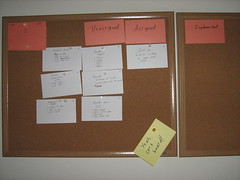
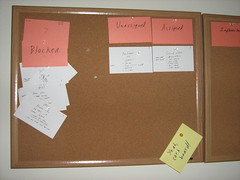
I came up with a list of interrelated concerns I wanted to keep in mind during this project’s run. I posted this list up on my cork board next to my current iteration story cards so I can always see it as a reminder.

  • Player interest/boredom
  • Interface simplicity/complexity
  • Screen size vs world size
  • Game balance/dominant strategies
  • The Feel of Being a Villain

I might not be able to address everything here in the time I have, but having these concerns written out can help me whenever I wrestle with a design decision.

Player interest/boredom: Some of the feedback I received about the Ludum Dare version of the game was that it wasn’t very fun. One of the concerns I had during development was that the player wouldn’t have much control over the game. In the end, the player’s choices boiled down to which monster to create, when to create it, and which tower to create it from. Once a monster is created, the AI controls the show, and the player can only watch what happens. If the AI was complex, it would make intricate decisions about where to go and what to do, which is fascinating during development, but it probably isn’t too much fun for the player. While I was relatively pleased with how the AI worked out, I didn’t want the game to be more fun to program than to play.

There is a small amount of randomness in the pathfinding to help prevent each play session from looking the same, but I didn’t want the randomness to affect the game too much either. It would be pretty frustrating if you couldn’t predict how useful it would be to summon a monster at a specific tower. So oddly, making the AI simple and more predictable created a much better player experience. He/She could make a decision and feel confident about it or know why it was the wrong move to make. Still, I think there is room for improvement in terms the player’s interaction choices to make it more interesting and compelling. At the very least, there should be better feedback for the player to let him/her know why the AI is doing what it is doing.

In terms of pacing, there are a few issues to address, namely game speed and resource increments.

The game runs very slowly by default. The thinking behind this speed was that I wanted this game to have a more epic feel. The hero would slowly be making his way to your castle, tackling towers along the way, and you’ll be working on armies to deal with him. In other games, when you’re in the role of the hero, you are progressing through the game level by level, screen by screen, enemy by enemy, and I didn’t want the game to be over too quickly.

Unfortunately, I learned that testing AI and other feature changes was annoying at this speed. With 72 hours to make a game, waiting 20 minutes to see what happens when the hero makes it to the castle was way too long. Eventually, I created a debug speed for myself. In the end, I found that I enjoyed playing at this increased speed. Game sessions were quick and easy to replay again and again, reminding me of how easy it is to get sucked into hours of playing Strange Adventures in Infinite Space even though each session might not last more than a few minutes at most.

Pressing “F” speeds Stop That Hero! up 10x, but unfortunately I didn’t provide such documentation in the original release of the game itself so most people probably played the slower-paced (and less fun) version.

Regardless of the game speed, the resource increments came in too slowly and only got worse as a game session went on. As I explained in the Stop That Hero! post-mortem, I was trying to prevent the player from creating overpowered monsters very quickly, and since I had mere hours of playtesting, I ended up with low starting resources and a very slow increment over time. To make matters worse, I tried to tie those regular resource increments to the number of towers you controlled. In practice, it means that you’re strongest at the beginning of the game when you have hardly any resources, and it only gets worse as the hero clears the towers. In the mid and late game, when you need resources the most, you get less. While you can gain resources depending on the strength of the monster that killed the hero, it was almost impossible to do it with a bat, which would give you the most resources, and if you could kill the hero with a dragon, you’re probably doing well enough that the smaller amount of extra resources are enough. I wasn’t happy with how I handled resources, but again, I had limited time to find a better way.

I spent quite a bit of time since the compo trying to come up with alternative ways to handle resources. I’ll write about those alternatives later. In any case, I wish I had thought to make the monsters much weaker than the hero so you could create an army instead of a handful of monsters.

Interface simplicity/complexity: I liked that the player’s input was limited to clicking, but it put a lot more responsibility on me as the game designer to make sure that the player could do meaningful things with those clicks. Since I am also interested in giving the player more interesting choices and options, I need to worry about how complex the interface can get.

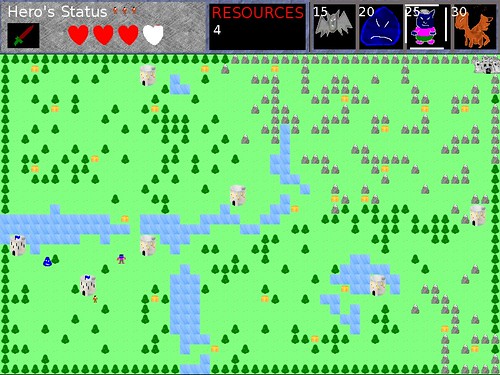
Right now, the player is limited to clicking on the UI at the top of the screen and on the towers. If I wanted the player to have a bit more influence on the AI, how would I provide those controls without making things confusing? One thing I’d like to experiment with is the inclusion of a flag or banner. You can click to place it in any valid location on the map, and your minions will try to reach it, giving you a bit more control over the monsters in your army. Maybe you want them to move towards a specific tower to defend it, or maybe you want to head the hero off at some location. Either way, you no longer have to worry if the AI is capable of figuring out where the best place to go is.

So how do I do it? Do I simply provide a banner icon in the UI, and clicking on it changes the mouse cursor so that the next click places the banner? Does clicking on any non-tower result in the placement of the banner by default, eliminating the need for the icon? Can the player choose to influence particular individuals and leave others alone, or is it all or nothing? Is the banner always present, or should it disappear after some time? Maybe it should disappear when the first monster touches it? Maybe monsters will ignore it after they do touch it, allowing existing monsters to continue moving toward it. Should new monsters created when a banner is out go toward the banner, or should they use independent pathfinding until a new banner is placed? Maybe each tower should have its own banner to direct new monsters. As you can see, even this one feature requires a lot more design and can impact a number of different parts of the game.

Basically, even though the player can only click on the screen, I want to make sure the simple interface doesn’t result in simple play. The player’s choice on where, what, and when to click should be powerful enough to allow the player to do everything he/she wants to do. At the same time, I don’t want to clutter up the screen with a million things to click on. I’d rather not make the interface terribly intimidating.

Screen size vs World size:

The game’s graphics are tiny, but the current screen resolution is 800×600. Each tile is 16×16 pixels. It’s playable and works well. For now, I’m focusing on the desktop, but I want to keep in mind the option of porting to mobile? For example, newer versions of the iPhone might support the current resolution, but older models would only support 400×300. Halving the tiles to 8×8 would functionally work, but the hero and monster entities are smaller still! Would they even be recognizable at such a tiny resolution?

Could the graphics be blown up? I could try to make the game using 32×32 tiles, and then the smaller resolution version would use what I have now, and both would be fine. The question then becomes: will the game world be large enough?

I’d rather not let the player have the option of scrolling on the map simply because doing so would complicate the interface more, so I’d like the entire world to fit on the screen. If the world is currently 50×32 tiles, and halving that would be 25×16 tiles.

Since the game currently runs relatively quickly, it’s hard for me to see how good it would be to shorten it. Then again, pacing might work out better. I’d like to experiment with the world size and graphic resolution to see how it all feels.

Game balance/dominant strategies:

I don’t want the player to find a single, unbeatable way to play. It removes the challenge and stops it from being a game. Of course, I also don’t want the game to be too hard. I don’t want the player to feel like he/she should only use one or two of the monsters. The bat flies but is super weak. The blob is slow and land-based, but a little stronger. The ogre is stronger still. The dragon can fly and is fastest and strongest. With the current version of the game, I found that I rarely used blobs or ogres since I either couldn’t afford anything other than bats or I wanted to wait until I had enough resources for the dragons. When I used the blobs or ogres, they moved slowly and stupidly. Of course, that was what I originally wanted them to do, but it only became obvious after release how annoying those two units were. Making them somewhat smarter might have changed the feel of the game, but I may end up with completely different monsters by the time this project is over.

The Feel of Being a Villain:

The game needs to let the player feel like he/she is doing evil. A big part of it will come from the graphics and audio, but what about the game play? Creating monsters should feel good for being so wrong. Killing the hero should result in a mini-celebration. Could towns be razed? Does the land look worse as you do better in the game? Is there a way to convey the player’s evil power whenever he/she does an action in the game? Can the mouse cursor look like an evil, gnarled hand? What would I do for mobile phones with no mouse cursor?

What do you think? I’d love to get feedback on some of these thoughts.

Categories
Game Design Game Development Games Geek / Technical Linux Game Development Personal Development Post-mortem

LD18: Stop That Hero! Post-Mortem

Ludum Dare 18 was over a month ago. While I didn’t get the game finished in time for the main compo, the Ludum Dare Jam was running simultaneously and offered an extra day to let me finish and submit it.

Stop That Hero! was my most ambitious game yet. It was partially inspired by a book I was reading about artificial intelligence in games and what ended up becoming the winning theme: Enemies as Weapons. I liked the idea of a hero controlled by the computer while you sent enemies to try to stop him. My initial vision was more like Super Mario Bros. That is, the game was going to be a platformer with multiple levels, and you were going to send enemies such as Goombas and Koopa Troopas at the hero. I realized right away that learning how to implement a platformer was not going to be an efficient use of my time, especially since implementing new AI techniques was already going to be a challenge. So I switched from a “reverse Super Mario Bros.” to a “reverse Legend of Zelda” game. The hero would be trying to conquer your towers and ultimately your home castle, and you would use a variety of minions to kill him first.

What Went Right

  1. Early Prototyping Saved Time.

    More prototyping

    During the Ludum Dare #15, I was able to leverage my newly learned rapid prototyping knowledge to good effect, as I explain in the Mineral Miner post-mortem. Even though I had an idea of what I wanted to do before this latest competition started, I still spent some time fleshing it out on paper. Doing so helped me realize requirements I didn’t know I had, such as the need for AI visibility. I also got a feel for the game play, including how the player should spawn enemies and what they’ll do. Prototypes still work well!

  2. Simple Controls Forced Creativity. I wanted the player to do everything with the mouse for a few reasons. One, it would make the game more accessible and easier to play. Two, it would force me to make a simpler game. If the player can’t do too much, then there shouldn’t be a lot of complexity for me to implement. Since I knew that I was going to have enough difficulty implementing AI more advanced than any I’ve ever implemented before, I didn’t want to let the rest of the project’s scope get too large. With simple controls, I would have to figure out other ways to make the game compelling. While simple controls still left me with a lot of design choices and directions to go in, I was able to focus my efforts, and I think the game turned out much better for it.
  3. A Focus on Artificial Intelligence Was Smart. Right away, I knew that most of my time would be spent working on the AI. The game depended on it. I had just finished reading AI for Game Developers shortly before the compo started, and I realized that I never did so in all the time it was on my shelf! I learned some really cool and basic techniques, and I learned that sometimes simple AI tech is better than more complex AI tech. I was also glad I had Artificial Intelligence for Games, Second Edition to act as a more in-depth, up-to-date resource. Between these two books, I was able to create a decent bit of AI. My game’s AI needs related to behavior and pathfinding. Behavior was easily handled by a state machine, but the biggest dependency was on pathfinding. My implementation of A* was somewhat flawed from the start due to the fact that my AI agents didn’t necessarily have a single target at any given time and it was possible they didn’t see anything near them in the first place, but I was pleased with the results considered how much time I had to work within. Seeing a bunch of AI monsters moving about the screen on their own, avoiding each other, and otherwise looking like they had agendas of their own was a proud moment for me.
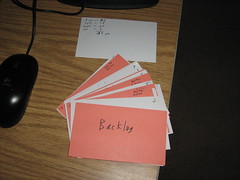
  4. Agile Planning Kept Me Focused and Aware of Priorities.

    Agile backlog First iteration

    Since I had a good sense of what the game was going to involve, I was able to plan quite a bit up front. It’s fairly common knowledge that the waterfall model doesn’t work in software development, but I wasn’t planning down to every detail. With Agile story cards, I knew what features to implement, but the implementation details were dealt with when I assigned a story card to myself. The problem with working alone is that no one is there to act as a check against my estimates for how difficult any particular story should be, but for the most part, things worked out well enough. I got two big benefits from using an Agile process to manage my project. One was that I always had a task in front of me. I never floundered, wondering what I should work on next, so my time in front of the computer was highly focused and productive. The other big benefit was knowing what features to focus on and what to cut as the deadline loomed. I originally wanted to have animations and special effects, but as the weekend went on, I knew these tasks weren’t nearly as important as getting working AI. Out they went, and I felt good about the decision.

What Went Wrong

  1. I Spent Too Much Time On The UI and Menus. I took time to prototype and come up with Agile story cards early in the process, but where I went wrong was not giving myself deadlines for those story cards. Ludum Dare was almost halfway through when I finally had an implementation of a window that I could close by clicking a menu item. Granted, clicking was an important aspect of the game, but I probably could have done so without worrying about how the menus would work.
  2. I Broke My Rule About Keeping the Art Simple. In past LDs, I realized that I would spend way too much time trying to create decent-looking art. Mineral Miner benefited from low-quality art because I was able to spend my time finishing it. For this LD, I thought keeping the graphics tiny would help, and it did, but I still found myself trying to draw a decent looking dragon when it wasn’t that important to make it look good. It simply had to be functional. Again, implementing AI was supposed to be my biggest challenge, but trying to create monsters that looked somewhat like what they were supposed to be was where I spent a lot of my time.
  3. I Missed the 48 Hour Deadline. Ludum Dare is normally a 48-hour competition, but LD 18 was a combination 48-hour compo and 72-hour game jam. I normally try to get a good night’s sleep, but I stayed up late this time around. While I was able to get a lot of work done, I found myself making mistakes and having difficulty keeping the code structure in my head. By the end of the second day, I was disappointed that I didn’t have a finished game, so I went to bed. That third day was when everything came together for me, but missing out on the 48-hour deadline meant that I missed out on feedback from other entrants. The compo has rated entries while the jam did not, so entering a compo game would guarantee some feedback in the form of ratings and comments. As I was only able to enter the Jam, my game was ignored by and large. This is the first time that the Jam format was tried for Ludum Dare, and next time there might be some changes to address these concerns, so hopefully entering a game in the Jam won’t feel like second-class LD.
  4. The Game’s Balance Is Off. On the last day of the Ludum Dare Jam, I found I had time to actually play the game. I tried to change values such as the Hero’s strength and speed and the amount of resources you obtain. I didn’t want the player to be able to create a dragon or two right away, so I lowered the starting resources, and then I didn’t want the dragons to come out soon after the game started, so I slowed down the resource increase. While I was able to make such a dominant strategy hard to do in the beginning of the game, it can still work well for the player so long as he/she has patience. Also, it had the side-effect of slowing down the pace of the game. You can only create a handful of minions in any game session, which isn’t nearly as fun as having an entire army swarming on the map. I would have liked more time to balance the game so that it was harder to pull off dominant strategies AND was fun to play.

What I Learned

  1. Simple AI Can Do Wonders! The AI in my game didn’t turn out nearly as complex as I originally thought it needed to be, but maybe it’s good that it didn’t. The AI boiled down to a few pathfinding algorithms and the selection of a target to move to, which isn’t very different from a game such as Pac-man. Once I fixed a number of bugs with the pathfinding, Stop That Hero! came alive. It really did feel like you were creating minions to do your bidding.
  2. Agile Project Planning Is Quick and Useful. Creating a prioritized requirements list and a schedule estimate helped me keep tabs on my progress throughout the weekend. I always knew what task to focus on, and I was able to change my plans when I realized that things were going too slowly for me to get it all done. I received advice that I should have deadlines for my tasks since a schedule doesn’t mean much without them, and I’m inclined to agree. With deadlines/milestones, I probably would have realized how slow my progress was earlier on.
  3. I Need Sleep. Working through the night and into the morning, I learned that my most productive spurts were soon after waking up and having breakfast. Otherwise, even if it felt like I was making progress, I was actually creating problems by inserting bugs and implementing badly thought-out designs. I was able to recover, but in general, I think getting regular sleep is still more beneficial to my project’s health (and my own!) than not.

As in previous Ludum Dare compos, I’ve found my biggest problem is deciding where to spend my time and for how long. Creating a simple menu infrastructure and twiddling with image editors to try to make good looking art took away time from implementing AI and fixing the game’s balance. Project management suffered since I didn’t give myself deadlines, but it did keep me focused. In the end, I had a complete game, with sound, and I’ve decided I liked this project so much that I’ll be updating it and polishing it up for PoV’s inspiring challenge to sell a game by the end of October.

For future projects, I’ll need to give myself milestone deadlines to ensure that I don’t spend too much time on tasks, and I’ll also need to make sure that any art assets I create are primarily functional. Alternatively, I need to dedicate the time to learn how to create quality art and how to use the Gimp.

Categories
Game Design Game Development

My Game Design Prototype Toolbox

Last year I posted about my shopping trip to a hobby store to buy game design prototyping tools. Some weeks ago, I bought even more items, such as tiny wooden barrels and glass beads. These tools are great for doing quick and easy paper prototypes of game designs.

I’ve been keeping them in small plastic bags, and all of those bags were in a larger freezer bag. While this was functional, it felt unsuitable. I’m a game designer, and some of my most important tools are in plastic food bags? It’s not right.

So I went shopping again and found a nice toolbox for less than $15. It has these cool compartments that I can move about relatively easily, and when the lid is closed, everything stays in place.

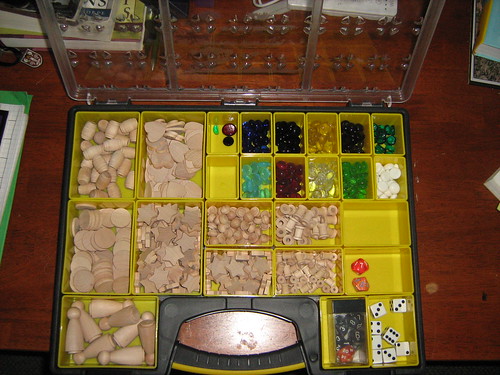
I put all of my wooden pieces and glass beads in the toolbox, and each gets its own compartment. I realized I had a lot more star-shaped wooden pieces than any other piece, though. I even had room for more things, so I put in some dice. My dice collection isn’t much, but I had them separate from my prototyping tools before. Now they’re all together.

Here’s a shot of the toolbox opened.

Prototyping Toolbox

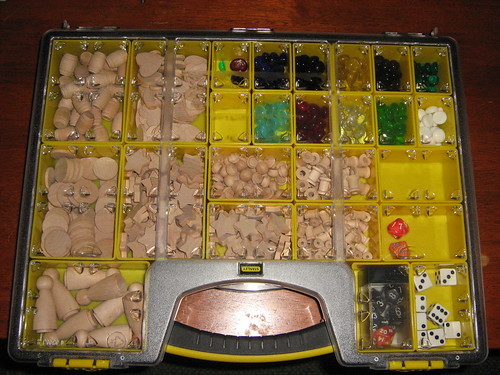
And here’s a shot of the closed toolbox.

Prototyping Toolbox

The plastic bags were a bit more portable. I could put the entire collection in my bookbag when I left home, but this toolbox is its own luggage. By and large, I don’t find myself going out to do prototyping, so it isn’t that big of a deal.

What’s in your game design prototype toolbox? How do you store your physical paper prototyping tools?

Categories
Game Design Game Development Geek / Technical Linux Game Development Personal Development

LD18: Stop That Hero! Ported to Win32!

I’ve updated my LD final entry page, but I wanted to let you know that I finally created a Stop That Hero! Windows port (2.2MB)!

Now you have no excuse not to play! Well, assuming you don’t use a Mac. Or some other OS. Then you have an excuse.

Categories
Game Design Game Development Geek / Technical Linux Game Development Personal Development

LD18: Stop That Hero! Development Time Lapse!

Here’s the time lapse for my 72 hours of development on Stop That Hero!

Categories
Game Design Game Development Geek / Technical Linux Game Development Personal Development

LD18: Stop That Hero! Is Finished!

I apparently needed sleep and a third day to get this game completed, but here it is!

Stop That Hero! is finished

So far, the Stop That Hero! Linux version (1.6MB) is all I have. I just started using CMake for my build scripts, so please let me know if the game won’t run on your computer.
Get the Stop That Hero! source

I’ll work on a Windows port, but for now, I’m going to relax! It’s been a grueling 72 hours!

UPDATE: Windows port (2.2MB) created and available for you!

I also updated the Linux build. It’s the same code, but the build was done on an older Linux-based system, so it should run on more systems without a problem.

Categories
Game Design Game Development Geek / Technical Linux Game Development Personal Development

LD18: I’m In the Home Stretch

I’m at the final iteration!

The home stretch!

Basically, the tasks I have left:

  • create instructions screen
  • add sound effects
  • package this baby up!

In the last iteration, I was play testing and balancing as best as I could. I decided that the bat was too expensive, so I moved it down in front of the slime in terms of costs. I lowered the starting health of the Hero and gave him fewer lives. I also tweaked the level design a bit to accommodate the AI’s inability to see too far ahead. There are also victory and defeat screens now.

I finally got the AI working well enough that I realized that I wasn’t just debugging the program anymore. I was playing the game! And it’s actually not that lame! B-)

Categories
Game Design Game Development Geek / Technical Linux Game Development Personal Development

LD18: Let’s Keep on Jammin’!

I missed the deadline for the main compo, but I can still submit my game to the Ludum Dare Jam. The deadline is 24 hours after the end of the compo, so I have until 9PM tonight to finish this game.

After a good night’s rest, I woke up with bug fixes. Seriously, I was lying in bed, slowly waking up, and I thought, “Oh, yeah, I implemented cooldown for the entities after they attack, but I forgot to ensure that cooldown ends.” I fixed a crash bug which also prevents the creatures from trying to leave the world map. And I improved the exploration mode of the AI so that the entities should no longer wiggle or fidget. They pick a direction and go until they reach it. I found that the reason why the hero was getting stuck in place. It was due to the fact that I was checking if he had reached a very exact location, and with his speed, he sometimes overshoots it. When he tries to go back to it, he overshoots again, forever. I enlarged the collision detection box to compensate.

When I finished Iteration 4, I found out that accidentally implemented some stories from Iteration which deal with entities attacking each other. I’ve simplified combat so if entities are not in cooldown and are touching, they’re attacking. That implementation left Iteration 5 fairly moot. In fact, I decided to skip the remaining story in Iteration 5 which dealt with some nuanced AI that I’m not even going to look at, so I’m on to Iteration 6. You can see the backlog of skipped story cards under the Iteration card.

Iteration 5 finished quickly; On to Iteration 6

I’m pretty excited. It’s only 10AM, and I’m on the last two iterations. Iteration 7 is basically sound effects and packaging the game up, and frankly (and sadly), sound is optional at this point. B-)

Categories
Game Design Game Development Geek / Technical Linux Game Development Personal Development

LD18: Missed the Deadline but Continuing On

I got to Iteration 3 by scrapping some of the art and animations I had planned for Iteration 2. Those story points go back into the backlog.

Iteration 3

Iteration 3 was a bear. It was where a lot of the advanced AI had to be implemented. I’ve never done A*. Most of my AI was very simplistic, which went with the simplistic games I’ve done before. This game was going to be different.

Or at least I hoped it would. Entities would bumble about, get stuck, and fly off the world map even though I explicitly told them not to!

I had a quick lunch which was easy to make while I continued to work.

Vegan pizza and applce juice

Unfortunately, the deadline for the main Ludum Dare compo passed when I finally figured out the A* algorithm (it turned out that there was a greater-than sign when there should have been a less-than sign, which is why the entities were moving so strangely). After the pathfinding, the entities still had to interact.

I had the Hero moving toward targets it sees nearby, although every so often I see that he gets stuck in a certain tile for some reason. Enemies seem to have trouble moving to the Hero like I expect, but they find him soon enough.

But with Iteration 4, they fight!

Iteration 4

Do you see how the Hero’s health is down?

See enemies put on the hurt!

That’s the first time it has been like that outside of arbitrary tests being conducted. One of the dragons did that! Good job, my babies!

Since the main compo is over, the only option I have left is to continue on. I can still try to enter the Ludum Dare Jam, which gives me an extra 24 hours before the submission deadline.

For now, though, I’m going to bed. These last 48 hours have been grueling, frustrating, and exciting.

Categories
Game Design Game Development Geek / Technical Linux Game Development Personal Development

LD18: Good Morning, Ludum Dare!

Good Morning, Ludum Dare!

I went to bed after 5:30AM after getting some rudimentary AI in. I don’t know why the ground-based characters have no second-thoughts about going through the trees and mountains. If anything, they should want to avoid them. I’m sure there’s a bug in the implementation.

Watch them move!

I woke up feeling fairly crappy, but I know what will fix that!

Let's wake up and get this game done!

Yeah, OJ! Oh, and, yeah, sure, I suppose Banana can come along, too.