Categories
Game Design

Game Design Analysis: Let’s Play Tic-Tac-Toe

Tic-Tac-Toe, or Naughts and Crosses if you are wrong, is a children’s game. It’s a solved game, which means there is always a best move someone can make, and the only reason why it appeals to children today is because they haven’t figured out the solution yet.

In any case, it’s a simple game. Let’s analyze the heck out of it as a game design exercise.

First, let’s look at the rules of Tic-tac-toe.

Setup:

We need a 3×3 grid and two players.

One player places X pieces, and the other player places O pieces.

Choose a player to go first.

Game play:

On a your turn, you place the piece you represent in an open square in the 3×3 grid.

That’s…pretty much it. All you can do is place your piece in the grid. Then it is the other player’s turn.

Resolution:

If, after placing a piece, you have three of your pieces in a row, column, or diagonal, you win the game.

If there are no more open squares in the grid, and no one has won, then the game is a draw.

Analysis:

It doesn’t seem very complicated once you write it out, does it? We knew it was a simple game, but wow, that’s pretty simple.

What’s interesting is what’s not explicitly mentioned in the rules but ends up being a part of everyone’s mental model of the game.

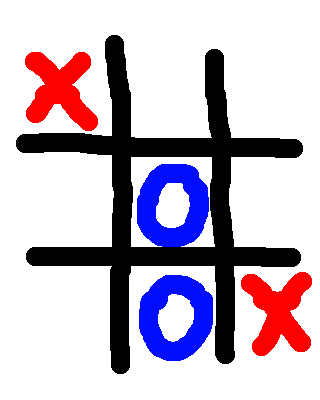
Here’s an example game in progress:

Tic-Tac-Toe

If it is X’s turn, where should the next piece be placed? At the top center square in the grid. Why?

To block O from winning. Because O just needs to place one more piece to get three Os in a row and win, and X doesn’t want to lose, X has one move that prevents O from winning here. Blocking isn’t explicitly mentioned in the game rules, and yet it becomes a key aspect of any serious Tic-tac-toe player’s strategy.

Tic-Tac-Toe

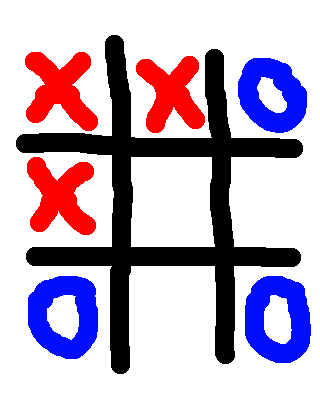
How about the above situation? O has just placed the piece at the bottom right. What’s the next move for X?

The answer: it doesn’t matter. O has forked and is now potentially able to win on both the right column and on the bottom row. If X places a block in either the bottom center or the middle right spot, then O simply places a piece in the other spot and wins the game. Forks are also absent from the rules, but expert players always look for an opportunity to create one.

Blocking and forking are examples of dynamics that are the emergent properties of the game’s mechanics. A minor change in the rules can have an impact on the game play.

What if you could use your turn to destroy a piece and open up a space in the grid? The obvious idea is that it would be hard to win because players would essentially destroy the opposing player’s piece any time it threatened to get to three in a row. Ok, what if we allowed each player to do so only once in a game?

Tic-Tac-Toe

It might slow the game down a bit. Destroying a piece merely delays the opposing player’s move by one move. The game is so simple and so very, very solved that it might not really change the nature of the game much.

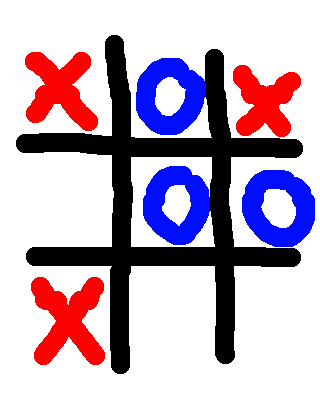
But one dynamic that might evolve is the discovered fork, as the above example can show: even though O is threatening to win with a fork, X has just placed the piece at the bottom left. What if X decides to destroy the O in the center? Now instead of merely preventing a potential win by O, destroying that O resulted in a fork in which X can now win either with the left column or the diagonal.

The end of this game would still be a draw if everyone played perfectly, but it might surprise the amateur player.

Conclusion:

Even without custom rules, it’s easy to see how the simple mechanics can result in more complex game play than might be expected. Even a simple game like Tic-Tac-Toe has emergent game play that derive from the rules.

The big takeaway lesson here is that you need to see a game in action in order to really understand the game, which is why playtesting your own designs is so important.

Categories
Game Design Personal Development

What Are the Hard Skills of a Game Designer?

There are hard skills and soft skills.

Hard skills are things you can practice outside of any context. Soft skills are usually built upon the hard skills.

Basketball players can practice shooting three-pointers over and over outside of the context of a real game. During a game, knowing when to take a three-point shot is a soft skill, which depends on reading the defense, knowing the shot clock, and keeping in mind the current score.

When I think about hard skills vs soft skills, I found myself struggling to think of the hard skills of a game designer.

A game designer needs to be able to communicate, which means writing and drawing well. But I have a hard time seeing writing prose as a core exercise in getting better at designing games.

A game designer needs to be able to establish rules for setup, for procedure, and for resolution. But how does rule-setting translate into a hard skill that I can practice outside of the context of a game? Do I train as a game designer by setting arbitrary rules for everyday activities? “When getting ready in the morning, I must do everything with my non-dominant hand.” It might be interesting to experiment for a week with setting rules and restrictions where they don’t need to exist, but will I really get better at game design for it?

A game designer needs to be able to prototype and playtest. Do you take an existing game and create your own board, cards, and tokens? Does doing so actually help with future prototyping? Maybe. I actually like this idea. You practice with existing games, and it helps you get a more intuitive feel for exactly what goes into a game of your own creation. Maybe you didn’t appreciate how many different cards are in a game of Onirim until you tried to make them yourself.

But hard skills specific to game design seem hard to identify. Game design tends to be about trade-offs and figuring out second-order effects of rule changes, which are mostly about soft skills. But maybe I’m missing something basic that I’m not appreciating.

What do you think? What are the hard skills of game design?

Categories
Game Design

Behind the Scenes with Bhaloidam

I love learning about how things are made.

The finished product often hides the false starts, the problems solved, and the journey.

The iPhone’s scratch-resistant glass is something owners don’t think about because many of them don’t know that the scratches on earlier prototypes were seen as problematic enough to do something about, even a little over a month before the official release. Robin Williams tried out a number of different ways to portray Mrs. Doubtfire, so that scene in the movie when he was getting turned into a women and discarding a few attempts also happened in real life. Disney animators had to work out how many frames of animation to show before playing speech in order for it to look natural.

Upon discovering that his email address was publicly accessible, I once emailed American McGee to ask him about the workings of Alice, specifically about the part in which you turn into chess pieces and move about the giant chess board on the ground. I got a short reply along the lines of “We had to ship, so it wasn’t perfect. Try to have fun instead of focusing on the details!” I remember thinking, “But, focusing on the details IS fun for me!

When you have only the finished product, you don’t think much about it and you take a lot for granted. When you learn how it was made, you gain a greater appreciation for the craft, the effort, and the ingenuity of the people involved.

So I was excited to see that my friend Corvus Elrod has released a visual history of Bhaloidam, the participatory story-telling platform he created. You can read more about it at Bhaloidam.com.

I know what Bhaloidam looks like today, but it’s fascinating to see how it back in 1991. I’m curious about what CorWorlds was, as a quick search online reveals nothing. B-)

I loved exploring how complexity was added, then stripped completely away, before coming back into something recognizable in today’s Bhaloidam. I was delighted when I saw the hexagonal paper cups and pente stones.

It was only a high level history, but it still felt like digging under a city to find another city acting as its support structure. And while I knew he was working on it for over two decades, now I can walk through and see the progression over that time in a more visceral way.

Bhaloidam‘s handbook and lifewheels are freely available online as print and play (PaP), with high-quality Skein packs available for purchase in the store at a great price.

Categories
Game Design

How Long Does It Take to Make a Game?

Originally, games were made by solo developers. It took a long time because the code was at the level of binary, and the games were simple.

As computing power grew, so did the capabilities of the game developers. For years, games were seen as expensive productions by hundreds of developers working in teams for potentially half a decade. Someone interested in game development wouldn’t even know where to start because it seemed so overwhelming.

Then indie game development became more well known. Games could be made in mere months, like in the old days, but with much better tools to leverage.

Then people tried to see how quickly they could make games. One Game a Month makes a game out of finishing and publishing games each month. Ludum Dare challenges you to make a game in 48 hours (by the way, there’s a major compo later this month you should join!). People involved at Garage Games had Game in a Day, a 24 hour competition.

The 0hr Game Jam takes place during Daylight Savings Time, in the hour that is lost between 2AM and 2AM.

In the past, Andy Moore has said that an hour is plenty of time for a game. “I’m not talking a WHOLE GAME (you need a weekend for that!), but an individual mechanic, feature, or tweak? It should take less than an hour to hash out the lowest common denominator version of that.”

Jonatan “Cactus” Soderstrom, famous for his quick development, gave a talk at GDC in 2009 on The Four Hour Game Design.

With paper prototypes and the amazing digital tools accessible to almost everyone, it’s easy to try something out quickly and see if it will work before you spend months or years building content around an idea.

So games can be made quickly, and some are even good games. Really good. Some quickly-developed games even become massive financial successes. Flappy Bird was made in a couple of days and was earning its developer $50,000 a day at one point.

But not all games can be Flappy Bird, even if a quick glance at the App Store might make you think otherwise. Some games need more time to cook. Maybe you found a core mechanic that works, but you spend more time iteratively tweaking and playtesting and fixing issues you find.

Pac-man‘s AI took half a year to perfect. Monster Loves You! took months of prototypes, and the finished product had a custom dialog engine and plenty of content. Tower of Guns was developed over 600 days.

2dBoy has a 7-part series on the development of World of Goo, a game which was famously based off of a quick prototype called Tower of Goo made in four days. The original World of Goo demo release happened a year after development started.

At 8 months into the project:

it’s now almost 4 months after we thought we were 3 months away from finishing the game. we continue to fool ourselves and think we’ve got another 3 months left to go.

So how long does it take to make a game? It clearly only takes a few hours, plus time for playtesting, content creation, and polish, all of which takes much longer than anyone expects.

Categories
Game Design

Making Core Game Design Choices

I’m making a tycoon game about raking leaves. At first, it was slow going, partly because I lost focus on what I was really trying to accomplish, and partly because I was treating it’s development as something that needed to be fully formed from nothing.

Then I realized that most of the player interactions are menu based, and the GUI and related content would be independent of the game play itself, which is going to be geared towards the development of the invisible economy and the player’s feedback related to the consequences of his/her actions.

I normally think of prototyping along the lines of my handy-dandy physical prototyping toolbox, in which I use paper and drawn lines with wooden pieces and stones to represent objects. I could prototype menus on paper, which I think would work well for getting the feel of the GUI, but I don’t think it would work as well for what should be on the menus in the first place.

So I’m creating a command line version of my game. The UI is fairly stripped down, and it’s easy to code. I just accept input as numbers, and the relevant choices in a given menu are processed. Simple.

And effective! I was surprised what only a few hours of development churned out. I even have a basic weather system in place.

MAIN MENU

1: See neighborhood
2: View inventory
3: View weather report
4: Quit current game

3
Today: Mostly cloudy with a 86% chance of rain
Tomorrow: Mostly sunny with a few clouds with a 15% chance of rain

I can quickly play the game as it is being developed because build times take mere moments. I’m spending time designing rather than coding infrastructure because the infrastructure is so lightweight.

But what about the bigger design decisions?

In this tycoon game, I had a general idea of the player being able to set a rate, do some work, and get paid for it. Simple, right?

But when I started to play, I realized this simple idea has a lot of unanswered questions. Do you set your rate before you get clients? Do you set it on a client by client basis? Do you charge hourly, or for a finished leaf raking job by the size of the yard, or is it a static rate? Does the game track time in hours, meaning you need to decide which yards to work on in a given day based on how long they take, or in days, so your decision is which yard you tackle on a given day?

This is a core decision that determines how the game will be experienced. It’s terrifying because this decision basically says what the game won’t be like. You can’t include all of them because they’re mutually exclusive, and you can’t put off the decision because without it, you have no game.

How do you make such a decision?

I have criteria to measure my options against, such as whether or not the option fits my design goals. An educational game would play differently from a physics puzzler. But what about deciding between a number of options that all seem to fit the higher level design?

In Lemonade Stand, you set the price of a glass of lemonade before the day starts. Then you start the day, and you find out at the end of the day how many glasses people bought and how much income you got.

There’s no haggling. There’s no adjustment during a given day. It’s a simple abstraction to a real life situation and quite accessible to the children it was geared towards.

But since it’s a game, it could have gone in any number of directions. The game could have had you interacting with each individual customer, making many minor decisions such as how much to fill each glass or if you should charge someone more or less. It could have become a higher fidelity simulation, but it would have been more difficult to play. It would have been a different game entirely geared towards a different audience.

Similarly, as a designer, I need to figure out the course of my game. I could see this as a huge decision and go through a lot of analysis about which is best before picking a direction, and even then I can only hope I made the right choice.

But I could also just try all of them and see what happens.

When prototyping, a cheap and quick implementation allows you to experience the real thing instead of wondering. You could implement the simplest solution, see how it feels, and either add to it and tweak it or discard it and try something else.

Maybe I’ll be surprised at how the simpler solution actually feels perfectly fine, or maybe I’ll discover that two different approaches are just variations on the same design. Maybe I’ll decide on an approach, but after developing a good amount of the game around it, I decide it doesn’t quite work and pick up one of the other approaches again because I realize it has some benefits now that I didn’t see before.

Read about the changing design of Threes by Asher Vollmer and Greg Wohlwend, or multiple prototypes of the board game New York 1901 by Chénier La Salle, and you can get an idea of how much sweat it takes to design a game.

It’s hard work. Game design isn’t just playing games and it isn’t just writing a story for your platformer or FPS. It’s more like trying to determine which of 10,000 materials to use to make a lightbulb than it is about shining a flashlight in the right direction in an attempt to discover the fun.

The more options you try out, the more informed a decision you can make about the play experience, but it takes effort and time.

So in the end, the answer to the question of how you decide on core game play is to continually prototype and play test.

What else helped you make such core game play decisions in the past?
Categories
Game Design

Make Better Games by Ignoring Games?

Filip Wiltgren wrote about the benefits of silence in Stop Gaming and You Will Be a Better Designer.

In reading The Artist’s Way by Julia Cameron (/me adds it to his wishlist), Wiltgren found a counterintuitive way to get more creative.

Instead of working on game designs, playing games for research, or reading game industry news, you give it all up for a week. And give up on television so you don’t have it as an outlet either.

And without the regular routine and habits, your brain will feel idle and anxious.

When you can’t expend your energy on consuming your habit then your brain will start to create your habit itself. You will, effectively, be pushing all that energy into creativity relating to what you like. If you’re a chef you might get ideas for great dishes. If you’re a driver you might get ideas for how to do that perfect tailspin. And if you’re a game designer you will suddenly be popping up ideas for games, mechanics and solutions at a rate that you’ve never experienced before.

Looking up The Artist’s Way online, I found people talking about this detoxification along a different line. One person wrote about a social media detox with good results.

So, it’s essentially media fasting. Wiltgren geared it towards games and the writings of people about games online. The key is to disconnect from what everyone else is saying temporarily, which gives you time and space to process and figure things out.

And I think I’ve done this recently on my own. I realized that I could keep reading pro tips and best practices and advice, but some of it is contradictory, and there’s so much of it to read these days from people who may or may not know what they are talking about that if I keep reading it, I’ll never actually get to try the advice out myself to see if it works.

So I stopped seeking it out, and I started using that time to work on myself instead. And I realized that a small bit of improvement with real results is infinitely better than seeking out the best method or perfect way before I start.

I think a news fast was helpful for my general outlook in life. I find ignoring the news for a bit means I find more to be positive about. As a part-time indie game developer, I worry that I already don’t spend enough time on games and paying attention to what is happening in my industry, so I’m hesitant to try out a game fast anytime soon.

Maybe a fast would be a good thing to do after a day or a week of doing nothing but absorbing games. Eat and breathe games, then give yourself time and space to process it all without any more input, and see what happens.

Have you tried this detoxification before?

Categories
Game Design

What Do Your Game Designs Say On Your Behalf?

It’s easy to see someone’s writing as representative of his/her views. The words are right there expressing ideas in a very direct way.

Similarly, a movie can have a certain message buried in it. Sometimes the message is a bit more obvious because it hits you over the head.

Games are no different. The verbs inherent in a game tell you what the designers thought were important.

Some games aren’t saying much. It’s hard to get political with Pong or Angry Birds.

But other games say a lot.

Why are women almost always portrayed as damsels in distress? Why are they seen often as rewards for the player? What does it say about the designers’ view of women?

Why are many games about violence? What does it say about the designers’ position on how best to handle conflict?

You could argue, “But they’re just games!”

But I think games are important, and I think they can have a great impact.

I’m not saying that playing games can turn you into a mass murderer.

But I am saying that the message of games can influence someone’s thinking in a subtle way.

Maybe the next time you bump into someone you’ll see it as an act of aggression to be responded to in kind instead of the accident it was. Maybe you’ll be more inclined to scream obscenities at someone when you’re angry instead of discussing your differences. Maybe you’ll be more interested in winning an argument than in finding common ground with your spouse.

Or maybe you’ll be more inclined to cooperate with your coworkers. Maybe you’ll value puzzle-solving over brute-force. Maybe you’ll see people as equals instead of as resources in your quest.

The messages of your game designs can say a lot about your worldviews. Are you being careful with the messages your games send on your behalf?

Categories
Game Design

Dealing with Game Designer’s Block

You’re working on your game, and you are struggling to get it to come together.

Maybe it’s taking a long time to implement. Maybe you are in the middle of a large project and you’re getting sick of it. Maybe partway through you realize you haven’t even decided what experience you’re aiming for yet.

Maybe it’s time to take a short break to design a simpler game.

Simple Board Game

Brenda Romero’s introductory game design exercise is ideal in these situations. Instead of trying to create a completely unique and commercially-viable game, solving all of the various subproblems you find there, this exercise gives you a simple framework to build around while still giving you a chance to stretch your game design muscles.

Create a race-to-the-end board game, and iteratively build up a complete game. It doesn’t have to be something you can sell. It just has needs to be something you can point to and say, “I made it” and could be something you might whip together in a short period of time.

Doing these kinds of exercises is the equivalent of an artist sketching a quick drawing in a notebook with a pencil. It might not be lead to anything more, but it’s a way to actively engage your mind while also resting it for your main work.

Categories
Game Design

Valuable Books on Game Design

Earlier this month, I watched a 2013 recording of a game design talk by Lost Garden’s Daniel Cook, Game Design Theory I Wish I had Known When I Started:

The slides don’t actually seem to exist anywhere, by the way.

It’s a great presentation, and he goes very high level, leaving the details of each item as an exercise for you to explore in your game design education.

At some point he mentions that there are only a handful of game design books worth having, and he lists three of them in his talk.

I already owned a copy of A Theory of Fun for Game Design by Raph Koster. It was out of print for a bit, and I was strung along by an ordering system snafu on one website that couldn’t actually seem to process the order in 2008.

But eventually I got it, and I should probably reread it again because in watching Cook’s talk and in seeing comments by others, everyone seemed to love it more than I remember loving it, and maybe I missed something the first time.

The other two books Cook mentioned in his talk are: Game Feel: A Game Designer’s Guide to Virtual Sensation by Steve Swink and Game Mechanics: Advanced Game Design by Ernest Adams and Joris Dormans.

I didn’t know about these books, but on the strength of Cook’s recommendation alone, I ordered them, and now I have my own copies.

My New Game Design Books

When I was in college, I studied computer science, and I had a roommate who studied Human-Computer Interaction. I remember thinking that HCI would come in handy in game development, and here Swink has written an entire book on the topic geared towards games.

I used to own a book by Ernest Adams and Andrew Rollings called Game Architecture and Design, and the only reason I got rid of it was because a new edition had come out. Ernest Adams has written quite a few books on game design, some geared towards specific types of games. Game Mechanics is over 300 pages of deep exploration of the topic, and I look forward to diving into it.

Both of these books are deep dives into subtopics in game design. There are other books on my shelf that I really enjoyed which are a bit more general.

One is Game Design Workshop: A Playcentric Approach to Creating Innovative Games, Third Edition by Tracy Fullerton, a great textbook which I reviewed last year. I also went through a number of the exercises weekly for a time, which you can see at Game Design Workshop Wednesdays.

One book with accessible, non-digital exercises that do not require a computer or other expensive technology is Challenges for Game Designers by Ian Schreiber and Brenda Romero. Combine this book with Schreiber’s free online courses on game design, Game Design Concepts and Game Balance Concepts, and you’ve got a good set of game design educational resources.

Tynan Sylvester’s Designing Games covered some of the same ground as other game design books, which is to be expected, but it also brought some fresh perspective and seemed more holistic. I appreciated the discussion on marketing and business influences since games aren’t created in a vacuum. I wrote review of Designing Games last year as well.

What game design books on your shelf do you find the most valuable?

Categories
Game Design Game Development Geek / Technical Personal Development

How to Find Indies in Iowa

When I started out as an indie game developer, I found a home on the Internet. It was a set of forums dedicated not just to game development but also to making a living from it.

And while daily online communication, or maybe just procrastination, was helpful, it was nothing compared to the monthly face-to-face meetups we had in Chicago. We met either downtown at a Dave & Buster’s or at a Starbuck’s in Schaumburg.

It was kind of a loose mastermind group, in which we tried to set goals for the next meeting and held each other accountable to them. We had a range of completely newbies to experienced and successful business owners, and we all met, tried out each other’s games, and gave feedback.

So when I moved to Des Moines, Iowa, I immediately wondered where a similar collection of indies were.

They’re hard to find, so I decided to put a summary on this page in the hopes that it will be easier for everyone to connect with groups they might not have otherwise known existed.

The Iowa Game Dev Friendship Club has a mailing list at https://groups.google.com/forum/#!forum/igdf. It’s made up of indies and enthusiasts from all across the state of Iowa, especially out of Ames and Iowa City which is where our major universities are.

There is now an associated Iowa Game Dev Friendship Club Facebook group.

Sometimes a good number of members show up at a game jam, but otherwise they don’t try to organize massive face-to-face meetings. There have been Des Moines-area meetups in the past, such as the Midwest Mingle.

If you’re in Ames or Iowa City, your local university has a game developer organization. Iowa State has the Iowa State Game Development Club, which has an enthusiastic Twitter account at @isu_gdc and a ISU Game Dev Club Facebook page.

University of Iowa in Iowa City has EPX Video Game and Animation Studio, formerly known as Animation and Interaction at the University of Iowa. You can find them at their weekly meetings and at their EPX Facebook group.

UPDATED 2016: The International Game Developers Association has a Des Moines chapter. You can find them on Twitter (@igdadsm) and Facebook (https://www.facebook.com/groups/227434834257939/.

Did I miss anyone? Is there an Iowa indie game developer meetup you’re hosting that I don’t know about? Let me know, and I’ll update this list.