Categories
Game Design Game Development Geek / Technical Linux Game Development

July #1GAM: I’m Pickin’ Up What You’re Puttin’ Down

My last One Game a Month July project update mentioned updated exhaustion animation and more complex stamina and air supply systems, which I think added a bit of richness to the game.

My most immediate goal was to be able to identify objects in front of the player.

July #1GAM

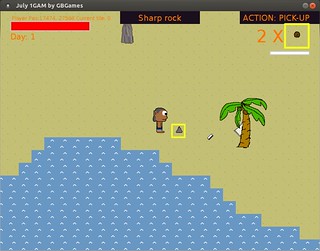
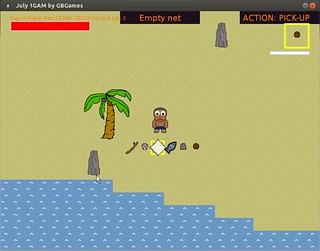
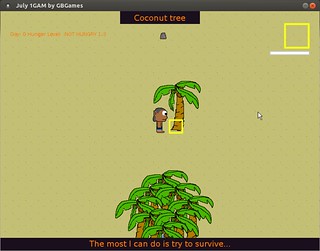
In the above screenshot, the player is facing a coconut tree, and a little bit of descriptive text appears.

July #1GAM

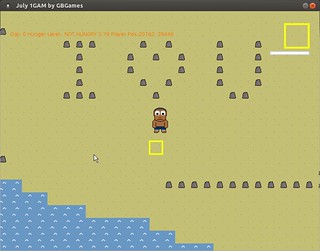
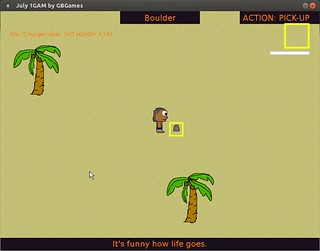
And as you can see, I shrunk the boulders. It’s temporary. I wanted to add rocks to the game, and rather than create a new object, I just changed how an old one is rendered.

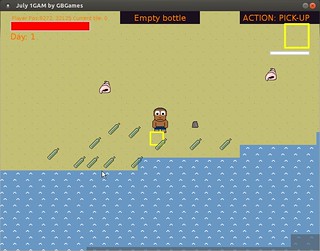
You’ll also notice that standing in front of a rock results in an action becoming available. If you press the spacebar, you’ll pick it up:

July #1GAM

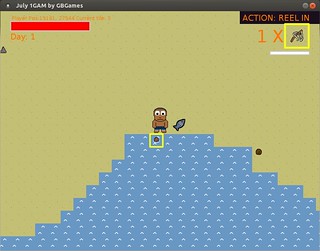
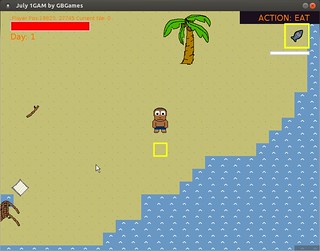
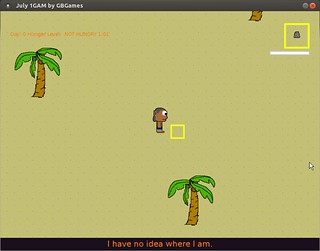
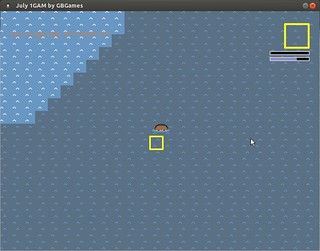
And that yellow box at the top right corner of the screen is your currently equipped item from your inventory.

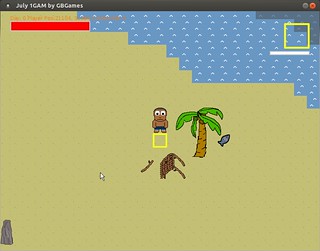
Putting that box in required changing the UI slightly. I think it works out well enough:

July #1GAM

What happens when you want to change what’s equipped?

An inventory system is the next item on my list!

I want the player to be able to bring up an inventory menu to:

  • select and equip items
  • drop an item
  • eat/use/consume an item
  • combine items

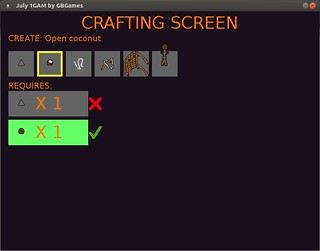
That last one is how the resourceful Castaway will best be able to make the most of a life on a desert island. Combining tree branches would result in a lean-to, which the player can place to provide some shelter, for example.

As I think about all of the items and combinations, I realize that there’s a lot of systems to add to make them worthwhile. For instance, the lean-to is really only useful if I require the player to sleep and seek shelter from weather, which means I need some kind of per-day exhaustion mechanic and a weather system.

Also, can you combine sticks with rocks to make clubs? It would make sense to have a need for a club, such as attacking any wildlife you find for food.

Whoa, wait! What about the Low Violence Challenge? If you recall, I wanted to challenge myself to create games that were less about destruction and violence. I was inspired by Corvus Elrod’s Low Violence Challenge. It was surprisingly hard at first! I have a game idea file that was almost useless this year because so many of my one-line designs depended on “ATTACK” as the main mechanic.

While I think that adding combat mechanics necessarily adds violence to the game, it won’t represent the majority of the game play. Weapons and violence aren’t going to be the focus of this game. Yes, you can attack animals and eat their meat, but you can also opt to be a vegetarian. This game is about exploration and survival, and it is most definitely not about eliminating all other life on the island.

And besides, since it isn’t the core of the game, it’s probably not going to be the first thing I work on. I have less than three weeks to finish the game, after all.

Categories
Personal Development

Happy Independence Day!

Independence. It’s fantastic.

And it’s still only a dream for some people.

Imagine lying on your death bed.

Would you be happy you haven’t fired on all cylinders and instead played a conservative game?

Or would you be happy if you could say that you gave it your all and didn’t let fear stop you?

If you are not yet indie, set a goal, make a plan, and go achieve it.

Categories
Game Design Game Development Geek / Technical Linux Game Development

July #1GAM: Castaway Exhaustion, Meters, and Richer Experiences

Now that it is July, I’m continuing work on my One Game a Month project, Shipwrecked.

At the end of June, I was trying to create a new image to indicate that the player is either drowning or collapsed on the ground. I had a first try, but it didn’t read very well:

June #1GAM

That last frame is supposed to be the “collapsed on the ground due to exhaustion” image, but it didn’t look very different from the “facing up” image.

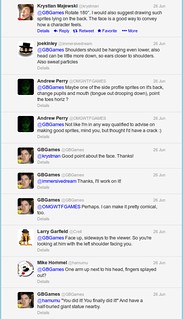
So I asked for help on Twitter and Google+, and I got some great suggestions:

July #1GAM - HelpfulTweets

Unfortunately, I ran out of time last month, but that’s when I created Dark Horse last Saturday and submitted that game for June.

So when I got back to work this month on Shipwrecked, I wanted to make it obvious to the player how dangerous it is to stay out in the water too long.

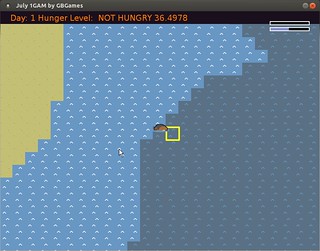
I created a few more frames of animation for drowning, which happens when you’re out of stamina and swimming. You can still swim, but you only have a few seconds of air left. If you run out of air, you die. Swimming has the Castaway bobbing in and out of the water, but drowning shows what little of his face that is above the water in anguish:

July #1GAM

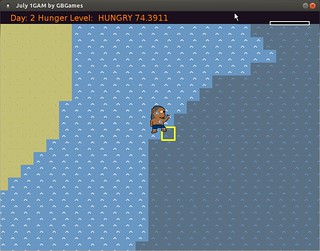
And if you make it back to shore in time, here is the new “collapsed due to exhaustion” look, based on the feedback I received:

July #1GAM

I also added a stamina bar to the top right of the screen. If you are drowning, a second bar appears to give you an indication of how much air you have left. Both of these bars can be seen in the above screenshots.

When you stand still and aren’t swimming, you regain stamina slowly.

What I like about everything I just described is that it is a pretty simple system that provides a better play experience. It is slightly more complicated than what I had before. Originally, if you had no more stamina and were swimming, you instantly drowned. It was harsh, and you had little feedback.

Now, stamina informs whether or not you have the strength to swim. If you don’t, then you start drowning, but you still have time to get back to safety before you run out of air. Air becomes a secondary resource, and the player has more options. Do you risk swimming to that smaller island that may or may not be within swimming distance, or do you turn back? It’s up to you how conservative you want to play. What’s more, stamina doesn’t recover if you are moving, so if you have to keep running away from something chasing you, you are risking the danger of not being able to swim very long.

I’m reminded of a talk given by Chris Crawford in which he discusses the use of variable ranges rather than booleans to provide a larger experience. If you have an NPC in adventure game, you could have a boolean that represents whether or not the character is hostile towards the player, but wouldn’t it be possible to have a richer experience if there were any number of in-between states, such as indifferent? Or secondary states, such as confident or fearful?

While I’m pleased with the stamina and air supply systems, I still need to give the player some way of eating food and recovering from hunger. I could implement a simple system in which touching nearby food objects automatically consumes the food, but in keeping with the above ideas, wouldn’t it be a richer experience to have an inventory system and give the player the choice of when to eat? As a couple of examples, I can introduce the concepts of food spoilage and cooking.

At the same time, July 31st will be here before I know it. I can’t get carried away with feature creep before I have created the core of the game play.

Categories
Game Design Game Development Geek / Technical Linux Game Development

June #1GAM Entry: Dark Horse

So despite my efforts, I wasn’t able to finish the game I’ve been working on all month for June’s One Game a Month project.

So I took a good chunk of Saturday to make an entirely different game instead.

I’ll continue working on Shipwrecked for July, but Dark Horse is a very simple racing game that I managed to get done in less than four hours.

Download Dark Horse for Linux 64-bit (362 kb tar.gz file)

It was originally a Zero Hour Game Jam project from last November that I never finished. It started out with a very simple rendering of a horse that can jump.

June #1GAM

I then added hurdles and birds as obstacles, a clock, and a previous best time to beat for the challenge:

June #1GAM

The still images don’t show the horses legs spinning in place, and when the horse jumps, it looks pretty frantic.

Hitting obstacles slows you down and prevents you from making your best time. You need to jump over the hurdles on the ground while avoiding the birds, which fly up and down in the air.

Each race has a random collection of obstacles. I thought about adding collectables to give the player more incentive to get in the air to make the birds a bit more dangerous, but then I thought about giving rewards for collecting all of the items, and unfortunately my game development time is up for this weekend.

Dark Horse is not polished, but it feels good to get this old project to a completed state.

And next month, I hope to deliver the ambitious Shipwrecked. I’ve already dedicated 23 hours to it, and another month might be enough. B-)

Categories
Game Design Game Development Geek / Technical Linux Game Development

June #1GAM: Swimming and Boulders; Also, Is It Too Ambitious?

Last week, I posted a video of dancing coconut trees for my One Game a Month project for June.

I ran into some technical issues when loading and rendering the world and its objects in the right place, and so I didn’t get as much accomplished this weekend as I would have liked.

I still don’t have an inventory system, but I thought about adding a shark to the game, which means that the player should be able to enter the deep water for at least short periods of time before drowning.

June #1GAM

The Castaway, in his pampered past life, never learned how to swim.

I’ve also added rocks. I’ve been experimenting with making them look right. Above, they were large boulders, but they looked odd when the player was standing next to them. Below, they are a bit smaller width-wise, but I made them tall to avoid making it look like you could pick them up. It’s…odd.

June #1GAM

Still, now it is possible to have areas of the island that are impassable unless you take a more roundabout route.

As it stands, the game has day/night cycles, a large island to explore, two objects (coconut trees and boulders), water to swim in as well as wade through, and hunger.

But it still isn’t really a game.

Next up:

  • make the player die from hunger
  • give the player a new object that helps alleviate hunger
  • give the player a temporary mount of time to be in deep water before drowning

I would like some concept of fatigue, a way to create a shelter, weather effects such as rain, animals such as sharks and crabs, and an end goal. I worry that I can’t do it all by Monday, though. I’m half-tempted to churn out something simple for this month and continue working on this project next month.

Categories
Game Design Game Development Games Linux Game Development

June #1GAM: Half an Hour and a Lovely Bunch of Coconut Trees

Yesterday’s post about my June #1GAM mentioned my huge island to explore and new coconut tree sprites.

After just half an hour yesterday morning that I didn’t think I’d actually take advantage of, I have animated coconut trees:

I intend for the trees to animate when the Castaway shakes them in an attempt to knock down coconuts, but for now they dance in unison in a poor imitation of Super Mario World.

They aren’t pretty animations, but then I’m just making programmer art over here.

Categories
Game Design Game Development Geek / Technical Linux Game Development

June #1GAM: A Huge Island with Coconut Trees

In my last One Game a Month project post, I mentioned that I had message routines and created tiles for an island.

At the time, I said the next steps were:

  • Add a map. A big one that spans more than a single screen.
  • Make the camera center on the Castaway as we explore the map.

Well, I did it. And I might have gotten a bit overambitious.

June #1GAM

Above is an image of my 1024×1024 map so far. Each pixel represents a tile, as it does for the maps of my first major game, Stop That Hero!. I find loading images and defining tiles by colors to be quick and easy.

But I’m starting to realize how much work it is to create such a large world. I wish I had time to figure out some procedural algorithm to generate an island for me. As it is, I’m plotting things by hand, and taking shortcuts as I get bored. You can see the mess of green swirls at the bottom left as an example.

In any case, I thought I should add some other elements to the island, so now there are coconut trees:

June #1GAM

I like the way they look when they are clustered together, even if the lack of variety makes them look more cookie-cutter than would be ideal.

I am finding a problem with rendering, however. Specifically with Z-ordering. There is no concept of an obstacle yet, so the Castaway can walk through trees. When he is above a tree and walking down, he’s behind it until his feet hit about halfway down the tree, then he pops in front of it.

I think it is because the render ordering is based on the top-left corner of a blitted image and not the hotspot location, which would be the bottom of the tree and the feet of the Castaway. When the Castaway’s feet get about halfway down the tree, his head is just below the top of the tree, so now the system thinks he is in front. Hopefully that’s what it is and can be easily fixed.

I did run into one problem with the map loading that I’d like to share here. The 1024×1024 map is split into 32×32 graticules (I refused to call them “chunks”). Each MapGraticule is split into 32×32 tiles.

When I loaded a graticule from the map, I did it by getting the pixel offset and then matching tiles to colors in each pixel in the 32×32 area of the image.

When I ran the game, however, I was confused why so many graticules appeared very similar. In fact, they looked the same. What gives?

My image loading code was fine. The problem was when I created the MapGraticule objects for the island map in the first place.

I did so like so:


for (int column = 0; column < WORLD_WIDTH; ++column)
{
   std::vector<MapGraticule*> graticules(WORLD_HEIGHT, new MapGraticule(graticuleWidth, graticuleHeight, DEFAULT_TILE));
    m_map.push_back(graticules);
}

For those of you unfamiliar with C++, the above code loops through each column in the world, creates a collection of pointers to MapGraticule objects, and adds it to the world map.

For those of you very familiar with C++, you see what I did wrong. I created a single MapGraticule object, but created a vector of pointers…that all point to that same object.

So when I was populating each graticule with the right tile data, I was actually overwriting the same object’s data. When I went to render the world, I was likewise getting the data to render from the same object instead of multiple objects like I expected.

It was a simple fix. I simply added a loop to go through each row and created a unique MapGraticule object for each coordinate:


for (int column = 0; column < width; ++column)
{
    std::vector<MapGraticule*> graticules;
    for (int row = 0; row < height; ++row)
    {
       graticules.push_back(new MapGraticule(graticuleWidth, graticuleHeight, DEEP_WATER));
    }
    m_map.push_back(graticules);
}

My next task is to give the player something to do other than explore the map.

Walking around is fun and all, but the people demand drama!

They want the player to pick things up. They want the player to put things down. They want the player to eat things.

Oh, the excitement!

And I might shrink the size of the island while I’m at it.

Categories
Game Design Game Development Geek / Technical Linux Game Development

June #1GAM: Islands and Messages

The other day, I had merely a walking Castaway demo for Shipwrecked, my June One Game a Month project.

I spent a little more time on the controls than I thought I would. It didn’t feel right. I tried something simple at first:


if (an arrow key has been pressed since the last update)
{
velocity = 1.0
player.setDirection(the direction of the arrow key)
}
if (an arrow key has been released since the last update)
{
velocity = 0.0
}

It worked well enough. The Castaway moves at a constant speed until the key is released, then he comes to a complete halt.

The problem was that if you are switching directions periodically, sometimes the velocity drops to 0 even if you feel like you should keep moving.

So I changed it. Now, instead of checking for key release, I check the status of all four arrow keys. If none of them are currently pressed, THEN set the velocity to 0.0. Otherwise, allow the movement to continue.

It feels much better.

I’ve also added some message routines. Basically, if there is a message to display to the player, it will end up in a queue with a timer. When the message is visible, the timer ticks down to 0, and it removes the message from the queue for the next one. It took me all of 15 minutes to implement.

And instead of a giant purple emptiness, I added some tiles.

In this Shipwrecked message queue video demo, you can see all of the elements of the project in action, including being able to read a few lines in the Castaway’s diary:

I simply painted the tiles down using for-loops, so the Castaway could walk on water right now if I let him.

So the next big things to do:

  • Add a map. A big one that spans more than a single screen.
  • Make the camera center on the Castaway as we explore the map.
  • Give the player something to do other than explore the map.

My worry is that I’ll get to the end of the month without any game play. I still haven’t exactly figured out what actions the player has, nor what the ending looks like.

It’s partly because I’m worried that I’ll be too ambitious. For instance, if I implement the ability to get heat stroke, it means the player needs to be able to avoid it, which means finding or building shelter. Do I have time to implement the ability to collect resources and build a lean-to (as well as draw one that looks half-decent)?

These last few things have come together quickly. Maybe I’ll get lucky and won’t have to compromise entirely on the concept of a Castaway surviving on a desert island after a shipwreck.

Categories
Game Design Game Development Geek / Technical Linux Game Development

June #1GAM: We’re Walking, Here!

Last time, I introduced the Castaway for my One Game a Month project for June. I’ve since created a few more poses and some basic walking animations.

Here’s a June #1GAM video demo I quickly put together:

Next up is giving the player direct control through the arrow keys, which means changing directions and needing to set the right frame when standing still.

And after that, I think I’ll add some basic text displays. I like the idea of tooltips and descriptions popping up when you are exploring the world. Maybe it will tell you if you’re getting hungry, similar to how NetHack does it. Or maybe I’ll be more direct than that. B-)

Soon after, I’ll create the world to explore, and I’m thinking about cutting back on line-of-sight since I might not have enough time to really play with it.

Categories
Game Development Marketing/Business

Why Should I Compare My Efforts to Yours?

Often people become indie game developers the same way anyone first becomes an entrepreneur.

They fall into it and don’t realize just how big of a job they really have.

It’s one thing to be a hobbyist. You are doing game development for the love of doing it. You make games you want to play, and if anyone else likes it, it’s gratifying, but it’s gravy on top of just spending time on something enjoyable. And if you make a few bucks, so much the better. Now your hobby is helping you pay for pizza and beer.

But if you want to do it for a living, it’s harder.

You may not realize it at first. You might think, “Duh, I know that running a business is different from enjoying a hobby. I’m aware of the difference.”

But you don’t. Unless you’ve got the experience, you can’t prepare for how much pain and effort there is, how much anguish and despair you might feel, and how stressed out you can be due to spending time handling all manner of business-y things and not getting to the “real work” of game development, the whole reason you decided to pursue it full-time.

You don’t know the struggle to believe in your own self-worth when another month goes by in which you haven’t made enough income and you have a family to support, worrying that they are secretly wondering when you’re going to give up “playing with the computer,” go find a “real job,” and place your priorities in the “right” place.

You don’t know what it is like to work, work, work, only to feel like you haven’t made enough progress to justify all of the sleepless nights and bloodshot eyes and missing out on social experiences, and all you know how to do is more work.

Every once in awhile, you’ll pull yourself away from your wheel-spinning and isolation and look out into the world. There, you’ll see huge successes like Minecraft. You’ll read about Steambirds, Triple Town, and plenty of IGF-winning games getting good press. You’ll find threads about how indies need to pursue mobile or F2P or how the only way to make money on PC is through Steam (despite successes like Minecraft).

And then you look at your own efforts, and you start to compare and contrast.

Unfair Comparison

Above: my May One Game a Month project, Hungry Frogs looks quite terrible, especially in comparison to something like Incredipede.

Am I Doing the Indie Thing Wrong?

Being an indie game developer means choosing your own path and following your own dream. In chasing it, though, sometimes it is hard to look at everyone else and not wonder if you’re missing out on some opportunities.

The mobile games space has grown to the point that we’re simply calling them games now. Free-to-play is essentially shareware taken to an extreme, but if you are trying to make a game that requires a purchase to play, good luck. Customers have the option of playing multiple new, effectively-free games per day. Everyone is having a hard time getting their games noticed, and your entire sales model might be a relic that is making it harder for yourself.

Ouya and Occulus Rift are the new hotness. It’s exciting to have another console that isn’t controlled by a company such as Microsoft or Nintendo, and finally having virtual reality headsets at a low-cost? What took so long?

Making games for tablets, creating your own alternative reality gaming, utilizing ads and in-app purchases, accepting donations, successfully driving a Kickstarter campaign, having a larger supportive network of indie friends…all of these things seem to be what all of the other indies are doing.

Why aren’t you?

Following The Money

The April issue of Game Developer magazine (R.I.P.) featured the annual salary survey. It still blows my mind how much average programmers and artists made, considering I’ve always heard how you can make more money programming bank software than working in the game industry. But of course, these numbers come from the major studios for the most part.

This salary survey also featured their fourth annual “Indie Report”, which surveyed independent developers and teams.

And found that they make almost nothing from their efforts.

Their average income was less than $25,000. Only 5% of them made over $200,000 from their games, while 78% made less than $30,000. Half made only $500 or less.

And these numbers are lower from the previous year, meaning that indies today are making less of a living than they were in the past, although to be fair there seems to be a lot of fluctuation from year to year.

But seriously, most indies surveyed (they collected data from 422 indies around the world) said they made less, sometimes much less, than what someone working a minimum wage job could earn in the United States.

Regarding the App Stores that everyone either loves or hates, we’ve all heard about how hard it is to impact your sales success there. Either you get featured or you don’t. It turns out that getting featured isn’t everything either, according to Jeff Tunnell’s post We Can’t Make It Here Anymore. At one point he talks about Color Sheep‘s success:

In spite of winning the two “app store lotteries” and getting featured by both Apple and Google along with stories in the New York Times and on huge traffic YouTube channels, their game has only sold around 50,000 copies, which has grossed $35,000 (after app store cuts). Considering that they spent $10,000 to launch and market their games at PAX, they have netted $25,000 before paying their wages.

At the other end, we have occasional successes. Awesome Guy Andy Moore recently posted Monster Loves You! By The Numbers, sharing the expectation-shattering sales numbers of the game he worked on in collaboration with Dejobaan Games and Other Awesome Guy Ichiro Lambe. Here’s a game that wasn’t really like anything else, that they nurtured from concept to delivery, and it worked out fantastically for the developers.

But even these successes make you wonder if your own efforts to make Yet-Another-Match-3-or-Minecraft-Clone is a waste of time.

Wait, You’re Not the Money?

Until I read the Game Developer salary survey, I was worried that I was missing out. Obviously most game developers wouldn’t be making enough money to do more than pay for an occasional meal, but a good number are probably doing well, right? I felt as if every time I looked up, I saw another example of an indie darling’s blood, sweat, and tears that finally got recognized and had paid off handsomely, or at least enough to pay to move out of his/her parents’ house. Every time I saw a demo of a game that people were praising, I thought I was looking at a game that was killing in the marketplace.

But the truth is, you can’t tell how well a game will sell from the look of a game, the charisma of a developer, or the amount of press dedicated to either one.

You can’t tell what the developer’s quality of life is like, and whether or not he/she is someone you really want to emulate.

And you can’t tell what a developer’s goals are. $20,000 would be plenty for someone with a lifestyle like Jason Rohrer, but is it a match for your desired lifestyle?

Everyone is making it up as they go along, so it isn’t as if some people have figured out how to live your life better than you are.

So why should you stress yourself out about not being like those other game developers?

Comparisons Add Stress

While running an indie game development business means understanding the trends and market demands, it doesn’t mean hopping on the bandwagon. Just because everyone else is doing it, it doesn’t mean you have to follow along.

When I, as an indie of many hats, put on the business owner hat, I realize that there are better things I can do than worry about how other indies are doing their starving-artist performance art. If most indies are putting their games out in Steam Greenlight, or pursuing F2P on iOS, or raising funds on Kickstarter…well, most of them aren’t making a sustainable living. No market, platform, or tool is going to magically make things all better in your struggle to earn enough to support yourself and your family while doing what you love.

And looking at the ones who actually are successful? Well, they already did it the way they did it. Following their lead might mean sharing in their success, but it often means getting scraps along with the other bajillion indies who are also going to jump into the now-open space.

Sure, you can say that some people get lucky. Notch has repeatedly claimed luck played a big part in the success of Minecraft, and I’m sure there was some luck involved in the success of Monster Loves You!, but I also think that putting love into what you do helps a lot.

Being an indie game developer is clearly not for people who should expect to make a truckload of money by churning out game-like software, so all you can do is put your heart and soul into what you’re making. Anything less is probably going to be rewarded appropriately.

On top of it, each indie has a different past. Notch has been making games for years, and some people have been doing so for decades. To compare your fledgling skills against someone who can put together a more highly-polished game in an hour than you can in a month is a good way to build an inferiority complex.

It’s fine to look at someone else’s skills and think, “I want to aspire to be that proficient and prolific.” It’s another to compare the results of your efforts to someone else’s. It will only stress you out and prevent you from being productive.