Categories
Personal Development

Looking for Outside Approval

As a child, I internalized a lesson that is still with me today.

I learned not to rock the boat.

If I did something on my own, the repercussions were not always positive. Sometimes people got upset with me. Other times I was scolded.

For example, in school we were supposed to cut out our drawings of fruits and vegetables and glue them onto a cornucopia.

Well, I apparently wasn’t paying attention to how everyone else was doing it, and I did what made sense to me. I glued the paper so that it seemed as if the food was coming out of the side.

When the teacher saw what I was doing, she expressed concern, and she showed me what everyone else had done, which was gluing them on top in an abstract way.

I wasn’t in trouble, but I was singled out in front of everyone, and I didn’t like the feeling that I had inadvertently done something wrong.

And this same situation played out in a number of ways in school, at home, in relationships.

So I made a point of always trying to figure out what was the right thing to do so that I didn’t do the wrong thing.

Sometimes this is a good thing. For instance, in software development, I get asked to create a feature, and it’s easy to follow the spec and still end up with the wrong thing. It’s essential to ask questions and get clarification so you don’t waste anyone’s time.

But sometimes my seeking out the right thing slows me down. My approach to a particular situation might be perfectly fine, but I get this feeling that it’s suboptimal or that someone smarter than me might handle it different.

So then I don’t do it. I don’t volunteer my idea. I don’t take initiative. I don’t trust my own work will be good enough.

And not doing it means no one can be upset if I do it wrong. If the boat’s getting rocked, it’s not by me, so I can’t be in trouble.

Often I spend time looking into best practices to see how other people approach a particular issue. Sometimes there is a best practice, and sometimes there are opinions masquerading as facts.

But what am I really waiting for? Am I looking for approval from a secret society of experts who have figured out the One True Way?

Sometimes there isn’t a Right Way. There are often many ways, and just because someone is finding success one way, it doesn’t mean you should follow in their footsteps.

Sometimes there isn’t a way yet. There is no one to follow, and no one to say, “Yeah, go do that.” Anyone who has advice here would say, “No way! Don’t do that! No one does that! Here, follow this tried-and-true path.”

When I don’t have a resource that tells me exactly how to do something in a way I can easily understand, such as how to represent entities in a game, I worry I’m doing it wrong, or I’m doing it suboptimally, and it can cause me a lot of anguish.

I’m piecing information together and coming to new conclusions, and I don’t necessarily have someone at hand to let me know if I’m on the right track. I’m on my own, and I hesitate.

It’s as if I become afraid of someone’s disapproval, even if no one is there to do the disapproving but myself. I fear I’ll mess up badly even if the worst-case consequences are easy to recover from.

But these fears probably mean I’m growing and learning somewhere. So I push through the fear.

I rock the boat.

Because even though the lesson not to do so is still there, I internalized a new lesson as a grown-up:

I get to choose who to listen to, and I can trust myself.

Categories
Game Design

Do You Keep Design Notes on Games You Play?

Game Design Notes

It can be argued that being a good game designer requires exposure to a wide variety of games.

By playing, breaking down, and studying games, you learn what already exists, how well it seems to work, and what is available to borrow or steal from.

How people approach this study can vary. Some people are methodical, keeping detailed notes on each and every play session.

Others might bother to record their experiences, preferring to let those things that influence them more organically pop up into their consciousnesses as they work later.

Personally, I’ve occasionally written a blog post about the design of a game, but I think I would benefit from taking time to more deeply analyze games and recording my observations to refer to later so that I don’t forget or gloss over them.

How do you approach the study of existing game designs?

Categories
Personal Development

You Make Time; You Don’t Find Time

Yesterday I wrote about my method of keeping my goals in front of me using a scoreboard. On my scoreboard are a number of metrics I track and set goals for, including game development hours.

I have a day job. I have responsibilities at home. I have a family. So how do I find the time?

My friend Mike Grosso, teacher and author of I Am Drums, recently posted a video responding to the question “How do you find the time to write?” which I found quite insightful:

Mike talks about not watching a single episode of Game of Thrones, choosing to spend his precious time elsewhere.

The thing is, most people don’t do this. They spend their time on Facebook, posting on their friend’s feeds, checking on clickbait, and viewing cat photos for potentially hours. They watch the latest season of Orange is the New Black or Unbreakable Kimmy Schmidt as soon as it is available, binging on the content. They go out with friends. They hit snooze on their alarms instead of getting up right away.

None of these are bad things to do, and when your friends are involved, it’s easy to justify spending time with them. You don’t want to be out of the loop when everyone else is talking about who got killed in the last episode of The Walking Dead. You also don’t want to be a hermit or lose important relationships.

But everyone has the same 24 hours in a day. How you spend those hours is your choice.

Mike chooses to write, and he manages to finish novels as a result.

I learned early on that trying to squeeze in time for game development around the rest of my responsibilities isn’t sustainable. Because I see it as a priority, I set aside time specifically to work on game development.

Now it could be argued that I don’t make nearly enough time for it to be productive, but each person has their own priorities and workload, and I’m always adjusting mine as I find ways to improve my efforts. I cut activities and put off others in order to focus on higher priorities.

And sometimes they are temporary changes. I go to Team Trivia with friends every week, and for two months I stopped going so I could use those evenings to work on game development. Sometimes temporary hermit mode means you get stuff accomplished. And when you come back to society, you have something to show for it aside from being able to say, “Hey, I finished watching Parks and Recreation finally.”

Thanks for the concise reminder about prioritizing where you spend your time, Mike!

Categories
Game Development Marketing/Business Personal Development

We’re Over Halfway Through 2015. How’s Your Scoreboard?

Did you notice that the year is half over?

That we’re in the 3rd quarter of the year, and also that the first week of it is already over?

Most people have long forgotten their New Year’s resolutions. Others have solid goals they’ve kept in front of them on a daily basis.

For some, the passage of time is terrifying. It’s a reminder of how much older we’re getting. Some people wait until the last minute to work on something important, cramming it all in at the end, and I’m sure it’s true on a larger scale as well.

For others, the passage of time is merely a constraint. They knew there would be a point in time when 2015 would be halfway over. The question was what they might accomplish by then. What would they learn? How healthy will they be? What kind of individuals will they be?

I’ve struggled with keeping an awareness of my goals in the past. I would set goals, and I would even be specific about them. I wanted to lose 20 lbs, or I wanted to earn a set amount of income from my business in a year.

And then it would be the end of the year, and I would find myself thinking about setting goals, which reminds me that I’ve already set goals.

I just forgot about them.

One problem is I didn’t make plans to accomplish those goals. A goal without an plan? It’s like saying “I’d like a million dollars” and never caring one way or another if I get it.

Even if I did make plans, they would be vague and easy to forget. No matter how detailed or lightweight a business plan is, it does you no good if you keep it in a drawer and never look at it.

Another problem is that the goals weren’t very inspiring on their own. They lacked context. Losing weight is OK, but it sounds like loss and pain. Being healthy and fit sounds exciting and inspiring. What could I do if I was fit enough to play a soccer game like I did when I was in high school? Or even better, if I could keep up with my nieces when we played together?

Making money from my business is OK, but I had no reason to expect the money. Why would people pay me? How can I even expect the rate of sales that it would require? Setting goals about the value I provide to players, on the other hand, is something that I can control. It keeps me customer-focused.

But I found that making the goal a daily part of my life was key to keeping my awareness up.

I have goals for my business. I have a few metrics I care about, and I used to have the same problem of forgetting about the goals I had set.

For instance, my higher level goals involve the number of games published and the number of new customers I find.

It doesn’t matter what number I set if I then go about my day to day ignoring them. Then if I do remember to check my status one day, I’ll find that nothing has changed.

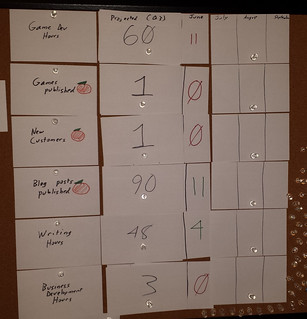
So I made a rudimentary scoreboard out of a corkboard and some index cards.

My Scoreboard

It’s on the wall across from my desk so I can look up and always see what my goals are and how I’m doing. I have a spreadsheet on my computer with similar data, but it requires me to open it and specifically look at it. This scoreboard, however, is easy to see at all times, which keeps my mind focused.

I have a day job, so finding time to work on my business is an important consideration, which is why I have a goal for the number of hours I spend doing game development, and I have another goal for time spent doing business development. If I don’t pay attention to my time, it’s easy for me to let opportunities to work on my business slip.

But just spending time on game development isn’t an end in itself. It’s meant to lead to the bigger goals, which are marked with a crude drawing of my logo.

I want to publish a game this year, and I want to gain at least one new customer from it. Why only one customer instead of a thousand? Because that first customer will be a major accomplishment, and I will move the goal posts once I do accomplish it.

I see my blog as a key part of my marketing, and so I have content goals for it, too. In the last two quarters I ignored my blog so I could focus on game development. I figured a post a month would be decent.

But for the next quarter, I want daily posts. My reason for the massive increase, which requires me to take precious time from game development?

It’s another way to keep my goals in front of me. I’ll write about my business, about my vision, mission, and purpose, on a daily basis, which means I’m consciously putting these things in front of me.

I used to do so by making a short post on my Google+ profile, but I thought, “Why am I giving my words to Google? Why not own the content myself?”

I don’t want half of the year to pass without me realizing it and without any change in my goals. My goals aren’t mere wishes. I know they require conscious effort to accomplish, which requires me to keep them in front of me, no matter how hard it gets or how many distractions there are.

I’ll adjust my scoreboard throughout the year. Each day is geared towards the week’s accomplishments, which are geared towards the monthly goals, which are in support of my quarterly goals. If I decide my goals need tweaking, such as the number of game development hours I spend, I’ll set a new target, and I’ll make plans accordingly.

For instance, last quarter I dedicated two evenings to game development in an effort to get to 100+ hours, but I found it was difficult to keep those evenings dedicated with a lawn that needed to be mowed and various other urgencies cropping up.

So I’ve scaled back to 60 hours because I believe it is doable while also giving me a reason to stretch. My productivity is very low compared to where I want to be, and even though 60 hours in a quarter isn’t very much at all, it’s more than I have been demonstrating. Last quarter I did about 48.5 hours, and the quarter before that was 43.25 hours.

It’s hard to accomplish much with so few hours. I’m aware that some people spend hours daily on their part-time businesses. For me, 5 hours a week would actually be an improvement, so that’s what I’m aiming for these days.

But if I didn’t keep these goals in front of me, it would be easy for my actual time spent to be near 0 hours a week because I wouldn’t realize the time was passing. I wouldn’t realize that half of the year had passed without much to show for it.

Instead, I’m able to look back and see what I accomplished in the last six months.

So how’s your scoreboard? Are your goals top of mind?

Categories
Marketing/Business

Depending on Personality vs Process

Recently I read the news that Reddit let go of their director of communications. As she was a key part of the popular Ask Me Anything interviews, which often featured major celebrities, the moderators of the /r/IAMA subreddit locked it down in protest, and a number of other subreddits did the same.

It’s back now, but the volunteer moderators are unhappy with the sudden change and lack of communication from Reddit’s staff. The good news is that the backlash seems to have resulted in efforts by the site’s staff to work with the moderators to make things work more smoothly.

I can appreciate how the removal of a key employee can change everything. People worry about Apple’s future with Steve Jobs gone now. It can be disappointing to go to a favorite restaurant and discover that they replaced the chef and now everything tastes and looks different. A high turnover can mean that each time you call your utility company you are never sure how helpful the staff member will be on the other end of the line.

But I found it strange how dependent organizations can be on one person. It sounded like Victoria Taylor was great at what she did for organizing interviews, but what happens if she gets sick? What if she for one reason or another is no longer available?

Tl;dr: for /r/IAMA to work the way it currently does, we need Victoria. Without her, we need to figure out a different way for it to work.

Personalities are great, and in some places they are key. Radio DJs, for instance, can seriously impact ratings.

But if you are dependent on one key person, and that person goes away, you’re left high and dry.

In management, the situation is described as getting hit by a bus. If it happens to you, what’s your organization’s contingency plan to carry on without you?

In a large organization, not having a way to function without some key individual probably means you don’t have your key processes documented. You are expecting one person to know how to do everything, and no one else needs to.

You have a single point of failure, and when it fails, it is catastrophic.

We have been really blindsided by all of this. As a result, we will need to go through our processes and see what can be done without her.

Yep.

If you are a lone wolf indie game developer, or any solo entrepreneur, then without you, there is no business.

But even so, take this situation as a warning that you should figure out the processes you depend upon. You might not always be available to personally handle things in a unique way each time. You want consistency.

If you ever get to the point where you want to hire help, for instance, you’ll need to know what that help should do. You don’t want to depend on someone to wing it and change how your business appears to function to your customers. You don’t want to accidentally give the appearance of changing chefs.

Categories
Geek / Technical

Finding the Missing WordPress Text Editor Toolbar After Upgrade

I recently updated my self-hosted WordPress install, and everything seemed fine until I went to write a new blog post. That’s when I found that the toolbar buttons were missing.

I don’t use the Visual editor in WordPress, preferring to type the text/HTML out myself. The Visual editor’s toolbar was available.

I found a lot of people running into this issue over the years. Suggestions ran from reinstalling the WordPress installation to reinstalling TinyMCE in the wp-includes/js directory to permissions issues to disabling plugins.

I’m partially annoyed because TinyMCE is for the Visual editor, not the Text editor, and searching for the Text editor specifically still gives you this advice which is a waste of time.

But anyway, I determined it was my All-in-One SEO plugin being out of date. Once I updated it, I was able to see the toolbar in my Text editor again.

I hope this helps someone else fix similar issues much faster than I did.

Categories
Personal Development Politics/Government

Independence Means Having Real Choices and the Opportunity to Make Them

In game design, balance is important. If you create a variety of options for the player to choose from, but one is superior to the rest, then the rest might as well not be in the game because the player will always choose the the best item.

Dominant strategies are often an accident. Whether it is a lack of play-testing or an oversight, designers don’t usually put them in on purpose.

But it is easy to see how the existence of a dominant strategy ruins things. Instead of having a lot of choices as the designer intended, the player effectively has none.

Technically you could argue that the player still has choices, and if he/she wanted to play with an extra challenge, it’s possible. People try to finish the original Legend of Zelda while collecting the minimum of upgrades, for instance:

But in most cases, the player is trying to optimize their play, and the existence of an always-optimal choice means the player is always going to make that choice.

There are also choices that are always terrible. They also might as well not exist because the player will never choose it over a superior option.

In real life, balance is not guaranteed. People make all sorts of choices in all sorts of circumstances.

For many people, these choices aren’t real choices at all.

For instance, who to vote for. While we seem to be gaining a U.S. presidential candidate every other week, eventually it will get pared down, with our two-party system causing many people feel like they only have two choices: bad, and worse.

Technically, they have two other choices: not voting, or voting third party. But many feel that these aren’t real choices. One abdicates responsibility, and the other feels like you barely doing any better since the majority of people think they only have two real choices and so your third party vote ends up having a negligible effect. You feel like you’re railing against the wind because not enough people joined you.

In other cases, the choices might be there; you just can’t take advantage of them.

In some countries in the world, practicing your faith is deadly. Talking about the problems of the government is deadly. Protesting is deadly. You could say that the citizens still have a choice, that they are independent, but it would take unusual courage and strength for them to stand against their oppressors. It’s heart-breaking. The door to the cage might be open, but those armed guards don’t look like they’ll let you walk through them unscathed.

In countries like Greece, bad policies have resulted in the majority of the population paying for the sins of a few major players. The people can’t leave the situation easily, and it is frustrating because the way out of the situation isn’t obvious.

It’s easy to take our independence for granted. People have fought for our rights for centuries, whether it was winning our independence from foreign enemies or our livelihoods and dignity from domestic ones.

People can complain about the President’s policies or the way Congress can’t seem to cooperate to put together meaningful legislation, and they don’t generally need to worry about retaliation from the government.

You can leave a job with terrible conditions and find another, or start your own business, or go on strike and demand better conditions. Yes, some choices here are more painful or terrifying, but not overly so. We as a nation frown upon monopolies specifically because the lack of real choice is seen as harmful. We get concerned when one company seems to be able to set their own terms independent of competition or the health of their workers.

You can change your religion, and aside from sharing in awkward family meals or attempts to make you feel guilty, the consequences don’t tend to result in a shortened life expectancy.

Sometimes the guards to the cage door are only ourselves. Maybe we’re blinded to the opportunities, or we don’t have all of the information to make an informed choice, or it takes more effort than we realize, or our circumstances make it difficult, or maybe we aren’t bothering to participate.

But we can fix or change any of those circumstances. We can learn more about the situation. We can make plans. We can get help.

Don’t waste your opportunities. Don’t take the easy route. Don’t go with the weaker strategy in life just because everyone else around you is using it.

Take advantage of your independence. You have choices, and even if it is hard to do so, you can make them.

Categories
Geek / Technical Personal Development

When Standing on the Shoulders of Giants Isn’t the Right Thing to Do

In almost any endeavor, you can go it alone, or you can get help. You can spend all of your time researching and practicing and tweaking until you figure things out, or you can buy a book or hire a consultant and have someone tell you what they have already figured out after years of his/her life were spent on the topic.

Leveraging the work that has been done by others is a shortcut, and it is perfectly fine to take them. If you want to learn how to do software development, you don’t need to build your own computer architecture, as you can leverage the existing Von Neumann architecture in most modern machines. You don’t need to start from first principles. Someone already figured it out, and you can take advantage of it.

This kind of advice is ingrained in our culture.

Don’t reinvent the wheel.

Don’t spend your time doing that task when you can hire someone to do it for you faster and at a level higher quality, which saves you time, too.

This is the way it has always been done, and it’s the best way we know.

On the other hand, sometimes we advance the arts and sciences by starting over and exploring our assumptions.

In Bret Victor’s talk The Future of Programming in which he pretends to be an IBM engineer from 1973, complete with transparencies and a projector, he talks about the problem of people who think they know what they are doing:

He starts out explaining the resistance to the creation of assembly code by the people used to coding in binary. Coding in binary WAS programming, and assembly was seen as a waste of time and just plain wrong.

He goes on to talk about exciting advances in programming models from the late 60s and early 70s, and extrapolates some tongue-in-cheek “predictions” about how computers will work 40 years in the future, predictions that lamentably did not come about. Today we still code much the same way people did back in the 60s.

Ultimately, he warns that there is a risk to teaching computer science as “this is how it is done”.

The real tragedy would be if people forgot you could have new ideas about programming models in the first place.

The most dangerous thought that you can have as a creative person is to think that you know what you’re doing, because once you think you know what you’re doing, you stop looking around for other ways of doing things. You stop being able to see other ways of doing things. You become blind.

Game design applies here, too. Video games from the 70s, 80s, and 90s were quite varied. People were figuring them out because no one knew what they were. They tried everything.

Eventually some key genres popped out of this period of experimentation, and some control schemes and interfaces became common. It’s hard to imagine real-time strategy games without Dune 2‘s UI conventions.

Five years ago, Daniel Cook wrote about reinventing the match-3 genre:

It occurred to me that game design, like any evolutionary process, is sensitive to initial conditions. If you want to stand out, you need to head back in time to the very dawn of a genre, strike out in a different direction and then watch your alternate evolutionary path unfurl.

When people think of a match-3 game, they have something in mind because all match-3 games tend to be similar. Triple Town ended up being quite different, yet it was still recognizable as a match-3 game, and people loved it.

Some people merely need to leverage existing infrastructure. People are using Unity for game development because, much like Microsoft’s XNA before it, it handles all of the boiler-plate for you, and it also provides a lot of the technical tools in an easily-accessible way so you can focus on the development of the game rather than the technical details of making a game.

But some people are pushing what’s been conventionally thought of as possible. Spore, for instance, had to procedurally generate animations for characters that weren’t prebuilt, which meant someone had to figure out how to do so. There was no existing 3rd-party library to leverage. The shoulders of giants here weren’t high enough.

I’m part of a book club right now involving algorithms. We’re reading Steven Skienna’s mostly-accessible book The Algorithm Design Manual, and it’s been enjoyable and challenging. I haven’t studied algorithms since college, and I kind of wish I could go back and check my notes from class.

But what bothers me when reading this book is the warning about trying to completely invent a new algorithm on your own. Skienna argues that most problems can probably be adapted by sorting the data or otherwise thinking about it in a way that an existing algorithm can solve it.

And he’s right.

But someone had to have figured out these algorithms in the first place, right? Someone saw a problem and had no way to solve it, so he/she came up with a way, optimized it, and published it.

But today I’m expected to just learn what they did and use it, and I feel like I’m being told to stay away from actually trying to figure out a better way on my own, as if all of the algorithms that can be invented have been invented.

And if I just want to solve particular existing problems, it’s probably practical advice.

But if I want to explore an entirely new kind of problem, what am I supposed to do with old assumptions and solutions? Square pegs don’t go in round holes, and I don’t think we want a future where we are taught that round holes are the only kinds of holes in existence.

Categories
Game Development Marketing/Business

Treating Indie Game Development as a Business Isn’t News, Is It?

A couple of days ago, Mike “PoV” Kasprzak announced his retirement from game development.

He will still be working on Ludum Dare and isn’t going away, but he’s no longer going to try to make games for a living.

Part of the reason is because he’s not feeling any younger and is looking to settle down. So I won’t post that potentially embarrassing picture of him eating at the Ludum Dare meetup for GDC 2011.

But part of the reason is because he’s concerned about a lack of opportunity in game development:

…my point is that it’s no longer about just making games. It’s not about games that look good, games that play well, games that have a message, games that are different, games in a popular genre or theme; No, instead it’s all about games that stand out, and games people want. You can’t advertise or market your way to success. Those things help, but only if the game itself has that potential. Almost every successful indie you know has put multiple years in to their projects. And for every indie you know, there are hundreds you don’t. It’s not practical to just make games and hope to make a living.

This news came shortly after Tale of Tales announced they were giving up on commercial games:

We really did our best with Sunset, our very best. And we failed. So that’s one thing we never need to do again. Creativity still burns wildly in our hearts but we don’t think we will be making videogames after this. And if we do, definitely not commercial ones.

There was this excellent article on Destructoid the other day claiming that game development is getting crowded.

And the problem is that just making a good game is no longer enough. The job of the modern indie developer is to make a good game & put it in front of millions of people.

And I think that means that we need to change how we think of indie game developers. From basement coders to people who understand marketing & business. After all, what we’re doing is running small businesses.

It sounds like the easy days are behind us, and it is going to take real work from now on to not only make a good game but also to do the ugly, messy things that it takes to run a business, such as marketing and sales.

But wait…hasn’t this always been the case?

I remember reading about the swelling of the supply in games on the Indie Gamer forums ten years ago. Someone was nice enough to keep track of the releases from week to week, as well as the top games, and eventually a conclusion was reached: if so many games are getting released every day, and it takes you anywhere from months to years to make a game, that’s a lot of competition you have to wade through to get noticed, and that’s only if you don’t count the many games released AFTER you’ve released yours.

So marketing and promotion were seen as key differentiators. People dedicated to these roles popped up because there was a big opportunity. Game developers wanted to work on games and outsource their marketing.

And this was back during the popularity of Flash portals, before the modern mobile era.

Here’s an article in 1999 responding to a post about why game development sucks:

Talin says there are lots of reasons for failed products. Crappy products, crappy marketing, crappy distribution, crappy placement at the stores etc.

But, ultimately it usually comes down to the fact that not enough people wanted to play your game. Especially in this day and age when you can put your game up just by uploading it to some file website. If your game is truly something tons of people get addicted to it will spread around this new wired world. If on the other hand people don’t want your game nothing is going to make them want it.

People were still using shareware to market their games back then.

So, yes, the tools to make games today are easier to access than ever, which means anyone can make games, which means anyone is making games.

It’s crowded, and it is hard to stand out.

But it has always been a business, and most of the serious indie game developers knew this fact. It isn’t some new revelation. The tactics might change, but the understanding that you needed to do market research and get people to know your game even exists was always there.

I don’t like cliché, but “If you build it, they will come” isn’t a viable, sustainable strategy for a game developer. It hasn’t been one in a very, very long time. Maybe when the first personal computers were being released, and your competition was almost no one, then sure, just having the only game in town might work.

And if you are only interested in making games as a hobby, then go to town. Make the games you want to make and see if people might enjoy them. Maybe you’ll make some pizza and beer money as a bonus!

But if you are interested in a sustainable living making games on your own, it’s hard because you aren’t just making games anymore. You’re doing market research. You’re doing product management, which is different from product development, which is different from project management. You’re doing contract negotiation, hiring, firing, accounting, accounts receivable, accounts payable, and more.

And if you are doing it by yourself, you still wear all of those hats even if you neglect a number of them.

But none of this is really new. It’s just an awkward truth that has to be learned by each generation.

Categories
Personal Development

Setting an Example by Your Actions

I was at a baseball game last night, and I was disappointed.

It wasn’t just because the Iowa Cubs blew an early lead and lost it in the end. It was because while I expect the major league players to give up on first base runs, I expected the minor league players to try harder.

In baseball, if you get a hit and think you won’t even get a chance to run to second base, you are allowed to overrun first base. That is, you don’t need to keep your foot on first base to stay safe. You can run past it, and so long as you don’t indicate that you’re going for second base, you just need to focus on getting to first base before the opposing team can force out.

In little league, we were taught that even if it looked like the other team was easily going to field the ball and get it to first base before you could get there, you run as fast as you can. They might make a mistake and throw it over their teammate’s head. They might panic because it could be close. It’s baseball. Anything can happen in baseball.

And yet, I watched time and time again as the minor league players kept slowing down before getting to first base, as if it was a foregone conclusion that they were out.

From my seat in the stands it might have been hard to tell, but it looked like a number of those plays were closer than their lack of urgency implied. If they gave it a bit more effort, if they hadn’t given up, how many base hits would they have had that night?

Worse is that there were all of those people in the stands, many of them children. They’ll see this example and take it with them to tee-ball or little league. And why not? It’s what the real baseball players were doing.

And that’s what was more disappointing than the loss. It was the example being set.

When Clint Dempsey tears up the referee’s notebook, he’s setting a bad example. He’s supposed to be the international veteran in that game, yet he acted like a child not happy that his parents are telling him that there are rules he has to follow.

When you show up chronically late to your job, you’re setting an example (by the way, Self, that was directed at you).

When you yell and scream at your spouse in front of your children, you are setting an example.

When you post petty, ugly, or hateful things on Facebook, you are setting an example.

And these examples send messages to people, mainly “This is how a real ______ acts.”

Fill in the blank with “baseball player” or “software engineer” or “Christian” or “partner in a loving relationship” or any role or position you can see someone holding.

How are you acting in your roles in life? If you were a stranger witnessing your actions day to day, would you be proud of the example you’re setting?