Categories
Game Development Marketing/Business

The Great Gatsby Was a Flop; How’s Your Game?

Yesterday while listening to an audiobook, I learned that F. Scott Fitzgerald died thinking that his greatest work was a failure.

He earned just $2,000 from The Great Gatsby. In today’s money, it represents a bit more, and he was in the top 1% of income earners in his time, but this was his major novel. He put a lot of blood, sweat, and tears into it, but he got paid the same as or less than he did for his short stories. How depressing!

Now, there are different definitions of success, and financial success isn’t everything. But Fitzgerald expected Gatsby to be a huge financial success and was disappointed.

Today, the work is taught in schools, which is how I became familiar with it. I had to write a paper on the novel as part of my high school English class, and I remember someone saying, “Hah, good luck! That’s the teacher’s favorite book.”

So I made sure to do my research well. I even read the book twice before writing my paper early enough to be able to edit it instead of trying to get it all done on the last day. I got an A, and I found I quite enjoyed the book as well.

Incidentally, I learned that The Great Gatsby is still not in the public domain, despite the author having been dead for three-quarters of a century.

The audiobook mentioned a number of Fitzgerald’s peers who are widely recognized today as geniuses as well, but when they actively published, they experienced modest financial success. The very financially successful literature was apparently kind of terrible and written by authors who are all but forgotten, but people couldn’t get enough of them.

So what’s the lesson here as an indie game developer?

No one has it easy. Fitzgerald was a popular figure, and his greatest work still couldn’t find traction with the public in his lifetime, despite the praise he got from fellow writers.

Most people look to the great successes for inspiration. What was Howard Schultz’s secret to success for Starbucks? How did Mark Zuckerberg make Facebook the juggernaut it is? See what Notch did with Minecraft?

They are all human. They all failed somewhere. Some found great financial success, while others didn’t.

We don’t often hear about the failures of successful people. We forget about the struggle and look for the glamorous.

Then we look at our own results and worry we don’t measure up. We think we’ll never be great ourselves, because we don’t recognize that our failures are exactly the same kinds of failures that the successful people had.

When you publish a game, it’s entirely possible that no one will find out about it. You pour your heart and soul into a game for months or years, and it could flop. Meanwhile, you see other games take over the world and hear that the developers made them in a few weeks in their spare time.

You see huge and successful indie games, games that get all the press and sales, and you compare your efforts to what you perceive as someone’s effortless genius. It can be heartbreaking and frustrating.

Some of us stop bothering to try.

But failure is part of the process of succeeding.

Ideally, you get to success while you can still enjoy it. You just need to make the attempt and get past the failure first.

Categories
Game Design

Valuable Books on Game Design

Earlier this month, I watched a 2013 recording of a game design talk by Lost Garden’s Daniel Cook, Game Design Theory I Wish I had Known When I Started:

The slides don’t actually seem to exist anywhere, by the way.

It’s a great presentation, and he goes very high level, leaving the details of each item as an exercise for you to explore in your game design education.

At some point he mentions that there are only a handful of game design books worth having, and he lists three of them in his talk.

I already owned a copy of A Theory of Fun for Game Design by Raph Koster. It was out of print for a bit, and I was strung along by an ordering system snafu on one website that couldn’t actually seem to process the order in 2008.

But eventually I got it, and I should probably reread it again because in watching Cook’s talk and in seeing comments by others, everyone seemed to love it more than I remember loving it, and maybe I missed something the first time.

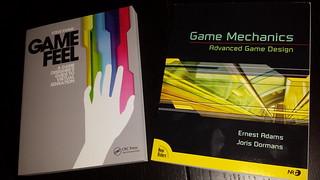
The other two books Cook mentioned in his talk are: Game Feel: A Game Designer’s Guide to Virtual Sensation by Steve Swink and Game Mechanics: Advanced Game Design by Ernest Adams and Joris Dormans.

I didn’t know about these books, but on the strength of Cook’s recommendation alone, I ordered them, and now I have my own copies.

My New Game Design Books

When I was in college, I studied computer science, and I had a roommate who studied Human-Computer Interaction. I remember thinking that HCI would come in handy in game development, and here Swink has written an entire book on the topic geared towards games.

I used to own a book by Ernest Adams and Andrew Rollings called Game Architecture and Design, and the only reason I got rid of it was because a new edition had come out. Ernest Adams has written quite a few books on game design, some geared towards specific types of games. Game Mechanics is over 300 pages of deep exploration of the topic, and I look forward to diving into it.

Both of these books are deep dives into subtopics in game design. There are other books on my shelf that I really enjoyed which are a bit more general.

One is Game Design Workshop: A Playcentric Approach to Creating Innovative Games, Third Edition by Tracy Fullerton, a great textbook which I reviewed last year. I also went through a number of the exercises weekly for a time, which you can see at Game Design Workshop Wednesdays.

One book with accessible, non-digital exercises that do not require a computer or other expensive technology is Challenges for Game Designers by Ian Schreiber and Brenda Romero. Combine this book with Schreiber’s free online courses on game design, Game Design Concepts and Game Balance Concepts, and you’ve got a good set of game design educational resources.

Tynan Sylvester’s Designing Games covered some of the same ground as other game design books, which is to be expected, but it also brought some fresh perspective and seemed more holistic. I appreciated the discussion on marketing and business influences since games aren’t created in a vacuum. I wrote review of Designing Games last year as well.

What game design books on your shelf do you find the most valuable?

Categories
Game Design Game Development Geek / Technical Personal Development

How to Find Indies in Iowa

When I started out as an indie game developer, I found a home on the Internet. It was a set of forums dedicated not just to game development but also to making a living from it.

And while daily online communication, or maybe just procrastination, was helpful, it was nothing compared to the monthly face-to-face meetups we had in Chicago. We met either downtown at a Dave & Buster’s or at a Starbuck’s in Schaumburg.

It was kind of a loose mastermind group, in which we tried to set goals for the next meeting and held each other accountable to them. We had a range of completely newbies to experienced and successful business owners, and we all met, tried out each other’s games, and gave feedback.

So when I moved to Des Moines, Iowa, I immediately wondered where a similar collection of indies were.

They’re hard to find, so I decided to put a summary on this page in the hopes that it will be easier for everyone to connect with groups they might not have otherwise known existed.

The Iowa Game Dev Friendship Club has a mailing list at https://groups.google.com/forum/#!forum/igdf. It’s made up of indies and enthusiasts from all across the state of Iowa, especially out of Ames and Iowa City which is where our major universities are.

There is now an associated Iowa Game Dev Friendship Club Facebook group.

Sometimes a good number of members show up at a game jam, but otherwise they don’t try to organize massive face-to-face meetings. There have been Des Moines-area meetups in the past, such as the Midwest Mingle.

If you’re in Ames or Iowa City, your local university has a game developer organization. Iowa State has the Iowa State Game Development Club, which has an enthusiastic Twitter account at @isu_gdc and a ISU Game Dev Club Facebook page.

University of Iowa in Iowa City has EPX Video Game and Animation Studio, formerly known as Animation and Interaction at the University of Iowa. You can find them at their weekly meetings and at their EPX Facebook group.

UPDATED 2016: The International Game Developers Association has a Des Moines chapter. You can find them on Twitter (@igdadsm) and Facebook (https://www.facebook.com/groups/227434834257939/.

Did I miss anyone? Is there an Iowa indie game developer meetup you’re hosting that I don’t know about? Let me know, and I’ll update this list.

Categories
Personal Development

Letting Go of Negativity

Social media is a great way to find out what everyone is thinking.

Unfortunately, it can show the dark side of people all too easily. Sometimes it is extreme and explicit, and sometimes it is subtle, but either way, people have a capability of being quite terrible.

They voice their anger and opposition about things that don’t impact them, and you might strongly disagree because it does impact you and your loved ones.

It can be painful at times, especially if they get personal. You can get riled up. You can get angry.

And there’s nothing wrong with feeling this way.

It’s just that it saps your energy so you can’t spend that energy on something better.

My friend Danyelle posts a weekly video called Wednesday’s Words of Wisdom in which she shares a quote and talks about how it resonates with her, and her video on July 15th was about letting go of outrage:

It’s one thing to be passive in the face of anger. It’s another to decide to spend your time on something with more consequence. People on Facebook or Twitter can easily share their opinions that no one asked for, and you don’t have to engage at their level.

Someone shares a hurtful meme? You might not even know about it because while they’re on Facebook posting something that people may or may not see, you’re setting a good example by your actions and making a real difference in the world.

It can be somewhat addicting to want to get into the anger and outrage debate, but when you look back in five years, are you going to be proud of the online arguments you participated in willingly, or are you going to be grateful you let those things go so you can spend your time making real progress in your life and the lives of others?

Categories
Game Development Personal Development

Setting Effort-based Goals vs Outcome-based Goals

Since I am a part-time indie game developer, I am highly aware that the time I spend on game development tends to be a very significant function of my output.

If my other responsibilities are great, and I don’t consciously make an effort, maybe I’ll only get a couple of hours of work in. No matter how efficient I could use that time, two hours a week isn’t going to let me accomplish much. I can’t prototype or play test much, nor can I really get much implemented.

So all year I’ve been setting goals to increase this amount in a sustainable way. That is, I make sure I can handle my day job, my family, and my home responsibilities while also ensuring I get enough sleep. Stealing time from my sleep, for instance, allows me to temporarily use that time productively, but it always catches up with me and I end up paying for it in the end. What usually happens is I get slower and less efficient, and then I start sleeping in, which takes away my precious mornings that I dedicate to game development.

Recently I’ve been rereading Steve Pavlina’s book Personal Development for Smart People: The Conscious Pursuit of Personal Growth, and in the chapter on Power, he talks about personal quotas.

The idea is that to increase your performance in an area of your life, you can set minimum daily quotas to reach. Some authors set a daily word count. No matter how long it takes, they must write 250 words. Or maybe they do what I’ve been trying to do and set a minimum number of hours since word count might not represent the effort of writing very well if they spend a lot of their working time researching or editing, actions that don’t necessarily increase their word count but still contribute to the finished project.

Pavlina said he used to dedicate a few hours to writing, but he found that the end results weren’t ideal because his focus was on putting in the time instead of finishing. So he focuses on outcomes. Instead of writing for two hours, he writes until he finishes an article.

In a way, this reminds me of the Theory of Constraints and the story told in The Goal: A Process of Ongoing Improvement. Eliyahu M. Goldratt’s protagonist is put in charge of a failing manufacturing plant.

This plant has very expensive machines, and so the company insisted that to be the most efficient, those machines should be running as close to 24/7 as possible. Downtime meant lost efficiency and wasted opportunities to make back the investment in those machines.

Here, they were focusing on effort.

What they forgot was that the effort should serve a purpose.

People weren’t buying what was being made, either because they produced too much, or it wasn’t the right product for their needs, or the finished product couldn’t be made because there were bottlenecks in the manufacturing process in which some parts were ready while others needed to wait to be made. No matter how efficient the plant was in utilizing their resources, all they ended up with was a warehouse storing the unsold and unneeded parts they were creating.

Once they started to focus on the finished product, the outcomes, they rearranged priorities, ensuring that what was being built at any given time was shortening the time of the entire process, not just making any one part more efficiently.

I just spent the last couple of months implementing what was supposed to be a “simple” physics model for a game I’m working on. It turns out, physics isn’t simple, and there are plenty of solved problems in this domain, as well as many available 3rd-party libraries such as Box2D. But no, I insisted on implementing my own. I don’t need an entire physics engine. I just need something that looks good enough. How hard can it be?

In terms of my personal education, I gained a lot. I consulted a number of resources, such as the Impulse Engine by Randy Gaul and Chris Hecker’s Physics articles for Game Developer Magazine. I had a refresher from my high school and college physics classes, plus I learned about ways in which physics engines in games have historically fallen on their faces.

But in terms of outcomes, that’s two months I spent implementing and tweaking a small part of my overall game project. I focused on spending time on development, and I just kept working on what I was working on because I didn’t ever feel I had a good stopping point. It’s easy to want to spend a lot of time fiddling with coefficients and parameters to see if I can get the feel just right.

If, instead, I really focused on outcomes, such as getting the physics implemented in a week, maybe I would have seen that I was running out of time and so decide to use a 3rd-party library.

It doesn’t matter if I wrote the code myself. It matters that I am a step closer to having customers play the game.

Some game developers keep a simple list of tasks in front of them, and they work on whatever seems interesting, adding and removing tasks as they go. Others have a full project plan.

Now, as a part-time indie game developer, time still means results. If I spend 10 hours in a week, I am able to focus more than if I spend two hours in a week. It can mean the difference between getting meaningful accomplished in a given development session versus starting and stopping over the course of weeks to get something equivalent done.

So time still has a huge effect on output.

But I can do a better job of ensuring that the time I do spend on game development isn’t open-ended. There’s always more work to do, so just putting in time to work isn’t necessarily going to result in all of the work getting done so much as just a portion of the work getting done really, really well.

Categories
Politics/Government

Another Reminder about the 1st Amendment to the U.S. Constitution

Another, apparently needed, reminder: the 1st amendment is about the government not being allowed to stop you from speaking your mind. You can’t be arrested for stating your opinions, no matter how terrible or controversial.

The 1st amendment DOES NOT protect you from the consequences of that speech with regard to your fellow citizens or the media, who have their own right to decry what you say, including calling you a bigot if they think you’re being a bigot.

You aren’t being censored illegally just because you don’t like that someone’s opinion of your speech is negative.

You’re just being censured, legally.

Categories
Game Design

Probability for Game Designers

Dice

On Twitter, Chevy Ray complained about the use over simplifying terms in math that end up confusing him, and Sven Bergström provided a link to a useful resource.

Thanks, Sven!

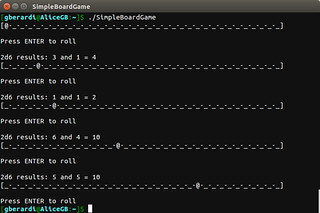
Probability for Game Designers by Cheapass Games founder James Ernest takes you on a quick tour of probability theory to help game designers understand their own designs better.

We tend to use experimental and anecdotal evidence to decide whether random events are working or not. You can only playtest your game a limited number of times, but many of the random possibilities may be extremely rare. A practical analysis of the random events can give you a better understanding of whether your latest dice-rolling catastrophe was a fluke or a serious problem.

He explains odds, expected value, statistically independent events vs statistically dependent events, and more, and he provides examples from games and quick exercises to help drive the points home.

I’m also going to dig into Ernest’s other articles on game design, including the related Volatility in Game Design notes from GenCon 2012.

Categories
Game Design Game Development Personal Development

Anyone Can Create, and They Do: Your Design Choices Matter

I used to have a QBasic game review site, which meant I was part of a small group of sites dedicated to playing and reviewing games made by a small community on the relatively young Internet.

Surprisingly that effort translated into a little bit of paying work when I found out that Game Tunnel was looking for reviewers. I got a little bit of money each time I wrote up what I thought about a specific independent game, plus I usually got the game for free. It wasn’t enough to quit my job and live off of it, but it was enjoyable.

Over all that time, I saw a number of review sites come and go, and every so often one of them would get the idea to do a special write-up on “the worst games of [insert year here]”. Anyone could publish a review site,and sometimes that meant anyone did, and they decided it would be fun to write insults for laughs.

Now, I get it. In many creative industries, there’s always a “best of” list, and there are awards shows dedicated to highlighting the top efforts. So why not a “worst of” list? Why not highlight the terrible? People love to hate on things.

In fact, I didn’t know this, but the Razzies, which highlight the worst in film, have been around since 1981. It’s all in good fun, and it’s actually gotten relatively popular, with a few celebrities coming to accept their Golden Raspberry award in person.

If you search on YouTube, you’ll easily find lists of the worst games.

Worst Games Lists On YouTube

That’s unfortunate ad placement, huh?

People love to hate on E.T. for the Atari 2600, or John Romero’s Daikatana, or any number of games based on movies.

Ok, so people love to hear about failure. The popularity of reality television already tells you this fact.

I personally think this kind of tear-down is the stuff of tabloids. It’s never something you’ll find at the Academy Awards or The Academy of Interactive Arts and Sciences. And this isn’t a complaint about high-brow vs low-brow. I’m not above a good slapstick comedy or the occasional mindless action game.

It’s about ease.

In the modern age of citizen publishing media, with blogs, videos, and social network posts, anyone can write about how much they hated the latest stinker at the box office or a terribly-written-yet-popular novel or a disappointing offering from a major game publisher.

And many do.

But what a terrible way to spend your time! Dwelling on the negative, insulting people you don’t know, and kicking them when they are down? Ick.

It’s also easy. Someone could spend months or years writing and rewriting a novel only to find an online mob ready to hate it upon publication. One cleverly-worded Tweet of criticism, and it can start an avalanche of hate. Because of groupthink, these “Yeah, gee, it’s so awful!” comments can even come from people who have never read the work in the first place (again, see E.T. for the Atari 2600).

It’s one thing to critically analyze what makes something bad. You can comment on the inconsistent plot, or the dated graphics, or question the message. You can say it is derivative and unimaginative and compare it to earlier efforts, such as when my friend Ian Simmons wrote his review of Pacific Rim and compared it to Independence Day. It takes effort and experience to understand why something is bad and to be able to communicate it, and it comes from a desire for improvement. It’s a teacher giving a low grade on a creative writing assignment with the note, “I expected more from you.”

But it’s another thing entirely to slam something without giving much thought to it. At best, it’s a drive-by insult. At it’s worst, it’s bullying. It’s more about the humor of a good put-down than about seeking improvement. It’s the teacher who hates teaching because he despises the students and has to insult them to feel better about his miserable life.

When everyone has the ability to create, you are going to see a lot of terrible creations, and the ease of publishing means some of these creations get front-page status.

That top 10 worst games video on YouTube got over 2 million views. There was a choice made about what to focus on, and the creator of the video decided, “Yeah, let’s go for negativity.”

That’s 2 million people who got the subtle message that criticism is the same as complaining, who think that it’s normal to highlight what’s wrong with something, who shed at least one point of resistance to expressing an insult about someone or their creation because, hey, look at all those other people having fun at his/her expense.

I’ve been focusing on reviewers and critics, but the original purpose of this post was to focus on the act of creation itself, and specifically about game development.

With the wide availability of high-quality tools and resources, anyone can make a game, and many do.

Some people make great games, some people make mediocre games, and a lot of people make clones.

But some people make games with questionable designs. There was a choice about what to include in a game, and the creator decided that gratuitous violence, casual misogyny, and even downright hate was the way to go.

It’s one thing to make a game about shooting everything in sight when everything in sight is out to get you, like in Space Invaders or Doom.

It’s another to make a game in which the only motivation is death and destruction for its own sake. Here you’re just putting together game mechanics with perversity, and not in a good way.

You could simulate complex interpersonal relationships, or you could go the easy route of hypersexualization, stereotypes, and power fantasy.

There are legitimate arguments and positions to take, and there are careless (or careful) non-positions that do in fact take a position.

For instance, making a game about doing nothing but shooting civilians “just for fun” says something about your worldview and the worldview of your game’s fans, at least in what’s considered “fun”.

It’s a choice.

And with the increased availability of tools and publishing platforms, anyone can make these kinds of choices.

And many do. Sometimes without realizing that they are making important choices.

And some of these choices get front-page status, which means a lot of people get the subtle message that these choices are normal.

It’s why I prefer highlighting the best and get uncomfortable when it comes to tearing down the worst.

Because focusing on the worst is easy. Anyone can do it, and anyone can make horrible stuff so there is always fodder, but more importantly, it sends a message that focusing on the worst is a good use of time, that it’s innocent and fun to dogpile on someone after they dared to put themselves out there.

It can be petty and mean, and I like to think the wider community can do better.

And focusing on the best means that the creators of purposefully bad creations don’t get rewarded for being horrible or lazy. It means raising something up and saying to everyone, “See what amazing things can be done?”

It means inspiring people to make the choice to aspire to good work, to expect more from themselves.

Categories
Game Development Geek / Technical

How Supreme Commander Handled Rendering

I found this neat exploration of the insides of Supreme Commander, the spiritual successor to one of my favorite games, Total Annihilation.

Specifically, in Supreme Commander – Graphics Study, Adrian Courrèges takes you through a tour of the rendering of a single frame of the game.

Animations show each step in the process, making it easy to see how you can go from culling a subset of the terrain to adding shadows to rendering meshes and particles to overlaying the UI.

Categories
Geek / Technical Personal Development

Taking Advantage of Downtime #8035dsm

I’m not a huge live music fan.

I mean, when I go, I find I enjoy myself, but I don’t tend to actively seek out concerts and bands to listen to.

This weekend is the 80/35 music festival here in Des Moines, and my wife and I go every year, partly because she’s a big live music fan.

There are local bands, but the festival tends to find big names, such as Modest Mouse, Wu-Tang Clan, Cake, and The Flaming Lips. People I would have heard of as a casual music fan.

Last night we saw Wilco play, and today we’re looking forward to Weezer.

It’s like the dream of the 90s is still alive in Des Moines.

We like to bring a blanket, set up a few lawn chairs, and hang out with friends while enjoying the music from afar.

Wilco at 80/35 from afar

And I like to bring my doodle book. Since the beautiful people of Iowa tend to show up at music festivals, and I’m just sitting there, it’s like getting a free life drawing class in, although with less nudity.

Sometimes people sit still for long periods of time, and sometimes they move quickly and I can only get the barest sketch in.

Doodle Book from 80/35

I like people-watching, and I enjoy doodling, even if I’m not a trained artist. So I enhance the experience of listening to live music with a fun way to practice my drawing skills.

It’s not work, so it isn’t like I’m forcing myself to squeeze every ounce of productivity out of my day, ruining any sense of enjoyment I have for life during what is supposed to be my downtime.

But at the same time, improving my drawing skills can help with my game design. If I can sketch out something that’s in my head more accurately, it makes it easier to communicate my intent.

But I don’t set a quota of drawings. I don’t force it. I just draw.

And I found doodling is a lot less annoying to the people around me than practicing my analytical skills by wondering aloud about the design of the light show or the logistics of setting up the concert. B-)