Categories
Game Design Game Development Games Geek / Technical Linux Game Development Personal Development

LD18: Prototyping and Ideas

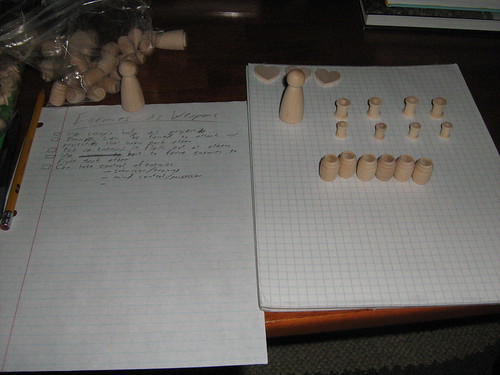
It’s time to prototype some ideas! I have a chance to play with my new barrels and hearts!
Prototyping!

But let’s take a step back and try to come up with some ideas. Assuming you play as the hero in the game, what are the various ways you could use enemies as weapons?

1) You could use the enemy’s body as a projectile. Your attack might send Enemy A flying, but when A hits B, B is hurt. Maybe A is immobile, especially if they are somehow stuck together now, as below:
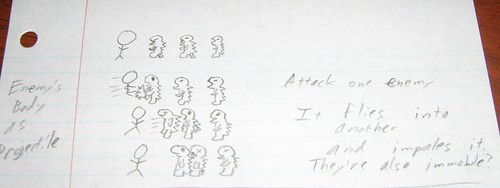
Enemy's body is a projectile

2) You could force the enemy to use its own projectiles, which happen to be damaging to all entities in the game, including other enemies. Somehow, you have to provoke the enemy into attacking. In this example, you can see that the enemy throws out its spines, leaving it naked and vulnerable. It would probably need to head home to reload, and the other enemies in the vicinity were killed.
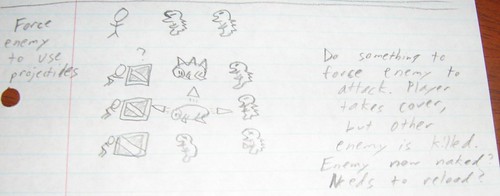
Force enemy to use projectiles

3) You could pick up the enemy, causing it to panic and flail. Until it can get itself free from your grasp, you can move it close to other enemies and let it destroy them.
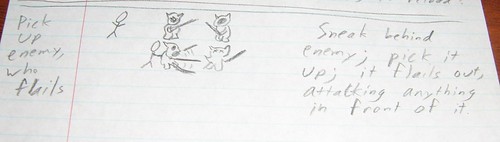
Pick up enemy and let it flail

4) You could use bait to lure enemies into combat with each other. When they see the steak in this example, the two enemies can’t help themselves. They love steak! Unfortunately, only one of them can have it, so they end up in a dust cloud. Only one will survive. And get steak.
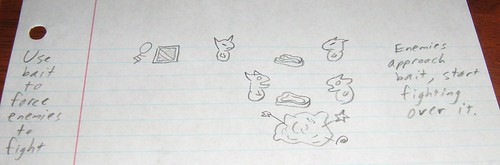
Force enemies to fight over bait

5) You could take control of the enemy in various ways. First, you could attack an enemy, bring it under submission, and train it to fight for you. It’s kind of like a Pokemon or the monsters in Rune Factory, if you’ve played that one. Second, you might have the ability to control an individual enemy’s mind or take possession of it’s body. It’s kind of like the game Space Station Silicon Valley for the N64. Third, maybe the enemies all follow whoever holds a certain token or item, like a wand or staff. If you are in control, now the enemies are yours to command! Fourth, you can find a way to mount and ride an enemy. If you can do so, you can then use it to ram into other enemies.
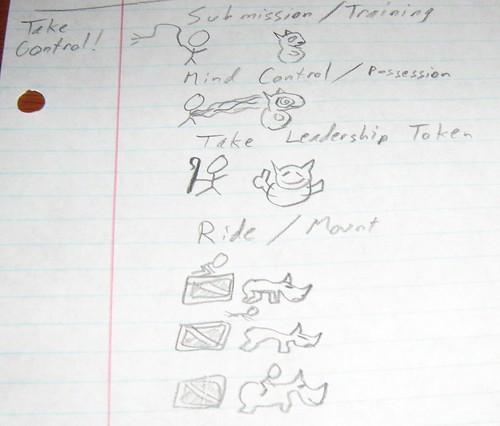
Take Control

So these are some of the ideas I have running through my head. Even though I’ve been thinking about sending enemies after an AI hero for much longer, I’m starting to like the mechanics listed here. Any thoughts?
Categories
Game Design Game Development Geek / Technical Linux Game Development Personal Development

LD18: Theme Is Enemies As Weapons

I was hoping that “Enemies as Weapons” would be the theme. I normally do not think about game ideas or concepts before the compo starts, but this time, I couldn’t help but think about how I would approach this one.

In Super Mario Bros, it’s common to use Koopa shells to take out enemies, so I tried to think about how the hero could somehow change the state of a foe to make it harmful to its allies. Could you pick them up, which causes them to lash out? Could you simply hit one, which makes it do something to protect itself instinctively, but its defensive weapons happen to be harmful to enemies as well?

But then I thought: what if I allowed the player to generate enemies for an AI hero? Imagine having a bird’s eye view of a world, and you can see the hero approaching your domain, but you can select an appropriate type of enemy, create it, and send it to meet the hero. At first it might be easy, but the hero has multiple lives, so you’d have to send more and varied enemies to stop him/her.

I liked the idea of generating enemies to go after an AI hero. I’ve never had very interesting AI in my previous games, but I’ve recently been reading “AI for Game Developers” and was getting a bit inspired. Ludum Dare is usually a chance for me to learn something new, so maybe this time around I’ll be learning how to implement some AI capable of avoiding obstacles, evading other entities, and figuring out how to get through the world.

Or, I should realize I only have 48 hours to implement the entire game and I might not want to spend too much time figuring out something as huge as advanced artificial intelligence. Simple AI is sometimes good enough.

Categories
Game Design Game Development Games Geek / Technical Linux Game Development Personal Development

Ludum Dare 18 Starts Today!

Everyone’s favorite 48-hour solo game development competition, Ludum Dare, is running in its 18th iteration starting tonight at 9PM Central Time (US).

As always, I’ll be updating my game development progress here and on the LD blog.

Currently, the final round of theme voting has contenders such as Technology in the Wrong Time Period, Cooperation, Enemies as Weapons, and Evolution.

Oh, and Double ZOMBIE Rainbow is another theme.

Categories
Game Development Games Linux Game Development Marketing/Business

What Game Platforms Do You Support?

While I beat the drum about supporting GNU/Linux gamers, more than a few people have noticed that the world doesn’t revolve around Windows vs Mac vs GNU/Linux anymore. Jeff Tunnell wrote in February that putting your game on OS X and GNU/Linux is not enough.

Instead of debating OSX, Linux, and Windows vs. just Windows, you should be considering all OS’s, Flash, the browser, Facebook, MySpace, Hi5, Steam, Instant Action, Greenhouse, your own site, iPhone, Android, other smart phones, Nintendo DS, Xbox via XNA, XBLA, Playstation Network, Wii Ware, box distribution, Casual Portals like Big Fish Games and Yahoo Games, Flash Portals like Kongregate and New Grounds, international portals.

When I worked to convert a game to Flash and bring it to Facebook, Sea Friends was the result. And until I made this effort, I didn’t realize how much Flash, Facebook, and the web in general were individual platforms.

When Netscape and Java were new, the promise was that applications would no longer be locked into the operating system you were using. All work and play would be in the web browser. The push got stopped long ago, but look around you today. Facebook is huge, and more people spend time logging in there than many other sites. The iPhone had a gold rush, and Android phones may have their own.

And the platforms impact how you play. Games available through Facebook and other social networking sites tend to be social games. It’s only natural. If you can’t interact with friends in some meaningful way, your game won’t get played. iPhone games tend to be quick and easy to play, which are perfect for people who are sitting on a bus or waiting in line somewhere.

If anything, supporting Windows exclusively, as many indies do, is a sure-fire way to marginalize your game in the world. Supporting Windows exclusively is easier, yes, but why should you expect that doing the easy thing will be profitable?

But the bigger point is that supporting Windows, OS X, and GNU/Linux aren’t enough. Does this mean that Joe Indie has his work cut out for him? Perhaps, but it also means your game has many ways to meet potential players. You have many options for testing your game designs long before you invest years of your life into the implementation.

Always see, and really see, what is possible.

Categories
Games Linux Game Development Marketing/Business

Linux Gamers Demonstrate Demand & Support Suppliers

I like calling attention to the reasons why you should support Mac OS X and GNU/Linux as a game developer, especially since so many people still ignore these markets at their peril.

Recently, Koen Witters of Koonsolo Games wrote about how surprised he was to find that Linux users show their love for the company’s indie game. He posted Mystic Mine‘s downloads and conversions stats, and the results demonstrate that GNU/Linux users are a gaming market that is relatively easy to target and is willing to purchase quality games.

Mystic Mine is an action-puzzle game with simple controls. You basically switch tracks for mine carts to use as they collect coins, diamonds, and other items. As more and more carts run around, you’ll find yourself switching tracks just to keep them from running into each other, and the action can get frantic.

This game is available for GNU/Linux as a native client, and the customers are buying. I downloaded the demo, and the game runs right out of the box. It’s a fantastic user experience.

Contrast that experience with EVE Online. Back in February, EVE Online‘s official GNU/Linux support ended. The reasoning? Not enough GNU/Linux users to make it worth the complexity of supporting three operating systems.

If you read the comments of that news item, you’ll see that everyone agreed the native client was horrible. One person said that using Wine to emulate the Windows version worked better than the native client. People even left the game because the native client was so painful to use.

No wonder there weren’t many GNU/Linux users. Based on the feedback I’ve seen, they were treated as if they were second-class customers, given an inferior experience and expected to act like it was good enough.

Again, contrast that experience with 2D Boy’s World of Goo. GNU/Linux users had to wait for that game to be released long after the Windows version was. When the port was finally released, more games were sold on that day than any other day.

This day beat the previous record by 40%. There is a market for Linux games after all 🙂

If you’ve played World of Goo on GNU/Linux, you know that the native client is great. It’s not buggy. It’s not frustrating to use. It just works.

So Mystic Mine and World of Good are both games that treat GNU/Linux users as first-class customer, and the creators are rewarded with good conversion rates and sales. EVE Online produces an inferior experience for GNU/Linux users, and then the creators cite the low number of customers as the reason to drop the poor support they were providing.

If you want to argue that EVE Online is an MMO and has different support costs, keep in mind that A Tale in the Desert is also an MMO, and when it first came out, 38% of GNU/Linux users converted to paying customers while only 20% of Windows users did.

In terms of absolute numbers, there are more Windows users than GNU/Linux users, but there are other benefits besides sales and subscribers. Publicity is a huge one. With websites dedicated to Mac and Linux games, you’ll easily make a name for yourself if your game is well-made. Of course, if you half-ass it, you’ll make a different name for yourself.

I’ve asked before: why aren’t there more Linux-using gamers? But the market exists. It has a significant user base. And they pay money.

As an indie, you can afford to provide a quality experience for these people and reap the benefits, especially since, by and large, the mainstream game industry ignores them.

Categories
Game Design Game Development Games Geek / Technical Linux Game Development Personal Development Post-mortem

LD#15: Mineral Miner Post-mortem

Ludum Dare #15 is over, and I already wrote that the results are in. Aside from placing well in Community, which shows how much I love participating in LD48, I also saw my overall ranking come in at around the 40 percentile. I was ranked #63, which sounds good, but there were a number of ties for previous rankings. Out of 144 entries, Mineral Miner was 87th. It’s much better than coming in almost dead last in the previous Ludum Dare (and not completely last only by virtue of two other entries not getting rated at all), but I’ve done better.

Let’s look back on this project and see what happened. First, let’s go over a summary of the game. Mineral Miner turned out to be a puzzle game in which you drive around a cavern in a tank, getting out to collect minerals. You can only collect one mineral at a time, so you need to drop off collected minerals in your tank to collect more. If you are near a monster lair and not inside the safety of your tank, a monster will come out and chase you. If a monster catches you, you lose. If you collect all the minerals, you can leave the level and win.

What Went Right:

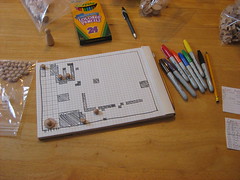
  • Rapid Prototyping on Paper I took a free, online game design course at GameDesignConcepts.wordpress.com, and I was able to put use those skills to great effect. During the competition, I posted about my prototypes. With only 48 hours, it can feel painfully slow, but I iterated through the design, adding a new mechanic, trying it out, and deciding whether to keep or remove it, and then repeating until I had something I thought might be fun. Painfully slow? It took me almost no time at all. In previous LD48s, I’ve been known to add mechanics at the last minute in an attempt to make a game out of the code I was writing. This time, I knew exactly what mechanics I needed, and there were no real surprises here. The finished game ended up playing exactly how I hoped it would. Prototyping!
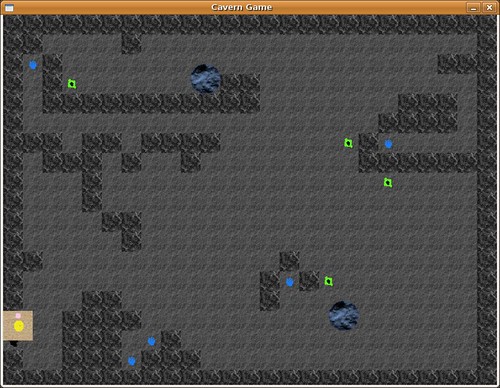
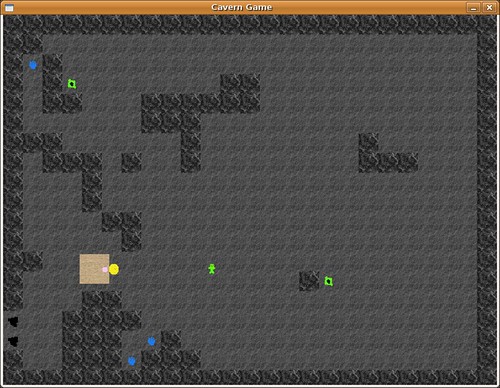
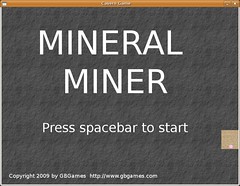
  • Quick ‘n Dirty Graphics I’m not terribly familiar with art tools, such as The Gimp, and so every LD48 I find myself looking up how to use it to create what ends up being ugly art for my games anyway. I decided that this time, I wouldn’t try to make anything fancy. If I have any images that need text, I will use the basic text tool instead of the script-fu that creates cool looking logos if you tweak parameters just right. The tank? A square with a dot to let you know which way is the front. The driver? A yellow circle. Hey, it worked for Pac-man. I was able to focus more of my time on making the game because I wasn’t frustrating myself with trying to create halfway decent artwork.

    Screenshot-Cavern Game

    CavernGameCollisionDetection

  • I Made Sound Effects This is my fifth Ludum Dare, and only the second time that a game I made had sound effects. Because I had a game that pretty much worked the way I expected it to, I had time for some polish. I made a list of sound effects I thought I would need, used sfxr to create the beeps and boops, and wrote the code to tie it all together. Adding sound really makes a big difference to a game, and I was glad that I could do so for this one.
  • Faster Build Times and Lighter Distributables Because I had been doing some work on my Vampire Game, work that involves using TDD from the first line of code, I also did some work on my build scripts. Going from a 10 minute build time with a distributable that is already 10+MB due to including source libraries to a build that finishes in seconds and is less than 2MB is amazing for productivity, especially as it comes down to the final hour of the competition. Everything happened so much faster, keeping me focused on game development instead of getting distracted as I waited for a build to finish. Now, it isn’t as if my builds always took 10 minutes, but going from checked out source code to a complete build would. Once the libraries were built with my old system, compiling and linking would still take some time, much longer than the time it took with my new build scripts. Plus, one of the complaints I would get from previous competitions is that my game package was so large, so that’s one complaint I did not see this time around. B-)
  • Simple AI Goes a Long Way I remember taking a few minutes to think about how I wanted the monsters to interact with the level. Should they obey the walls and other obstacles, like the player has to? If so, that would take a bit of AI programming. I don’t have much experience with AI, and I didn’t want to take the time to learn it for this LD48, so what did I do? I made the monster head towards the player every step, ignoring the environment. I could explain it away. It’s a monster. Maybe it climbs walls like crazy? The big surprise was how well it looked. Besides making it move towards the player, I also made the monster randomly move horizontally or vertically to do so. Combined with the sound effect when it comes out of its lair, the twitchy looking monster moving really fast at the player actually feels scary.

What Went Wrong:

  • Distractions I have two cats, and both of them have been featured in previous LD48s, so I won’t focus on their antics too much. My home office wasn’t in a usable state, so I was out in the kitchen or living room. The cats love distracting me from productivity, and LD#15 was no exception. The one thing I did my hardest to control was external obligations. Anytime someone wanted to make plans with me for the weekend of LD48, I would politely tell them that I was busy. And it worked! I was able to focus almost entirely on eating, sleeping, and LD48ing…except for the Chicago Fire game.

    Chicago Fire vs D.C. United

    I won tickets to the Fire vs D.C. United game, which happened to be the same weekend. They were really good tickets, too, and so I made an exception. In practical terms, I lost a good chunk of Saturday. I was able to get the game finished, but having an extra hour or two would have been good for tightening up the graphics and audio. On top of knowing that, the Fire lost, so it wasn’t even as fun a game to watch from the 2nd row as it could have been.

  • The Sound Effects Were Very Rough By far the biggest complaint from people playing my game is that the audio hurts. I was able to get audio in within the last hour of the competition, but I didn’t have time to adjust it. I knew that some of the sound effects were loud and obnoxious, especially the one that plays when you bump into walls, but I couldn’t dedicate the time to tweaking it. The deadline was looming, and I still had a few more programming tasks to complete.
  • There’s Only One Level Right before the end, I realized that I did not have a victory condition. I had programmed a way to lose if a monster caught you and also if you tried to leave the level without collecting all of the minerals, but someone will eventually collect all of them. What then? Ideally, I would have added code to load the next level, created that level, and kept going. In fact, Level 2 is in the distributed game, although it is a copy of Level 1 and there is no code that knows about it. I was thinking about taking Level 1 and breaking it up into at least three levels, with each level introducing new puzzles and getting progressively more difficult. Three doesn’t sound much better than one, but it would have made a big difference. The player would have felt that progress was being made, and the later levels could introduce the trickier ways to deal with monster lairs.
  • Level Loading Bug I could not figure it out in time for the deadline, and I still haven’t looked at it since, but every so often, the level loading code would choke on the data, bringing the game to a halt. Sometimes shutting down the game and rerunning it would work. The data came from a text file, and my code is supposed to load a single character at a time, mapping the value to a tile. Sometimes, however, it would choke because a single character variable would have a value that is two characters long. For a time, I was dedicated to fixing it, but with only 48 hours, a good chunk of which I couldn’t make use of, I decided that since it wasn’t a show-stopper, I would keep going. I really wish I could have figured out why that bug was there. Besides ruining the perceived integrity of the game, I know at least one person didn’t review it due to this crash.
  • Making a Puzzle Game I didn’t set out to make a puzzle game. I didn’t want to worry about creating a lot of content. One level might not be such a problem if the level was varied and fresh each time you played. I could have created a procedural level generator, but I never built one before. I didn’t want to spend time learning how to do so, nor did I want to spend the time tweaking the algorithm to make nicer levels even if I did end up accomplishing it. Out of all of the ideas I came up with, the game I liked the most ended up being a puzzle game, which unfortunately meant I was either going to spend a lot of time making clever levels or finish a game with hardly any levels. It ended up being the latter.

What I Learned:

  • Rapid Paper Prototypes Work My game design skills are sorely lacking, but I’ve been able to practice what I learned in the game design concepts course, and it really paid off with Mineral Miner. I’m not claiming that it’s a fantastic game, but it did rank #45 in the Fun category, putting it in the top 50%, and #27 in the Innovation category, which puts it in the top quarter! It feels good to know that the game design I prototyped early on before writing a single line of code came together, and the comments for my entry showed that people saw a lot of potential in my game. Everything I wanted to put into the game, I learned from minutes of drawing on paper and messing around with tokens. I didn’t need to have a game engine coded up to explore, discard, and introduce mechanics, which means I saved a lot of time that would otherwise have been wasted on code that would get thrown away and changed needlessly.
  • Quick ‘n Dirty Graphics and Audio Can’t Be Permanent My art and audio work was minimal and saved me a lot of time, allowing me to work quickly at getting the game play up and running. Unfortunately, my overall rating got hurt here. I was near the bottom in the Graphics category at #104 and surprisingly a little better in the Audio category at #77. I was hoping for time near the end to replace crude art and sounds with better ones, but it didn’t happen. On that note, even if it did happen, it wouldn’t be more than marginally better since I don’t have the practice and skill with my art tools. One suggestion was to use images of my prototype work, and I agree, the drawings look much nicer.
  • My Pacing Still Needs Work I felt much more confident about my entry this time around, but I still found myself finishing the game at the last minute. There’s very little time for polish when the complete game forms only an hour before the deadline! It’s especially a concern since I decided to go with quick and low-quality art in order to get the game running as quickly as possible. I probably could have set mini-deadlines for myself. 48 hours sounds like an incredibly compressed period of time to make a game, and it is, but it’s still enough time to flounder. Early on, I have two whole days to worry about everything. In the last 5 hours, I’m in crunch mode. I could stand to manage my time and prioritize my tasks much better.

If I could do LD#15 over again, I would try to manage my time better. I could have had the prototype work done much earlier on, leaving me with more time to do the actual programming and arting. I might have been able to get more levels and variety in if I didn’t waste 5 or 10 or 20 minutes at a time wondering what to do. Still, even though Mineral Miner wasn’t a winner of Ludum Dare, I felt it was a success. I designed early on paper instead of designing with hard-to-change code, and I was able to focus on making the game I felt had a chance of being fun. People said they enjoyed the game and wished there were more levels. It was a complete game, meaning that aside from the level loading bug I mentioned above, everything that happens in the game happens because I designed it that way. In 48 hours, a complete game that provided some entertainment for others is a good accomplishment.

Categories
Game Design Game Development Games Geek / Technical Linux Game Development Personal Development

LD#15 Results Are In!

It’s 2 weeks later, and Ludum Dare #15 is officially over. The results are in, and I placed 5th…in the Community category. Unfortunately there was no food category this time around, or I could have gotten the gold in that one. B-)

Seriously, congratulations to the makers of the top ten overall entries! The #1 overall game was Beacon by ChevyRay, which was also featured on IndieGames.com’s Freeware Game Pick not too long ago. Congratulations to ChevyRay for making a splash there!

I’ll have a post-mortem of the Mineral Miner soon, but here’s a summary of how I did: badly in graphics and audio, decent in humor and fun, and well in innovation and theme. A number of people REALLY hated the audio, but they seemed to really like the actual game play. When people are unhappy that there is only one level, it means I left them wanting more in a good way. B-)

My entry ranked #63 overall, being 87th out of 144 entries. There were a number of ties for various placements, so the ranking only goes to #107. I’m a little disappointed in how well my entry did, but there was some great competition. I did much better in LD#13, but I still consider this Ludum Dare to be a success for me. I had a finished game by the end of 48 hours, one that got some great feedback from players. I got to practice skills from the game design concepts course I took this summer, and I would say they really helped me put this game together before a single line of code was written.

Once again, congratulations to the winners! There are some fantastic games in the mix!

Categories
Game Design Game Development Geek / Technical Linux Game Development Politics/Government

LD#15: My Time Lapse

Categories
Game Design Game Development Geek / Technical Linux Game Development Politics/Government

LD#15: Mineral Miner – Final Entry

CavernGameFinal

I did it! I submitted my entry just in time for the end of the competition, too! And it is the first time since LD#11 that I’ve submitted a game with audio, no matter how jarring!

You can download the GNU/Linux version here: Mineral Miner for GNU/Linux: 1.2MB

I’ll try to have a Windows port up as soon as possible. Mineral Miner for Windows: 2.1MB

Controls:
Use the arrow keys to move around.
Press the space bar to jump into and out of the front of your tank.

Collect all the minerals and return to the exit to finish the level.
You can only hold one set of minerals at a time. Return the minerals you collected to your tank to collect more.
Watch out for monsters! If you get too close to a monster lair, a monster will come out and attack you. You’ll have to find a way to stop them from coming out.

Congratulations to everyone who participated and finished a game in 48 hours!

Categories
Game Design Game Development Geek / Technical Linux Game Development Personal Development

LD#15: Ahh! Real Monsters!

Monsters!

They chase you, and they look better at doing so than I would have thought. Now I have to implement player death.