Categories
Games Geek / Technical

What Is This Ninja Game?

And why does it look so fun? B-)

I saw some people playing this game earlier during GDC outside of the IGDA booth, and I wish I hadn’t pulled a back muscle recently so I could participate.

I recorded this second session, which was much bigger. I had to stop recording since the Moscone Center was closing for the day and I was not a volunteer, but I tried to capture the thrilling conclusion to this session:

I need to hang out with playful people more often! B-)

EDIT: Ah, it’s an Indiecade thing! Free Ninja

This post was scheduled to be published at a time when I will not be able to access the computer. I’ll respond to comments when I return at the end of the month.

Categories
Game Design Game Development Games Geek / Technical Marketing/Business Personal Development

The After GDC Glow

Last week I attended my first Game Developers Conference, and I guess the best way to start the recap is to say that I had a blast!

The Independent Games Summit was full of different groups of indies. Some knew each other from TIGSource. Others have been around forever. And since we’re all indies, we each had our own unique story and reason for being there. Even so, it felt as if everyone knew each other and were fairly supportive. It was like a very odd yet loving family.

I only had a Summit & Tutorials pass since it seemed to be in the sweet spot between the too-expensive All Access Pass and the “let’s hang out with people who want to find a job at the Career Pavilion” Expo pass. While I couldn’t attend a lot of the cool talks and panels in the later half of the week, I was still able to attend any of the summits.

At one point, I skipped out on the IGS summit for an AI summit talk on pathfinding. James Anhalt of Blizzard talked about the pathfinding problems of StarCraft 2, Alexander Kring of Nihilistic focused on Heroes on the Move, and Nathan Sturtevant from the University of Denver worked on Dragon’s Age: Origins. They each gave a glimpse into the tech behind the games, and the Q&A session at the end made me laugh because it was almost all complaints about StarCraft.

If I would have attended the Google Android Day tutorials, I apparently could have received a free Google device. I didn’t, but I got to see the long line for the tutorials that morning. It’s kind of the same, right?

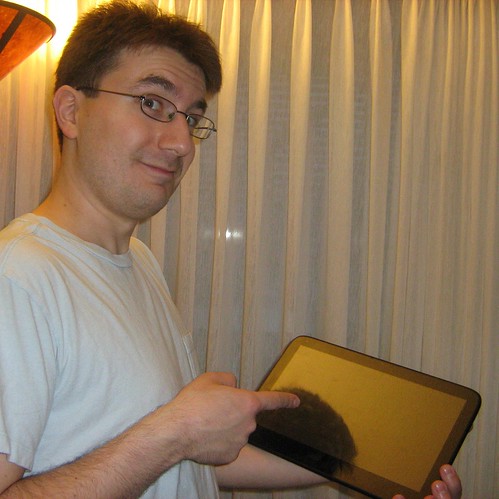
On the other hand, I did sign up for an Intel AppUp event with Mike “PoV” Kasprzak and Phil “philhassey” Hassey and received this baby:

My New Intel-provided, Meebo-based Tablet

It’s a Meebo-based EXOPC Slate! I finally got a cool consumer electronics device!

The best part of GDC was meeting everyone I’ve only ever spoken to on IRC or on web forums. Whether I was having lunch, standing in line, or walking to a session, there was always someone’s name to call out to and say “Hey! I recognize you from your online avatar!”

I briefly met Leigh Alexander, Drew Sikora, Ian Schreiber, Noah Falstein, and Derek Yu. I met game developers I’ve talked to on the Indie Gamer forums and in the #ludumdare IRC channel. I met game developers I’ve only heard about in passing.

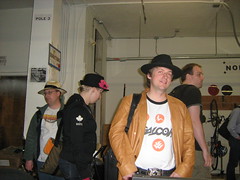
The IGDA booth with Corvus Elrod and company!

And I got to hug Corvus Elrod of Zakelro! Don’t forget to vote for the 2011 IGDA board!

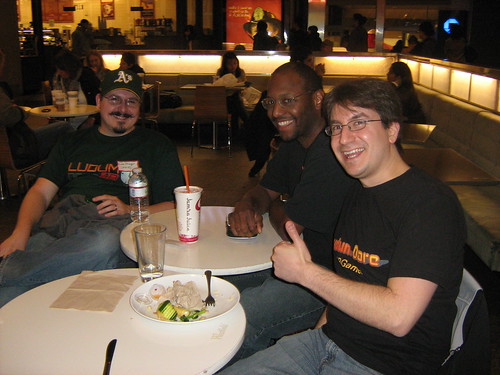
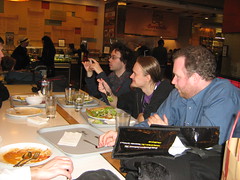
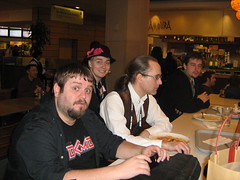
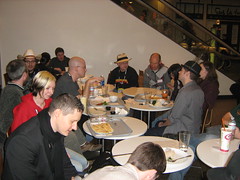
The Ludum Dare meetup was fun and had a good turnout:

Ludum Dare meetup

Ludum Dare meetupLudum Dare meetupLudum Dare meetup

There were so many of us, we needed multiple tables!

And here’s a link to a bunch of us wearing LD48 shirts.

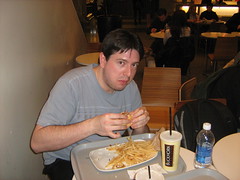
And one action shot of PoV eating:

PoV eats!

I was finally able to attend the Independent Games Festival and the Game Developers Choice Awards.

The IGF/GDCA at GDC

Congratulations to Mojang for winning five awards between the two events, including the Seamus McNally Grand Prize in the IGF!

At the end of the week, we had the Ludum Dare Jam at Noisebridge, a really cool hacker space.

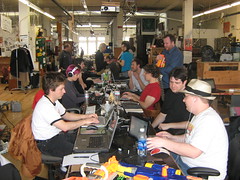
Ludum Dare Jam at NoisebridgeLudum Dare Jam at Noisebridge

And an action video of Phil Hassey sleeping:

I had to leave the jam early and get on a plane the next morning, but I definitely want to do GDC next year! Heck, two days into it, I half wanted GDC to be over so I could get back home and make games sooner!

In the meantime, what was your favorite part of GDC?

This post was scheduled to be published at a time when I will not be able to access the computer. I’ll respond to comments when I return at the end of the month.

Categories
Game Development Games Geek / Technical Marketing/Business Personal Development

Off to My First GDC!

Wooooooooooooooooo!

WOOOOOOOOOOOOOOOOO!

After years of being one of those people who was a bit jealous of everyone who was going to the Game Developers Conference, I realized that I’m now one of those people to be jealous of. Today I will be setting foot in San Francisco, and tomorrow I will pick up my badge for the GDC!

And then I’ll be wide-eyed and star-struck and generally feel like the humble newbie I am. B-)

I’ll be attending the Indie Games Festival for the first time, meeting Ludum Dare regulars at the Ludum Dare meetup for the first time, and otherwise taking in the sights and sounds of GDC…for the first time!

I’ll be there through Saturday, so feel free to contact me through Twitter: @GBGames

WOOOOOOOOOOOOOOOOOOOOOOOOOOOOOOOOOO! GDC!

Categories
Game Design Game Development Games Geek / Technical Linux Game Development

Stop That Hero! Is Apparently an RTS

At the end of the last progress update, I mentioned the realization that there could be a lot of code and logic in the player-facing parts of the game that aren’t part of the game. That is, when people talk about how complex the interface can be, they aren’t talking about particle physics, 3D culling, or fancy special effects. They’re talking about how the front end’s complexity can rival the back end’s.

And somehow I hadn’t realized it before. I knew that the interface should be separate from the game, but I didn’t know that the interface was responsible for more than merely displaying the game world and its objects. It’s a heavy-weight in its own right, handling menus, HUDs, and inputs that the simulation ultimately doesn’t even know is happening.

I used StarCraft‘s interface to illustrate the idea that the player interface is more than a mere window into the simulation. It can have complex logic that the game simulation doesn’t actually care about. As far as the simulation is concerned, it receives commands. Most of the actions you take in StarCraft do not result in commands to the simulation.

If you click on an SCV, and then click the Repair button, and then click a burning Bunker, the interface is responsible for figuring out what you’re trying to do. It isn’t until you click on that Bunker that the simulation receives a command along the lines of “SCV 1 REPAIR BUNKER 5”. Up until then, only the interface has to know you’re working with a particular SCV, what commands are available to an SCV in general, what buttons to display in the SCV menu, which SCV menu you’re looking at, etc.

Stop That Hero!’s interface

Now that I know that I can expect the interface to my game to be incredibly complex as opposed to a dumb and simple view, it actually made it much easier to realize how to proceed with my project. I don’t have to do everything within the simulation, and in fact, I can expect a huge part of the work to involve the player’s interface.

Stop That Hero!‘s interface isn’t like most games in that there is no avatar to control. You’re not directly moving an entity with the arrow keys or commanding it to jump with the spacebar. You simply create them at the appropriate towers in the world, and they’ll figure out where to go and what to do on their own.

But how do you create them at towers? The original prototype had a menu hardcoded at the top right of the screen. If you wanted to create a monster at a tower, you had to click the monster icon at the top right, then click on the tower. If you had enough resources, you summoned the monster you selected.
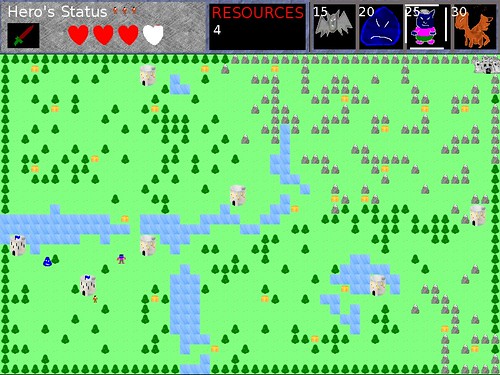
Stop That Hero! is finished

It was functional, but I didn’t like how it felt. Why is the selection of the monster to summon separate from the act of summoning? While it makes it easy to create a bunch of the same type of monster at once, it’s also easy to accidentally create a monster if you click on a tower without wanting to.

I wanted something more intuitive, and it turned out that pie menus are exactly what I want.

Except my GUI code is incredibly basic. I have menu screens and buttons, and everything assumes it is starting at the top left corner of the screen. In order to even simulate a pie menu, I needed a way to display menus at arbitrary locations, and it would help to be able to offset a menu from its center instead of the top left corner.

Which meant giving menus dimensions (how else can you know what the center is?) and having my IMGUI-ish system understand how to display and detect updates at arbitrary offsets.

In the end, after some research, questions, and determination, I do have this sequence working:

First, click on the tower you want to summon a monster at:
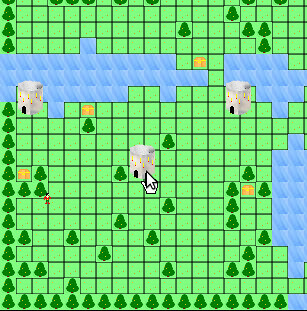
Summon Monster Menu: Step 1

The Monster Summoning Menu appears over that tower, which means it is right under your mouse cursor:
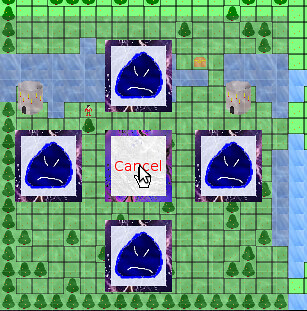
Summon Monster Menu: Step 2

Select the monster you want to summon by moving your mouse cursor to the appropriate icon. Right now, I only have a Slime, but others will be added later:
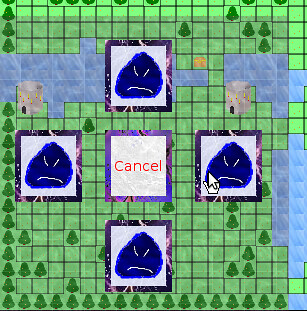
Summon Monster Menu: Step 3

Congratulations! You’ve summoned a Slime monster!
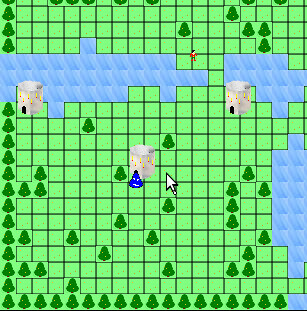
Summon Monster Menu: Step 4

Besides the infrastructure changes to support arbitrary menu placement, configuring the menu is easy, and each button fires off whatever event I want when it is clicked.

Tricky Aspects

One of the things I still need to figure out is what to do with a tower near the edges of the screen. Right now, the menu is always centered on a tower, which means clicking on a tower near the side of the map results in a menu with icons you can’t see. They’re being displayed off screen.

It’s not such a problem if I can display the menu outside of the screen the way a game like SimCity/Micropolis does, but since I’m not using Gtk to render the menus, they have to be rendered within the screen. I could add more screen real estate around the play area, but I’m trying to keep the game at a low resolution like 800×600 to accommodate players with older computers and netbooks. I could make the play area scroll, so even if you were at a corner of the map, it would be displayed in the center of the screen, but I want the players to see everything at once. I could reduce the play area so that I have a border to work with, but I’m not sure I like losing so much level data just because of the UI.

My best option if I want to keep the pie menu is to detect if the menu is being displayed offscreen and have it adjust automatically, but I’m not sure if the menu appearing away from where you expected it becomes too unintuitive, defeating the purpose. Otherwise, I might have to get rid of the pie menu altogether.

RTS development in a vacuum

In any case, I now have a player interface that I can easily change, but one thing I didn’t anticipate was how similar it is to a real-time strategy game’s interface. I didn’t really think of Stop That Hero! as an RTS, and yet I suppose Dungeon Keeper and Populous had RTS-like interfaces, too. Or, rather, the interface is composed of icons that let you influence the world.

I discovered that while FPS or platformer development articles and tips are a dime a dozen, RTS development seems to be something that everyone must reinvent themselves since there is a lack of information out there. I know of a couple of strategy game programming books that focus on DirectX, and either people found them lacking, or they focused heavily on DirectX as opposed to the game.

Even if there was a basic breakdown of every aspect of an RTS project, leaving the research of each item as an exercise for the reader, I’d find it more helpful than figuring out what those aspects might be as I stumble across them myself.

While most games probably have a hard-coded GUI baked into a game, some games are more expandable upon release. I remembered that Total Annihilation allows player-created units, and I figured that there had to be a way to provide access to the GUI so that new units can be created by the player in game. I checked out the game’s modding tools and discovered how it handled its GUI elements. I spent an entire day perusing technical references and modding tutorials, peaking at the game’s default data files, and generally immersing myself in the internals of the game. It is fascinating how GUI images are tied loosely with the name of the unit or command.

World of Warcraft isn’t an RTS, but its GUI is supposed to be highly configurable by players, and there are interesting references explaining how the XML ties in with Lua commands and functions within the game.

Looking at how other games do it with the limited access they provide is like trying to study a map by staring at the back side. It’s hard work, and I’m sometimes limited by the games I have access to for the most part, but it is sometimes the best guidance I can get when it comes to figuring out how to implement my own game.

Categories
Game Development Games Geek / Technical Marketing/Business Personal Development

I’m Going to the GDC (FINALLY)!

I finally purchased a Game Developers Conference pass for the first time!

After years of having to hear about the conference and the summits and the talks and the panels and the awards and the parties after the fact, I am actually going to be a participant!

Now I’ll get to attend the Indie Games Festival!
Now I’ll be able to meet game developers and journalists in-person instead of merely through IRC, Twitter, or blogs!
Now I get to be snubbed by major game developers when they hear I’m an independent game developer!

There were always excuses not to go in the past, such as not being able to request enough time off from a day job or not having the money. And the cost for registering for the pass, booking a plane, and staying at a hotel for a week was a big obstacle.

And cost was still a major stumbling block for me. Until I can make some income on a regular basis, I’m trying to be very careful with how I spend my money.

So how did I justify the massive expense this time?

For one thing, I have a friend currently residing in San Francisco who said I can crash at his place. No need for a hotel now!

Now, the GDC pass was tricky. I could have saved a lot of money by getting an Expo pass, but I wouldn’t be able to participate the entire week. Getting an All Access pass was prohibitively expensive. I opted for the Summits & Tutorials Pass since it seemed to offer the right balance of access and cost. While I won’t be able to attend a number of events, I will be able to go to tutorials and the Independent Games Summit.

Still, it wasn’t chump change, and I still had to book a flight.

My decision to pay so much at this time was based on a few thoughts:

  • I can technically afford to go, and I might be too poor to go next year if my income level doesn’t change from $0.
  • I can finally meet people who are involved in the industry, whether peers or mentors. My involvement has almost always been virtual. At least in Chicago there was the IGDA chapter, but the local game developers tended to be inactive, and they seem to drop like flies.
  • I hear it is an experience.

So, bottom line, I’m going because it is a huge opportunity for me to be more involved in my industry and get to meet other participants.

I’m really excited. I’m actually going to be at GDC, and I’d love to meet you!

Who else is going to GDC?

Categories
Game Design Game Development Games Marketing/Business Personal Development Post-mortem

Stop That Hero! October Challenge Post-Mortem

October 31st came and went, and Stop That Hero! was not in a position to be sold, even as a beta or alpha project. Partway through the month I realized that even if I was able to finish the project, the work of setting up the payment systems, customer support, and even the website was going to take some time as well. According to my estimates, I’d finish the game sometime between the end of October and the beginning of December. As disappointing as it would be not to finish in time for the October Challenge deadline, I also knew that it was a “fun” deadline as opposed to a hard “must-hit-this date” for my business.

I will continue to work on Stop That Hero! because I believe in the project, but I’d also like to get better at project management. Now that the deadline has passed, I can look back on the month and think critically about how I did. Even though there was no business-related urgency in getting the game finished for the Ludum Dare challenge, I still wanted to do so, and it was demoralizing to realize that the game wasn’t going to be finished in time.

For the unfamiliar reader, Stop That Hero! was originally created for the Ludum Dare 18 Jam. The player was an evil villain in charge of a castle and a number of towers, and a hero character was trying to conquer the castle, liberating towers and collecting treasure chests along the way. The player would create minions at any of the towers, and those minions would try to kill the hero. Kill the hero three times, and you win. Lose the castle, and you lose the game.

For this project, I wanted to make Stop That Hero! a commercial-quality game that required no proprietary dependencies and ran on at least GNU/Linux (my preferred platform) and Windows, with plans for a Mac OS X port and an eye toward mobile devices. I wanted the game to be data-driven instead of hard-coded. I wanted the game to have multiple game modes and levels, and I wanted me and the players to have the ability to create our own custom levels with custom rules. I realized that it was a lot to do for a first release, so my intention was to make the game hard-coded yet easy to change so that it was using external data and scripts. Future updates would involve replacing the hard-coded bits with loadable data.

What Went Right

While it might seem strange to think that anything went right for a project that wasn’t finished, I do believe there were some good things that positively impacted the project.

  1. Planning and Preproduction Time. Even before the October Challenge was announced, I knew I wanted to take Stop That Hero! and make a full game out of it. I spent a few weeks at the end of September looking at every aspect of the game, from resource handling to monster variety to game modes.

    While I think the original LD18 game’s mechanics were marred by a lack of game balance and probably could stand on their own, I wanted to investigate every possibility for making this game the best it could be. I identified major design challenges that I wanted to focus on early on. I also speculated on how much of the game could be data-driven or scriptable. This early planning helped me visualize how I wanted the finished game to look and feel.

  2. A Regular Work Schedule. As an indie game developer, I have no boss imposing a schedule on me. Keeping my job doesn’t require my presence during official office hours anymore. Since I determine my own schedule, I can do whatever I want, whenever I want. It’s not a license to slack off and take vacations every week, of course. My income depends on the output of my efforts.

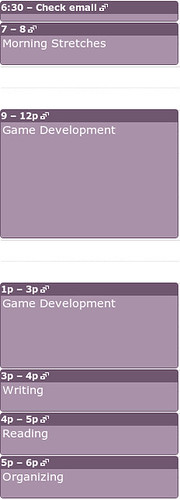
    The thing is, my time usage wasn’t very productive or balanced, and it hasn’t been for months. If I spent time on game development, I’d find that my writing would slip. If I wrote, I’d find that magazines and books would pile up in my inbox. If I read, I’d realize that I almost missed paying an important bill. Coinciding with the time I started preproduction for this project, I realized that I needed to do something to change my situation. To make my productivity a bit more predictable, I created a regular set of hours for myself. Until I had a game to sell, I wasn’t going to make any money, so production took up the lion’s share of the time I spent in a day. To ensure that there was balance between game development and everything else I wanted to get done, I gave myself regular hours for writing, reading, and organization. I use Google Calendar to setup recurring events. You can see an example of my day below:

    Regular Hours I discovered I wasn’t very good about waking up early enough for the morning stretches part, which is something I want to work on next month, but I tried to stick to the schedule. If I missed stretches, I wasn’t making it up at the expense of being late for game development. If I was late for game development, I wasn’t going to encroach on writing time. If I did make such allowances, it would destroy the whole point. For the most part I stuck to the schedule, which meant I was doing about 4-5 hours of game development per day, an hour of writing per day, an hour of business or game development reading per day, and an hour of organization per day. While part of me wondered if I needed more time dedicated to game development, the balance allowed me the time I wanted to learn, share, and prevent things from slipping through the cracks. While I might tweak the hours going forward, I definitely prefer this self-imposed, organized, and regular schedule over letting each day’s activities be determined by whim.

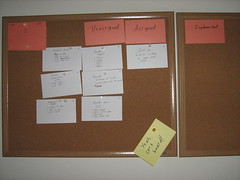
  3. Agile Scheduling As Early Warning System. Once again, I’m pleased with the knowledge I learned from using nothing more than a couple of cork boards, some index cards, and pins. Before the project started in earnest, I created an estimate of the work I needed to do as well as an estimate of how much I thought I could do per week. As the weeks passed, I realized how poorly I was doing in terms of keeping with the schedule.

    I wrote about it in Agile Alert: Slow Project Progress as well as Balancing Current and Future Needs, but the point was that without using story cards and a burndown chart, I wouldn’t have any idea when this project would be finished or what I could do to improve my situation. It allowed me to make project decisions earlier rather than later as well as weighing the advantages and disadvantages of delivering the finished project later.

What Went Wrong

  1. Not Planning Time For Art and Sound Work. The Jam version of the game features all art and sound created by me. I’m not that great of an artist, and I’m no sound designer. If this game is going to be polished, I was going to need to hire someone else to do the work. Of course, until I needed the higher quality assets, I could use my current art/sound assets as placeholders.

    The thing is, I never really had a plan for how I was going to go about finding contractors to provide the replacements. For a project that was originally expected to be sold by the end of the month, I should have had a plan in place for getting all of the final polish in. It would have been hard to ask for finished art when the game itself was nowhere near playable, so it isn’t a total negative, but I could have started a search for artists and composers. At the very least, I could have looked into pre-made art and sound packages. Otherwise, I would be spending a lot of time learning how to create half-way decent art and settling for lame sound effects and no music.

  2. Underestimating the Complexity of the Software Architecture Hacking a game together in a weekend is relatively easy because the code is prototype-quality. It’s meant to be used for a few days, and you don’t need to worry about maintenance or future updates. The future is mere minutes later, and then it is over. For the October Challenge, I wasn’t interested in a single sale. I was interested in the health of my business. When there is one sale, I expect more to come later, and so I wanted to make high-quality software that is easy to provide support for.

    Unfortunately, I didn’t realize until late in the month how little experience I have with creating a full-fledged project from scratch. When all of the code is in a single, monolithic file with almost no external data driving it, it takes no work to determine what data structures should live where. When you’re working on software with flexibility and maintenance in mind, it’s a completely different mindset. Since I didn’t have much in the way of reusable code that was of the quality I desired, I was spending a lot more time working on infrastructure and scaffolding than I expected. I could write an individual piece of code well enough, but I had very little experience with knowing what individual pieces of code I needed to write in the first place.

    Also, with unit testing, the code that “works” would only work in tests, whereas the actual game still needed a number of other parts of the project finished before I could see anything that looked like progress on the screen. It’s good to see the green bar as often as I do, but it’s frustrating that the actual game doesn’t do anything more than it did the week before. I now understand what the stakeholders felt like at my last day job whenever I would say “Yes, I’m making great progress. No, there’s nothing new for you to see yet.” Sometimes you just need to throw something, anything, up on the screen every once in awhile.

  3. Not Being Decisive About What Game I Was Making. Since I wanted the game to be data-driven and scriptable, I thought that the major design work would take place with malleable data rather than rigid code. I wanted multiple game modes, and I had an idea of what each one might include. I thought that there could be single level instances as well as campaigns of levels that tie together somehow. I wanted victory and defeat conditions to be scriptable, but I also wanted some core mechanics to be as well. For instance, while the basic game might provide all of the towers up front for the player with no way to retake a tower that the hero has liberated, a different level configuration could require the player to conquer independent towers first and provide the ability to retake them if they are liberated.

    The problem with the game designer’s “I want it all” approach is that it put a lot of pressure on the programmer to make the software incredibly flexible. Since the designer and the programmer positions are both filled by me, it meant that I was asking a lot of myself. I knew better than to make a game engine that could be any genre, any game, but I didn’t realize that making a Stop That Hero! engine that essentially allowed for endless variety of game modes and mechanics wasn’t any less difficult. While the previous sentence sounds like it should have been self-evident, I didn’t have 20/20 hindsight to help me write it back when this project started. It seemed to be so simple. So long as the game was driven by data and scripts, I could make any mode I wanted.

    At the beginning of the project, I had supposedly made a decision to implement a particular game mode as part of the version 1.0 of the game, but I didn’t want to give up on the flexibility to do any of the others I had thought of. If I really wanted to hit the end of the month deadline, I probably could have pared down the feature requirements list. Flexibility can be retroactively coded in after 1.0 was released. Instead, I gave myself the impossible task of getting everything done and hoping it could be done in time without regard to how long it would take. It’s no wonder the schedule slipped.

  4. Getting Into a Developer Funk. Towards the end of the month, I hit a point where I could not make forward progress no matter how much I wanted to do so. I was second-guessing myself, partly because I probably felt overwhelmed with the architecture work, and partly because I made the mistake of doing research and development on the state of the art for component-based game objects. Basically, I wanted a component-based game object system since it would help me in my quest for a flexible and data-driven game, but I learned a number of competing ideas, and I found that any new code I wanted to write had all of these new mental filters in the way. Data-driven Programming vs Object-oriented Programming, game objects vs game entities, encapsulation vs getting things done, etc. It was a lot to take in, and I had difficulty getting all of the new information to settle down in my head.

    When I finally abandoned my attempt at the component-based system, I still couldn’t make progress on a less flexible entity system. How hard can this be? I did a working version in the original Jam version of the game, right? Well, once again, I wasn’t throwing all variables and data structures in the same class anymore. I couldn’t make decisions because I was paralyzed with the fear that I would make a poor one.

    I experienced a smaller version of this when I was getting into unit testing for the first time. For instance, I’m not used to the need for as much Dependency Injection as I did on test-driven work, and I was losing confidence that I was doing software development “right”. Early in a project, you might think of one reference to an interface that an object needs, so you provide that reference in the constructor of the object. Weeks later, and you might have 4, 5, or 6 such references as parameters, and suddenly you’re faced with the need for another one. At this point, it starts to feel wrong, especially since it can hard to keep it all straight in my head. Since I was working alone, I didn’t feel I had anyone to discuss it with, so I would have to move forward reluctantly. Eventually, the fear that I was doing something wrong paralyzed me.

    I did eventually get out of my funk and started making forward progress again, but it was only after a long phone conversation with a more software architecture-knowledgeable friend. Thanks, Larry! When you think you’re lost, sometimes all you need is some guidance and advice.

What I Learned

  1. How Much Technology I Needed and Didn’t Have. If I didn’t care about making my game available for GNU/Linux or avoiding proprietary solutions, I could probably have used technology such as GameMaker, Unity, or Flash to make a game. They offer plenty of game development-specific support, either directly or through libraries. Instead, I had to do a lot of work myself. While libSDL provided a number of basic hardware abstraction services, I still needed to write a lot more game-specific code.

    Again, I understood I wasn’t writing an end-all, be-all game engine, but I still lacked a repertoire of code to help me make the game. A lot of my time was spent laying down the basic infrastructure to allow me to work on the game. It’s odd since I can easily hack together a working game in a weekend, but when the project’s seriousness demands more, I found that I lacked the basics. While I knew what tools I would use at a fundamental level, such as which compilers and libraries I would use, I didn’t realize I needed to figure out what technology I needed to create. If I did, I probably would have planned for it in the schedule or I would have pursued a simpler project in the first place. For instance, while I knew I needed AI pathfinding, it didn’t occur to me that I’d need something more sophisticated to track all of the objects in my game than a bunch of independent collections of data.

  2. How Much I Still Need to Learn Between software architecture and the basics of game engine requirements, I hit a number of stumbling blocks that forced me to pull books off of shelves and search online for answers. I would have thought I knew enough about game development to make a game, but I had underestimated how much more work there was to take an otherwise working game that was hacked together and writing the code in a way that made it easier to debug, fix, and change.

    Working with others would help us all glean knowledge from each other, but as an indie, I’m going to need to interact with game developers in more than a social way. Also, I need to get better at project estimations. I was too optimistic this time around.

  3. How Difficult It Is To Talk About Game Development When It Is Not a Hack Fest. Most of the people I talked to on IRC were helpful when it came to particular aspects of what I was doing, but they almost all seemed to perceive that I was hampering my efforts with the use of unit tests and the desire for high code quality. “Just finish the game” is easy to say when you’re working on an LD48 competition entry for fun, but when your business depends partly on the ability to provide customer support without introducing bugs and problems, it’s not just fun and games anymore.

    Selling a copy would have been nice at the end of the month, but I also want the ability to sell more copies later. Selling a hard-to-support game isn’t a good way to improve my ability to stay an indie long term. The October Challenge wasn’t an end in itself for me. I saw it as a kick in the pants to get me focused on moving my business forward. By and large, it worked. I have a project that is still moving forward even if it is at a slower rate than I would like. Still, it was difficult at times to talk about game development as a business-related endeavor since not everyone had the same long-term goals.

As I said, I am continuing this project even though the October Challenge is over. Using the project data so far and assuming I continue to work at the same rate, I can expect to finish the game by December. It’s still just an estimate, but it is a much better informed one than the one I made at the beginning of the project. While it is disappointing that I couldn’t finish this project in the month, I am pleased with some things. My schedule helped me make consistent progress, and I have a much better understanding of the game’s design questions since I spent so much time thinking about them before the month started. Still, while I had done a simple technical feasibility assessment, I needed to do a deeper study to realize all of the things I needed for this project. Basically, as much as I tried to plan ahead, there were some things that just weren’t on my radar. I know better now. Besides having done a lot of work for this project that can be reused, future projects should benefit from pursuing a better understanding of their technology requirements.

Categories
Game Development Games Marketing/Business Personal Development

Results of the Ludum Dare October Challenge

November begins, and that means the Ludum Dare October Challenge is over. Creating a game and selling a single copy was the goal, and you can see the results of the 2010 October Challenge.

At the time of this writing, there were 13 19 20 entries submitted. Some of the games are still awaiting their first bit of revenue, but others have sold their first copies as soon as release day!

Congratulations to everyone who has risen to the challenge!

Categories
Game Design Game Development Games Geek / Technical Linux Game Development Personal Development Post-mortem

LD18: Stop That Hero! Post-Mortem

Ludum Dare 18 was over a month ago. While I didn’t get the game finished in time for the main compo, the Ludum Dare Jam was running simultaneously and offered an extra day to let me finish and submit it.

Stop That Hero! was my most ambitious game yet. It was partially inspired by a book I was reading about artificial intelligence in games and what ended up becoming the winning theme: Enemies as Weapons. I liked the idea of a hero controlled by the computer while you sent enemies to try to stop him. My initial vision was more like Super Mario Bros. That is, the game was going to be a platformer with multiple levels, and you were going to send enemies such as Goombas and Koopa Troopas at the hero. I realized right away that learning how to implement a platformer was not going to be an efficient use of my time, especially since implementing new AI techniques was already going to be a challenge. So I switched from a “reverse Super Mario Bros.” to a “reverse Legend of Zelda” game. The hero would be trying to conquer your towers and ultimately your home castle, and you would use a variety of minions to kill him first.

What Went Right

  1. Early Prototyping Saved Time.

    More prototyping

    During the Ludum Dare #15, I was able to leverage my newly learned rapid prototyping knowledge to good effect, as I explain in the Mineral Miner post-mortem. Even though I had an idea of what I wanted to do before this latest competition started, I still spent some time fleshing it out on paper. Doing so helped me realize requirements I didn’t know I had, such as the need for AI visibility. I also got a feel for the game play, including how the player should spawn enemies and what they’ll do. Prototypes still work well!

  2. Simple Controls Forced Creativity. I wanted the player to do everything with the mouse for a few reasons. One, it would make the game more accessible and easier to play. Two, it would force me to make a simpler game. If the player can’t do too much, then there shouldn’t be a lot of complexity for me to implement. Since I knew that I was going to have enough difficulty implementing AI more advanced than any I’ve ever implemented before, I didn’t want to let the rest of the project’s scope get too large. With simple controls, I would have to figure out other ways to make the game compelling. While simple controls still left me with a lot of design choices and directions to go in, I was able to focus my efforts, and I think the game turned out much better for it.
  3. A Focus on Artificial Intelligence Was Smart. Right away, I knew that most of my time would be spent working on the AI. The game depended on it. I had just finished reading AI for Game Developers shortly before the compo started, and I realized that I never did so in all the time it was on my shelf! I learned some really cool and basic techniques, and I learned that sometimes simple AI tech is better than more complex AI tech. I was also glad I had Artificial Intelligence for Games, Second Edition to act as a more in-depth, up-to-date resource. Between these two books, I was able to create a decent bit of AI. My game’s AI needs related to behavior and pathfinding. Behavior was easily handled by a state machine, but the biggest dependency was on pathfinding. My implementation of A* was somewhat flawed from the start due to the fact that my AI agents didn’t necessarily have a single target at any given time and it was possible they didn’t see anything near them in the first place, but I was pleased with the results considered how much time I had to work within. Seeing a bunch of AI monsters moving about the screen on their own, avoiding each other, and otherwise looking like they had agendas of their own was a proud moment for me.
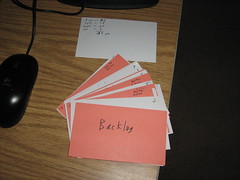
  4. Agile Planning Kept Me Focused and Aware of Priorities.

    Agile backlog First iteration

    Since I had a good sense of what the game was going to involve, I was able to plan quite a bit up front. It’s fairly common knowledge that the waterfall model doesn’t work in software development, but I wasn’t planning down to every detail. With Agile story cards, I knew what features to implement, but the implementation details were dealt with when I assigned a story card to myself. The problem with working alone is that no one is there to act as a check against my estimates for how difficult any particular story should be, but for the most part, things worked out well enough. I got two big benefits from using an Agile process to manage my project. One was that I always had a task in front of me. I never floundered, wondering what I should work on next, so my time in front of the computer was highly focused and productive. The other big benefit was knowing what features to focus on and what to cut as the deadline loomed. I originally wanted to have animations and special effects, but as the weekend went on, I knew these tasks weren’t nearly as important as getting working AI. Out they went, and I felt good about the decision.

What Went Wrong

  1. I Spent Too Much Time On The UI and Menus. I took time to prototype and come up with Agile story cards early in the process, but where I went wrong was not giving myself deadlines for those story cards. Ludum Dare was almost halfway through when I finally had an implementation of a window that I could close by clicking a menu item. Granted, clicking was an important aspect of the game, but I probably could have done so without worrying about how the menus would work.
  2. I Broke My Rule About Keeping the Art Simple. In past LDs, I realized that I would spend way too much time trying to create decent-looking art. Mineral Miner benefited from low-quality art because I was able to spend my time finishing it. For this LD, I thought keeping the graphics tiny would help, and it did, but I still found myself trying to draw a decent looking dragon when it wasn’t that important to make it look good. It simply had to be functional. Again, implementing AI was supposed to be my biggest challenge, but trying to create monsters that looked somewhat like what they were supposed to be was where I spent a lot of my time.
  3. I Missed the 48 Hour Deadline. Ludum Dare is normally a 48-hour competition, but LD 18 was a combination 48-hour compo and 72-hour game jam. I normally try to get a good night’s sleep, but I stayed up late this time around. While I was able to get a lot of work done, I found myself making mistakes and having difficulty keeping the code structure in my head. By the end of the second day, I was disappointed that I didn’t have a finished game, so I went to bed. That third day was when everything came together for me, but missing out on the 48-hour deadline meant that I missed out on feedback from other entrants. The compo has rated entries while the jam did not, so entering a compo game would guarantee some feedback in the form of ratings and comments. As I was only able to enter the Jam, my game was ignored by and large. This is the first time that the Jam format was tried for Ludum Dare, and next time there might be some changes to address these concerns, so hopefully entering a game in the Jam won’t feel like second-class LD.
  4. The Game’s Balance Is Off. On the last day of the Ludum Dare Jam, I found I had time to actually play the game. I tried to change values such as the Hero’s strength and speed and the amount of resources you obtain. I didn’t want the player to be able to create a dragon or two right away, so I lowered the starting resources, and then I didn’t want the dragons to come out soon after the game started, so I slowed down the resource increase. While I was able to make such a dominant strategy hard to do in the beginning of the game, it can still work well for the player so long as he/she has patience. Also, it had the side-effect of slowing down the pace of the game. You can only create a handful of minions in any game session, which isn’t nearly as fun as having an entire army swarming on the map. I would have liked more time to balance the game so that it was harder to pull off dominant strategies AND was fun to play.

What I Learned

  1. Simple AI Can Do Wonders! The AI in my game didn’t turn out nearly as complex as I originally thought it needed to be, but maybe it’s good that it didn’t. The AI boiled down to a few pathfinding algorithms and the selection of a target to move to, which isn’t very different from a game such as Pac-man. Once I fixed a number of bugs with the pathfinding, Stop That Hero! came alive. It really did feel like you were creating minions to do your bidding.
  2. Agile Project Planning Is Quick and Useful. Creating a prioritized requirements list and a schedule estimate helped me keep tabs on my progress throughout the weekend. I always knew what task to focus on, and I was able to change my plans when I realized that things were going too slowly for me to get it all done. I received advice that I should have deadlines for my tasks since a schedule doesn’t mean much without them, and I’m inclined to agree. With deadlines/milestones, I probably would have realized how slow my progress was earlier on.
  3. I Need Sleep. Working through the night and into the morning, I learned that my most productive spurts were soon after waking up and having breakfast. Otherwise, even if it felt like I was making progress, I was actually creating problems by inserting bugs and implementing badly thought-out designs. I was able to recover, but in general, I think getting regular sleep is still more beneficial to my project’s health (and my own!) than not.

As in previous Ludum Dare compos, I’ve found my biggest problem is deciding where to spend my time and for how long. Creating a simple menu infrastructure and twiddling with image editors to try to make good looking art took away time from implementing AI and fixing the game’s balance. Project management suffered since I didn’t give myself deadlines, but it did keep me focused. In the end, I had a complete game, with sound, and I’ve decided I liked this project so much that I’ll be updating it and polishing it up for PoV’s inspiring challenge to sell a game by the end of October.

For future projects, I’ll need to give myself milestone deadlines to ensure that I don’t spend too much time on tasks, and I’ll also need to make sure that any art assets I create are primarily functional. Alternatively, I need to dedicate the time to learn how to create quality art and how to use the Gimp.

Categories
Game Design Game Development Games Geek / Technical Linux Game Development Personal Development

LD18: Prototyping and Ideas

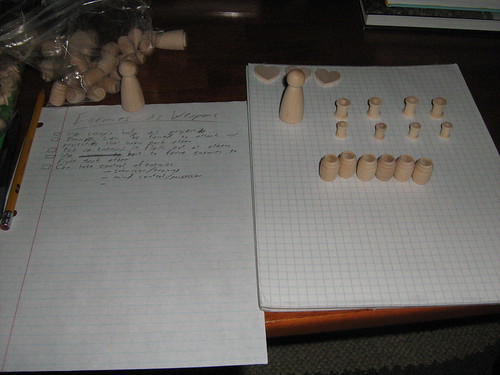
It’s time to prototype some ideas! I have a chance to play with my new barrels and hearts!

Prototyping!

But let’s take a step back and try to come up with some ideas. Assuming you play as the hero in the game, what are the various ways you could use enemies as weapons?

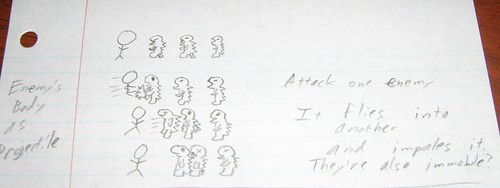
1) You could use the enemy’s body as a projectile. Your attack might send Enemy A flying, but when A hits B, B is hurt. Maybe A is immobile, especially if they are somehow stuck together now, as below:

Enemy's body is a projectile

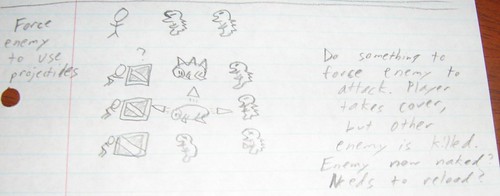
2) You could force the enemy to use its own projectiles, which happen to be damaging to all entities in the game, including other enemies. Somehow, you have to provoke the enemy into attacking. In this example, you can see that the enemy throws out its spines, leaving it naked and vulnerable. It would probably need to head home to reload, and the other enemies in the vicinity were killed.

Force enemy to use projectiles

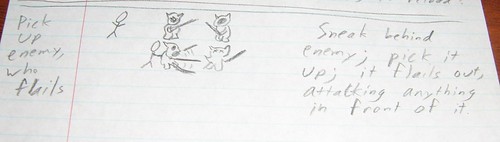
3) You could pick up the enemy, causing it to panic and flail. Until it can get itself free from your grasp, you can move it close to other enemies and let it destroy them.

Pick up enemy and let it flail

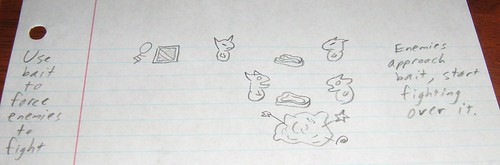
4) You could use bait to lure enemies into combat with each other. When they see the steak in this example, the two enemies can’t help themselves. They love steak! Unfortunately, only one of them can have it, so they end up in a dust cloud. Only one will survive. And get steak.

Force enemies to fight over bait

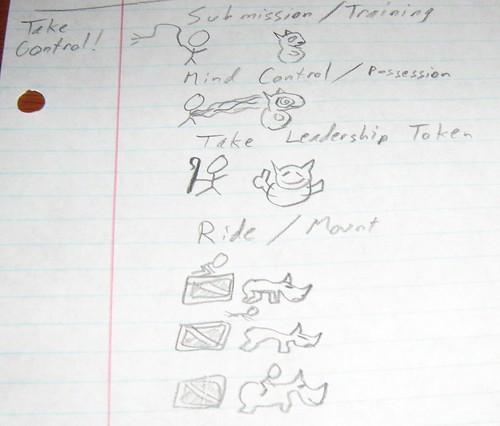
5) You could take control of the enemy in various ways. First, you could attack an enemy, bring it under submission, and train it to fight for you. It’s kind of like a Pokemon or the monsters in Rune Factory, if you’ve played that one. Second, you might have the ability to control an individual enemy’s mind or take possession of it’s body. It’s kind of like the game Space Station Silicon Valley for the N64. Third, maybe the enemies all follow whoever holds a certain token or item, like a wand or staff. If you are in control, now the enemies are yours to command! Fourth, you can find a way to mount and ride an enemy. If you can do so, you can then use it to ram into other enemies.

Take Control

So these are some of the ideas I have running through my head. Even though I’ve been thinking about sending enemies after an AI hero for much longer, I’m starting to like the mechanics listed here. Any thoughts?

Categories
Game Design Game Development Games Geek / Technical

LD18: My Previous Ludum Dare Montage

Ludum Dare Montage

I did five Ludum Dare competitions in a row, starting with LD #11. I missed out on a couple, but now I’m back for #18!

I’m excited! Only a couple more hours to go.