Categories
Game Design Game Development Geek / Technical Linux Game Development Personal Development

LD#13: Breakfast!

I woke up this morning kind of groggy. I had to sleep on the couch because my cats left me a smelly surprise on my bed. I guess they didn’t like being locked out of the office. B-(

It snowed a lot last night. It’s very white out. I need to drop off my laundry at the laundromat, and I also want to go to the pet store to purchase Nature’s Miracle enzyme cleaner. Darn cats.

Anyway, breakfast!

Breakfast #1

I’m afraid I probably won’t do well in the food competition this time around, but we’ll see.

I’ve also been thinking about my project. Perhaps it won’t be a simple puzzle game because then I would need to design puzzles. I was thinking it could be an action game in which you play the role of the getaway car trying to outrun the police, but then I would need decent AI and it might end up being a clone of Pac-man. I’ll think a little bit more about this game.

Categories
Game Design Game Development Geek / Technical Linux Game Development Personal Development

LD#13: Road Lockdown Mock-up

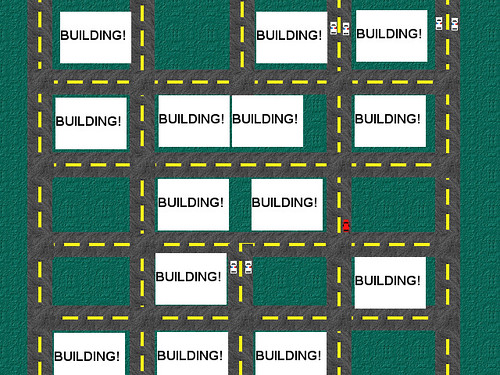
I liked the idea of the police strategically blocking certain roads so that the criminals can’t get away. Road Lockdown is my current name for the project, but it might change. B-)

Road-Mockup.png

From this mock-up, you can see the red getaway car of the criminals as well as the squad cars blocking the roads. I think I’ll keep the road images for the final game, and the cars seem to have come out fairly nice, I think.

I think I’ll go to sleep now. Tomorrow morning I have a lot of coding to do.

Categories
Game Design Game Development Geek / Technical Linux Game Development Personal Development

LD#13 Theme: ROADS

So the theme is Roads. According to the voting results, it was the only one with a positive number of votes overall, and yet the IRC channel is erupting with people surprised that it was the theme that won out.

What are some ideas?
– Building roads between cities to facilitate commerce.
– Managing traffic congestion.
– Planning/Acting on The Road Ahead for your life.
– Maintaining a small town’s roads.
– Transporting materials along a long road.
– Find your way without a map, searching for a lost road.
– Strategically shut down certain roads to guide a getaway car to the police.

There are plenty of ideas, and I’m sure I’ll come up with more.

Categories
Game Design Games Marketing/Business Personal Development

Back from Vacation

Last night I got back from over a week-long vacation. I visited friends in Des Moines, and it was very relaxing, aside from hurting my back and seeing the chiropractor four times. I walked around downtown Des Moines, visited the historic Capitol Building, went to a dueling pianos show, watched a couple of movies, danced at a nightclub, and otherwise had a great time.

Oh, and I learned how to play checkers.

I was in the library and passed the game section. There was a book on playing checkers. I thought, “Ok, I haven’t played that game since I was a kid, and I think I heard someone saying that it is as cerebral as chess. Let’s see why.” Did you know that the official rules of checkers REQUIRES you to jump your opponent’s piece if you can do so? I didn’t know this rule, and when I asked, it seems that most of my friends didn’t either! This one simple rule suddenly makes this otherwise child-friendly game really, really complicated.

Besides trying to figure out ways to make simple games more strategic by forcing moves the way checkers does, I spent a good amount of time figuring out my next move in life. I read a couple of books and articles on life purpose and business and wrote a bunch of notes. I took advantage of my time away from work obligations to think about what I want out of my life. I’ll have more to write about my decisions later, but suffice it to say that I don’t want life to force my hand because it might put me in a suboptimal situation.

It’s my move.

[tags] checkers, life purpose, business, game development [/tags]

Categories
Game Design Game Development Games Marketing/Business

Meaningful Play 2008

Gregg Seelhoff announced that he attended Meaningful Play 2008, an academic conference ” that explores the potential of games to entertain, inform, educate, and persuade in meaningful ways”, and he posted his notes.

  • Day 1: Want some good data on casual gamers and Flash game business models?
  • Day 2: Want some good data on 60+ year-old gamers as well as serious games?
  • Day 3: The wrap up, with some information about a panel on board games.

I’ve been thinking about the kind of games I wanted to make, and rather than create short-term sales product that will be thrown away within a week, I’d like to make games that matter. Games that stick around long after you’ve played them, like a good book or a good movie. I really liked the idea of an entire conference dedicated to meaningful play, and I hope I can attend the next one. There were some good nuggets of information that Gregg managed to report, such as who plays games at Pogo.com and for how long, but I especially liked reading the following on what kinds of serious games received good reviews:

An acceptable game (threshold 1) succeeded in the areas of technical capacity and game design. A good game (threshold 2) passed threshold 1 and, additionally, succeeded with aesthetics, visual and acoustic. For a game to be great (threshold 3), it had to pass both previous thresholds and also succeed in the final two areas of social experience and storyline (“narrativity and character development” is too long). Few games reached the final threshold.

Look at that! A prioritized list of what makes up a good game!

It’s unfortunate when you can’t play games because they are made for specific platforms, especially when there is always this emphasis on the ubiquity of Flash. Many of the games Gregg links to were Windows-specific, and they wouldn’t run in Wine. When so many of these games aren’t even meant to be commercially viable, is it still a valid argument that providing a port to other platforms such as Mac and Gnu/Linux would be pointless since having access to a few hundred thousand more players wouldn’t be worth it?

I would have liked to know more about Ian Bogost’s keynote, but Gregg provided some good notes for most of the rest of the conference. I have more than a few PDFs to download and read through.

[tags] meaningful play, game design, game development, serious games, casual games, conference [/tags]

Categories
Game Design Game Development Games Marketing/Business Personal Development

Now Is the Best Time to Make Games

Jeff Tunnell posts for the first time in a long time about how you shouldn’t fear the economy and should start your game business now. Yes, there is a lot of doom and gloom about how the economy is stagnating and people are worried about paying the bills.

But that just means there are less people willing to take the risk of starting their own businesses! Less competition means more opportunities for your business!

But how do you start? I wrote an article about Forming an LLC in Illinois, and running an LLC is much easier than running an S Corporation. If you don’t know the difference, there are plenty of resources online about the different types of business entities.

I also wrote about what an indie developer needs to know about copyright. Copyright laws can be quite complex, so it pays to know at least SOMETHING about them.

Not sure how to even start making games? I also wrote You Can Make Games, which describes how easy it is to get into game development, and the best part? It has gotten even easier since I wrote that article two years ago! With technology like PopCap’s framework (and TuxCap for people who want to recognize that there are people who use Mac and GNU/Linux), libSDL, and freely available Java and Flash web development tools, there should be nothing to stop someone with a computer, an idea, and a willingness to put some effort behind it from making a game.

There are great articles and other resources for running your game development business at GameDev.net. Advice can be found at the IndieGamer forums.

So what’s stopping you? And for that matter, what’s slowing me down?

[tags] indie, game development, video games, business [/tags]

Categories
Game Design Game Development Games

No Thousander Club Update for Two Weeks?!

These past two weeks have been very unproductive, so there just isn’t anything to report for the Thousander Club. Crunch at the day job isn’t over yet, and since it started getting a bit colder, I haven’t been feeling 100%.

Instead, how about a list of links to interesting indie-related things going on in the world today?

  • Jay Barnson continues writing about his first playthrough of Wizardry 8 in Swimming with Psi Sharks. I enjoy reading his design notes near the end of each post. I really need to break out my copy of the game and catch up to where he is, although Etrian Odyssey 2 does bring back memories of the Proving Grounds of the Mad Overlord.
  • He’s also written an update on the comedy RPG Frayed Knights in Dungeon Scrawls, in which he wrestles with the design of the dungeons so that each one stands out as memorable. I love behind-the-scenes stuff like this!
  • Anthony Salter continues his Let’s Play Starflight! series of videos in Quest for the Cloak. I have been watching him play this game, and it looks like a modern remake might be fun. I wonder how many older games would benefit from a remake that takes advantage of the state of the art in interface design and standardized control schemes.
  • He’s also posted a few updates of his Populous-like game Planitia. He’s added multiplayer capabilities, and there is even a video of it now! Watch Anthony get pwned by his daughter!
  • Cliffski has released Kudos 2! He also wrote about the post-release crush. Work doesn’t stop just because you’ve released your game.
  • Ludum Dare had a miniLD this weekend. The theme was very creative: MSPaint is the best level editor ever. All games made during this weekend have to be able to load the same levels, which are defined in 64×64 BMPs. Imagine a game like Rom Check Fail, only now imagine that a bunch of games can trade level data and they still run! Check out the entries at LudumDare.com!
  • EDIT: I just remembered that Keith Weatherby II has posted video of Hypno-Joe, and it’s looking pretty schnazzy!

What has everyone else been up to?

Categories
Game Design Game Development Games Marketing/Business

Is Casual Mutually Exclusive with Hardcore?

Years ago, Nintendo Power’s 100th issue listed the best 100 games of all time. Besides Mario and Zelda games, Final Fantasy and Dragon Warrior, there was the game listed at #3: Tetris.

I remember that a lot of people complained that there is no way that Tetris could be ranked so highly in such a list. In fact, people still complain when they see Tetris listed very highly in Nintendo Power’s most recent update of the list with the top 200 games.

Tetris is a great game. It was probably the first financially successful game that caused other game developers to say, “Wait, I’m crunching for years at a time, and I could have made THAT?” So why all the animosity? Oh, right. It’s a casual game. It’s too simplistic to be considered among the best.

But is casual really mutually exclusive with hardcore? Are these words really describing two different types of games?

Earlier this year, Corvus wrote that casual games can be identified as such by how forgiving they are. If you only have 5 minutes in your busy schedule to dedicate to a game, you’ll play Bejeweled sooner than you’d play Starcraft. Trying to play Starcraft in 5 minutes would be an exercise in stress management. You can’t just stop when you have to leave, so your choice is to keep playing the map you’re currently on, ruining your schedule, or quit and lose your progress. Bejeweled much more forgiving in this sense.

In this sense the GameBoy game Wario Land 2 was much more casual in nature than many other platformers. In this game, Wario was unkillable, a departure from the typical Mario-based platformers. If you can’t kill or harm Wario, what can you do? Solve puzzles! If you’re not very dexterous, the game doesn’t punish you the way Super Mario Bros would. Again, it’s very forgiving. Contrast Wario Land 2 with Super Mario Sunshine, which gives you a limited number of lives, requires you to restart a level if you fail, and features enemies and obstacles that can kill Mario. Super Mario Sunshine is very punishing. The challenge comes in punishment avoidance.

Contrast Strange Adventures in Infinite Space against Sins of a Solar Empire, two very different games. One lets you play multiple games within a matter of minutes, while the other one requires a much larger time commitment. Actually, if you’ve ever played SAiIS, you’ll know that the game also requires a larger time commitment simply because you won’t notice that an hour has passed and that you’ve played hundreds of sessions. Still, the interface for SAiIS is point and click and dead simple. SoaSE might have a good interface for strategy fans, it’s just hard to fathom someone fresh to video games getting it as easily as they would with SAiIS. And how about the difference in game play? If you lose a space battle or otherwise fail in SAiIS, it’s not so bad. Just start a new game, just like you would if you won. Try again. The sting of defeat isn’t harsh because you probably lost and won many games in the time it took you to read this post. Losing in SoaSE, on the other hand, is a bit more harsh.

So maybe there is a difference between casual and hardcore games, but I still think that there are steps that a game developer can take to make any game more accessible. Developers should take steps to make the complexity more manageable through the interface at the very least. And if your game is punishing the player for taking certain actions or for failing, ask if it is really necessary to punish him/her that badly. Hey, Nintendo! Do we really still need a limit on lives for Mario games?

[tags] indie, casual game, game design [/tags]

Categories
Game Design Game Development Games Marketing/Business

The Complexity of a Casual Game

Since so many people seem to be surprised that Spore, a game that mixes all sorts of game genres into one game, didn’t create the ultimate experience for each of those sub-games, and Will Wright’s recent interview with MTV in which he claims that Spore was meant to be a casual game:

“I’d say that’s quite accurate,” Wright told me. “We were very focused, if anything, on making a game for more casual players. “Spore” has more depth than, let’s say, “The Sims” did. But we looked at the Metacritic scores for “Sims 2?, which was around 90, and something like “Half-Life“, which was 97, and we decided — quite a while back — that we would rather have the Metacritic and sales of “Sims 2? than the Metacritic and sales of “Half-Life.”

And one way of getting there is to present a narrower range of options than a hardcore player might be expecting?

“Yes,” he said. “Part of this, in some sense was: can we teach a “Sims” player to play an RTS [or Real Time Strategy game]? … I think the complexity we ended up with was toward that group.”

So reducing the range of options is one way to make a game more casual, but what options are we talking about? I think there are two ways in which you can look at a game’s complexity: input complexity and rules complexity.

With input complexity, the available interface options are limited. For a complex input scheme, look at NetHack. There is a command for drinking, and one for eating. One for putting on armor, and one for equipping weapons, and one for putting on a ring, and entirely different commands for taking them all off again! Attacking can use any number of commands to kick, throw, fire an arrow, zap a wand, or swinging your weapon. NetHack is definitely NOT a casual game, but look at FastCrawl for a more accessible game. Instead of requiring the player to know every function of every button, key, or icon, you limit the interface. Technically Tetris can be played with three functions: move left, move right, and rotate piece. It’s not a mindless game, though. You can employ various strategies at various stages of the game. There is complexity, but it is hidden behind a simple interface. This combination makes it an accessible game, as the success of the GameBoy with children and adults alike can attest to. For another example of a simple interface, see Fishie Fishie. From the creator’s page:

Yesterday I played a game that had three different buttons for “jump”. Three! I mean, really, what’s happened to the world? How am I supposed to keep an eye on the kids, stay up to date with current affairs, and remember which button to press when I want to esape the toothy maw of an airborne crocodile? In protest I built Fishie Fishie, a game you play using exactly one button.

Rules complexity deals with what’s happening in the game itself. If you’ve ever played the Buffy the Vampire Slayer board game, you know what I mean when it comes to complexity. The interface is simple and familiar enough: roll dice, move players, attack other characters. But then you have to keep track of hit points, goals, who is a vampire when, and yes, the current phase of the moon! And if you’ve never played Dungeons and Dragons, just keep in mind that choosing your character’s class, alignment, feats, skills, and armor is what you do BEFORE you start playing. If you’re playing a cleric, trying to turn the undead will result in moans from the other players since play basically STOPS until you do all the complex calculations to figure out how many ghouls at what strength you turned or destroyed. Now compare these rules to the “0 player” Game of Life. There are only four rules, and yet the ways these rules interact, the dynamics of the game, are rich and complex.

Buffy could have taken a lesson from the card game Fluxx. In Fluxx, the rules change constantly as you play since played cards can add, change, or remove rules. Even though you would think it would be too complex and only appeal to the geeky, in my experience it seems that everyone loves it. I think a key part of it is that the rules aren’t hidden away in a manual but right there on the cards in front of you! You can walk away from the game to get a snack while the rest of the players take their turns, and when you get back you know exactly what the state of the game is just by checking the cards. An otherwise complex game made casually accessible by its interface!

Perhaps Buffy fails to appeal to playing fans not because it is too complex but because this complexity is hard to understand just by looking at the game. Every time you pull the game out of the closet, you have to re-remember the rules before you start, and usually that means someone has to read the instructions, if they still exist. Throughout the game, you have to periodically consult the instructions to clarify what to do in certain situations. With Fluxx, you can just start playing.

So can you make a complicated rule-set accessible by limiting the interface? Can you reduce the rules of the game to a handful and make an otherwise complex game easier to grok? It seems that if the rules are simple, the interface can also be simple, but if the rules are complex, the interface doesn’t have to be. If you believe that reducing complexity is key to making a game more casual-friendly, I believe you can still make otherwise hardcore games more accessible by making the interface intuitive and simple.

[tags] indie, casual game, game design [/tags]
Categories
Game Design Game Development Games Marketing/Business

Indie Business Rules: Relationships and Service

Jay Barnson wrote Business Rules for Indies, in which he tries to apply Jack Welch’s “cardinal rule of business” to indie game developers.

Never let anyone come between you and your customers or your suppliers. Those relationships take too long to develop and are too valuable to lose.

While game portals are a good short term solution for developers who are trying to reach a large number of players and paying customers, they aren’t so good for the long term.

In business, finding a new customer willing to pay for your products is much harder and much more expensive than selling your products to existing customers, who have already shown a willingness to buy from you. But if you sell through a portal, you don’t have a customer. You get paid, but by the portal, as a cut of the sales. If you were to sell directly to your customers, however, you not only get the sale, but also a relationship with your customer.

If you sell a game through a portal for $20, you get paid a small percentage. The portal gets the lion’s share, but of course the portal is the one with all of the traffic and customers, and so you are essentially paying for the chance to sell greater quantities than you could on your own.

If you sell a game directly for $20, you get to keep the income. You might not get as many sales on your own, but what you do get in this situation is customer information. YOU know who is willing to buy the kind of games you make, and so YOU can sell them expansions, sequels, and affiliate products. You can address them in newsletters and tell them about new sales you’re offering. That $20 is just the start of how much that customer might buy from you over the lifetime of your business. You trade short-term financial gain for future profits.

The theory sounds all well and good, but with so much competition out there, how can you hope to get ANY attention unless you’re on a portal? And if you’re on a portal, you aren’t allowed access to customer information, and in some cases you aren’t even allowed to let your customers know who made your game! The portals have become the new form of publishers, which is what being indie was supposed to get you away from.

Dan Cook’s The Casual Games Manifesto addresses all of this and more, but the essence of the article is that you need to develop a relationship with your customers, whether they found you directly or through a portal. Can you integrate your games into a service that YOU and YOU alone provide? Then the portal becomes your access point to customers and not just a distribution channel.

The Casual Games Manifesto got me thinking about specific changes I can make to my business model. If I make one game, and it takes me three months or three years, I have to compete with all of the hundreds of games released in that time. But if I create a game tied to a service I provide, am I competing with the same games anymore? I think what might make such a change hard for indies is that providing a game service requires outsourcing or hiring others to build and manage it. Then again, are you doing this as a hobby that pays a little bit for your pizza and beer, or are you running a serious business?

Either way, don’t feel that you need to let the portals come between you and your customers. If you don’t want them to, you have options.

[tags] indie, business, portal, game development [/tags]