Categories
Game Design

Book Review: Designing Games by Tynan Sylvester

Note: this post was originally published in the March 2014 issue of ASPects, the official newsletter of the Association of Software Professionals.

Designing Games by Tynan Sylvester

Many people have tried to create a comprehensive definition of games but have failed. Most definitions are either insufficient in that certain games are left out, or they are too broad and encompass too much that are not games. In “Designing Games”, Tynan Sylvester writes that games are “an artificial system for generating experiences.” Disney amusement park rides are clearly not games but would be considered such by this definition. It’s obvious he erred with the latter option.

Still, Sylvester’s definition is useful when approaching game design from the point of view of the player. When you tweak a space marine’s jumping ability, what emotion are you trying to provoke? When you insist on having simulated people visible in your simulated city, what is it that you want the player to think? How did the designers change the player experience in Super Mario World by ending levels with a giant gate instead of the flagpole from the original Super Mario Bros?

Much like the principle of Chekov’s Gun says that everything seen or mentioned in a film, play, or story should serve a purpose and everything else should be removed, game design demands that you make decisions in the same way. According to Sylvester, games are made to provoke emotion. As he puts it, “think of a game as a strange kind of machine – an engine of experience.”

The first part of the book is about the nature of games. The author identifies mechanics as the basic rules that define a game, then identifies the interaction of mechanics and play to generate events. A mechanic might be that a player can run. An event is what actually happens, that is, the actual running a player is doing. While most other entertainment media author events directly, events in games occur at the intersection of rules and play.

The key to being a good designer of games is to engineer mechanics that result in meaningful play. Events should be important to the player. He makes the claim that the importance of an event comes from the emotion it provokes. While emotions don’t have to be extreme, they matter. A key skill is identifying subtle emotions.

Sylvester argues that events have emotional relevance when they change the states of values that are important to people. In the game Minecraft, players are attacked at night by creatures, putting them in a state of danger. It is only in building a fortification that a player feels safety. In Lemonade Stand, selling lemonade means a shift from poverty to wealth. In World of Warcraft, joining a guild to fight a major enemy turns strangers into friends.

The greater the emotion, the more significant an event can be. Selling one extra cup of lemonade on a hot day might merely result in a few more cents in your pocket, but selling one extra cup when it means the difference between profit and loss is a huge victory. Some games give you bonuses for doing an event multiple times in a row. For instance, after Pac-Man eats a power pellet, the ghosts turn blue for period of time, and they are edible. Eating a ghost in Pac-Man gives you 200 points, but eating a second ghost gives you 400, a third 800, and a fourth 1600. The event is the same, but each subsequent event has more riding on it.

It’s the combinations of emotions along with the thoughts and decisions of a player that makes up the experience of play. The second part of the book is about how to create a game to generate the general experience you desire for players, the craft of game design. The chapter on elegance focuses on how to create emergent complexity from a few mechanics. Another chapter focuses on skill and how it creates barriers to entry to a game as well as dictate how deep a game is. Tic-Tac-Toe is a solved game for grown-ups while young children might find it a challenge. Chess, on the other hand, seems to have a skill ceiling that is beyond our abilities to master completely. In between we have games that are fascinating until players become bored with them.

The chapter on narrative focuses not on how to craft a good story but on the tools one may use to do so in this interactive medium. A fantastic concept is the idea of apophenia, which is our tendency to see patterns in complex data. I’ve heard of game designers amazed that players attribute malice and tenacity to an enemy that is in actuality programmed to act randomly. Apophenia means that emergent stories can come out of games so long as enough information is there to give players a reason to think. Out of the techniques the author mentions for generating apophenia, my favorite is labeling. Giving two identical monsters the names Poindexter and Grunt might result in a player thinking that one is acting much more intelligently than the other, even if it isn’t the case. There’s also the implied backstory regarding how those creatures were given those names. Labeling can also apply to attributes as well. It’s similar to writing a novel and describing a character as ravishingly gorgeous. Rather than actually write details about how someone is attractive that may or may not appeal to a reader, the reader’s imagination fills in the blanks, resulting in a richer and more entertaining story even though you actually provided less.

There are also chapters on decisions, balance, multiplayer design, motivation and fulfillment, and a game’s interface. I really appreciated the chapter on the market. “Every design decision is affected by the purpose the game was created to serve”, whether it is getting someone to buy a commercial game or walk away with deep thoughts after playing an art game. The entire chapter is about understanding the market you are creating a game for, and it is one of the biggest gaps in most books in game design. I’m pleased it was addressed quite well in this book, providing tools such as positioning and value curves, and explaining market segments, while also reminding the reader that models are imperfect.

For example, no one could predict that StarCraft would become a cultural phenomenon in South Korea. It was the result of a confluence of the popularity of Internet cafes, recent investments in broadband infrastructure, a recession that provided incentive for inexpensive entertainment, and TV channels dedicated to the boardgame Go that made broadcasting professional StarCraft matches a logical conclusion. Another example is The Sims, the greatest selling PC game of all time. It created its own market after struggling to get buy-in from the publisher. Existing models gave no indication that a video game about playing house would be so popular.

The third part of the book focuses on the process. Game design is geared towards the creation of a game, which is a major project. Planning such a project is much like planning a software project: sometimes we don’t know what we want until we see it working, or not working, in front of us. Playtesting is needed when tweaking mechanics or introducing and removing others entirely because it is only through play that a designer can understand the experiences being generated by the changes. Planning becomes difficult as a result, but planning can’t be ignored.

Iteration is the key, and Sylvester borrows ideas from Eric Ries’ “The Lean Startup”. We have uncertainty at every step in designing a game, so we conduct experiments to resolve the uncertainty. The steps are to plan, build, and test, and you do so to get back information about what works, what causes confusion, what problems might exist, and more. The book explains how to conduct playtesting, and it dedicates another chapter to ways to generate the designs to test in the first place.

I learned quite a bit from the chapter on dependencies, an understanding of which can help mitigate the risk that comes with creating a game. By identifying how various aspects of a game design are interrelated and dependent, we can create a graph called a dependency stack. The dependency stack informs us what aspects of a design to focus on implementing first. If goblin raids only make sense if there are castles to raid, you want to focus on the castle-building aspects of the design first. What’s more, a change in the implementation of castle-building would likely cascade to changing how goblin raids work, so a dependency stack also provides information about the risks associated with change. The biggest benefit it can provide is helping the designer identify the core game play, the minimum mechanics at the bottom of the stack that provide the meaning and experience desired.

There are some sections on management, teamwork, workplace politics, and handling incentives to work on a project. While these are all covered quite well in entire books on their own, Sylvester touches on them as a warning to aspiring game developers: recognize that game development is hard.

There’s a way to make it less difficult though. The last chapter focuses on the importance of the values that a game designer has. “I don’t think anyone can prescribe the best values for all designers. I do, however, think that every designer could benefit from thinking about what values they believe in. Because values keep us steady. They are immutable standards that stabilize us against the political and emotional turmoil of daily design work.”

Between this chapter and the one on understanding the market, Sylvester demonstrates his understanding that games don’t get designed in a vacuum. Too many game developers throw something together and put it out without any thought to why. The recent news about Flappy Bird’s creator taking down the highly profitable app because it brought him too much attention highlights the importance of knowing what you are getting yourself into when designing a game.

While I found some of the concepts in the book have been mentioned elsewhere, such as Jesse Schell’s “The Art of Game Design”, and I wish Sylvester would have touched on concepts such as the Mechanics-Dynamics-Aesthetics (MDA) model, I would highly recommend “Designing Games” for its comprehensive treatment of game design. I know I have quite a few new tools I want to wield at my own projects.
Categories
Game Design Game Development

Accessibility and Inclusion in Games: #AccessibilityJam Starts This Weekend

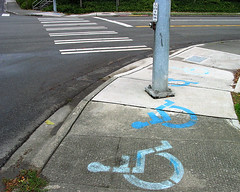
Access for skinny wheelchairs only

I just learned about Accessibility Jam, which is running from May 11th through June 1st.

The goal of this jam is to raise awareness, giving developers knowledge and experience of how to make mainstream video games accessible to gamers with disabilities, to provide good examples of what’s possible, and move accessibility towards being widely accepted good practice in the game design process.

The idea isn’t to make niche games that cater specifically to gamers with disabilities. The jam is meant to raise awareness and increase the accessibility of the kinds of games that are already being made.

I’ve written in the past on designing games to account for color-blindness. I recalled a beta test for a game in which one person complained about how hard it was to see the green vehicle on the green grass. This complaint confused me at first because the vehicle in question was blue. I eventually changed it to look significantly more interesting and give it a different color. Without that beta test, I would have inadvertently ignored a significant chunk of my audience.

Ok, so you can easily accommodate a color-blind player by using more than color to differentiate important aspects of your UI. You just need to be conscious about it and know about the tools of shape and size.

But what about players with other vision impairments, including those who have difficulties with reading? Or people who have hearing, cognitive, or motor impairments? Accessibility is a big topic, and you can’t possibly be expected to spend the time and effort here when you are trying to focus your attention on making the best game you can, right?

Well, the jam provides some awesome accessibility resources and tips, which features a number of useful links, such as the Includification Guide provided by the AbleGamers Foundation. This PDF is only a little less than 50 pages and offers practical checklists, advice, and examples, as well as numbers to indicate that there is a significant market you can reach with your efforts in accessibility.

Another link is Game Accessibility Guidelines, “a straightforward reference for inclusive game design” broken into basic, intermediate, and advanced topics. This site is a treasure-trove of information, and more importantly, it shows how easy it is to address accessibility. Basic considerations include using easy-to-read fonts and font sizes, especially as reinforcement of audio cues. Such a small effort means not just a more accessible game but a better game for everyone.

An example of an intermediate consideration is providing options in game speeds. Offering game speed configuration and the ability to prepare actions while the game is paused are some easy ways to assist those with motor and cognitive impairments. As a side-effect, it means accommodating people with different preferred play styles.

Once while demonstrating my casual real-time strategy game, Stop That Hero!, to someone, he requested that I add a game speed slider. While I’ve had requests for a way to increase speed when you just want to get your orcs across the map quickly to see what happens, this player wanted something more like a turn-based game.

Pausing the game but still allowing player interaction meant that he could take his time to make decisions about what minions to summon and where to summon them. I’m afraid I never got to that feature before I put the game on the back-burner, and while I initially didn’t like it as I thought it might ruin the feel of the game I was creating, I have since realized that allowing players to enjoy the game at their own pace allows for a much better experience for more players. That it means the game would be much more accessible to people who might not otherwise be able to enjoy the game is an exciting prospect.

So, are you planning on participating in Accessibility Jam? It sounds like a great opportunity to learn and practice ways to make your game more playable by a wider audience.

(Photo: https://www.flickr.com/photos/drdul/210641686 | CC-BY-SA-2.0)

Categories
Game Design

Avoiding Player Elimination in Game Design

Dr. Lewis Pulsipher, author of Game Design: How to Create Video and Tabletop Games, Start to Finish and creator of the strategy boardgame Britannia, has a YouTube channel on Game Design, currently with over 20 videos on topics such as tabletop game history, level design, and content creation. A number of these videos are meant to be part of a game design course Pulsipher teaches.

In Avoiding Player Elimination in Game Design, he talks about ways to keep people playing throughout a game instead of feeling that it is hopeless to continue if they are too far behind.

In the above video, he focuses heavily on war games, but he touches on a simple idea for keeping non-conflict games relevant throughout the play session: providing escalating values and rewards. You can see this effect at play in some Eurogames.

Mario Party games tend to incorporate this idea, too. Even if you’re losing, you might get bonus stars in the end to keep you competitive.

The rest of the video is a fascinating bite-size nugget of game design thoughts, and I wish there was more to the discussion.

What are you favorite game design videos on YouTube?

Categories
Game Design Game Development

Game Design Pro Tip: Don’t Ban Specific Activities

Fishing ban!

In Ban the ban: essential game design advice (with examples), Nick Bentley talks about the cognitive dissonance of establishing rules and then creating special “but you can’t do X” rules to prevent problems.

Why do such rules exist? The most common reason is, during play-testing, the designer discovered players want to take an action that would hurt the experience – for example, a too-powerful action every player would take every turn if allowed. The most obvious fix is to ban it.

He then goes on to explain how doing the most obvious fix is a bad solution.

Banning otherwise-expected actions means the rules become harder to learn and the game play itself becomes awkward as you are constantly checking your planned actions against the rules.

Bentley’s post is a fascinating bit of insight into how a design problem can turn into a design success. By not banning actions, you have to allow for them. The entire point of banning a move is because it is unbalanced or otherwise ruins the game, so how do you allow it without the game suffering?

Interestingly enough, the answer can sometimes mean a much deeper and more compelling game.

Basically, take the action that you deem is too strong and assign a huge cost to it.

Bentley gives a couple of examples and a counter-example to see when it makes sense to include a ban, but the result is a choice that makes sense within the rules and can sometimes result in a more strategic game.

While Bentley is talking about boardgames, you can see how it would be applied to video games.

For example, if your game has inventory, you could limit the amount that could be carried. If a player with a full inventory comes across some new loot, the choice is to get rid of something to carry the new thing or not pick it up. Think Diablo or Minecraft.

NetHack, however, allows you to carry whatever you want, but it balances it with an encumbrance penalty. The penalties get more and more severe as you collect more things. You start off with penalties to speed and attack ability. If you carry too much, the penalties include not being able to walk up or down stairs, getting hungry faster. Carry even more, and you start taking damage for each move you take, and eventually you can get to the point where you can’t move at all.

Instead of arbitrarily deciding that a player can’t carry that much inventory, you turn it into a strategic choice. Do you want to struggle to carry all of the groceries from the car into your apartment so you can do it in one trip, or are you going to make multiple trips so it is easier?

You can see how this method of balance would apply in terms of limits on the number of units in a real-time strategy game. Some games add an upkeep cost which increases after you add so many units. Now I can choose to have too many units in my army temporarily if I’m willing to pay the cost, say for a large offensive push or to defend against the same.

“You can’t perform this quest. You don’t have a sufficient experience level.” No, by all means, try to perform the quest, but it is going to be incredibly punishing. The balance is already built in here!

Sometimes limits are technical in nature, such as the number of units you can have in your army at once. Still, you can see how allowing the player to decide if a decision is a poor one or a good one despite the cost means a deeper play experience than it would have been if you were limiting things arbitrarily.

(Photo: https://www.flickr.com/photos/jo-h/6009234100 | CC-BY-2.0)

Categories
Game Design Game Development Geek / Technical

Explore Game Mechanics Interactively At This New Site

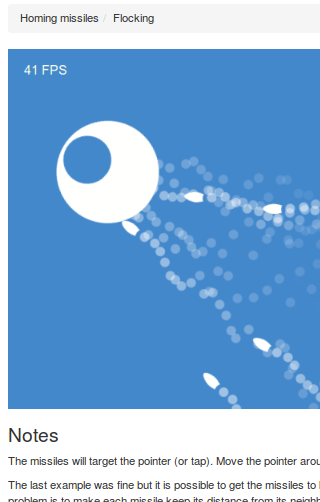
Flocking on GameMechanicExplorer.com

If you’re new to game development, or even if you are a veteran making a game of a type you’ve never made before, you might find yourself doing research on how to best implement the mechanics. Whether it is figuring out how best to implement ballistics or how to move a rocket ship, it’s not just the math but the approach you might be looking for.

For instance, last year I made a Frog and Flies clone called Hungry Frogs for One Game a Month. I remember spending quite a bit of time on the jumping mechanic as this was the closest I’ve ever come to implementing a platformer. In the end I wasn’t completely happy with what I had. My main complaint was that it wasn’t easy for me to identify the maximum height of the frog’s jump without tweaking variables and seeing what happens. But considering the few hours I spent on it, I delivered something that worked well enough.

Still, if GameMechanicExplorer.com had been around then, it would have saved me some time.

The site offers you a list of common game mechanics, each of which has at least a handful of examples with an in-browser demo and a JavaScript code example written using the Phaser framework.

Each example focuses on one concept and includes the source code for the implementation. They aren’t meant to be extremely polished or to represent a complete game. They aren’t highly optimized. They may not even be the best way to implement the mechanic being demonstrated! (They’re certainly not the only way.) They are written for clarity so that it is easier to understand the underlying concepts and apply them to your own work in your own engine. I expect that some of these examples will evolve as I gain experience. But hopefully you’ll find them useful and you can use them as a jumping off point for your own games.

At the time I am writing, there are examples for bullets, spaceship movement, following, homing missiles, raycasting, lighting, effects, easing movement, and even walking and jumping.

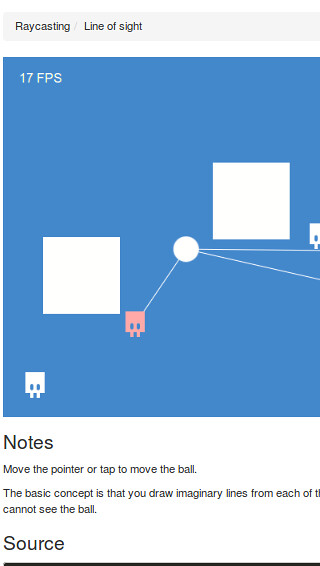
Line-Of-Sight on GameMechanicExplorer.com

The walking and jumping examples start out by showing you the naive approach, which has the on-screen character either stationary or moving at full speed. It’s functional, but it doesn’t feel right. The next example introduces the concept of acceleration to make the movement smoother, but it identifies a problem that is introduced. The next example introduces the concept of drag.

The next few examples take you through basic jumping mechanics, including double jumps and variable jump heights, the latter of which I needed for my hungry frog game.

I enjoyed spending time exploring different mechanics, such as seeing how various easing functions compare to each other, or how to use raycasting to do line-of-sight checks. I remember someone once posted a comparison of jumping mechanics of Mario, Meat Boy, and Mega Man among others, but I can’t find it today. GameMechanicExplorer.com is filling that void nicely.

I’m looking forward to seeing the implementation of some of the upcoming mechanics, including camera controls and the advanced platformer ones.

John Watson, you have provided aspiring game developers a great service.

Categories
Game Design Game Development

The Indie Interview Series

Interview recording equipment

During the last half of 2013, Ben W. Savage conducted The Indie Interview Series “to inspire those who are considering game development” as well as those game developers looking for practical advice.

He asked the same series of questions of everyone, and prominent indies such as Christer “McFunkypants” Kaitila and Chevy Ray “Chevy Ray” Johnston spent anywhere from five minutes to a quarter of an hour answering. The topics ranged from how to get started in the game industry to who were major influences and what are major mistakes new developers make.

Adam “Atomic” Saltsman, creator of Candabalt, suggests that taking too big of a bite is a common problem. “Learning how to do a project is its own discipline … Start small, learn about the process, and then refine. That’s the key.” Nina “[insert nickname here]” Freeman of Code Liberation Foundation agrees in her own answer to the same question, repeating “simple prototypes, simple prototypes, simple prototypes” and suggests working in steps.

These are bite-sized nuggets of wisdom, and I wish there were more.

What’s your favorite interview? Did any of the answers resonate with you?

(Photo: https://www.flickr.com/photos/39781145@N00/254759786 | CC BY 2.0)

Categories
Game Design Games Marketing/Business

A Shameful Game Backlog, or a Glorious Library?

Last week, cliffski once again went on the offensive against the trend of selling games at deeply discounted prices. In We Need to Talk About Unplayed Games, he argued that the constant sales of games results in bad news for everyone.

People buy games based on almost nothing but a screenshot and a low price in an almost Pavlovian response to the announcement of a deep discount. They don’t even play the games, which sit on hard drives and rarely get considered. In fact, some people buy the games over and over again simply because they are in bundles with other games or they forgot that they already purchased them.

The results? Players Game buyers don’t value quality, the organizers of sales become gatekeepers, and the games themselves are devalued. If developers optimize for results, what role does game development have? Most players won’t see even a small percentage of the actual game, so why focus there? It’s similar to the concerns about narrative in games: if people don’t finish them and never see the story play out to completion, then why invest so much on game writing and elaborate plots in the first place?

It becomes less about the games themselves. People buy into the deep discount, no matter what is being offered, and for what? A backlog of games they ignore? That’s terrible!

Or is it? Ben Kuchera thinks otherwise in Your stack of shame is a lantern for your future, and a gift to the industry:

We respect people with large libraries of books, but we tend to look down on people with shelves and shelves of games.

Oof. When you put it that way, yeah. I suppose when I look at my shelves, I see books I haven’t read yet, as well as games that I obtained partially because they weren’t at full price. I have a copy of Civilization III still in shrink wrap when I found it at the store for only $15. Two incarnations of the series have since been released. I also have a number of Neal Stephenson books that are waiting for me to read them.

Kuchera’s argues that even if you don’t play the games now, what you are doing is sending a message to the developers and the industry about what kinds of games you want to support.

On the topic of sales, both cliffski and Kuchera agree. They work. To illustrate, I was at a party recently talking about these posts (I’m a pretty wild and crazy guy!), and a colleague told me that you don’t have to look further than JCPenny to see what happens when you buck the trend there.

In early 2012, JCPenny changed its pricing strategy. Instead of markups and sales, there would be “every day” prices.

Late last year, the company announced it was reversing the decision, citing dismal sales figures.

So, JCPenny discovers the hard way that despite the logic that a low price is a low price, there is some psychology to a sale price, to the idea of getting a bargain. Now we get to benefit from that information.

But Kuchera says the biggest benefit is that increasing your catalog of games is good for you.

Maybe you’re not ready for the pace of a game like Gone Home today, but you can never tell when the game will satisfy an itch you don’t know you had. Buying games on sale allows us to browse our own selections, be surprised at something we had forgotten we had bought, and find that finally, we’re ready for that game.

I can relate. When I was a child and had no way to earn money but a weekly allowance, I would save my money for months in order to go to Toys R Us and browse the game selection. One time, I picked up Wizardry: Proving Grounds of the Mad Overlord. I might have been 10 years old at the time. I had no idea what the game was, but the back of the box had illustrations of dragons, knights, and skeletons. COOL!

I tried to play it, but I couldn’t figure it out. I mean, I understood the mechanics of walking around the first-person maze, entering selections to fight, and casting spells. But I had no idea what I was doing. I would fight incredibly tough enemies and have a total party kill before I knew what happened. It was too much, and the game wasn’t what I expected at all.

It was a few years later when I pulled it out of my collection of games to try it out again, and my more mature self was able to grok it way better. Oh, I have to map out the maze I’m exploring! I need to make sure that I gain experience and skills and purchase good equipment before venturing too far into it. It all clicked. It all made sense. I wasn’t ready to play the game when I bought it, but I’m glad I did all those years ago because the Wizardry series became one of my favorites.

I appreciate what cliffski is concerned about. It would be nice if when a new piece of entertainment is released that everyone played it together. Around 10 years ago, I bought Total Annihilation and Homeworld: Cataclysm due to the recommendations of a friend, both times years after the games had come out. Cavedog’s Boneyards and Sierra’s WON.net were mostly empty before eventually being shutdown entirely, but I was told that they used to be filled with active gamers ready for your challenge. Had I bought the games on release, I might have experienced it, but as I was late to the party, I missed out.

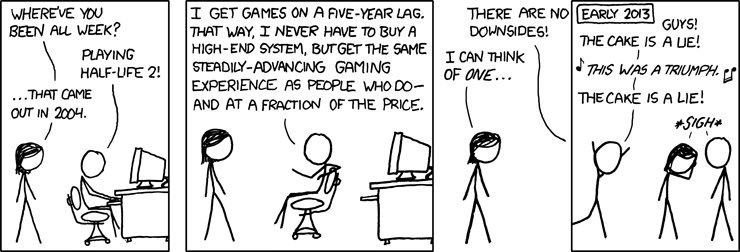
It’s captured perfectly in this xkcd comic.

The alt-text: “I remember trying to log in to the original Command and Conquer servers a year or two back and feeling like I was knocking on the boarded-up gates of a ghost town.”

Similarly, the Steve Jobs biography that was all the rage a couple of years ago? The local library had a high double-digit long waiting list. I never ended up reading it, although I still want to. But when I do finally get to read it, it would have been years after the book was topical. Am I similarly missing out by reading it so much later than everyone else?

Or isn’t that the point of books, that they are there for me to read whenever I feel like it?

And so it is with games. For years, I’ve always wondered how people can be so comfortable selling their old games to get credit towards the purchase of new games. I, on the other hand, still have my Atari 2600. I still have my NES, SNES, N64, and original Game Boy. Despite being able to play any Gamecube games on the Wii, I still have my Gamecube.

But more important than my inclination to keep consoles beyond the point that might be reasonable, I still have the games I bought for those systems. I’m still unhappy with the discovery that my father gave away the Apple II c+ from my childhood to his coworker, which means I lost my copies of Troll’s Tale, Snooper Troops, Below the Root, Bill Budge’s Pinball Construction Set, and other games. Some of them were beyond my capabilities at the time, but I’d be ready for them today.

But being able to pull out my older consoles and play games from almost two decades ago is a capability I enjoy having.

I currently have two large six-shelf bookcases in my office filled with books. I have a computer rack with a few shelves taken up by CD cases for computer games. In the living room are the console games. In another room is a set of shelves filled with boardgames and card games.

I used to fantasize about having an entire room of a house dedicated to being a library, with books and games stored from floor to ceiling.

Video games these days end up being in the cloud. I have 30 games across 7 virtual shelves on GOG.com, quite a few Humble Bundle bundles, and a few games in Steam. If not you then people you know have much larger catalogs of games stored as bits on a server.

It’s not as tactile, but we still enjoy having those collections to pick up and play whenever we allow ourselves to do so.

What I am not sure we’re seeing is a change in the game design efforts of developers, which is I think cliffski’s biggest concern. While some developers put out buggy and shoddy games, I don’t think they last long. Even if most games don’t get played, I don’t think a pretty screenshot and a sale is enough to get people to reward the developer. Reputation still matters.

How do you feel about your backlog? What impact, if any, do you believe the constant sales and discounts has on game design and the efforts of a developer?

Categories
Game Design

On Game Narrative, Again

Dan Cox said the following in reply to my recent post Plot Ignored + Unfinished Games = Useless Effort?

I’m fearful that the take-away for many developers will be to not attempt much of a story now. If people can’t remember their favorite game’s story, would go the logic, there’s not much of a reason to try at all.

Of course, I would argue that the problem is not that any particular game’s story is memorable or not, but more that, in general, they aren’t very good. Some are, sure, but way too many AAA games have very little story.

I imagine that there will be some industrial momentum that will keep writers employed in the game industry for some time.

That said, frankly, I think it’s difficult to make a good game with a fully authored story.

In game design, there’s the concept of meaningful play. If you give the player agency, then the player should expect to be able to express it. If you are trying to enforce a specific story, however, then that agency is an illusion. No matter what action the player takes, it won’t affect the story in any meaningful way, which reduces the quality of the game.

At the extreme, you have “press button to turn the page” kinds of games. Years ago, a friend of mine was excited to find a cheat code that allowed him to instantly finish missions of Star Trek: Armada because he just wanted to see the story. To him, he wasn’t playing a game, and in fact the game seemed to be an obstacle to his enjoyment of the narrative. He would have been happier if it was a a movie or new episode of Star Trek.

But many gamers want their actions to matter. So then you have games that allow you to go through XYZ branches of a story, where XYZ isn’t unlimited but is in fact quite limited, relatively speaking. But, hey, your choices affect the story!

I’ll admit to loving Wing Commander for its branching storylines. If you did poorly in a mission, you didn’t retry it until you got it right. If you survived, you kept going, and your ability to escort a supply ship or strike at a key base affected the war effort.

My favorite moment from the game, in fact, was the final mission in the branch of the story where the Tiger’s Claw is being forced out of the sector by the overwhelming Kilrathi. You were tasked with fighting off the enemy while the Tiger’s Claw slowly makes its way to the jump point to safety…and it was made clear that if you aren’t on the carrier when it leaves, you’re stranded. Everything I’ve failed to do throughout the game comes to mind as I realize that this is my last chance at doing something well.

Still, as enjoyable as the story was in that game, it was limited. There are only so many branches, scenarios, and missions.

And then you have games with no inherit story, yet the stories they generate can arguably be the most memorable. I have posted stories that were generated by the playing of NetHack plenty of times. And I’m overdue for one. B-)

Over half a decade ago (!!!), I wrote about the importance of stories:

In general, I suppose stories are important for games. I just think that they don’t necessarily have to be dictated from within the game. There is nothing wrong with games that tell a story, but games that do tell stories shouldn’t let the story get in the way of the game. Some people might prefer games that let them figure out their own stories. When I play Flatspace, I like to be a trader, but I like to hunt pirates as well. I don’t have to fight the pirates, but I’m just taking the law into my own hands, hoping to get my hands on the pirate who destroyed my life in my made-up past. There is no actual support for the story in the game, but there isn’t anything that gets in the way of that story, either. I enjoy the act of creation, even if it is only in my mind.

Amazingly, I still agree with my past self. The more games have fully authored stories, the less game-like I think they can be because authored story demands less meaningful game play. I don’t think there is anything inherently wrong with such games. They are wildly popular and have an audience, so it isn’t hurting them.

But when I play games, I’m not as interested in someone else telling me what my experience will be. My experience is my story, which gets generated during play. The more a game allows me to craft my own story, the more I think it is leveraging the strengths it inherently has. Minecraft allows so much story to be generated out of the interaction of play and mechanics, for instance. The Last of Us, on the other hand, only allows so much.

Games are meant to allow players meaningful interactions within a play area. While the game design can guide a player towards moods, ideas, and concepts, the story should be the player’s to generate. Otherwise, the meaning of play is nothing more than what the player needs to do to watch the rest of the movie that’s marketed as a game.

Categories
Game Design

Plot Ignored + Unfinished Games = Useless Effort?

Each time I logged into Twitter this week, I’m reminded that I’m not at GDC.

Thanks go to each of you who post about what’s happening. I live vicariously through you.

As for what’s happening, a colleague forwarded this article that covered the talk “Death to the Three Act-Structure” which mentions research by Microsoft that claims players can’t remember the plots of games.

Combine this information with the statistics that show most gamers don’t finish the games they play, and you can imagine how futile it feels to be a game developer trying to create a very intricate interactive story.

Of course, there has been a number of people pointing out that making games is not the same as making movies or books. The more you try to make your game like those other media, the less you rely on the strengths of games.

Games are less about specific details of plot and narrative and more about the experience the player has. You can guide it, you can influence it, but you can’t author it.

It’s 2014, and it sounds like people are finally figuring out that writing for games isn’t the same as writing a novel.

What was your takeaway from the talk?

Categories
Game Design Game Development Games Linux Game Development

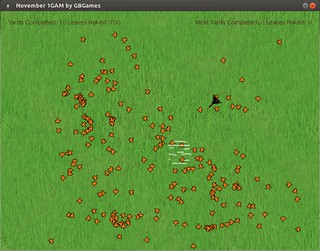
November #1GAM Entry: Raking Leaves

November’s One Game a Month entry is uncreatively-named Raking Leaves, a leaf raking simulator chock full of leaf-raking action!

Download Raking Leaves for Linux 64-bit (1.2 MB tar.gz file)

The object of the game is to rake all of the leaves into a single pile. The wind will blow the leaves around, however, and if you lose too many leaves off of your lawn, the game is over.

I had a lot going on this month, and so I didn’t dedicate a lot of time to making a game. Still, I wanted to make something for #1GAM. What could I make?

I recently bought a house, and with home ownership comes the oh-so-fun task of raking leaves. I decided to make a game out of that experience, and raking leaves is usually done in the Fall, which goes along with the optional theme of “Change”, so it was a perfect concept.

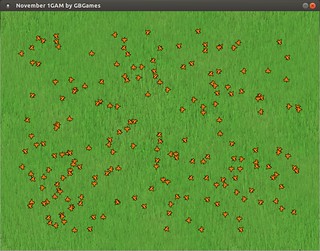
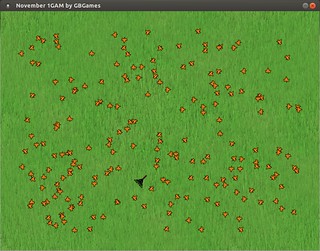
I started out making leaves and randomly throwing them about the yard.

November #1GAM

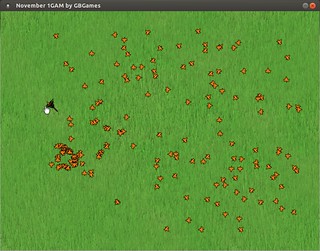
I then added a rake, which replaces the mouse cursor:

November #1GAM

I wanted to capture the frustration of raking leaves, and so when you click and move the rake, the leaves will move, albeit a bit slower than the rake. This means you have to go rake the same leaves over and over to move them a long distance. I was pleased that it was working as well as I had planned.

November #1GAM

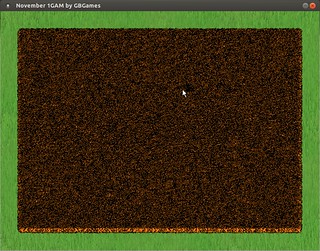
I had some funny bugs, such as this accident which features the level resetting over and over, except it wouldn’t reset the number of leaves but merely add to them. It looks like a giant set of orange hedges.

November #1GAM

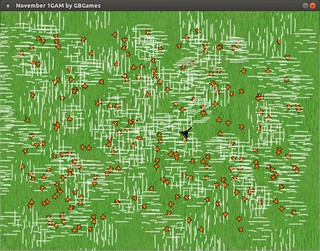
Another funny moment was after I added wind. I wanted early levels be less windy, while later levels would get more wind. Here is what it looks like to rake in a hurricane:

November #1GAM

Wind affects leaves in a radius around it, and the farther away the leaves are from the center of the wind, the less of an impact the wind will have. It works very well, but out of curiosity, I set the level to 1,100, which has over 20,000 leaves in it and has winds every second. It resulted in some cool visual effects, as you can see in this video:

Eventually I think I achieved a good balance, complete with a scoring system to let you know how well you’ve done compared to your best raking.

November #1GAM

Considering I worked less than seven hours on this project, I’m pleased with what I came up with. I had plans for rocks, bushes, trees, and other obstacles, as well as a child running around jumping into your pile and scattering the leaves. Having sound would help, too, but for now, I think I’ve got one of the best games about raking leaves out there.