Categories
Game Development Personal Development

Thousander Club Update: August 24th

For this week’s Thousander Club update:

Game Hours: 576 (previous three years) + 160.75 (current year) = 736.75 / 1000
Game Ideas: 775 (previous three years) + 10 (current year) = 785 / 1000

This past week I mostly worked on my Game Design Concepts design project, and using my new prototyping materials really helps in speeding up the play tests, allowing me to quickly discard mechanics that I find aren’t fun.

[tags]game, game design, productivity, personal development, video game development, indie[/tags]

Categories
Game Design Games Geek / Technical

Game Design Prototyping Awesomeness!

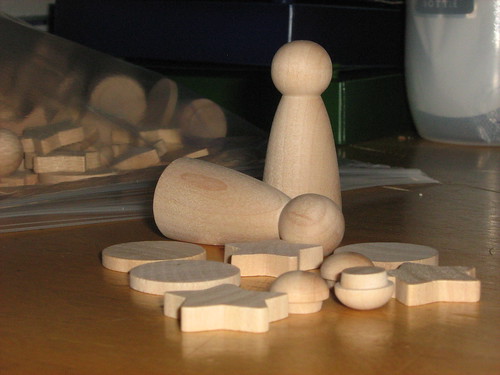
Recently I went to a craft and hobby store, which was too glittery for my tastes, but it was for a good reason. I wanted to buy these:

Prototyping materials

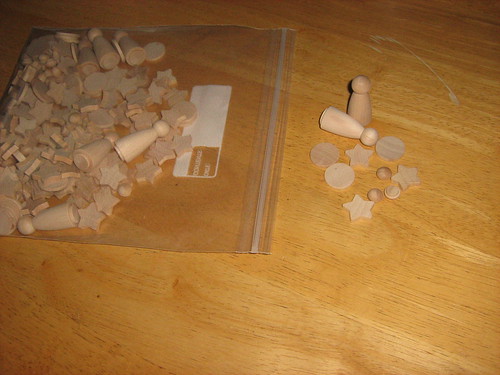
You can get a better sense of scale here:

Prototyping materials

If you’re looking for items online or at a store, the circles and stars are just flat pieces by the appropriate name. The tall board game avatars are called doll pins. The mushroomy pieces are furniture plugs. Since I purchased so many of each type, the total price came out to less than $40. It’s very likely that I paid too much for them, or that I bought too many, but as you can see, I have an entire bag of these items. Why?

In the Game Design Concepts course that I’m taking online, there was a post early on about creating a prototyping kit. After messing around with paper cutouts which blow away too easily or stones from a wedding centerpiece which are a bit dirty to hold (sitting in water that evaporated years ago will result in that), I decided I wanted some hardier stuff. These pieces can be used as various tokens for game prototypes.

In my design project for the class, I’m doing a high school reunion game, and on paper I had rules about earning prestige points by accomplishing various goals. Initially I marked these points as stars that I drew with a pen, but now I have star pieces which are more tangible. You get 4 prestige points? Here are 4 star-shaped wooden pieces that have a decent weight to them and feel nice.

I bought 8 doll pins. They come in packs of two, and I was originally going to get 2 packs when I thought, “What if I want to do something massively multiplayer?” B-)

The furniture plugs just looked cool. I could see placing them on spaces to indicate that there are traps or coins available.

And if I feel so inclined, I could always paint each item various colors.

If you would rather have a ready-made kit, check out the Piecepack, or if you’re looking for awesome craft parts for your own custom kit, look at CraftParts.com. And of course, you can probably find such items at any local craft/hobby store.

Categories
Game Design Game Development Games Geek / Technical Marketing/Business

Plants vs Zombies Developer Interview

In my post on Plants vs Zombies, I was lucky enough to have one of the people deeply involved in the production of the game answer some of the questions I had about the design process and behind-the-scenes work. I have been waiting for an in-depth interview with George Fan, the designer and creator of the game.

GeneralGames.ca’s interview with George Fan is a short one, and it isn’t as in-depth as I would like, but Fan does answer some questions about how the game came about.

In other interviews, he has said that he was innovating on the tower defense genre, mainly by improving the accessibility.

My goal was to take the tower defense standards and simplify them down to the point that almost anyone could pick up and play. With that in mind, I kept the playfield small and removed some of the things found in traditional tower defense that might not be as intuitive.

He mentions the humor aspect being a big focus as well.

There’s no word on whether or not a sequel to the game is in the works, but Plants vs Zombies is being ported to other platforms, including XBLA.

Categories
General

The Business Model of Selling Linux Games

I’ve been enjoying the visibility into Linux Game Publishing’s business at the LGP blog. The author is the CEO and Head of Development Michael Simms, and he is very accessible, responding to comments and listening to suggestions. Before his blog was launched, I remember seeing him on IRC regularly in Linux game-related channels.

Months ago, there was a post explaining why Linux games cost as much as they do. If you’re not familiar with Linux ports of popular games, you’d possibly be surprised that they cost as much as a new game…even though the original version of the game on Windows might cost half as much since it has been out for months or years! The basic argument: even if a game has has been out for some time on Windows, it’s new to Linux, and it costs LGP money to port the game in the first place.

At the suggestion of some commenters, he did a one day sale in which prices for most games were lowered. The sale results indicated that while the short term sales increase looked promising, the long term sales stayed flat with less revenue, not more.

But another thing LGP has done at the request of customers is offer downloadable games, including a rental option at a “ridiculously lower price”.

Most recently, there was the question of why LGP can’t simply provide the Linux version for free to people who purchased the Windows version. It’s a legitimate question, especially when companies such as id Software are providing free binaries for all platforms to people who purchased a game. I have a copy of the Linux port of Quake 3 Arena, and I know I can run it on Windows without paying for a second copy. I mention this example a lot, but I know one person who was told that she couldn’t play The Sims and all of the expansions she purchased on her new Mac because EA outsourced the Mac port of the game to another company, and that company was handling sales of the Mac port.

It’s a business model that works for EA, but not necessarily for the customer. And it’s the same with LGP.

As a customer, I prefer being able to buy a game once and play it anywhere I want. Windows, Mac, and Linux. The game is the same. Now, it could be said that I’m arguing that Xbox 360 or PS3 ports of the same game should also be available to me for free after purchasing the same game on my computer, but I’m not. In fact, 360 or PS3 games usually have some exclusive content, making it a different game in some way.

In any case, the argument for the business model is basically the same as the argument for Linux game pricing: you’re paying for convenience, and it costs money to give you that convenience. There is one additional point that Michael Simms made: companies like EA don’t care about Linux, and so the business model I’d prefer is just not going to happen.

Which is too bad. It’s why I find that I don’t purchase many games these days. If I find anything that interests me, I remember that it’s not available for Linux. Instead of supporting those games, I could spend my money on a game that is actually supported where I want to play it. Starcraft 2? Yeah, call me when it runs in Wine. Maybe. I might want to play a different game by then, one that is natively supported.

The good news is that the business model that LGP currently uses seems to be working for them. Micheal Simms said, “The business model we have isn’t ideal, I’ll be the first to admit. But it is the only one that works as the market stands.”

I’m not so sure that it is the “only” model that works today, but I’d like to hear more about other developers and publishers’ experiences. Anyone out there with a different model that works for them?


Categories
Geek / Technical Marketing/Business Politics/Government

Do Patents Stifle Innovation?

The Copyright Clause of the United States Constitution states that Congress shall have the authority to “promote the Progress of Science and useful Arts”, and it specifies how Congress shall do so: “by securing for limited Times to Authors and Inventors the exclusive Right to their respective Writings and Discoveries.” See my article on what an indie needs to know about copyright for a primer on the topic.

Copyright, trademark, and patent laws were created to provide the latter in the hopes that it encourages the former. While anecdotal claims have been around for some time which insist that patents are stifling innovation, especially in the realm of software development, the prevailing view is that patents are good for innovation. Of course, that claim is also anecdotal.

Dr. Andrew W. Torrance and Dr. Bill Tomlinson simulated different types of patent systems, using PatentSim, which sounds like an MMO based around owning and utilizing patents. Based on their simulations, using different patent models, they found that the data “suggest that a system combining patent and open source protection for inventions (that is, similar to modern patent systems) generates significantly lower rates of innovation (p<0.05), productivity (p<0.001), and societal utility (p<0.002) than does a commons system.”

Read about the study at Patents and the Regress of Useful Arts.

Changing the US Patent system is tough, especially since so many businesses exist with an interest in keeping the status quo, but if promoting the useful arts and sciences can be more effective by NOT continuing with current practices, it sounds like “securing for limited Times to Authors and Inventors the exclusive Right to their respective Writings and Discoveries” was an erroneous assumption on the part of the Founding Fathers.

Categories
Game Design Game Development Games Geek / Technical Marketing/Business

Defining Indie

Wolfire Games has a new blog post that attempts to define what indie games are. Defining what “indie” means has been about as tough as defining what a “game” is. I’ve covered a few attempts here and here.

What people in general think “indie” means can affect how a new game is welcomed into the market. I know that a number of game developers worry that labeling their games as “indie” might negatively affect sales since people might associate “indie” with “low-budget” and “amateur”. On the other hand, other developers want people to associate their “indie” game with “innovation” and “creativity”.

Wolfire Games mentions Microsoft’s handling of their Live Arcade and Community Games sections. When the name of “Community Games”, which has generally been considered the home of poorer quality games, was changed to “Indie Games”, many developers balked at the idea of associating “indie” with “worse”.

After talking a bit about how various organizations have defined “indie”, Wolfire gives its definition: an indie game is one motivated by passion and designed by the people actively working on it.

And right away, I’m sure some of you are uncomfortable with that definition, too.

So if you make a game that seems to appeal to people willing to spend their money, and you work on it to improve the revenue, you fail the first part? Or what if you are just absurdly bad at the marketing and business aspects? Do you pass the first part?
And if you have a small company that actually separates the game designer from the programmer, it fails the second part?

I think that most people can agree that being indie means having full creative freedom over your work. I think if you look at Wolfire’s definition, it attempts to solve the problem of answering “Who is indie?” with “EA” or “Nintendo”. While EA technically has freedom in that no one tells EA what to do, EA is far removed from the actual development of a game, and any game they publish is presumably not being made without their influence somehow affecting it. On the other hand, Introversion, creators of Defcon and Darwinia, are able to exercise creative freedom without worrying about a publisher making feature requests or design changes. They sink or swim based on their own efforts.

What about a company like Valve? Most people try to claim that “indie” means you don’t have a publisher, but what if you ARE the publisher AND develop games? Well, how many levels of hierarchy are there? Does it impact the creative freedom of the developers of any individual game? Valve would also be considered too big by Wolfire’s definition. Portal was made by a group within Valve, which implies to me that full creative freedom by the hands-on developers was hampered.

Basically, if you’re big enough to have studios within your company, you’re not indie because each studio is beholden to some other part of the organization.

Perhaps a better way to define indie is to restate Wolfire’s attempt as: an indie game is one that involves full creative freedom for the people working directly on it.

Now it’s your turn to be uncomfortable with my attempt at a definition. Feel free to comment and poke holes in my definition. B-)

Categories
Game Development Personal Development

Thousander Club Update: August 10th

For this week’s Thousander Club update:

Game Hours: 576 (previous three years) + 155.75 (current year) = 731.75 / 1000
Game Ideas: 775 (previous three years) + 10 (current year) = 785 / 1000

Sometimes, Test-Driven Development makes the simple stuff hard, but once it is done, it’s so beneficial. Case in point: the main menu. I’ve been working on the main menu for my Vampire game, and in the past, I would have probably got it knocked out quite easily. TDD forces a good design to appear, but in exchange I have to spend a little more time on it than I expected. The nice thing is that it won’t be as hard-coded and game-specific as my normal implementations would.

And a side benefit of using TDD so far? My build times are obscenely fast. It takes just over 20 seconds to build my entire game from scratch, and I suspect a good chunk of that time to be the extracting and building of my unit test framework. Granted, my game doesn’t do much right now, but it is very satisfying to know that it takes almost no time at all to go from a fresh project pulldown to a finished and tested build. I credit TDD with forcing me to use interfaces, short functions, and fewer dependencies.

[tags]game, game design, productivity, personal development, video game development, indie[/tags]

Categories
Game Design Game Development Games Geek / Technical Personal Development

Ludum Dare #15 is Coming!

It’s August, which is one of the months of the year, and that means that Ludum Dare, the the tri-annual 48-hour game development contest, is back!

Suggest your theme, and in the coming weeks the theme vote will commence. Will Exploding Bananas win? Circuits? Glow in the dark? Cooking? We’ll find when the contest officially starts on August 28th!

Here are the results of LD#14 from this past April. I ran away with the gold…in the Food sub-competition. My journaling abilities also commanded a respectable 5th place. The theme then was Impending Wall of Doom, and there were a lot of creative ideas that people implemented.

Ludum Dare is always a fun time, and the last one broke records for number of participants. Will a new record be set at LD#15?

Categories
Game Development Marketing/Business

Indie Game Challenge

I received an email recently informing me about the Indie Game Challenge. Here’s Lord British in a somewhat humorous video to simultaneously poke fun at wannabe game developers and introduce the contest:

The Challenge is designed to be the preeminent competition for video game developers by offering winners almost $300,000 in prize money and scholarships, including $100,000 grand prize awards for both the winning professional and non-professional games. In addition, finalists will receive national exposure and be eligible for additional prize money by having their pitch videos posted on GameStop.com and GameStop TV for People’s Choice Award voting. Complete entry and contest details are available at www.indiegamechallenge.com.

If I understand the rules correctly, you have until October 1st to submit a game and a pitch video explaining why you and your team should win. Prizes include a scholarship to The Guildhall, opportunities to pitch your game to a major game publisher, and cash.

Whether this contest is life-changing remains to be seen. It bothers me a bit that one of the prizes for this “indie” contest is getting the ear of Capcom, Nintendo, Microsoft, EA, and others, effectively making it less indie to me, but it could be a big opportunity if you aren’t as concerned.

If anyone is planning on joining this contest, feel free to post a comment here! I’d love to hear about your decision, your team, and your game!

Categories
Game Development Personal Development

Thousander Club Update: August 3rd

For this week’s Thousander Club update:

Game Hours: 576 (previous three years) + 151.25 (current year) = 727.25 / 1000
Game Ideas: 775 (previous three years) + 10 (current year) = 785 / 1000

Woo hoo! I broke 150 hours so far for the year! Last year around this time, I wasn’t even at 90 hours. With a new Ludum Dare competition coming at the end of the month, it looks like I’ll be doing a lot of game development in 2009. Relatively. It’s still far less than ideal, of course.

[tags]game, game design, productivity, personal development, video game development, indie[/tags]