Categories
Game Design Game Development Games Geek / Technical Linux Game Development Personal Development Post-mortem

LD18: Stop That Hero! Post-Mortem

Ludum Dare 18 was over a month ago. While I didn’t get the game finished in time for the main compo, the Ludum Dare Jam was running simultaneously and offered an extra day to let me finish and submit it.

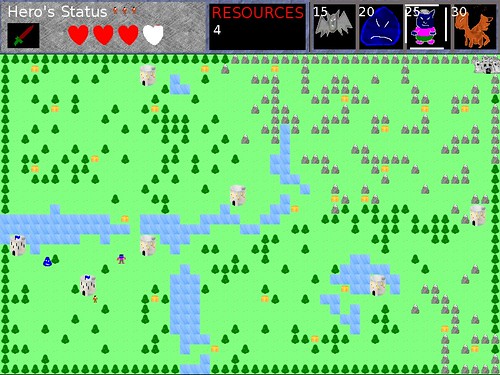
Stop That Hero! was my most ambitious game yet. It was partially inspired by a book I was reading about artificial intelligence in games and what ended up becoming the winning theme: Enemies as Weapons. I liked the idea of a hero controlled by the computer while you sent enemies to try to stop him. My initial vision was more like Super Mario Bros. That is, the game was going to be a platformer with multiple levels, and you were going to send enemies such as Goombas and Koopa Troopas at the hero. I realized right away that learning how to implement a platformer was not going to be an efficient use of my time, especially since implementing new AI techniques was already going to be a challenge. So I switched from a “reverse Super Mario Bros.” to a “reverse Legend of Zelda” game. The hero would be trying to conquer your towers and ultimately your home castle, and you would use a variety of minions to kill him first.

What Went Right

  1. Early Prototyping Saved Time.

    More prototyping

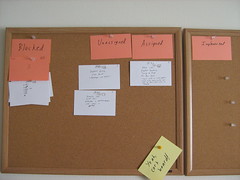
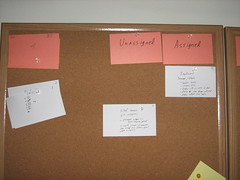
    During the Ludum Dare #15, I was able to leverage my newly learned rapid prototyping knowledge to good effect, as I explain in the Mineral Miner post-mortem. Even though I had an idea of what I wanted to do before this latest competition started, I still spent some time fleshing it out on paper. Doing so helped me realize requirements I didn’t know I had, such as the need for AI visibility. I also got a feel for the game play, including how the player should spawn enemies and what they’ll do. Prototypes still work well!

  2. Simple Controls Forced Creativity. I wanted the player to do everything with the mouse for a few reasons. One, it would make the game more accessible and easier to play. Two, it would force me to make a simpler game. If the player can’t do too much, then there shouldn’t be a lot of complexity for me to implement. Since I knew that I was going to have enough difficulty implementing AI more advanced than any I’ve ever implemented before, I didn’t want to let the rest of the project’s scope get too large. With simple controls, I would have to figure out other ways to make the game compelling. While simple controls still left me with a lot of design choices and directions to go in, I was able to focus my efforts, and I think the game turned out much better for it.
  3. A Focus on Artificial Intelligence Was Smart. Right away, I knew that most of my time would be spent working on the AI. The game depended on it. I had just finished reading AI for Game Developers shortly before the compo started, and I realized that I never did so in all the time it was on my shelf! I learned some really cool and basic techniques, and I learned that sometimes simple AI tech is better than more complex AI tech. I was also glad I had Artificial Intelligence for Games, Second Edition to act as a more in-depth, up-to-date resource. Between these two books, I was able to create a decent bit of AI. My game’s AI needs related to behavior and pathfinding. Behavior was easily handled by a state machine, but the biggest dependency was on pathfinding. My implementation of A* was somewhat flawed from the start due to the fact that my AI agents didn’t necessarily have a single target at any given time and it was possible they didn’t see anything near them in the first place, but I was pleased with the results considered how much time I had to work within. Seeing a bunch of AI monsters moving about the screen on their own, avoiding each other, and otherwise looking like they had agendas of their own was a proud moment for me.
  4. Agile Planning Kept Me Focused and Aware of Priorities.
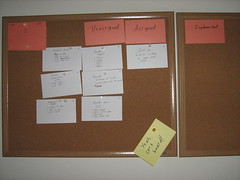
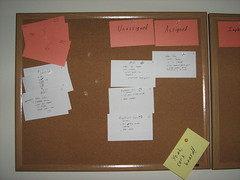
    Agile backlog First iteration

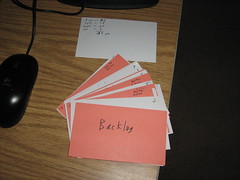
    Since I had a good sense of what the game was going to involve, I was able to plan quite a bit up front. It’s fairly common knowledge that the waterfall model doesn’t work in software development, but I wasn’t planning down to every detail. With Agile story cards, I knew what features to implement, but the implementation details were dealt with when I assigned a story card to myself. The problem with working alone is that no one is there to act as a check against my estimates for how difficult any particular story should be, but for the most part, things worked out well enough. I got two big benefits from using an Agile process to manage my project. One was that I always had a task in front of me. I never floundered, wondering what I should work on next, so my time in front of the computer was highly focused and productive. The other big benefit was knowing what features to focus on and what to cut as the deadline loomed. I originally wanted to have animations and special effects, but as the weekend went on, I knew these tasks weren’t nearly as important as getting working AI. Out they went, and I felt good about the decision.

What Went Wrong

  1. I Spent Too Much Time On The UI and Menus. I took time to prototype and come up with Agile story cards early in the process, but where I went wrong was not giving myself deadlines for those story cards. Ludum Dare was almost halfway through when I finally had an implementation of a window that I could close by clicking a menu item. Granted, clicking was an important aspect of the game, but I probably could have done so without worrying about how the menus would work.
  2. I Broke My Rule About Keeping the Art Simple. In past LDs, I realized that I would spend way too much time trying to create decent-looking art. Mineral Miner benefited from low-quality art because I was able to spend my time finishing it. For this LD, I thought keeping the graphics tiny would help, and it did, but I still found myself trying to draw a decent looking dragon when it wasn’t that important to make it look good. It simply had to be functional. Again, implementing AI was supposed to be my biggest challenge, but trying to create monsters that looked somewhat like what they were supposed to be was where I spent a lot of my time.
  3. I Missed the 48 Hour Deadline. Ludum Dare is normally a 48-hour competition, but LD 18 was a combination 48-hour compo and 72-hour game jam. I normally try to get a good night’s sleep, but I stayed up late this time around. While I was able to get a lot of work done, I found myself making mistakes and having difficulty keeping the code structure in my head. By the end of the second day, I was disappointed that I didn’t have a finished game, so I went to bed. That third day was when everything came together for me, but missing out on the 48-hour deadline meant that I missed out on feedback from other entrants. The compo has rated entries while the jam did not, so entering a compo game would guarantee some feedback in the form of ratings and comments. As I was only able to enter the Jam, my game was ignored by and large. This is the first time that the Jam format was tried for Ludum Dare, and next time there might be some changes to address these concerns, so hopefully entering a game in the Jam won’t feel like second-class LD.
  4. The Game’s Balance Is Off. On the last day of the Ludum Dare Jam, I found I had time to actually play the game. I tried to change values such as the Hero’s strength and speed and the amount of resources you obtain. I didn’t want the player to be able to create a dragon or two right away, so I lowered the starting resources, and then I didn’t want the dragons to come out soon after the game started, so I slowed down the resource increase. While I was able to make such a dominant strategy hard to do in the beginning of the game, it can still work well for the player so long as he/she has patience. Also, it had the side-effect of slowing down the pace of the game. You can only create a handful of minions in any game session, which isn’t nearly as fun as having an entire army swarming on the map. I would have liked more time to balance the game so that it was harder to pull off dominant strategies AND was fun to play.

What I Learned

  1. Simple AI Can Do Wonders! The AI in my game didn’t turn out nearly as complex as I originally thought it needed to be, but maybe it’s good that it didn’t. The AI boiled down to a few pathfinding algorithms and the selection of a target to move to, which isn’t very different from a game such as Pac-man. Once I fixed a number of bugs with the pathfinding, Stop That Hero! came alive. It really did feel like you were creating minions to do your bidding.
  2. Agile Project Planning Is Quick and Useful. Creating a prioritized requirements list and a schedule estimate helped me keep tabs on my progress throughout the weekend. I always knew what task to focus on, and I was able to change my plans when I realized that things were going too slowly for me to get it all done. I received advice that I should have deadlines for my tasks since a schedule doesn’t mean much without them, and I’m inclined to agree. With deadlines/milestones, I probably would have realized how slow my progress was earlier on.
  3. I Need Sleep. Working through the night and into the morning, I learned that my most productive spurts were soon after waking up and having breakfast. Otherwise, even if it felt like I was making progress, I was actually creating problems by inserting bugs and implementing badly thought-out designs. I was able to recover, but in general, I think getting regular sleep is still more beneficial to my project’s health (and my own!) than not.

As in previous Ludum Dare compos, I’ve found my biggest problem is deciding where to spend my time and for how long. Creating a simple menu infrastructure and twiddling with image editors to try to make good looking art took away time from implementing AI and fixing the game’s balance. Project management suffered since I didn’t give myself deadlines, but it did keep me focused. In the end, I had a complete game, with sound, and I’ve decided I liked this project so much that I’ll be updating it and polishing it up for PoV’s inspiring challenge to sell a game by the end of October.

For future projects, I’ll need to give myself milestone deadlines to ensure that I don’t spend too much time on tasks, and I’ll also need to make sure that any art assets I create are primarily functional. Alternatively, I need to dedicate the time to learn how to create quality art and how to use the Gimp.
Categories
Geek / Technical

Where Good Ideas Come From

I’ve been reading about intelligence and learning, and I was fascinated with the idea that the conscious mind can sometimes get in the way of full-brain thinking. If you’re reading a textbook for class, for instance, you might read in order, word for word, trying to analyze and memorize and understand everything as you go. The problem is that you are so busy trying to piece things together on such a small scale that you miss out on overall patterns and the meaning of the entire text. One suggestion for reading is to go in layers. Start by paging through and picking out headings and bold words. Within minutes, you have some ideas about how the textbook is laid out conceptually, and then you can start going deeper as you gain curiosity. It’s like reading in layers, and it helps aid your comprehension.

One big part of this kind of learning is the idea that your subconscious mind needs time to let things sink in while you aren’t thinking about the topic. You sometimes get the most insight into a textbook after you wake up in the morning. In the following video, there’s a mention about taking time to let hunches and ideas incubate which I think goes along with this idea.

The video argues that exposure to lots of ideas and thoughts is the primary driver for innovation. Not all of this exposure leads to good ideas, but “chance favors the connected mind.” Having all of these various thoughts in your head, you might get overwhelmed thinking about them purposefully and actively, but incubation time, getting away from problems, seems to help. I’ve woken up from a good night’s sleep with awareness of program bugs I introduced into my project before I went to bed, and usually the fixes for those bugs came along as well. B-)

I think I’m focusing much more on the incubation aspect than the video did, but I believe spending time away from a problem can help solutions develop in your mind and develop good ideas.

I think I’ll go for a walk now.

Categories
Game Development Marketing/Business Personal Development

An Inspiring Challenge

Mike Kasprzak, or PoV from Ludum Dare fame, issued a challenge the other day:

Make a game — take it to market — sell (or license) 1 copy

Many of you have done the first part, but let’s go all the way this time. The simplest definition of a professional game developer is someone that has made money selling games. So lets create-us some new “professionals” and get some games out!

Think of this as a race. Have something new for sale and in a store by the end of October. And if you can sell a copy (or sign a licensing deal), you win.

Creating a game in a weekend is doable, but to polish it up and make it marketable in a little over a month? That’s a bit more daunting. It will take a lot more work, focus, and determination, and in the end, there’s no guarantee that you’ll have any customers.

But the key to the challenge is to realize that you don’t win by being a best-seller or getting to the top of the sales charts. You win by selling one copy.

Just one copy? That’s quite doable. It’s not easy, but it’s definitely possible. While PoV says there are no restrictions, I don’t think it counts if you ask your mother to pay you a few bucks for your game, so to rise up to this challenge, there’s a bit more work left to do even after the game is finished. Setting up payment processing and a website, signing up for an app store of some kind, or joining a contest are just some of the ways to attempt it.

Personally, as a relatively new full-time indie game developer, I know that I’ve been struggling with the fact that I need to make a game that sells. Do I spend six months working on a single game, or do I restrict the scope to make a game in a matter of weeks? What’s the income potential of each? How risky is to base so much of my potential income on a single game versus making a bunch of smaller games with possibly little market appeal? How much time do I have to figure it out before my savings disappear?

It’s a lot of responsibility to make such a high level decision for a business. It impacts everything the business will do. There’s plenty of analysis paralysis potential in that decision.

But selling one copy of a game by the end of next month? It will take some infrastructure and hard work, and I may still “fail” at this challenge, but the effort will still put me way ahead.

Categories
Game Design Game Development

My Game Design Prototype Toolbox

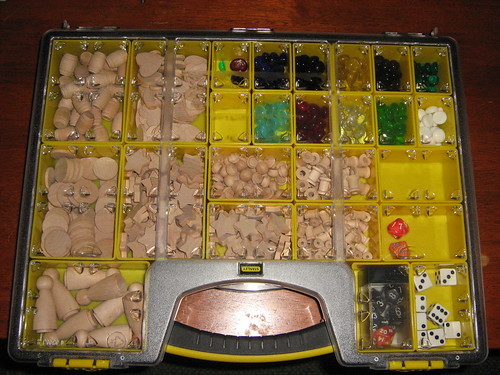
Last year I posted about my shopping trip to a hobby store to buy game design prototyping tools. Some weeks ago, I bought even more items, such as tiny wooden barrels and glass beads. These tools are great for doing quick and easy paper prototypes of game designs.

I’ve been keeping them in small plastic bags, and all of those bags were in a larger freezer bag. While this was functional, it felt unsuitable. I’m a game designer, and some of my most important tools are in plastic food bags? It’s not right.

So I went shopping again and found a nice toolbox for less than $15. It has these cool compartments that I can move about relatively easily, and when the lid is closed, everything stays in place.

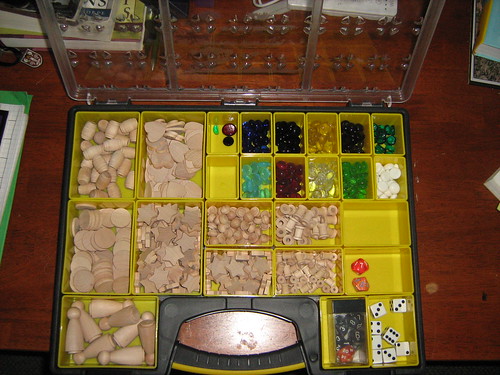
I put all of my wooden pieces and glass beads in the toolbox, and each gets its own compartment. I realized I had a lot more star-shaped wooden pieces than any other piece, though. I even had room for more things, so I put in some dice. My dice collection isn’t much, but I had them separate from my prototyping tools before. Now they’re all together.

Here’s a shot of the toolbox opened.

Prototyping Toolbox

And here’s a shot of the closed toolbox.

Prototyping Toolbox

The plastic bags were a bit more portable. I could put the entire collection in my bookbag when I left home, but this toolbox is its own luggage. By and large, I don’t find myself going out to do prototyping, so it isn’t that big of a deal.

What’s in your game design prototype toolbox? How do you store your physical paper prototyping tools?

Categories
Game Design Game Development Geek / Technical Linux Game Development Personal Development

LD18: Stop That Hero! Ported to Win32!

I’ve updated my LD final entry page, but I wanted to let you know that I finally created a Stop That Hero! Windows port (2.2MB)!

Now you have no excuse not to play! Well, assuming you don’t use a Mac. Or some other OS. Then you have an excuse.

Categories
Game Design Game Development Geek / Technical Linux Game Development Personal Development

LD18: Stop That Hero! Development Time Lapse!

Here’s the time lapse for my 72 hours of development on Stop That Hero!

Categories
Game Design Game Development Geek / Technical Linux Game Development Personal Development

LD18: Stop That Hero! Is Finished!

I apparently needed sleep and a third day to get this game completed, but here it is!

Stop That Hero! is finished

So far, the Stop That Hero! Linux version (1.6MB) is all I have. I just started using CMake for my build scripts, so please let me know if the game won’t run on your computer.
Get the Stop That Hero! source

I’ll work on a Windows port, but for now, I’m going to relax! It’s been a grueling 72 hours!

UPDATE: Windows port (2.2MB) created and available for you!

I also updated the Linux build. It’s the same code, but the build was done on an older Linux-based system, so it should run on more systems without a problem.

Categories
Game Design Game Development Geek / Technical Linux Game Development Personal Development

LD18: I’m In the Home Stretch

I’m at the final iteration!

The home stretch!

Basically, the tasks I have left:

  • create instructions screen
  • add sound effects
  • package this baby up!

In the last iteration, I was play testing and balancing as best as I could. I decided that the bat was too expensive, so I moved it down in front of the slime in terms of costs. I lowered the starting health of the Hero and gave him fewer lives. I also tweaked the level design a bit to accommodate the AI’s inability to see too far ahead. There are also victory and defeat screens now.

I finally got the AI working well enough that I realized that I wasn’t just debugging the program anymore. I was playing the game! And it’s actually not that lame! B-)

Categories
Game Design Game Development Geek / Technical Linux Game Development Personal Development

LD18: Let’s Keep on Jammin’!

I missed the deadline for the main compo, but I can still submit my game to the Ludum Dare Jam. The deadline is 24 hours after the end of the compo, so I have until 9PM tonight to finish this game.

After a good night’s rest, I woke up with bug fixes. Seriously, I was lying in bed, slowly waking up, and I thought, “Oh, yeah, I implemented cooldown for the entities after they attack, but I forgot to ensure that cooldown ends.” I fixed a crash bug which also prevents the creatures from trying to leave the world map. And I improved the exploration mode of the AI so that the entities should no longer wiggle or fidget. They pick a direction and go until they reach it. I found that the reason why the hero was getting stuck in place. It was due to the fact that I was checking if he had reached a very exact location, and with his speed, he sometimes overshoots it. When he tries to go back to it, he overshoots again, forever. I enlarged the collision detection box to compensate.

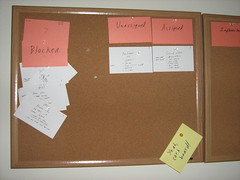
When I finished Iteration 4, I found out that accidentally implemented some stories from Iteration which deal with entities attacking each other. I’ve simplified combat so if entities are not in cooldown and are touching, they’re attacking. That implementation left Iteration 5 fairly moot. In fact, I decided to skip the remaining story in Iteration 5 which dealt with some nuanced AI that I’m not even going to look at, so I’m on to Iteration 6. You can see the backlog of skipped story cards under the Iteration card.

Iteration 5 finished quickly; On to Iteration 6

I’m pretty excited. It’s only 10AM, and I’m on the last two iterations. Iteration 7 is basically sound effects and packaging the game up, and frankly (and sadly), sound is optional at this point. B-)

Categories
Game Design Game Development Geek / Technical Linux Game Development Personal Development

LD18: Missed the Deadline but Continuing On

I got to Iteration 3 by scrapping some of the art and animations I had planned for Iteration 2. Those story points go back into the backlog.

Iteration 3

Iteration 3 was a bear. It was where a lot of the advanced AI had to be implemented. I’ve never done A*. Most of my AI was very simplistic, which went with the simplistic games I’ve done before. This game was going to be different.

Or at least I hoped it would. Entities would bumble about, get stuck, and fly off the world map even though I explicitly told them not to!

I had a quick lunch which was easy to make while I continued to work.

Vegan pizza and applce juice

Unfortunately, the deadline for the main Ludum Dare compo passed when I finally figured out the A* algorithm (it turned out that there was a greater-than sign when there should have been a less-than sign, which is why the entities were moving so strangely). After the pathfinding, the entities still had to interact.

I had the Hero moving toward targets it sees nearby, although every so often I see that he gets stuck in a certain tile for some reason. Enemies seem to have trouble moving to the Hero like I expect, but they find him soon enough.

But with Iteration 4, they fight!

Iteration 4

Do you see how the Hero’s health is down?

See enemies put on the hurt!

That’s the first time it has been like that outside of arbitrary tests being conducted. One of the dragons did that! Good job, my babies!

Since the main compo is over, the only option I have left is to continue on. I can still try to enter the Ludum Dare Jam, which gives me an extra 24 hours before the submission deadline.

For now, though, I’m going to bed. These last 48 hours have been grueling, frustrating, and exciting.