Categories
Geek / Technical Marketing/Business Politics/Government

Do Patents Stifle Innovation?

The Copyright Clause of the United States Constitution states that Congress shall have the authority to “promote the Progress of Science and useful Arts”, and it specifies how Congress shall do so: “by securing for limited Times to Authors and Inventors the exclusive Right to their respective Writings and Discoveries.” See my article on what an indie needs to know about copyright for a primer on the topic.

Copyright, trademark, and patent laws were created to provide the latter in the hopes that it encourages the former. While anecdotal claims have been around for some time which insist that patents are stifling innovation, especially in the realm of software development, the prevailing view is that patents are good for innovation. Of course, that claim is also anecdotal.

Dr. Andrew W. Torrance and Dr. Bill Tomlinson simulated different types of patent systems, using PatentSim, which sounds like an MMO based around owning and utilizing patents. Based on their simulations, using different patent models, they found that the data “suggest that a system combining patent and open source protection for inventions (that is, similar to modern patent systems) generates significantly lower rates of innovation (p<0.05), productivity (p<0.001), and societal utility (p<0.002) than does a commons system.”

Read about the study at Patents and the Regress of Useful Arts.

Changing the US Patent system is tough, especially since so many businesses exist with an interest in keeping the status quo, but if promoting the useful arts and sciences can be more effective by NOT continuing with current practices, it sounds like “securing for limited Times to Authors and Inventors the exclusive Right to their respective Writings and Discoveries” was an erroneous assumption on the part of the Founding Fathers.

Categories
Game Design Game Development Games Geek / Technical Marketing/Business

Defining Indie

Wolfire Games has a new blog post that attempts to define what indie games are. Defining what “indie” means has been about as tough as defining what a “game” is. I’ve covered a few attempts here and here.

What people in general think “indie” means can affect how a new game is welcomed into the market. I know that a number of game developers worry that labeling their games as “indie” might negatively affect sales since people might associate “indie” with “low-budget” and “amateur”. On the other hand, other developers want people to associate their “indie” game with “innovation” and “creativity”.

Wolfire Games mentions Microsoft’s handling of their Live Arcade and Community Games sections. When the name of “Community Games”, which has generally been considered the home of poorer quality games, was changed to “Indie Games”, many developers balked at the idea of associating “indie” with “worse”.

After talking a bit about how various organizations have defined “indie”, Wolfire gives its definition: an indie game is one motivated by passion and designed by the people actively working on it.

And right away, I’m sure some of you are uncomfortable with that definition, too.

So if you make a game that seems to appeal to people willing to spend their money, and you work on it to improve the revenue, you fail the first part? Or what if you are just absurdly bad at the marketing and business aspects? Do you pass the first part?
And if you have a small company that actually separates the game designer from the programmer, it fails the second part?

I think that most people can agree that being indie means having full creative freedom over your work. I think if you look at Wolfire’s definition, it attempts to solve the problem of answering “Who is indie?” with “EA” or “Nintendo”. While EA technically has freedom in that no one tells EA what to do, EA is far removed from the actual development of a game, and any game they publish is presumably not being made without their influence somehow affecting it. On the other hand, Introversion, creators of Defcon and Darwinia, are able to exercise creative freedom without worrying about a publisher making feature requests or design changes. They sink or swim based on their own efforts.

What about a company like Valve? Most people try to claim that “indie” means you don’t have a publisher, but what if you ARE the publisher AND develop games? Well, how many levels of hierarchy are there? Does it impact the creative freedom of the developers of any individual game? Valve would also be considered too big by Wolfire’s definition. Portal was made by a group within Valve, which implies to me that full creative freedom by the hands-on developers was hampered.

Basically, if you’re big enough to have studios within your company, you’re not indie because each studio is beholden to some other part of the organization.

Perhaps a better way to define indie is to restate Wolfire’s attempt as: an indie game is one that involves full creative freedom for the people working directly on it.

Now it’s your turn to be uncomfortable with my attempt at a definition. Feel free to comment and poke holes in my definition. B-)

Categories
Game Development Personal Development

Thousander Club Update: August 10th

For this week’s Thousander Club update:

Game Hours: 576 (previous three years) + 155.75 (current year) = 731.75 / 1000
Game Ideas: 775 (previous three years) + 10 (current year) = 785 / 1000

Sometimes, Test-Driven Development makes the simple stuff hard, but once it is done, it’s so beneficial. Case in point: the main menu. I’ve been working on the main menu for my Vampire game, and in the past, I would have probably got it knocked out quite easily. TDD forces a good design to appear, but in exchange I have to spend a little more time on it than I expected. The nice thing is that it won’t be as hard-coded and game-specific as my normal implementations would.

And a side benefit of using TDD so far? My build times are obscenely fast. It takes just over 20 seconds to build my entire game from scratch, and I suspect a good chunk of that time to be the extracting and building of my unit test framework. Granted, my game doesn’t do much right now, but it is very satisfying to know that it takes almost no time at all to go from a fresh project pulldown to a finished and tested build. I credit TDD with forcing me to use interfaces, short functions, and fewer dependencies.

[tags]game, game design, productivity, personal development, video game development, indie[/tags]

Categories
Game Design Game Development Games Geek / Technical Personal Development

Ludum Dare #15 is Coming!

It’s August, which is one of the months of the year, and that means that Ludum Dare, the the tri-annual 48-hour game development contest, is back!

Suggest your theme, and in the coming weeks the theme vote will commence. Will Exploding Bananas win? Circuits? Glow in the dark? Cooking? We’ll find when the contest officially starts on August 28th!

Here are the results of LD#14 from this past April. I ran away with the gold…in the Food sub-competition. My journaling abilities also commanded a respectable 5th place. The theme then was Impending Wall of Doom, and there were a lot of creative ideas that people implemented.

Ludum Dare is always a fun time, and the last one broke records for number of participants. Will a new record be set at LD#15?

Categories
Game Development Marketing/Business

Indie Game Challenge

I received an email recently informing me about the Indie Game Challenge. Here’s Lord British in a somewhat humorous video to simultaneously poke fun at wannabe game developers and introduce the contest:

The Challenge is designed to be the preeminent competition for video game developers by offering winners almost $300,000 in prize money and scholarships, including $100,000 grand prize awards for both the winning professional and non-professional games. In addition, finalists will receive national exposure and be eligible for additional prize money by having their pitch videos posted on GameStop.com and GameStop TV for People’s Choice Award voting. Complete entry and contest details are available at www.indiegamechallenge.com.

If I understand the rules correctly, you have until October 1st to submit a game and a pitch video explaining why you and your team should win. Prizes include a scholarship to The Guildhall, opportunities to pitch your game to a major game publisher, and cash.

Whether this contest is life-changing remains to be seen. It bothers me a bit that one of the prizes for this “indie” contest is getting the ear of Capcom, Nintendo, Microsoft, EA, and others, effectively making it less indie to me, but it could be a big opportunity if you aren’t as concerned.

If anyone is planning on joining this contest, feel free to post a comment here! I’d love to hear about your decision, your team, and your game!

Categories
Game Development Personal Development

Thousander Club Update: August 3rd

For this week’s Thousander Club update:

Game Hours: 576 (previous three years) + 151.25 (current year) = 727.25 / 1000
Game Ideas: 775 (previous three years) + 10 (current year) = 785 / 1000

Woo hoo! I broke 150 hours so far for the year! Last year around this time, I wasn’t even at 90 hours. With a new Ludum Dare competition coming at the end of the month, it looks like I’ll be doing a lot of game development in 2009. Relatively. It’s still far less than ideal, of course.

[tags]game, game design, productivity, personal development, video game development, indie[/tags]

Categories
Game Design

Quick, Easy, and Effective Paper Prototypes

In the Game Design Concepts course, I’ve found that one of the most beneficial aspects is the amount of practice with creating prototypes. Since the class is about video game design, there is a bias that any prototypes would also have to be in software, but the instructor is adamant that computers aren’t needed.

Just taking a few minutes to do a quick assignment or two, it is easy to demonstrate for yourself how useful paper prototypes can be. Right away, you can tell if the mechanics you’ve put together are dead in the water or if you have a good chance of creating a game other people would want to play. On the first day of class, for example, there was an assignment to quickly create a race-to-the-end board game. The steps seemed easy enough:

  • Draw a path and separate it into spaces.
  • Create a theme.
  • Create the rules that dictate how the players move.
  • Create ways to interact with your opponent.

Here’s the prototype I created on my first pass:
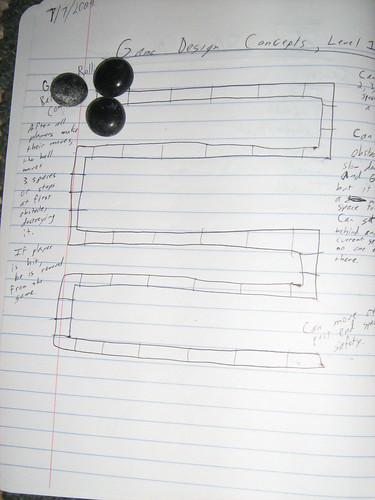
Game Design Concepts Prototype

The path winds down the page, although effectively it acts the same as a straight path. That’s Step 1.

Step 2, I decided that the two players are racing to the end to avoid a giant rolling boulder that is following them. I used some pebbles I have in a bowl on my coffee table to act as the players, and I picked a dirty one to be the boulder.

Steps 3 and 4 were interesting. The easy choice would have been to use dice to determine how far a player moves on a given turn, but I didn’t want chance to be involved in the game. I wanted the players to make interesting choices instead. I decided that the players could move 2, 3, or 4 spaces on a turn. If they move less than 4 spaces, however, they can instead place an obstacle behind them for each space they don’t move. That is, a person moving 4 spaces can place no obstacles, a person moving 3 spaces can place 1 obstacle, and a person moving 2 spaces can place 2.

After both players finishes their turns, it’s the boulder’s turn. The boulder will move 3 spaces, but it will stop early if it hits an obstacle. The obstacle is destroyed in the process of stopping the boulder.

The obstacles can be used to slow down your opponent as well. So if you move ahead and hit an obstacle, you destroy it, but have to stop moving forward to do so.

If the player is hit by the boulder, he/she is removed from the game, and the other player wins by default.

Great! That sounds cool. What’s next?

Well, let’s play it!

Ugh. This game sucks and is riddled with horribleness! What I found right away was a problem with one of the rules. If you can drop multiple obstacles…where do you put them? There is only one space behind you, so you can’t place both of them there. So does that mean you can place one behind you AND on the space you’re currently on? Sure…

But that leads us to the fundamental problem with the game. Whoever goes first, wins. The first player can move ahead and drop an obstacle. The second player will move and hit that obstacle, being behind the first player. Then the boulder moves forward and crushes the second player.

So I tried tweaking the rules of movement. Maybe you can only move 3 or 4 spaces, and if you move 3 spaces, you are allowed to drop one obstacle. Maybe the boulder can only move 2 spaces. Unfortunately, these small tweaks still had the fundamental problem. I realized that if I wanted to avoid randomness, I would need to do some bigger changes to make this game work. Perhaps change the level layout so that the players can choose where to move instead of always moving along a straight line? Maybe obstacles can only be moved around and not created?

Regardless of what gets decided, the point is that playing the paper prototype, which took mere minutes to create, made a major flaw obvious. Imagine if you were going to spend time writing code, creating art, and producing sound effects and music for this game, only to find out when it was almost finished that it is never going to be fun without major changes. That’s a lot of time and effort wasted, and it would probably take you a long time to find out that you wasted it in the first place!

Seeing these benefits again and again in the assignments for the course, I decided to apply it to my vampire game project. I already had a basic idea of how the player will interact with the game. The player’s job is to find the vampire’s coffin, hidden in one of the buildings in town.

There will be a town map, and the player could move through the streets and enter buildings. Time plays a major part of this game, so there will be a sun moving across the top of the screen to indicate when it is daytime, and a moon will pop up when it is nighttime.

When it is daytime, the vampires will be in hiding, and the player can move anywhere. At night, however, the vampires will be out and about, and they are invincible. They move much faster than the player, too. There will be a single vampire at first, but each night he survives, he will sire a victim and add to his army. Basically, the longer it takes the player to find the coffin, the harder it will be to survive.

Well, the above sounded simple enough, but what happens when I try to play it?
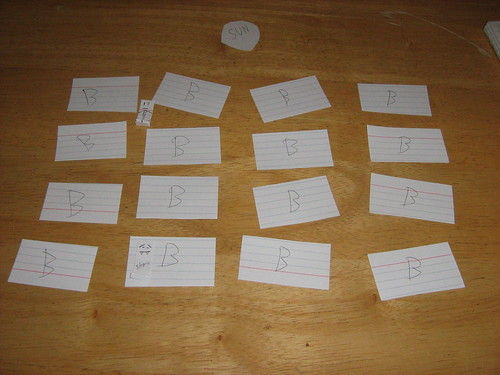
Prototype for Vampire Game

Above is my paper prototype. You can see the player at the northwestern part of town, and the vampire is hidden in a building at the southern end. The sun is out, and so the vampire is sleeping.

One of the first things I did was the simplest. Let the sun go down and see what happens. Right away, the player can see the vampire come out of his hiding spot. If the player can get inside a nearby building and survive until morning, he’s already won the game because now he knows where to find the coffin.

Huh. Well, that’s not what I wanted. For one thing, I want the player to seek out the coffin, searching each building in turn. If the player can simply wait for the vampire to reveal himself, there’s no tension and no fun. For another thing, I want the player to be afraid to be outside of the safety of a building at night. Staying out at night should be a good strategy for getting killed, not for winning. What could I do?

Aha! What if I limited the viewable part of the screen at night based on the player’s location?
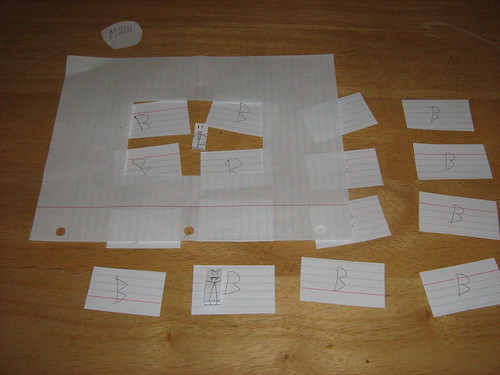
Prototype for Vampire Game

Look at that! Now, if it is nighttime, and the player is outdoors, he can only see the immediate vicinity. If a vampire appears out of one of these buildings, the player probably won’t have time to get away since the vampires are so fast. Otherwise, the player has no idea where a vampire might come from. On top of that, the only thing a player would want to do at this point is find safety. The vampires will find you, and you won’t know where they are until you see one…and if you see one, it’s too late.

Another set of paper prototypes involved the building view, which helped me figure out what the player should be doing when hiding from the vampires. I’ve already started programming, but I’m still early enough in the project that these paper prototypes, which took me minutes to make and play, saved me a lot of pain and frustration. When I can only dedicate so much time in my week to this project, it’s nice to feel somewhat confident that what I am working towards isn’t broken in a basic way.

Categories
Game Development Personal Development

Thousander Club Update: July 20th

For this week’s Thousander Club update:

Game Hours: 576 (previous three years) + 148 (current year) = 724 / 1000
Game Ideas: 775 (previous three years) + 10 (current year) = 785 / 1000

[tags]game, game design, productivity, personal development, video game development, indie[/tags]

Categories
Game Design

Game Design Concepts

For the past few weeks, I’ve been participating in a free online course on game design. The Game Design Concepts course is taught by Ian Schreiber, co-author of Challenges for Game Designers.

The basic point of the book and the course is that too many people are intimidated when it comes to learning how to design a video game. Schools claim that they would love to teach game design but cannot afford enough computers. Schreiber and Brenda Brathwaite argue that teaching game design does not require expensive hardware, software, programming experience, or any technology one would normally associate with video games. Game design can be done with inexpensive pen-and-paper, dice, index cards, and coins.

The blog is freely available, so you don’t have to be one of the 1400+ participants to read it. People have taken advantage of the class wiki in order to translate the course into multiple languages, making it more accessible! The forum is great for discussing the course topics with other students and getting feedback on assignments and ideas.

From day one, we’ve been designing and prototyping games. A number of the reading assignments outside of the book were familiar to me, such as Greg Costikyan’s article on a a common vocabulary for game designers and Dough Church’s Formal Abstract Design Tools, but when all of them are put together in the context of this course, the readings provided fresh insight, especially since they were immediately applicable to an assignment.

Most recently an assignment asked us to take a video game that did not already have a board game adaptation and create one. The exercise was in determining the mechanics that were key to the game, which should help when you go from a paper prototype to a video game, too. I chose Yars’ Revenge, and while I haven’t played my assignment, the feedback I received on the rules was quite positive. Quite a few of the submitted game rules looked fantastic. One of my favorites was based on Flatspace.

The class continues until August, and it’s definitely fun and practical. I would highly recommend it to any indie game developer. Is anyone else currently participating in it?

Categories
Game Development Personal Development

Thousander Club Update: July 13th

For this week’s Thousander Club update:

Game Hours: 576 (previous three years) + 147 (current year) = 723 / 1000
Game Ideas: 775 (previous three years) + 10 (current year) = 785 / 1000

[tags]game, game design, productivity, personal development, video game development, indie[/tags]