Categories
Game Design Game Development Geek / Technical Linux Game Development Personal Development

LD#15: Breakfast!

I woke up hours later than I wanted to, but that’s what you get when you spend the first night of Ludum Dare watching videos of games and playing other ones for inspiration . B-\

I had a simple breakfast:

Part of this complete breakfast

Knowing that I want to participate in the Ludum Dare 2010 Swimsuit Calendar, I’ve been trying to lose weight. While I haven’t been pursuing my push ups routine in some time, I can still eat right. Go Lean with almond milk, 2 bananas, and a glass of good ol’ reliable orange juice start my morning right.

Categories
Game Design Game Development Geek / Technical Linux Game Development Personal Development

LD#15: Ideas Based on Caverns

I came up with a few ideas for this theme:

  • Spelunker clone
  • Dig Dug clone
  • Explore randomized caves
  • Dig out your own cavernous bunker
  • Use regular flooding in the cave in some way
  • Alien cave explorer
  • Gold/Tin/Mineral miner
  • Hide from killers who are chasing you
  • Cube farm caverns

I vaguely remembering a cave level from the NES game Thunderbirds, but I don’t want to fire it up and play through it to completion to find out if I am remembering it correctly. Maybe what I think I remember about it is better anyway. B-)

I have spent some time thinking about these ideas, and what got me most excited was one involving the driver of a tank in a cavern. Think of Teenage Mutant Ninja Turtles for the NES, when you could drive around in the van, and imagine that you’re underground, searching for important items. The tank will protect you and can destroy things, but you need to get out of the tank every so often, leaving you vulnerable yet more maneuverable.

I’ll be prototyping some of these ideas on paper to see what is the most interesting.

Categories
Game Design Game Development Geek / Technical Linux Game Development Personal Development

LD#15: The Theme is Caverns

Caverns, eh? I believe I actually voted for that one. I’m wondering if we’ll have at least one Spelunker clone in the running. It would probably be up for a Towlr award as well. B-)

I plan on starting my night by coming up with some ideas and prototyping the heck out of them. Good luck to everyone!

Categories
Game Design Game Development Geek / Technical Personal Development

LD#15: Keynote Address by Mike Hommel

This.
Is.
Ludum
Dare.

Check out the keynote speech by Mike Hommel, aka hamumu, as well as all of the new things going on with the website. There’s a new submission system, thanks to Phil Hassey, and a new voting system.

As Mike said, “Let’s do this, man. Let’s ROCK AND ROLL!”

Categories
Game Design Game Development Geek / Technical Personal Development

Ludum Dare #15 Is Here!

The final round of voting is here, and these are candidates for the theme for Ludum Dare #15!

  • Burrowing
  • Castle
  • Caverns
  • Clouds
  • Cold and Frozen
  • Connections
  • Evolution
  • Flashlight
  • Flow
  • Glow in the dark
  • Herding
  • Recycling
  • Role Reversal
  • Town
  • Winds
  • Zombies

The winning theme will be announced at 10:00PM CST, and then we’ll have 48 hours to create a complete game based on that theme.

My personal favorites: Burrowing, Evolution, Castle, Town, and Winds.

Which ones are you hoping for? Any ideas for a mini-theme?

Categories
General

Ludum Dare Theme Voting Has Begun!

On Friday, August 28th, Ludum Dare #15 will begin, but before then, theme voting is needed. Round 1 of 3 includes “Dancing Trees”, “Burrowing”, and “Trampolines”. I’ve done my civic duty. Have you?

Also, the official website received a new facelift, and it looks like there will be improvements made here and there throughout the week. Specifically, there is currently a call to help fix issues with the entry voting. If you would like to help, it sounds easy enough. You need to submit a fake entry to the LD blog, and the details are located in the post Help Us Fix The Voting.

To avoid what happened to me last time, I’ve dedicated almost the entire weekend to making sure I participate as fully as I can on LD#15. No matter what happens, though, it should be a blast!

Categories
Game Development Personal Development

Thousander Club Update: August 24th

For this week’s Thousander Club update:

Game Hours: 576 (previous three years) + 160.75 (current year) = 736.75 / 1000
Game Ideas: 775 (previous three years) + 10 (current year) = 785 / 1000

This past week I mostly worked on my Game Design Concepts design project, and using my new prototyping materials really helps in speeding up the play tests, allowing me to quickly discard mechanics that I find aren’t fun.

[tags]game, game design, productivity, personal development, video game development, indie[/tags]

Categories
Game Design Games Geek / Technical

Game Design Prototyping Awesomeness!

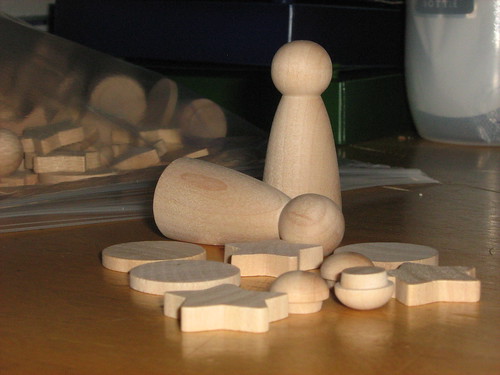
Recently I went to a craft and hobby store, which was too glittery for my tastes, but it was for a good reason. I wanted to buy these:

Prototyping materials

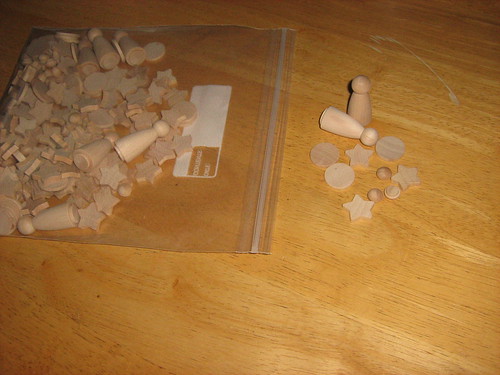
You can get a better sense of scale here:

Prototyping materials

If you’re looking for items online or at a store, the circles and stars are just flat pieces by the appropriate name. The tall board game avatars are called doll pins. The mushroomy pieces are furniture plugs. Since I purchased so many of each type, the total price came out to less than $40. It’s very likely that I paid too much for them, or that I bought too many, but as you can see, I have an entire bag of these items. Why?

In the Game Design Concepts course that I’m taking online, there was a post early on about creating a prototyping kit. After messing around with paper cutouts which blow away too easily or stones from a wedding centerpiece which are a bit dirty to hold (sitting in water that evaporated years ago will result in that), I decided I wanted some hardier stuff. These pieces can be used as various tokens for game prototypes.

In my design project for the class, I’m doing a high school reunion game, and on paper I had rules about earning prestige points by accomplishing various goals. Initially I marked these points as stars that I drew with a pen, but now I have star pieces which are more tangible. You get 4 prestige points? Here are 4 star-shaped wooden pieces that have a decent weight to them and feel nice.

I bought 8 doll pins. They come in packs of two, and I was originally going to get 2 packs when I thought, “What if I want to do something massively multiplayer?” B-)

The furniture plugs just looked cool. I could see placing them on spaces to indicate that there are traps or coins available.

And if I feel so inclined, I could always paint each item various colors.

If you would rather have a ready-made kit, check out the Piecepack, or if you’re looking for awesome craft parts for your own custom kit, look at CraftParts.com. And of course, you can probably find such items at any local craft/hobby store.

Categories
Game Design Game Development Games Geek / Technical Marketing/Business

Plants vs Zombies Developer Interview

In my post on Plants vs Zombies, I was lucky enough to have one of the people deeply involved in the production of the game answer some of the questions I had about the design process and behind-the-scenes work. I have been waiting for an in-depth interview with George Fan, the designer and creator of the game.

GeneralGames.ca’s interview with George Fan is a short one, and it isn’t as in-depth as I would like, but Fan does answer some questions about how the game came about.

In other interviews, he has said that he was innovating on the tower defense genre, mainly by improving the accessibility.

My goal was to take the tower defense standards and simplify them down to the point that almost anyone could pick up and play. With that in mind, I kept the playfield small and removed some of the things found in traditional tower defense that might not be as intuitive.

He mentions the humor aspect being a big focus as well.

There’s no word on whether or not a sequel to the game is in the works, but Plants vs Zombies is being ported to other platforms, including XBLA.

Categories
General

The Business Model of Selling Linux Games

I’ve been enjoying the visibility into Linux Game Publishing’s business at the LGP blog. The author is the CEO and Head of Development Michael Simms, and he is very accessible, responding to comments and listening to suggestions. Before his blog was launched, I remember seeing him on IRC regularly in Linux game-related channels.

Months ago, there was a post explaining why Linux games cost as much as they do. If you’re not familiar with Linux ports of popular games, you’d possibly be surprised that they cost as much as a new game…even though the original version of the game on Windows might cost half as much since it has been out for months or years! The basic argument: even if a game has has been out for some time on Windows, it’s new to Linux, and it costs LGP money to port the game in the first place.

At the suggestion of some commenters, he did a one day sale in which prices for most games were lowered. The sale results indicated that while the short term sales increase looked promising, the long term sales stayed flat with less revenue, not more.

But another thing LGP has done at the request of customers is offer downloadable games, including a rental option at a “ridiculously lower price”.

Most recently, there was the question of why LGP can’t simply provide the Linux version for free to people who purchased the Windows version. It’s a legitimate question, especially when companies such as id Software are providing free binaries for all platforms to people who purchased a game. I have a copy of the Linux port of Quake 3 Arena, and I know I can run it on Windows without paying for a second copy. I mention this example a lot, but I know one person who was told that she couldn’t play The Sims and all of the expansions she purchased on her new Mac because EA outsourced the Mac port of the game to another company, and that company was handling sales of the Mac port.

It’s a business model that works for EA, but not necessarily for the customer. And it’s the same with LGP.

As a customer, I prefer being able to buy a game once and play it anywhere I want. Windows, Mac, and Linux. The game is the same. Now, it could be said that I’m arguing that Xbox 360 or PS3 ports of the same game should also be available to me for free after purchasing the same game on my computer, but I’m not. In fact, 360 or PS3 games usually have some exclusive content, making it a different game in some way.

In any case, the argument for the business model is basically the same as the argument for Linux game pricing: you’re paying for convenience, and it costs money to give you that convenience. There is one additional point that Michael Simms made: companies like EA don’t care about Linux, and so the business model I’d prefer is just not going to happen.

Which is too bad. It’s why I find that I don’t purchase many games these days. If I find anything that interests me, I remember that it’s not available for Linux. Instead of supporting those games, I could spend my money on a game that is actually supported where I want to play it. Starcraft 2? Yeah, call me when it runs in Wine. Maybe. I might want to play a different game by then, one that is natively supported.

The good news is that the business model that LGP currently uses seems to be working for them. Micheal Simms said, “The business model we have isn’t ideal, I’ll be the first to admit. But it is the only one that works as the market stands.”

I’m not so sure that it is the “only” model that works today, but I’d like to hear more about other developers and publishers’ experiences. Anyone out there with a different model that works for them?