Categories
Game Design Games

What Games Teach Us About Relationships

The stereotype about video games is that they are played by loners, isolated in a basement somewhere.

It’s one person playing on a computer or a console, interacting with a machine instead of people.

And when you think about games such as Donkey Kong, Super Mario Bros, and the like, even if they allow multi-player, it’s usually just serial single-player, with one player waiting for the other player to lose or finish.

If a game is interactively multi-player, there tends to be an adversarial conflict. Pong pits one player’s skill against another, as do most sports games. The goal of many games is to defeat your opponent, whether you are talking Space War or Goldeneye. Your relationship to someone else is enemy vs enemy.

So games tend to lean heavily on the “you vs the world” narrative.

But games can also be cooperative. MMOs tend to have people band together. Star Trek Online has player-vs-player, but missions tend to be something you can take on with friends. Your relationship here is defined as allies, as teammates, or as guildmates.

But outside of MMOs, if there is a cooperative multiplayer, it seems to be notable. New Super Mario Bros Wii can be ridiculously fun and frustrating, but you’re all in it together. Most platformers weren’t simultaneously multiplayer in this way.

Board games and card games are often based on competition, but because they seem to be experiencing a surge in popularity and variety, it’s easy to find examples of cooperative games.

Arkham Horror by Fantasy Flight Games has players competing against the game system. While you might have one winner, everyone stands to lose if you try to go it alone.

Forbidden Island by Gamewright also has the players trying to collect all of the treasure and escape before the island sinks, and moves tend to be discussed before they are taken. “If you do XYZ, that would put us in a good position.”

Some games reinforce the idea that if you put your mind to it, you can accomplish anything. They are about private victories, as Stephen R. Covey would call it in The 7 Habits of Highly Effective People. You can be proactive. You can prioritize. You can keep your eye on the goal. It’s all about your independent thoughts and actions.

And some games reinforce the idea of interdependence, that we’re stronger together than we are apart. They are about public victories. You win together or you lose together.

I love competitive games, and I love a good solo game. Power fantasies can be fun, and there is nothing wrong with them. Saving the world on your own can be great.

That said, I do worry that if there are interpersonal lessons taught in some games, it is that other people are adversaries. If you treat life as a war, you versus the world, it can be very isolating and you’ll have a hard time working your way through reality which invariably involves other people.

In real life, you’d have allies, people who have their own agency and aren’t mere pawns in your game. You can accomplish more and do more in a team, and you’ll need to be able to interact with them as equals.

Some games remind you that you that there are other options than going it alone.
Categories
Game Design Games Geek / Technical

Learning New Old Games

Card Games

Last night, my wife taught me a card game she played with her grandmother earlier that day.

Hand and Foot is a Rummy game similar to Canasta, but it apparently has no standard rules. It was hard for us to look up what is allowed in certain situations. For instance, I was at the end of my Foot, and I had drawn two cards and now had an Ace and two Jokers. If I play them, I have no card left to discard. Am I allowed to do so, or do I have to discard at the end of a turn, meaning I can’t play my hand and must either give up a valuable Joker or an Ace.

It occurred to me that I’ve never played many card games. These days, I play Four Point Pitch and Up and Down the River with my in-laws, games I didn’t know a few years ago until they taught me. When I was younger, I played Solitaire, Kings in the Corner, and Thief with the Italian playing cards my parents always had on hand.

But as a game developer, shouldn’t I be more well played than I am? There are centuries of games out there, but if I limit myself to the popular video games of today, aren’t I also limiting my source for inspiration?

Granted, many are thinking that today is the Golden Age of Board Games. Between Kickstarter and popular cons, people are creating and playing games that aren’t the usual Scrabble and Monopoly. I’m participating in a few board game nights these days, whether it is at the day job or with friends, and I’m learning quite a few games.

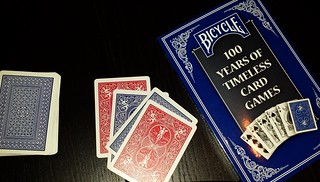
But I’m sure I can stand to learn a wide variety of card games. We even own a copy of the book Bicycle: 100 Years of Timeless Card Games, and I’ve never read it.

I’ve seen similar books on card games that are larger and probably more comprehensive, but 300+ pages of card games with their variations is a good starting point.

When playing Hand and Foot, I noticed a few self-regulating aspects of the game that were pretty clever. For instance, if you want to pick up the discard pile, you had to pick the entire pile up. If it was full, it meant you suddenly had a lot more cards in your hand, which means you can create melds more easily, but the discard pile might include multiple dangerous red 3s, and you can only get rid of each one once per turn. Have a red 3 in your hand reduces your score by hundreds of points. It’s a risk you might be willing to take if you have been struggling to complete melds, though.

Similarly, you might play all the cards in your hand until you have almost nothing left. That’s great, because you are close to getting rid of the cards in your hand, which allows you to pick up your foot (Oh! I get it now!), but it also means you have a harder chance of creating a meld and actually getting rid of those cards.

So just exposing myself to this one new old game got me thinking about game design. What if I spent time learning more such games in earnest? I wrote about consciously consuming information daily, and reading and listening to a variety of information is beneficial. I’ve been thinking about how important it is to also play a variety of games.

The great thing is, I already own a deck of cards. I’ve paid the expensive part. It can be quite the investment to get a new board game or video game, but a trip to the library might be all I need to do to find books on card games I could play with my existing deck.

Heck, I also have a bunch of dice, and I’m sure there are plenty of dice games out there, too.

It’s time to make a conscious effort to learn some new games. Got any recommendations?

Categories
Personal Development Politics/Government

Revisiting Your Existing Knowledge

I went to a Catholic grade school which included kindergarten all the way through to 8th grade. There was no clear break between grade school and middle school. To me, I went to grade school, then high school.

Often when I tell people about my grade school experience, I realize that people get confused about how young I was, so sometimes I have to say that it was my grade school/middle school.

Now that that’s explained, when I was in grade school, I recall distinctly the lessons about the Civil War. I remember the teacher specifically saying that the war was not about slavery, that it was about states’ rights.

I remember thinking, “Oh! I didn’t know that! The little I knew about the war was North and South, the country splitting between free states and slave states.” Learning about the slave states that stuck with the Union was kind of like learning about a piece of trivia and reinforced the idea that no, it wasn’t about slavery specifically. It was about whether or not the government can tell states what to do.

And in the end, the federal government won. The United States of America is a single entity, not a bunch of individual states.

And I carried this knowledge throughout my life. Whenever the Civil War came up, this fact about the reasons for the war being about states’ rights as opposed to slavery came with.

When I visited a Confederate museum in Virginia, I hadn’t seen the war from the Confedrate perspective, and while the museum was tiny, it was full of uniforms, battle standards, carvings such as an engagement ring made from a peach pit, and all matter of fascinating pieces of history. I found no mention of slavery, and I was not surprised.

So after the tragedy in Charleston, South Carolina in which 10 people were shot in a church by someone motivated primarily by race, I found it odd when a few friends posted on Facebook about calls to remove the Confederate flag from the capitol.

They kept talking about racism and slavery, and I was confused because, after all, the Confederacy wasn’t about slavery, right? Calling for the removal of the Confederate flag seemed irrelevant after a shooting driven by hate.

Then this article in the Atlantic called What This Cruel War Was Over published some of the rhetoric and public documents prior to the war.

Oh. It very much was about slavery.

It was about slavery, and it was about White supremacy. The election of Abraham Lincoln with his party’s radical agenda of stopping the spread of slavery was in direct opposition to the desire of leaders in the Southern states to spread slavery into the larger empire of America, which touches on our tensions with Mexico in a way I never saw before. The end of slavery would mean that Blacks would be bizarrely considered equal to Whites, and if that happened it would be the end of civilization as we know it. Even when the Confederates realized the rest of the world wasn’t so keen on helping their cause and so diplomats tried to spin it as states’ rights, it was abundantly clear by the writing and opposition that there was no reason for people to feel embarrassed about slavery, that it was actually a force of good and they should be proud of what it has accomplished.

It was about slavery. That people think so is not perversion by extremists. It isn’t miseducation. It’s part of the historical record, and it isn’t interpreted as it is part of the primary documents we have about the war. To the extent it was about states’ rights, it was the right of states to continue keeping a good number of their population as slaves in order to ensure equality among Whites. It’s an odd thing to today say is part of your proud heritage, and I now understand why people conflate slavery, White supremacy, and the Confederate States of America a lot more closely than I thought they deserved.

And I look back on my grade school days and recognize some of the things I’ve learned since. I remember a high school teacher informing our class that most text books are published by Texas and have a certain point of view built into them. Lies my teacher taught me, indeed.

Now, I’m from the Northern part of the country. In my mind, I always thought WE won the civil war. I identify with the Northern states despite the fact that I was born to immigrants over a century later and have no direct tie to the war. I can only imagine how painful this kind of knowledge can be for people who identify with the South, or who have ancestors who held such views and proudly fought for them.

There are things you learn from a young age, and you never think to question it because it just was. You have a base to build your knowledge on.

And then you find your base is a lie or wrong. It can be difficult because you feel like you are starting over. If that base was wrong, what about everything built on top of it?

But when is the truth ever not the goal? You know, when cynicism and duplicity aren’t involved?

Sometimes your continued education in life isn’t isolated to gaining new knowledge. Sometimes it is about relearning what you thought you already knew.

Categories
Personal Development

Consciously Consuming Information Every Day

When I was a child, my parents bought encyclopedias.

Plural.

We had Funk & Wagnall’s, which is still fun to say. We had Charlie Brown’s ‘Cyclopedia, which is where I learned about fun facts such as Laika being the first animal in space and what the Great Pumpkin is. We had a science-oriented one with cool projects to do at home and great illustrations.

We never had Encyclopædia Britannica, even though it was a household name:

The weird thing was that one day I decided to read them.

The illustrated ones were easy to read. Charlie Brown’s ‘Cyclopedia even had comics in them.

Funk & Wagnall’s was a bit more dense, and I don’t think I got past A, but the books were always around to look up various facts. When I played Illusion of Gaia and learned my character had contracted scurvy from being on a raft for a very long time, I looked it up and found out it was a Vitamin C deficiency. There was even a picture of a hamster with scurvy, which I still see in my head whenever the topic of scurvy comes up.

The point is that I was very privileged to have access to a local library anytime I wanted it, and I don’t know what the catalyst was, but one day I decided to actually consume it. I learned a lot about my world from a young age.

I know some people prefer not to read because they find it to be a pain and a struggle. But there’s always audiobooks. There are documentaries. Between TED talks and conference presentations, videos on YouTube, MOOCs, and podcasts, there’s plenty of information out there for you to learn from.

Of course, now you have a firehose of it, which means you need to be selective. You can’t consume it all. You’d have no time left for you to process it or make use of it or otherwise do anything in the rest of your life.

I listen to audiobooks on my 20 minute commute to the day job. I read at night before bed. In the morning, I might listen to an interview or read a magazine.

The topics are varied: personal development, business, software development, fantasy and science fiction, autobiographies, history, science, and more.

And since I can’t afford to own so many audiobooks, I’ve been taking advantage of my library card.

Let’s see. This is the…

$ date +%U
25

…25th week of the year. To date, I’ve consumed 29 books in some form or another, which means I’m well on track for a book a week, which is my goal.

And it doesn’t feel like it has taken up a huge amount of my time.

But I did make a conscious effort to consume good information. I didn’t necessarily pick a topic I wanted to learn more about, although I can see doing so to get deeply immersed in it. I picked audiobooks that seemed interesting off the shelf, and even the ones with narrators who cause my teeth to grate have been fascinating.

I know more about how the brain works, how modern urban living was made possible, and how chess evolved and spread. I learned who Shakespeare was and how little we know about him. I learned about the potential reasons why people think that young boys are in trouble today, ideas on how to raise children to be more aspirational, and on the science of thinking. Throw in some heavy physics and a light-hearted set of observations from the vantage point of a number of different people, and it’s not a bad amount of education in a year.

And I’ve still got six months to go, and I’m not even including all of the information I learned from magazines and podcasts.

Consuming all of this information doesn’t just mean I’m better at trivia night at the bar. It means I’m more informed. I can make connections between pieces of knowledge, which means I am more creative. I can understand the world better, which means I can navigate it more easily.

I was really privileged as a child to have access to so much information in my home. It helped me feed my hunger for knowledge, and today I make an effort to read or listen to something each day because that hunger is still there. I’m still curious about my world, and wouldn’t you know it, people have been nice enough to document it for me in an easily-consumable form.

Why not take advantage of it?

Categories
Personal Development

Learning to Paddle Your Own Boat

This past Sunday at church, a friend of mine was the celebrant, and he told a few stories about times he fell into water as part of a theme of revelry.

After the service, he and I were talking, and part of our conversation turned to lessons we try to impart to younger people.

He spoke about the time he and his children were using a kayak and a canoe. Because his son was older, my friend insisted his son use the kayak on his own at one point.

His reasoning? “I wanted him to learn how to paddle on his own. You can always sandbag in a canoe and let the other person do most or all of the work. In a kayak, you won’t go anywhere unless you put in the effort yourself and figure out how.”

Some days I wonder about my ability to paddle on my own. How much am I hiding behind the efforts of others?

Teamwork is great, and multiple hands can make light work, but if you took away my family or my coworkers, would I be embarrassed or proud of my contributions?

Categories
Geek / Technical

Why std::sort Crashes on My Collection of Objects

I’m working on the physics of my game, and I’m trying to sort the collidable object data on the X axis, then on the Y axis. Sorting should help my implementation of Sweep and Prune work faster, and so I wrote my own less than operator.

bool CollidableObject::operator<(const CollidableObject & rhs) const
{
    bool lessThan = (this->m_position.X() - this->m_radius) < (rhs.m_position.X() - rhs.m_radius);
    if (!lessThan)
    {
        lessThan = (this->m_position.Y() - this->m_radius) < (rhs.m_position.Y() - rhs.m_radius);
    }

    return lessThan;
}

Yet, when I call std::sort(beginIter, endIter), I get a seg fault in the bowels of the sorting algorithm.

Looking online, I find that the problem other people are running into is with their custom comparators. std::sort requires a strict weak ordering, meaning that if a < b, then you can't also say a == b, or else the sort algorithm's assumptions are invalid. Ok, but what was wrong with my code? It must be something else...oh, wait. I wanted to sort on the Y axis only if I couldn't sort on the X axis. My implementation checks the X axis, then if a.X() is not less than b.X(), it checks the Y axis, which means if a.X() == b.X(), or worse, if I know for sure that a.X() > b.X(), then I’m doing further sorting when I don’t want to do so.

I made this change:

if (!lessThan && this->m_position.X() == rhs.m_position.X())

And now everything is sorting properly and without a crash.

Categories
Game Design Game Development Geek / Technical Linux Game Development Personal Development

LD#32: A Giant Weapon Development Time Lapse #LDJam

I created a time lapse video of my development of “A Giant Weapon”:

Once again, you can find the game, albeit incomplete, at http://ludumdare.com/compo/ludum-dare-32/?action=preview&uid=251.

Categories
Game Design Game Development Geek / Technical Linux Game Development Personal Development

LD32: Submitted but Disappointed #LDJam

When I started this weekend, I thought, “I’m going to make a complete game that’s enjoyable to play.” I wanted the Button Masher Bros to play my game and enjoy themselves.

Towards the end of the deadline, I was thinking, “I might be able to get the bare minimum of something that could be called a game in.”

And by the end, I didn’t even have that.

I submitted my project, A Giant Weapon, which you can find at http://ludumdare.com/compo/ludum-dare-32/?action=preview&uid=251

LD #32 A Giant Weapon

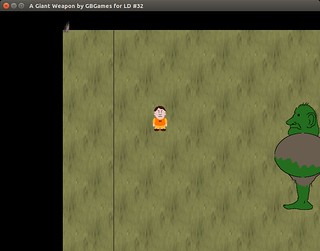
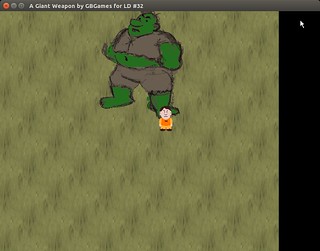
You click to tell your soldier to move, and you try to avoid the monster. There’s a game over screen when you get killed.

You can attract the monster’s attention by clicking on it.

Unfortunately, I didn’t add the reason why you would want to do so: to destroy your enemy’s camp.

Fighting bizarre and non-bizarre bugs slowed me down, but I did not do anywhere near as well as I would have liked.

I wanted to get something controllable by 12 hours in, and it took me almost 25 hours. Then I didn’t have anything resembling playability until the last couple of hours, and then I ran into trying to figure out what AI bugs and graphic offsets issues I had.

I watched my timelapse, and I can see that I didn’t take my own advice about not spending too much time on the art. I think the majority of my efforts involved getting the sprites right.

Oh, and the weird bug that caused bizarre issues with the buffer not updating? I think it turned out to be a glitchy system. Once the computer crashed, and yeah, I needed that to happen near the deadline, everything ran fine for the remainder of the compo. I should have rebooted right away. That problem cost me way too much in time and stress.

I’m pretty disappointed and deflated. It’s been two years since my last Ludum Dare compo, and I feel like I’m not any more capable as a game developer than I was then.

I know I have another 24 hours for a Jam entry, but I planned to dedicate only the past 48 hours to Ludum Dare and I will not be able to do much more.

All that pity aside, I did like my idea, and I think the game in my head would be enjoyable if I could have developed it. A bumbling giant monster that gets easily distracted is chasing the player who is trying to lead it to the enemy camp without getting killed in the process. Part of the game play was to get the giant to move in one direction while looking another, causing it to trip and fall. If it falls on top of a building or other enemy structures and units, they would get destroyed.

The monster and the player would each be able to pick things up and throw them. The player would throw things to attract the attention of the monster, while the monster would be aiming to kill. This feature got cut.

Towards the end, I even created quick art to create a building, including rubble, but it never made it into the game.

Categories
Game Design Game Development Geek / Technical Linux Game Development Personal Development

LD32: I’m 12 Hours Behind Schedule and Have Bugs #LDJam

I wanted to have something playable or at least controllable within 12 hours. I did it within 25.

LD #32 - Controllable Character

You can now click on the ground, and the soldier will move assign itself the goal of moving towards that point.

The monster is still just placeholder art with basic AI.

There are bugs, though.

For some reason, when I run my game, the loading screen gets inconsistent for me. The mouse cursor freezes on the screen on the main menu screen, in both of these cases, I see the screen look like it is locked, or flickering between two images that should not be on the screen. For instance, my loading screen says “Loading resource 8 of 14”, and it bounces back and forth between 8 and 9, which isn’t happening in my code, which makes me think that there is a problem with rendering.

Animation looks weird once I enter into the game, and so I have to restart the program and hope that I don’t see the issue again.

I tried it in another game which has more or less the same code, and it seems to work fine, so at least that rules out an expensive hardware issue.

But the bad news is that I have a ridiculously difficult to diagnose bug in my Ludum Dare project, and there is less than 24 hours left in the compo. There’s also a weird rendering issue in which my terrain is showing gaps behind it as I move about the world. B-(

And I still have a ton of work to do.

Also, I realized that with all of the struggles, I have been forgetting to commit my changes. Here’s the complete commit log:

$ git log
commit 35fabffff77407ce6a66a146ff297df254c5626e
Author: Gianfranco Berardi
Date: Sat Apr 18 20:29:47 2015 -0500

A lot happened; can control player character, have basic AI framework.

commit cc662aa500df16c01dae56ac3a419a64e0448c22
Author: Gianfranco Berardi
Date: Sat Apr 18 10:32:08 2015 -0500

Fixed camera; added grass, monster placeholder, and boulder.

commit 4656623ca6dfc9fc2e68620a7ec5056e171276e1
Author: Gianfranco Berardi
Date: Fri Apr 17 23:27:09 2015 -0500

Initial commit for LD#32.

Early on, I realized that my efforts were all over the place. I wanted to work on adding a playable character, and I ended up making some terrain instead. Nice, but not as important.

So I actually put together a quick design document, inspired by Hybrid Mind’s Ludum Dare 29 timelapse.

Holy cow, it made a huge difference! I was able to dump everything out of my head, realize there were some gaps, recognize that I had a scope issue, and also prioritize whenever I identified a new problem or bug to fix.

It also helps me see my progress. It’s easy to get demotivated when the clock keeps ticking, but seeing all of the completed work reminds me that I’ve made a dent, and it also helps me keep focused because I want to get more of those planned tasks crossed off my list.

Of course, I’m always realizing something that needs to be added, so the list will get larger. I’m not sure if more planning or more doing would have revealed that information to me sooner.

Categories
Game Design Game Development Geek / Technical Linux Game Development Personal Development

LD32: Breakfast and Even More Design #LDJam

Good morning!

I had some oatmeal with peanut butter and raisins, with some cinnamon and nutmeg. I also had a small glass of orange juice and the smoothie my wife made.

LD #32 - Breakfast the First

When I drank the smoothie, I noticed that the side of the glass had this very neat texture:

LD #32 -Potential Texture

I might tweak the color and turn it into the landscape in my game.

I decided that there will be a player character represented in the game. It adds risk, because if the monster catches up to you, you lose.

So, who are you? I originally envisioned some spoiled brat who wanted to get revenge on the people in his town. Maybe that cool neighbor with the better treehouse will think twice the next time he brags about how much better it is than yours.

But then I took a shower, where we often have our best ideas, and I thought of an outnumbered military unit desperately seeking a way to tip the balance in their favor. Finding a monster to do their fighting for them seems like a good alternative to dying and losing the war.

Which also gives the player a reason to worry about the monster getting killed before it can do its damage.

There’s 34 hours left in the compo. I better start planning.