Categories
Marketing/Business Politics/Government

Canadian Music Creators Against DRM

The Canadian Music Creators Coalition is a group of Canadian musicians and artists who have gotten together to say that they aren’t being represented by the multinational record labels.

[L]obbyists for major labels are looking out for their shareholders, and seldom speak for Canadian artists. Legislative proposals that would facilitate lawsuits against our fans or increase the labels’ control over the enjoyment of music are made not in our names, but on behalf of the labels’ foreign parent companies.

If you look at the link that says what they stand for, you’ll find that #2 says the following:

Digital Locks are Risky and Counterproductive

Artists do not support using digital locks to increase the labels’ control over the distribution, use and enjoyment of music or laws that prohibit circumvention of such technological measures. The government should not blindly implement decade-old treaties designed to give control to major labels and take choices away from artists and consumers. Laws should protect artists and consumers, not restrictive technologies. Consumers should be able to transfer the music they buy to other formats under a right of fair use, without having to pay twice.

Good on the Canadian musicians for taking a stand for themselves and their fans! And good on them for taking a stance against DRM. What customer actually wants technology that reduces the value of their purchase?

Also on the CMCC site is Steven Page’s A Barenaked Guide to Copyright Reform in PDF format.

Categories
Game Development Games Marketing/Business Politics/Government

You’re Playing CPG

Why We Need a Corporation for Public Gaming argues that we need a publicly funded organization dedicated to making high-quality, educational games for the public good.

The author, David Rejeski, made comparisons with the television industry, noting that noncommercial programming did not do very well without government involvement. A Corporation for Public Gaming would fund the educational games that aren’t as commercially viable as another FPS.

…The interactive nature of games, their ability to present complex and dynamic information, and, increasingly, to allow thousands of people to meet in sophisticated virtual environments means games can accomplish what TV never could in terms of addressing educational and social challenges.

However, serious games, like serious TV, are likely to remain a sidebar in the history of mass media. Non-commercial television floundered, despite millions of dollars of investment by the Ford Foundation, until the government stepped in and created a viable and long-lasting alternative. With similar vision and foresight, and a relatively small amount of funding, this could happen with video and computer games.

Some people complain that public television holds a political agenda, and so people might worry that games will be made that also express certain political viewpoints. “Not with my tax dollars!” is the cry. I haven’t really looked too much into public television’s supposed problems, but I believe that unpopular viewpoints need to be expressed. Unpopular pretty much means that it wouldn’t have funding from anyone.

If the industry is going to go where the money goes, then it isn’t likely that many serious games will get the funding they need. The CPG would also be an interesting development because it would also raise awareness in the general public about the nature of video games. Most people still believe that video games are just for kids, for example.

Categories
Game Development Games Geek / Technical Marketing/Business Politics/Government

Draconian Copy Protection Not Necessary for Games

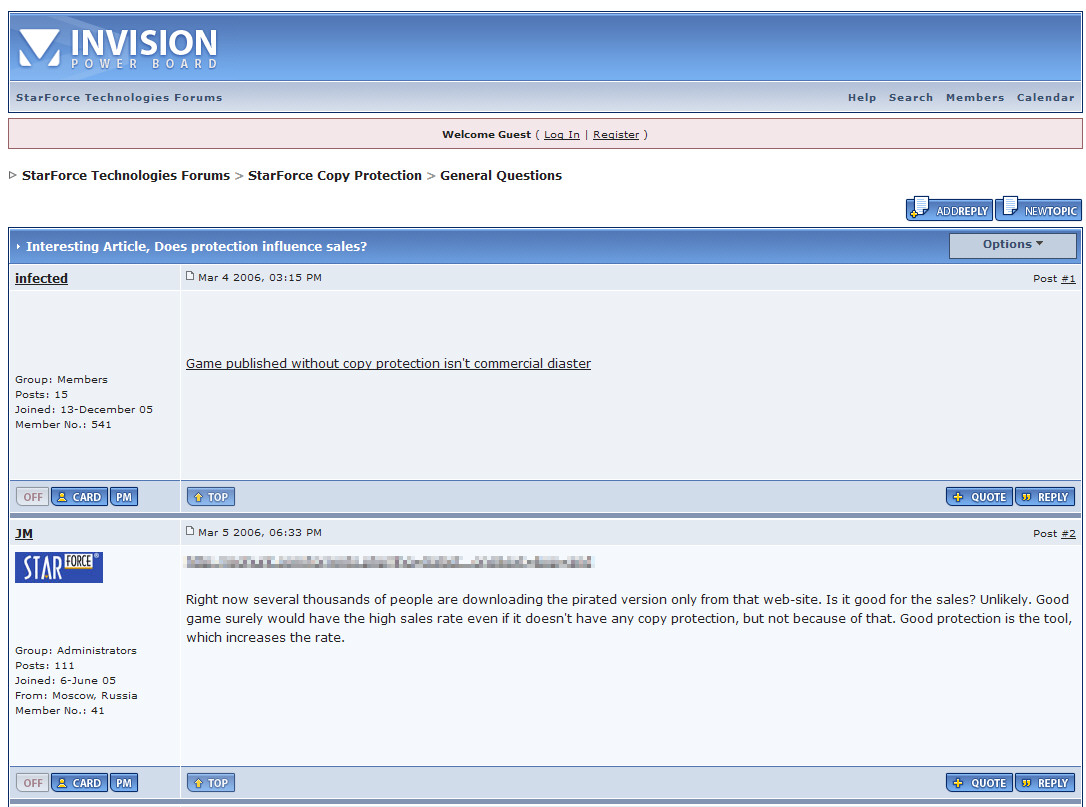
Stardock, creator of Galactic Civilizations 2, released a news item recently about the reasoning behind the lack of copy protection on its latest game. In it, Avatar Frogboy writes about better ways to combat piracy, namely by making it more attractive to be a paying customer than to download a copy illegally. It’s a refreshing viewpoint since most developers these days seem to believe that copy protection is a “vital” part of game development.

We realize that some people or companies might feel threatened at any evidence that implies that draconian DRM schemes or CD copy protection may not make that big of a difference in sales.

For example, we were quite disturbed to discover that the company that makes Starforce provided a working URL to a list of pirated GalCiv II torrents. I’m not sure whether what they did was illegal or not, but it’s troubling nevertheless and was totally unnecessary

Way to go, Starforce. Not only do you have a bad reputation for leaving behind junk on PCs when a person installs a game, but you go ahead and make yourself into quite a nuisance for companies that don’t fall for your marketing. Good job! You will continue to earn the scorn of gamers. Stardock should be commended for doing right by its customers and for keeping the moral high ground on this issue.

And look at the responses on that news item!

I bought the game for the sole reason you dont treat me like a criminal.

If anything knowing you can easily create a working backup of your games is what made me become a devout follower of Stardock in the first place.

Well Stardock I can tell you that ‘not’ putting DRM on your product is the reason I bought this game. I didnt buy ‘just’ because there is no copy protection, I also enjoy 4x games and GC2 is a good game. There are alot of games to choose from and I can only buy a few, so when it came time to decide what my next game was going to be I saw no copy protection for GC2 and my decisoin was made.

looks like I have to take might and magic 5 off my list too, I didn’t buy silent hunter 3 and X3 either just because
of that dreaded starforce

In some cases, the lack of draconian copy protection on a game made the purchasing decision easier for people. If you have a choice between buying two great games, one with DRM and one without, which would you choose? And isn’t it eye-opening that people are refusing to completely buy some games because of the type of DRM being used? If you want to increase sales, you make your product more valuable than a competitor’s offering. I haven never bought much music, but I have bought music at Audio Lunch Box because they promise me .ogg or .mp3 files without DRM. I don’t have to worry about copying my music to a second machine and having my music player accuse me of piracy. Why would I use anything with the misnamed FairPlay on it?

One poster referenced Rip Rowan of ProRec.com who wrote about the frustrations of so-called Digital Rights Management in Waves Native Gold Bundle 3.2 Featuring PACE Interlok. It’s sad how common a practice it is to purchase licenses and then use cracked versions for convenience.

In the best case, copy protection can be a mild annoyance for the customer. He also documents some worst case issues with PACE Interlok, including instances where uninstalling one “protected” package on a machine can invalidate the authorization to use another unrelated package, or installation reboots the system spontaneously, or the inability to use software due to downtime with the company you need to “phone home” to.

But the very worst part:

Within weeks of the commercial release of Native Gold Bundle 3.0, pirated versions of the software were available everywhere!

So all of my pain and suffering was for NOTHING! NOTHING! That’s what makes me so unbelievably ANGRY! It was all for NOTHING!

Now, why would you want your paying customers to feel this way? Why force them to jump through hoops, making cracked copies of your game all the more attractive? When you release your second game, or your fifth, what could you possibly offer to your customer to make him/her deal with your DRM crap rather than download a copy that can be played without effort? Why should I buy a music CD and risk having it ruin my computer when I can download the MP3s and know that they will just play?

I don’t like this sentiment, however:

Finally, I implore everyone who reads this article: do not steal software. That is why we are in this mess in the first place.

I’ve already written about how copyright infringement isn’t stealing, but that last sentence is what bothers me the most. Are you really supposed to believe that it isn’t the company putting you through painful copy protection? You’re supposed to just assume that it is the person who infringes the copyright that is at fault? Let’s take some responsibility here. Stardock isn’t forcing draconian copy protection on its customers. It’s game is not always legally acquired. If those darn pirates are the reason we’re “in this mess”, how does Stardock manage to take the high road?

Let’s put the blame for overbearing copy protection where it belongs. Yes, someone “stole” your game. That person shouldn’t do it, but he/she did it. At the same time, we already know that two wrongs don’t make a right, so don’t tell me that copy protection that punishes the paying customer is out of your hands. You have a choice, so when your customers complain, you can’t just say, “Well, if it weren’t for those pirates, we would make it easier for you, but we can’t.” Aren’t you supposed to please your customer? You know, the person who actually buys your projects? Increases your sales numbers? Improves your cash flow situation? If not, then who are you trying to please?

Categories
Game Development Politics/Government

More Copy Protection Questions

At Joe Indie, Dicto Simpliciter, Narcissism and Piracy warns developers about being overzealous with copy protection. I think it goes well with my DRM post from yesterday.

Regarding the stats some large companies and organizations throw around about “lost sales” due to piracy:

Regardless, the conversion rate demonstrates the basic idea that most of the people who look at a piece of software don’t buy it.

So, with that in mind, making the assumption that every download of a cracked version of your software/game is a lost sale is simply narcissism. Egomania, even. What else would you call the belief that your software/game is so good that everyone everywhere (even if they don’t speak the same native language you do) is going to just love it and spend hours upon hours enjoying it and cheating you out of your money?

Narcissism and egomania sounds about right. It’s a weird trick to know that you need to work on marketing or make a better quality game in order to increase sales while simultaneously convincing yourself that every pirated copy would have otherwise been a sale. A person who makes a copy of every mainstream game doesn’t magically have the hundreds or thousands of dollars to pay for it all, so how can you believe that every illegal copy of your game would have been a sale if you had better copy protection in place?

He essentially argues that you should aim to “keep the honest people honest”. Taking the time to make the copy protection stronger means that you can’t use that time to make your game better. Your game demo will be less effective, people won’t want to talk about your game as much, but hey, those darn pirates won’t “steal your livelihood”, right?

Categories
Game Development Geek / Technical Politics/Government

Why DRM?

Charlie “Flayra” Cleveland wrote Want to Make a Game? Here’s How. He notes that making a mod of an existing game isn’t as easy as it was years ago. To break into game development, he suggests the PopCap Games Framework or Torque. Both make game development much easier than having to learn how to program the low-level bits yourself for years.

But then he says the following:

One vital feature that both of these engines are missing is some sort of digital rights management (DRM) and/or e-commerce system.

Now, there are two problems I have with this statement. The first is that this post was supposed to be about making games, not selling them. A person trying to learn how to create his/her first game shouldn’t worry about marketing and sales. You’ll find that deciding between Plimus or Regnow is less important than figuring out how the standard game loop works. This issue is a minor one, so I won’t spend too much time on it.

The second problem, the one that I think is more important, is that I don’t think DRM is a “vital” feature. It’s weird how it keeps popping up. DRM & Unlock Codes at Greg Costikyan’s blog asks about DRM solutions. People are debating whether DRM should even be addressed by GPLv3. PC Gamer’s latest issue has an entire article on how to deal with Starforce and other stupid copyprotection schemes. Maybe it is a vital feature if your goal is to make playing your game a nuisance to potential and current customers. Maybe it is important if you intend to say to your customers, “I don’t trust you” while simultaneously claiming, “Our customers are incredibly important to us”. Maybe you can’t live without it if you have enough time to stop making games and to start playing with the trust of your customers.

I believe that so-called digital rights management is more about restricting the rights of customers and end-users than guaranteeing the rights of authors and artists. If new game developers are supposed to learn how to make the customer’s life difficult, then by all means consider DRM to be a “vital” aspect of a game development curriculum. I will continue to question why we’re supposed to assume that the customer is untrustworthy without any real evidence to suggest it.

Categories
Geek / Technical Politics/Government

Broadcast Flag is Back and Worse Than Before

No Broadcast Policy Without Representation! is something I am still reading through, but it seemed important enough to merit mention here.

In summary, apparently international treaties are forcing the United States to agree to allow distributors of works to own an exclusive right to distribution. The “broadcaster’s right” is recognized in a number of other countries, but not in the United States. It’s not unheard of for a television channel to get exclusive rights to broadcast a program for decades. Now they want to expand the law to cover broadcasts over the World Wide Web.

What does it mean? Right now if you create a copyrightable work, you own the exclusive right to that work. No one else can legally distribute it unless they get permission from you. With this law, as pointed out by James Love:

The proposed treaty concerns a system of ownership for
material transmitted over wireless means such as television, radio and
satellite, as well as wired communications over cable networks, and also
over Internet computer networks.

This proposal expands or gives new rights to transmitters of information,
even if they are not the creators of that information. Rights that are
normally reserved to creators and performers would be afforded to
organizations that merely transmit creations and performances — even if
those works are in the public domain, even if those works’ authors wish to
have the works distributed without restriction.

The possible consequences?

The casting entities fundamentally want a layer of ownership over materials
that they did not create or previously own. They want the treaty to
declare they “own” what they transmit, even when the materials are in the
public domain (government works, older works, materials donated to the
public domain, etc), when they cannot be copyrighted (facts, data, other
non-copyrightable materials), or when owned by third parties, including
those who have no interest in suppressing distribution of works (speeches
by government officials, Al Qaeda tapes, listserves, newsgroups, etc).

More links to the topic:

Categories
Politics/Government

Defending Games from Politicians

Tom Buscaglia’s awkwardly titled article on Gamasutra, Game Law:
Prior Restraint the Games – a Rant
, was printed on January 19th, 2006, but I only just now read it.

It is easy to complain on web forums. It is easy to say, “Good job!” when someone writes a well-opinioned piece on games. Buscaglia argues that it is easy and it isn’t enough. Gamers and game developers need to organize in order to make sure that change is effected that preserves the game industry.

When Illinois Governor Rod Blagojevich was trying to pass a law banning the sale of violent and sexually explicit games to minors, I wrote a few letters. I wanted my concerns to be heard. I had to push, but I eventually got a response.

The Sun-Times never did print my letter regarding this law. Unfortunately, I never sent similar letters to the Chicago Tribune. I never sent one to smaller, local newspapers. I never sent them to national newspapers. I never submitted it to any gaming news sites! There was definitely more I could have done to raise awareness of the issues. I am glad that people like Jason Della Rocca are around, but I really can’t depend on everyone else doing the work for me.

I do know that I will not be voting for Blagojevich in the future. I won’t be voting for Don Harmon or Deborah L. Graham either. I guess what frightens me most is the idea that the alternatives won’t be any better, but I don’t like the idea of having my vote held hostage just because the politician is “good enough”.

Categories
Geek / Technical Politics/Government

Free Software and the Power of Language

It’s been coming up a lot recently, and I, as a Gnu/Linux user and Free Software advocate, am getting tired of being lumped in with software pirates. Free Software and Open Source Software is not about getting something for nothing. They aren’t about stealing anyone’s livelihood. They aren’t about ripping off hard-working programmers.

The use of the word “free” is unfortunate in that people think it means “$0” or “no price”. The Free Software Foundation won’t use another word because they want to emphasize freedom; “open source” doesn’t call to mind the idea of freedom at all. The FSF philosophy is that all users should have the freedom to run, copy, distribute, study, change and improve the software.

Free Software refers to freedom, not price. Most people get that part.

What is frustrating is the number of people who support Free Software AND miss the entire concept of freedom. These people are worse than the ones who are against Free Software because they think it is about giving away things for free; they make it seem like the GPL was created specifically to prevent commercial use!

I’ve argued that the distinction between “free software” and “commercial software” is false; they are not mutually exclusive. A lot of people on all sides of the argument are careless with these words, which only muddies the waters and makes “free software” much more confusing to talk about. The use of the right words makes all the difference. “Death Tax” sounds a lot worse than “Estate Tax”, for instance, and the use of one term instead of the other helps to change the way you think, especially if you can’t be bothered to learn about the facts.

From gnu.org’s Words to Avoid:

“Free software” does not mean “non-commercial”. A free program must be available for commercial use, commercial development, and commercial distribution. Commercial development of free software is no longer unusual; such free commercial software is very important.

“Commercial”

Please don’t use “commercial” as a synonym for “non-free.” That confuses two entirely different issues.

A program is commercial if it is developed as a business activity. A commercial program can be free or non-free, depending on its license. Likewise, a program developed by a school or an individual can be free or non-free, depending on its license. The two questions, what sort of entity developed the program and what freedom its users have, are independent.

In the first decade of the Free Software Movement, free software packages were almost always noncommercial; the components of the GNU/Linux operating system were developed by individuals or by nonprofit organizations such as the FSF and universities. Later, in the 90s, free commercial software started to appear.

Free commercial software is a contribution to our community, so we should encourage it. But people who think that “commercial” means “non-free” will tend to think that the “free commercial” combination is self-contradictory, and dismiss the possibility. Let’s be careful not to use the word “commercial” in that way.

How many anti-Free Software zealots would be surprised at the above? Heck, how many pro-Free Software zealots would be surprised at the above? From flame wars on a forum to government reports to FUD spread by certain organizations and companies, the use of the word “commercial” as opposite “Free Software” or “open source” makes people think that FOSS must necessarily be non-commercial. It’s not.

When talking about free software, it is best to avoid using terms like “give away” or “for free”, because those terms imply that the issue is about price, not freedom. Some common terms such as “piracy” embody opinions we hope you won’t endorse.

Let me put that part in bold: Some common terms such as “piracy” embody opinions we hope you won’t endorse.

For those who think that the FSF is about supporting piracy, how do you explain that statement?

On the same page:

“Piracy”

Publishers often refer to prohibited copying as “piracy.” In this way, they imply that illegal copying is ethically equivalent to attacking ships on the high seas, kidnapping and murdering the people on them.

If you don’t believe that illegal copying is just like kidnapping and murder, you might prefer not to use the word “piracy” to describe it. Neutral terms such as “prohibited copying” or “unauthorized copying” are available for use instead. Some of us might even prefer to use a positive term such as “sharing information with your neighbor.”

Perhaps that last line might sound like support for piracy, and I have to admit that I also questioned what it meant. I sent an email to the FSF asking for clarification. The response was from Program Assistant Tony Wieczorek:

Our concerns with people referring to piracy are that companies use that pejorative term to denounce all of our efforts. We are afraid that people will call our legitimate and legal practices piracy for lack of a better term. That, of course, is not the case at all. We believe that software should be free, and we use the law (copyright law, in the case of the GPL) to achieve that (albeit in a way that most people don’t use that law – this is the idea of copyleft).

I think that paragraph is also meant to point out that equating copying software with raping and pillaging ships is gauche. The two crimes are nowhere near similar and people should make that point when they speak of illegal copying.

So the FSF doesn’t endorse piracy and wants to make sure that Free Software is considered distinct from something illegal. I feel that they are making two arguments at once and make their points needlessly confusing, but the second argument was that copyright infringement isn’t something comparable to what pirates did/do.

For an example of why the confusion about FOSS and commercial software is a problem, check out this news item on Linux Games announcing Caravel Games’ DROD: Journey to Rooted Hold. One comment in response to the idea of an open source shareware game:

WTF? What on earth is open source shareware?

Nevermind that id had released the source to a number of their older games while still requiring you to purchase the game to play it. The idea that Free and Open Source software can also be commercial software is too confusing for a lot of people. The expectation is that if it is commercial, then it can’t possibly be Free Software.

There are practical concerns, of course. You can’t just release your software under the GPL and expect to be able to sell it the same exact way you sold your proprietary software. Still, it is possible to make a profit by way of software that doesn’t restrict your customers’ freedoms. While it is easier to earn revenue through an MMO game through subscriptions — “The client can be both Free and free, but to play on our awesome servers, you’ll need to pay” — it is also possible to sell a non-MMO, open source game and make a profit. If you immediately make the argument that EXAMPLE XYZ proves that Free and Open Source Shareware can’t work, recognize that you are coming to a conclusion based on one counterexample. Rather than asking “How can I make it work?”, you are simply stating “It can’t work.”

If you think that the effort to make a profit from Free and Open Source Software is too great to justify, that’s fine. You’ve made what is hopefully a well-informed decision for yourself. Just realize that it isn’t impossible to make money from FOSS, that it isn’t illegal to use or create FOSS, and that it isn’t about getting something for nothing. Free Software is not about supporting piracy. It isn’t the opposite of commercial software. It’s about freedom, and when it comes to the GPL specifically, the license requires that commercial software be possible. It’s not a contradiction.

You’ll find people online who support FOSS but also make confusing statements about licensing. For a good example, the Linux Gamers’ Game List at icculus.org lists games that are available for Gnu/Linux. The license section would presumably tell you what the license for the game entails, but it actually doesn’t. It tells you whether or not it costs money. The reason I was given was that someone’s grandmother would get confused about the idea that a game could be Free and cost money. I think that the column shouldn’t be called “License” if it isn’t really about the license. I would think labeling it “Cost” would avoid confusion if the purpose of the listing is to help out people who would be confused about licensing issues. I also think that most grandmothers probably wouldn’t think to look for the list in question, let alone find it.

Another example? Pick one out of the many Free games, and you’ll most likely find one. The GPL was for computer code. It makes no sense when it comes to an image or a piece of music. Still, most authors will simply license the entire game under the GPL without a thought.

People will argue that the best part of FOSS is that it doesn’t cost anything. Now, when you were first told about the FSF, the GPL, and Free Software, who did you hear it from first? Was it from people who said, “It’s about freedom! Here, let me explain what I mean…” or was it from “It doesn’t cost anything!” Most detractors seem to hear it from the latter. For example, you’ll see lines like “But the FSF is in the minority when it comes to convincing developers that giving away their software for free is the right thing to do.” Reading that line, you’d think that the Free Software Foundation WAS trying to convince people to give away code at no cost. You’d also be more inclined to believe that the GPL was about giving away something for nothing and that FOSS is about stealing the livelihood of those would dare to try to make their software into a commercial product. The funny part is that the same people who complain that the GPL is about giving away software also prefer to use code licensed under BSD, MIT, and similar licenses that basically allow you to take code and make it your own…essentially, taking without giving. So while the GPL is supposedly guilty of forcing people to give away their code for nothing, the accusors prefer code that actually is available for nothing. Interesting, eh? But I digress…

Multiply each of the above with the millions of people on the World Wide Web, and you can see why people would be confused about the nature of Free Software. There is a definite minority who are “on message” for Free Software, but they have to compete with the language of those who think FOSS is evil — calling it a cancer or referring to supporters as communists — as well as those who think it is great but don’t actually get the idea behind it.

Categories
Politics/Government

Illinois Video Game Ban Ruled Unconstitutional

Governor Blagojevich plans to appeal a ruling by U.S. District Court Judge Matthew Kennelly that deemed the Illinois restrictions on sales were unconstitutional.

“This battle is not over,” Blagojevich said in a statement. “Parents should be able to expect that their kids will not have access to excessively violent and sexually explicit video games without their permission.”

He also added excessively violent movie tickets, DVDs, books, magazines, and cable television would be added to the list.

No, wait. That would be logically consistent. I made that part up.

Anyway, my favorite part from the article:

“In this country, the state lacks the authority to ban protected speech on the ground that it affects the listener’s or observer’s thoughts and attitudes,” Kennelly wrote.

Of course, what impact will it have on banning indecent material, such as porn? Wasn’t the point of doing so to prevent children from “being led astray”? You know, by affecting their thoughts and attitudes?

I didn’t read the official ruling, but I would think that that statement alone might do more than expected. Was it careless? I’m not a lawyer, but I think it was.

At the same time, while I am not a parent, I am not sure that I would want my government dictating to me what my children should and shouldn’t be able to see, read, or hear. No porn? No violent content? Yeah, I’ll just ban it in my own home, thank you very much.

Of course, banning the sales of such games to minors wasn’t really going to have a huge effect. Most of the time the parents buy the games for them anyway, and according to some anecdotal reports, they buy them even if the clerk at GameStop asks, “Are you sure it’s appropriate?” So how does the law help parents be better parents?

It doesn’t.

So why am I upset about such a law? If it wouldn’t have a big effect anyway, why oppose it?

Because if this law is allowed, then what’s to prevent someone from going further the next time? Will the actual development of violent games be banned next because the previous was found to not be good enough? Will the government actually be able to accurately rate games as appropriate or not, or will it just use vague language to cause a lot of confusion, resulting in the banning of games like Super Smash Bros Melee along with Mortal Kombat and GTA?

The government has enough problems and issues to deal with. Parenting is a tough job, and the government is not going to be able to do it.

Categories
Game Development Politics/Government

Future Copyright Developments

Ernest Adam’s The End Of Copyright on Gamasutra focuses on a very touchy subject. I don’t know if I agree that copyright will end completely, but I do like that Adam’s actually did what most people seem to be afraid to do: he looked at different possible business models. He also appreciates that copyright is not the inalienable right that some people make it out to be.

Obviously the traditional business model of selling a single copy to each player isn’t the only one that exists. MMO games, even before Everquest, show that subscriptions work just as well. Some people will pay for better features, improved items, or just faster servers. Some people would pay for the privilege of having a better quality experience. Imagine if a Mickey Mouse movie came out that wasn’t by Disney but was 100 times better than anything Disney ever produced? Sure, if there wasn’t any copyright, anyone could then redistribute it, but I’m sure you could make some decent money by charging for the privilege of seeing it when it is only released in a select few theaters that you control, right?

I don’t think copyright should go away, but even if it did, I don’t think it would be the end of innovation and science. People will still want to create. They will still want to design. They will still work. I really don’t see everyone falling on their knees and crying out “What do we do now without the protection of copyright?!?” Oh, I don’t know, you could just make money by being the sole provider of an original work?

Of course, without copyright you won’t even have open source software to blame for your inability to profit from your work. If people didn’t want to give away the source code, they could keep it a secret. People do so now, anyway, but without copyright there would be no legal recourse to get access to the source. Open source and proprietary software both benefit from copyright law, contrary to what some would report as fact.

Anyway, it is good that a big name is actually taking a look at the industry and saying, “Hey, you don’t HAVE to do things the way everyone else is!” The idea that the most popular business model isn’t necessary is still a “crazy” one to a lot of people.