Categories
Game Development Marketing/Business Personal Development

We’re Over Halfway Through 2015. How’s Your Scoreboard?

Did you notice that the year is half over?

That we’re in the 3rd quarter of the year, and also that the first week of it is already over?

Most people have long forgotten their New Year’s resolutions. Others have solid goals they’ve kept in front of them on a daily basis.

For some, the passage of time is terrifying. It’s a reminder of how much older we’re getting. Some people wait until the last minute to work on something important, cramming it all in at the end, and I’m sure it’s true on a larger scale as well.

For others, the passage of time is merely a constraint. They knew there would be a point in time when 2015 would be halfway over. The question was what they might accomplish by then. What would they learn? How healthy will they be? What kind of individuals will they be?

I’ve struggled with keeping an awareness of my goals in the past. I would set goals, and I would even be specific about them. I wanted to lose 20 lbs, or I wanted to earn a set amount of income from my business in a year.

And then it would be the end of the year, and I would find myself thinking about setting goals, which reminds me that I’ve already set goals.

I just forgot about them.

One problem is I didn’t make plans to accomplish those goals. A goal without an plan? It’s like saying “I’d like a million dollars” and never caring one way or another if I get it.

Even if I did make plans, they would be vague and easy to forget. No matter how detailed or lightweight a business plan is, it does you no good if you keep it in a drawer and never look at it.

Another problem is that the goals weren’t very inspiring on their own. They lacked context. Losing weight is OK, but it sounds like loss and pain. Being healthy and fit sounds exciting and inspiring. What could I do if I was fit enough to play a soccer game like I did when I was in high school? Or even better, if I could keep up with my nieces when we played together?

Making money from my business is OK, but I had no reason to expect the money. Why would people pay me? How can I even expect the rate of sales that it would require? Setting goals about the value I provide to players, on the other hand, is something that I can control. It keeps me customer-focused.

But I found that making the goal a daily part of my life was key to keeping my awareness up.

I have goals for my business. I have a few metrics I care about, and I used to have the same problem of forgetting about the goals I had set.

For instance, my higher level goals involve the number of games published and the number of new customers I find.

It doesn’t matter what number I set if I then go about my day to day ignoring them. Then if I do remember to check my status one day, I’ll find that nothing has changed.

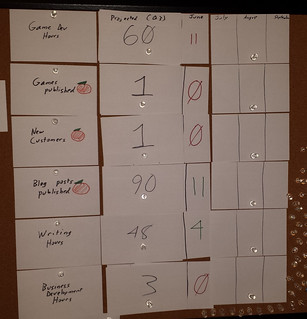
So I made a rudimentary scoreboard out of a corkboard and some index cards.
My Scoreboard

It’s on the wall across from my desk so I can look up and always see what my goals are and how I’m doing. I have a spreadsheet on my computer with similar data, but it requires me to open it and specifically look at it. This scoreboard, however, is easy to see at all times, which keeps my mind focused.

I have a day job, so finding time to work on my business is an important consideration, which is why I have a goal for the number of hours I spend doing game development, and I have another goal for time spent doing business development. If I don’t pay attention to my time, it’s easy for me to let opportunities to work on my business slip.

But just spending time on game development isn’t an end in itself. It’s meant to lead to the bigger goals, which are marked with a crude drawing of my logo.

I want to publish a game this year, and I want to gain at least one new customer from it. Why only one customer instead of a thousand? Because that first customer will be a major accomplishment, and I will move the goal posts once I do accomplish it.

I see my blog as a key part of my marketing, and so I have content goals for it, too. In the last two quarters I ignored my blog so I could focus on game development. I figured a post a month would be decent.

But for the next quarter, I want daily posts. My reason for the massive increase, which requires me to take precious time from game development?

It’s another way to keep my goals in front of me. I’ll write about my business, about my vision, mission, and purpose, on a daily basis, which means I’m consciously putting these things in front of me.

I used to do so by making a short post on my Google+ profile, but I thought, “Why am I giving my words to Google? Why not own the content myself?”

I don’t want half of the year to pass without me realizing it and without any change in my goals. My goals aren’t mere wishes. I know they require conscious effort to accomplish, which requires me to keep them in front of me, no matter how hard it gets or how many distractions there are.

I’ll adjust my scoreboard throughout the year. Each day is geared towards the week’s accomplishments, which are geared towards the monthly goals, which are in support of my quarterly goals. If I decide my goals need tweaking, such as the number of game development hours I spend, I’ll set a new target, and I’ll make plans accordingly.

For instance, last quarter I dedicated two evenings to game development in an effort to get to 100+ hours, but I found it was difficult to keep those evenings dedicated with a lawn that needed to be mowed and various other urgencies cropping up.

So I’ve scaled back to 60 hours because I believe it is doable while also giving me a reason to stretch. My productivity is very low compared to where I want to be, and even though 60 hours in a quarter isn’t very much at all, it’s more than I have been demonstrating. Last quarter I did about 48.5 hours, and the quarter before that was 43.25 hours.

It’s hard to accomplish much with so few hours. I’m aware that some people spend hours daily on their part-time businesses. For me, 5 hours a week would actually be an improvement, so that’s what I’m aiming for these days.

But if I didn’t keep these goals in front of me, it would be easy for my actual time spent to be near 0 hours a week because I wouldn’t realize the time was passing. I wouldn’t realize that half of the year had passed without much to show for it.

Instead, I’m able to look back and see what I accomplished in the last six months.

So how’s your scoreboard? Are your goals top of mind?

Categories
Personal Development Politics/Government

Independence Means Having Real Choices and the Opportunity to Make Them

In game design, balance is important. If you create a variety of options for the player to choose from, but one is superior to the rest, then the rest might as well not be in the game because the player will always choose the the best item.

Dominant strategies are often an accident. Whether it is a lack of play-testing or an oversight, designers don’t usually put them in on purpose.

But it is easy to see how the existence of a dominant strategy ruins things. Instead of having a lot of choices as the designer intended, the player effectively has none.

Technically you could argue that the player still has choices, and if he/she wanted to play with an extra challenge, it’s possible. People try to finish the original Legend of Zelda while collecting the minimum of upgrades, for instance:

But in most cases, the player is trying to optimize their play, and the existence of an always-optimal choice means the player is always going to make that choice.

There are also choices that are always terrible. They also might as well not exist because the player will never choose it over a superior option.

In real life, balance is not guaranteed. People make all sorts of choices in all sorts of circumstances.

For many people, these choices aren’t real choices at all.

For instance, who to vote for. While we seem to be gaining a U.S. presidential candidate every other week, eventually it will get pared down, with our two-party system causing many people feel like they only have two choices: bad, and worse.

Technically, they have two other choices: not voting, or voting third party. But many feel that these aren’t real choices. One abdicates responsibility, and the other feels like you barely doing any better since the majority of people think they only have two real choices and so your third party vote ends up having a negligible effect. You feel like you’re railing against the wind because not enough people joined you.

In other cases, the choices might be there; you just can’t take advantage of them.

In some countries in the world, practicing your faith is deadly. Talking about the problems of the government is deadly. Protesting is deadly. You could say that the citizens still have a choice, that they are independent, but it would take unusual courage and strength for them to stand against their oppressors. It’s heart-breaking. The door to the cage might be open, but those armed guards don’t look like they’ll let you walk through them unscathed.

In countries like Greece, bad policies have resulted in the majority of the population paying for the sins of a few major players. The people can’t leave the situation easily, and it is frustrating because the way out of the situation isn’t obvious.

It’s easy to take our independence for granted. People have fought for our rights for centuries, whether it was winning our independence from foreign enemies or our livelihoods and dignity from domestic ones.

People can complain about the President’s policies or the way Congress can’t seem to cooperate to put together meaningful legislation, and they don’t generally need to worry about retaliation from the government.

You can leave a job with terrible conditions and find another, or start your own business, or go on strike and demand better conditions. Yes, some choices here are more painful or terrifying, but not overly so. We as a nation frown upon monopolies specifically because the lack of real choice is seen as harmful. We get concerned when one company seems to be able to set their own terms independent of competition or the health of their workers.

You can change your religion, and aside from sharing in awkward family meals or attempts to make you feel guilty, the consequences don’t tend to result in a shortened life expectancy.

Sometimes the guards to the cage door are only ourselves. Maybe we’re blinded to the opportunities, or we don’t have all of the information to make an informed choice, or it takes more effort than we realize, or our circumstances make it difficult, or maybe we aren’t bothering to participate.

But we can fix or change any of those circumstances. We can learn more about the situation. We can make plans. We can get help.

Don’t waste your opportunities. Don’t take the easy route. Don’t go with the weaker strategy in life just because everyone else around you is using it.

Take advantage of your independence. You have choices, and even if it is hard to do so, you can make them.

Categories
Geek / Technical Personal Development

When Standing on the Shoulders of Giants Isn’t the Right Thing to Do

In almost any endeavor, you can go it alone, or you can get help. You can spend all of your time researching and practicing and tweaking until you figure things out, or you can buy a book or hire a consultant and have someone tell you what they have already figured out after years of his/her life were spent on the topic.

Leveraging the work that has been done by others is a shortcut, and it is perfectly fine to take them. If you want to learn how to do software development, you don’t need to build your own computer architecture, as you can leverage the existing Von Neumann architecture in most modern machines. You don’t need to start from first principles. Someone already figured it out, and you can take advantage of it.

This kind of advice is ingrained in our culture.

Don’t reinvent the wheel.

Don’t spend your time doing that task when you can hire someone to do it for you faster and at a level higher quality, which saves you time, too.

This is the way it has always been done, and it’s the best way we know.

On the other hand, sometimes we advance the arts and sciences by starting over and exploring our assumptions.

In Bret Victor’s talk The Future of Programming in which he pretends to be an IBM engineer from 1973, complete with transparencies and a projector, he talks about the problem of people who think they know what they are doing:

He starts out explaining the resistance to the creation of assembly code by the people used to coding in binary. Coding in binary WAS programming, and assembly was seen as a waste of time and just plain wrong.

He goes on to talk about exciting advances in programming models from the late 60s and early 70s, and extrapolates some tongue-in-cheek “predictions” about how computers will work 40 years in the future, predictions that lamentably did not come about. Today we still code much the same way people did back in the 60s.

Ultimately, he warns that there is a risk to teaching computer science as “this is how it is done”.

The real tragedy would be if people forgot you could have new ideas about programming models in the first place.

The most dangerous thought that you can have as a creative person is to think that you know what you’re doing, because once you think you know what you’re doing, you stop looking around for other ways of doing things. You stop being able to see other ways of doing things. You become blind.

Game design applies here, too. Video games from the 70s, 80s, and 90s were quite varied. People were figuring them out because no one knew what they were. They tried everything.

Eventually some key genres popped out of this period of experimentation, and some control schemes and interfaces became common. It’s hard to imagine real-time strategy games without Dune 2‘s UI conventions.

Five years ago, Daniel Cook wrote about reinventing the match-3 genre:

It occurred to me that game design, like any evolutionary process, is sensitive to initial conditions. If you want to stand out, you need to head back in time to the very dawn of a genre, strike out in a different direction and then watch your alternate evolutionary path unfurl.

When people think of a match-3 game, they have something in mind because all match-3 games tend to be similar. Triple Town ended up being quite different, yet it was still recognizable as a match-3 game, and people loved it.

Some people merely need to leverage existing infrastructure. People are using Unity for game development because, much like Microsoft’s XNA before it, it handles all of the boiler-plate for you, and it also provides a lot of the technical tools in an easily-accessible way so you can focus on the development of the game rather than the technical details of making a game.

But some people are pushing what’s been conventionally thought of as possible. Spore, for instance, had to procedurally generate animations for characters that weren’t prebuilt, which meant someone had to figure out how to do so. There was no existing 3rd-party library to leverage. The shoulders of giants here weren’t high enough.

I’m part of a book club right now involving algorithms. We’re reading Steven Skienna’s mostly-accessible book The Algorithm Design Manual, and it’s been enjoyable and challenging. I haven’t studied algorithms since college, and I kind of wish I could go back and check my notes from class.

But what bothers me when reading this book is the warning about trying to completely invent a new algorithm on your own. Skienna argues that most problems can probably be adapted by sorting the data or otherwise thinking about it in a way that an existing algorithm can solve it.

And he’s right.

But someone had to have figured out these algorithms in the first place, right? Someone saw a problem and had no way to solve it, so he/she came up with a way, optimized it, and published it.

But today I’m expected to just learn what they did and use it, and I feel like I’m being told to stay away from actually trying to figure out a better way on my own, as if all of the algorithms that can be invented have been invented.

And if I just want to solve particular existing problems, it’s probably practical advice.

But if I want to explore an entirely new kind of problem, what am I supposed to do with old assumptions and solutions? Square pegs don’t go in round holes, and I don’t think we want a future where we are taught that round holes are the only kinds of holes in existence.

Categories
Personal Development

Setting an Example by Your Actions

I was at a baseball game last night, and I was disappointed.

It wasn’t just because the Iowa Cubs blew an early lead and lost it in the end. It was because while I expect the major league players to give up on first base runs, I expected the minor league players to try harder.

In baseball, if you get a hit and think you won’t even get a chance to run to second base, you are allowed to overrun first base. That is, you don’t need to keep your foot on first base to stay safe. You can run past it, and so long as you don’t indicate that you’re going for second base, you just need to focus on getting to first base before the opposing team can force out.

In little league, we were taught that even if it looked like the other team was easily going to field the ball and get it to first base before you could get there, you run as fast as you can. They might make a mistake and throw it over their teammate’s head. They might panic because it could be close. It’s baseball. Anything can happen in baseball.

And yet, I watched time and time again as the minor league players kept slowing down before getting to first base, as if it was a foregone conclusion that they were out.

From my seat in the stands it might have been hard to tell, but it looked like a number of those plays were closer than their lack of urgency implied. If they gave it a bit more effort, if they hadn’t given up, how many base hits would they have had that night?

Worse is that there were all of those people in the stands, many of them children. They’ll see this example and take it with them to tee-ball or little league. And why not? It’s what the real baseball players were doing.

And that’s what was more disappointing than the loss. It was the example being set.

When Clint Dempsey tears up the referee’s notebook, he’s setting a bad example. He’s supposed to be the international veteran in that game, yet he acted like a child not happy that his parents are telling him that there are rules he has to follow.

When you show up chronically late to your job, you’re setting an example (by the way, Self, that was directed at you).

When you yell and scream at your spouse in front of your children, you are setting an example.

When you post petty, ugly, or hateful things on Facebook, you are setting an example.

And these examples send messages to people, mainly “This is how a real ______ acts.”

Fill in the blank with “baseball player” or “software engineer” or “Christian” or “partner in a loving relationship” or any role or position you can see someone holding.

How are you acting in your roles in life? If you were a stranger witnessing your actions day to day, would you be proud of the example you’re setting?

Categories
Game Development Personal Development

Learning from Game Development

Over a decade ago, while I was still in college, I went to my first indie game developer meetup. It was in a suburb of Chicago at a Starbucks, and it involved mainly people who participated in Dexterity Software’s game development forums, which are now the Indie Gamer forums. My first meeting’s minutes are still online: Indie Game Dev Meeting Summary December 2004

It was kind of a mastermind group. We showed off what we were making. Or rather, they did. I never had anything to demonstrate. I played their games and gave feedback, and we talked shop and set goals for the next month’s meeting.

Some people traveled from downstate to make it out to these meetings, which alternated between that Schaumburg Starbucks and the Dave & Buster’s in downtown Chicago.

I remember while packing up to leave one meeting I asked everyone, “How do I get better at programming?” At the time, I felt like I wasn’t making a lot of forward progress and it was mostly due to my lack of experience and knowledge.

I remember getting a few looks, there was a pause, and then someone said to nods of agreement, “Just…do it.”

It didn’t feel like very helpful advice, but I chalked it up to the idea that no one actually knows how they get good at something. When you are good at it, you don’t remember how you got there because your goalposts are always moving, and if you aren’t good at it, you don’t know how to change that fact.

Unless you ask, of course, and “just do it” actually is fantastic advice.

I learned C++ in college, but it was Visual C++ 6.0, and it wasn’t consistent with the C++ Standard, and I think I was taught wrong. I remember reading code online and not understanding why people were needlessly using “advanced data structures” such as vectors and sets. I taught myself BASIC on the Apple II c+, but programming in C++ was not fun or enjoyable.

But then I found some advice in the GameDev.net forums to read Accelerated C++: Practical Programming by Example. I bought the book, forced myself to read it from the beginning and do the exercises, and wouldn’t you know it, it turned out that C++ wasn’t so bad. What were considered advanced topics in college were introduced in the first few chapters.

I was still struggling to be productive with programming. I was challenged to find tools and libraries to make my job easier, and it is how I learned about a sprite engine, which I blogged about extensively.

I learned how to use libSDL. I succeeded at my first game jam when I attempted to work on Game in a Day, which was hosted by people at Garage Games. Kinda. I made something playable. It just wasn’t what I wanted to make originally.

And I learned a ton participating, including the first time I had an overwhelming sense of fear that I had no idea what I was doing and should stop, even though I had no rational reason for listening to this fear. I pressed on somehow, but I was shocked at how that experience challenged me. I didn’t expect it.

I had that almost tangible anxiety a second time, probably during my first Ludum Dare compo, but it was less powerful and I recognized it and pushed through it, and I haven’t felt it since.

I started finishing games. I built confidence in my abilities. When I read my old blog entries, I read about someone who struggled with focus and time management, someone who felt like he wasn’t putting in enough effort to learn and work on games.

But over the years, chipping away at ignorance made a difference. Today I’m seen as not only an expert in C++ but also in software development in general. I still find myself surprised by C++ today, though. For instance, sometime in the last couple of months I learned that I could forward declare more often than I thought I could.

A decade ago I couldn’t code my way out of a wet paper bag. Today, I could rearchitect a complete game halfway through its development without so much as a flinch.

Most of my experience and knowledge of software development came about due to my persistence with working on my own game projects. I did research on best practices. I sought answers to the problems I ran into. I wrote code outside of class and outside of my day jobs.

I just did it.

And while I might not have felt I was making a lot of progress on any given day, over a decade of such days resulted in a ton of growth.

It could be argued that a more focused effort with a lot more time dedicated to it would have been better, that I could have gotten to the same point years earlier.

But the advice would still be the same. You want to learn how to be a better programmer, artist, game developer, mathematician, engineer, or designer?

Just do what they do, and push through the “I suck” phase until you get the hang of it, push through the fear where you feel like you might choke and give up. Just do it, and even if you don’t figure it out today, tomorrow you’ll know how.

Categories
Personal Development

Do People Limit Themselves to Classes Like They Are in an RPG?

In an RPG, characters often have a class, which determines a large part of who the character is.

Often these classes not only tell you what role your character plays but also what the character’s limitations are. Fighters can wear most armor and wield most weapons. Clerics and mages can’t, but they usually make up for it with powerful magic and other abilities. Thieves and rogues aren’t usually very strong or know much magic, but they can be quick and resourceful, usually finding ways around the direct approach.

In real life, we often say things like, “I’m no good at math” or “I couldn’t draw to save my life”. Sometimes it is a matter of how our individual brains are wired. Pattern-thinkers get abstract concepts more easily than visual-thinkers, for instance. And for some, it is a genuine lack of interest.

But often it’s a matter of people limiting themselves, then declaring what they can’t do.

In Wizardry: Proving Grounds of the Mad Overlord, I used to have fun experimenting with the Change Class feature at the Training Grounds. I would create a character with not only a high strength but also a high IQ. I would create a mage, level up a bit to learn some higher level spells, then change my character into a fighter.

My fighter has to start over at Experience Level 1, but he/she retains all knowledge of spells from earlier time spent as a mage. Now I have a powerful character with some overlapping skills. My character won’t learn higher level spells, but he/she will eventually learn all of the spells up to the level of the highest level spell learned.

If you’re an artist, you’ve probably had people say to you something along the lines of, “You’re amazing, but oh, I’m not good at art.” You’ve been drawing all your life, perhaps, perfecting your craft, and these people are talking to you as if it’s some innate talent that allows you to effortlessly draw what you see in front of you.

I like to ask such people to draw a perfectly round circle. Often it ends up looking like an oval, and they say, “See? I can’t draw.”

Then I say, “If you did nothing but draw circles for hours, days, weeks, months, do you think you would eventually figure out how to make it rounder?”

Most people admit that, yes, they could see drawing a round, evenly-shaped circle as something they could probably figure out if they put in the effort and time.

And it’s how I demonstrate that we don’t have to limit ourselves to our professions or self-imposed classes. We can multi-class if we want. It might take more effort. If you spend eight hours a day working as a software engineer, you need to use the spare time outside of commuting, eating, and sleeping to get better as an artist, which would take longer than if you could dedicate all day to it.

But most of us don’t bother. I just wish most people would recognize it as a choice instead of performatively uttering their limitations.

Categories
Geek / Technical Personal Development

Learning about Art

Yesterday I went to the Des Moines Art Festival with my wife. Vendors from all over the country put their works on display and attempt to sell them, and the variety always amazes me.

There are oil, acrylic, or watercolor paintings. There are photographs. There are ceramic sculptures. There are wood carvings. There are metalworks, glassworks, and mixed media pieces. There are displays, frames, furniture, clothing, jewelry, baskets, kinetic sculptures, and plateware.

Some pieces are functional, and some are abstract. Some were gorgeous, and some were fascinating to look at. Some I could see having a place in my home, and some I could see never making it in through the front door. B-)

Almost all of them were priced outside of what I could afford, but it was still enjoyable to browse. It’s kind of like going through a museum and seeing what’s possible, and I found myself delighted by finding out about things unlike anything I’ve never heard of or seen before.

For instance, I learned about “scissor drawings”, and the artist explains how she creates her work in this video:

I learned what a skilled hand can do with wood, creating 2D art that looks three dimensional with no paint or dyes.

I learned about glass sculptures that look like architectural scale models.

I learned that some people are inspired by nature, found objects, inherited family heirlooms, and by abandoned places. Some people had artistic statements that were straightforward, some were general and vague, and others seemed to struggle with the idea of mixing commerce with art.

I had one conversation with an artist about the festival, and while I can’t remember exactly how she said it, she said, “One of the purposes of art festivals is to get people to be aware of what’s out there. It’s not all economics.”

So despite walking away with nothing, I feel I gained quite a bit simply knowing more about the artistry that’s out there in the world.

Categories
Personal Development

Please Grow Up

Last night, my wife and I saw the movie Inside Out, the latest Pixar film featuring the voices inside an 11-year-old girl’s head.

I enjoyed it, even though I wondered how much children might receive it since it seemed to deal with much larger themes than I can remember comprehending as a child. Then again, I don’t want to sell younger children short. I’m sure they can relate to dealing with feelings about their parents or friends, and I am willing to bet they understand more than I might expect.

During the credits, I saw this message:

This film is dedicated to our kids. Please don’t grow up. Ever.

The wording and punctuation is creeping me out. Put it in scary horror movie font, and you’ve got yourself a tagline for a slasher film about a murderous monster who targets kids.

Now, I get what they meant here. The appeal was for their children to keep their childlike wonder of the world, to avoid the idea that maturity means you can no longer play or be a goofball. And I’m all for that sentiment.

I want to see children express their creativity, explore their world, and feed their insatiable curiosities.

But they can grow up as they do so.

When I think back to my younger self, there are things I miss. Some things I don’t have time for because other priorities have taken over, and some I have made a conscious effort to bring back into my life. I don’t read encyclopedias in my spare time. Instead, I read with a focus, often looking up the thing I specifically want to know and diving deep into it only as far as I need to.

I used to doodle a lot, and I took two art classes in high school, but I let it go for a few years before picking it back up again almost 10 years ago. I now make a point of bringing my pencils and drawing pad to the weekly Team Trivia and draw the people around me.

But there are things I’d be embarrassed about. I don’t miss my awkwardness when meeting new people. I’m glad I’m more aware of the existence of an entire world around me because my youthful cockiness and self-centeredness would make it hard for me to get along with people today.

As you get older, you take on more and more responsibilities for yourself. It requires you to be ready for it, and some people struggle with the transition. For these people, getting older means never making time for enjoyment or learning because there is always work to do.

Being a grown-up doesn’t have to mean stunting your growth or stifling your dreams.

Categories
Personal Development Politics/Government

Revisiting Your Existing Knowledge

I went to a Catholic grade school which included kindergarten all the way through to 8th grade. There was no clear break between grade school and middle school. To me, I went to grade school, then high school.

Often when I tell people about my grade school experience, I realize that people get confused about how young I was, so sometimes I have to say that it was my grade school/middle school.

Now that that’s explained, when I was in grade school, I recall distinctly the lessons about the Civil War. I remember the teacher specifically saying that the war was not about slavery, that it was about states’ rights.

I remember thinking, “Oh! I didn’t know that! The little I knew about the war was North and South, the country splitting between free states and slave states.” Learning about the slave states that stuck with the Union was kind of like learning about a piece of trivia and reinforced the idea that no, it wasn’t about slavery specifically. It was about whether or not the government can tell states what to do.

And in the end, the federal government won. The United States of America is a single entity, not a bunch of individual states.

And I carried this knowledge throughout my life. Whenever the Civil War came up, this fact about the reasons for the war being about states’ rights as opposed to slavery came with.

When I visited a Confederate museum in Virginia, I hadn’t seen the war from the Confedrate perspective, and while the museum was tiny, it was full of uniforms, battle standards, carvings such as an engagement ring made from a peach pit, and all matter of fascinating pieces of history. I found no mention of slavery, and I was not surprised.

So after the tragedy in Charleston, South Carolina in which 10 people were shot in a church by someone motivated primarily by race, I found it odd when a few friends posted on Facebook about calls to remove the Confederate flag from the capitol.

They kept talking about racism and slavery, and I was confused because, after all, the Confederacy wasn’t about slavery, right? Calling for the removal of the Confederate flag seemed irrelevant after a shooting driven by hate.

Then this article in the Atlantic called What This Cruel War Was Over published some of the rhetoric and public documents prior to the war.

Oh. It very much was about slavery.

It was about slavery, and it was about White supremacy. The election of Abraham Lincoln with his party’s radical agenda of stopping the spread of slavery was in direct opposition to the desire of leaders in the Southern states to spread slavery into the larger empire of America, which touches on our tensions with Mexico in a way I never saw before. The end of slavery would mean that Blacks would be bizarrely considered equal to Whites, and if that happened it would be the end of civilization as we know it. Even when the Confederates realized the rest of the world wasn’t so keen on helping their cause and so diplomats tried to spin it as states’ rights, it was abundantly clear by the writing and opposition that there was no reason for people to feel embarrassed about slavery, that it was actually a force of good and they should be proud of what it has accomplished.

It was about slavery. That people think so is not perversion by extremists. It isn’t miseducation. It’s part of the historical record, and it isn’t interpreted as it is part of the primary documents we have about the war. To the extent it was about states’ rights, it was the right of states to continue keeping a good number of their population as slaves in order to ensure equality among Whites. It’s an odd thing to today say is part of your proud heritage, and I now understand why people conflate slavery, White supremacy, and the Confederate States of America a lot more closely than I thought they deserved.

And I look back on my grade school days and recognize some of the things I’ve learned since. I remember a high school teacher informing our class that most text books are published by Texas and have a certain point of view built into them. Lies my teacher taught me, indeed.

Now, I’m from the Northern part of the country. In my mind, I always thought WE won the civil war. I identify with the Northern states despite the fact that I was born to immigrants over a century later and have no direct tie to the war. I can only imagine how painful this kind of knowledge can be for people who identify with the South, or who have ancestors who held such views and proudly fought for them.

There are things you learn from a young age, and you never think to question it because it just was. You have a base to build your knowledge on.

And then you find your base is a lie or wrong. It can be difficult because you feel like you are starting over. If that base was wrong, what about everything built on top of it?

But when is the truth ever not the goal? You know, when cynicism and duplicity aren’t involved?

Sometimes your continued education in life isn’t isolated to gaining new knowledge. Sometimes it is about relearning what you thought you already knew.

Categories
Personal Development

Consciously Consuming Information Every Day

When I was a child, my parents bought encyclopedias.

Plural.

We had Funk & Wagnall’s, which is still fun to say. We had Charlie Brown’s ‘Cyclopedia, which is where I learned about fun facts such as Laika being the first animal in space and what the Great Pumpkin is. We had a science-oriented one with cool projects to do at home and great illustrations.

We never had Encyclopædia Britannica, even though it was a household name:

The weird thing was that one day I decided to read them.

The illustrated ones were easy to read. Charlie Brown’s ‘Cyclopedia even had comics in them.

Funk & Wagnall’s was a bit more dense, and I don’t think I got past A, but the books were always around to look up various facts. When I played Illusion of Gaia and learned my character had contracted scurvy from being on a raft for a very long time, I looked it up and found out it was a Vitamin C deficiency. There was even a picture of a hamster with scurvy, which I still see in my head whenever the topic of scurvy comes up.

The point is that I was very privileged to have access to a local library anytime I wanted it, and I don’t know what the catalyst was, but one day I decided to actually consume it. I learned a lot about my world from a young age.

I know some people prefer not to read because they find it to be a pain and a struggle. But there’s always audiobooks. There are documentaries. Between TED talks and conference presentations, videos on YouTube, MOOCs, and podcasts, there’s plenty of information out there for you to learn from.

Of course, now you have a firehose of it, which means you need to be selective. You can’t consume it all. You’d have no time left for you to process it or make use of it or otherwise do anything in the rest of your life.

I listen to audiobooks on my 20 minute commute to the day job. I read at night before bed. In the morning, I might listen to an interview or read a magazine.

The topics are varied: personal development, business, software development, fantasy and science fiction, autobiographies, history, science, and more.

And since I can’t afford to own so many audiobooks, I’ve been taking advantage of my library card.

Let’s see. This is the…

$ date +%U
25

…25th week of the year. To date, I’ve consumed 29 books in some form or another, which means I’m well on track for a book a week, which is my goal.

And it doesn’t feel like it has taken up a huge amount of my time.

But I did make a conscious effort to consume good information. I didn’t necessarily pick a topic I wanted to learn more about, although I can see doing so to get deeply immersed in it. I picked audiobooks that seemed interesting off the shelf, and even the ones with narrators who cause my teeth to grate have been fascinating.

I know more about how the brain works, how modern urban living was made possible, and how chess evolved and spread. I learned who Shakespeare was and how little we know about him. I learned about the potential reasons why people think that young boys are in trouble today, ideas on how to raise children to be more aspirational, and on the science of thinking. Throw in some heavy physics and a light-hearted set of observations from the vantage point of a number of different people, and it’s not a bad amount of education in a year.

And I’ve still got six months to go, and I’m not even including all of the information I learned from magazines and podcasts.

Consuming all of this information doesn’t just mean I’m better at trivia night at the bar. It means I’m more informed. I can make connections between pieces of knowledge, which means I am more creative. I can understand the world better, which means I can navigate it more easily.

I was really privileged as a child to have access to so much information in my home. It helped me feed my hunger for knowledge, and today I make an effort to read or listen to something each day because that hunger is still there. I’m still curious about my world, and wouldn’t you know it, people have been nice enough to document it for me in an easily-consumable form.

Why not take advantage of it?