Categories
Game Development Games

Aim for Purposeful Artistry, or “Just Be Games”?

Jay Barnson recently wrote Art. Or Not. He drew some parallels between science fiction and indie games. He talked about how older pulp fiction was how many great authors got their start, and some of their short stories became culturally relevant, and some of the authors became bigger names.

If I understand his argument correctly, he believes that they created art without specifically trying to do so, that the designation of artistry came later, after the authors tried to create good reads for the buying public.

The point is… many of the “classics” – the “masterpieces” that are held in such high regard today were simply yarns spun to pay the rent by these authors. Between a combination of good writing, good editing, a story that resonated with the audience, and possibly a healthy dose of good luck, these stories and serialized novels went on to become standards of excellence in their respective genres. The authors certainly did their best to make a great story, but I doubt they set forth with a prevailing desire to create “Art.”

Now, he separates “art” from capital-A “Art” without explaining too much about what he means, but I think it is safe to say that there’s a judgment call being made here on what he thinks counts as legitimate art versus art made out as more important than it really is.

In any case, while Barnson says he isn’t opposed to games having deeper meaning, he is concerned that indies are aiming to make games that are less like games and more like other, more traditionally accepted art as an attempt to make games relevant to critics, such as the late Roger Ebert, who is infamous for declaring that games can never be an art form unless they become more like movies.

Creating great art is difficult, no matter what the medium, but I don’t believe there are any problems with people trying to create art out of game mechanics.

I think one of the things that is difficult as an indie game developer trying to make culturally important works is that there is a perception that games are supposed to be fun, time-wasting playthings for children. To purposely make games that aren’t meant to be fun is hard for a lot of people to get their heads around. Games that aren’t fun sound like bad games to many players.

If you expect to play a game like Brenda Romero’s Train and think you’ll have the type of entertaining experience as when playing Ticket to Ride, you are going to be incredibly disappointed.

But the idea that video games can be more than merely fun is not a new one. Chris Crawford once gave a GDC talk about how, at a higher abstraction, entertainment is what games should aspire to. Fun is just one way to entertain.

As for aiming for art as opposed to letting “games be games”, why does it matter what purpose someone has for creating a game? Why does it matter who they try to please? If you’re an indie, who do you have to answer to but yourself?

F. Scott Fitzgerald was once quoted as saying “An author ought to write for the youth of his own generation, the critics of the next, and the schoolmasters of ever afterward.” He wasn’t writing to make money and leaving the question of his artistry to others.

So what about the idea that you don’t purposely try to create art, that it merely become so later? I don’t think it is necessarily the best way to go if you want to use the medium of games to create art. And some people specifically want to use the medium of games to create art. Or Art.

I’m with Jay on the idea that games are their own medium, that you don’t have to try to make them seem like other types of art. Games have their own strengths, and ignoring them would be much like how early filmmakers tried to record live theatre productions and not realizing how much more they could aspire to.

If you’re trying to make a commercially successful game, go ahead and try to please people, specifically your customers. But in most other endeavors, trying to please other people is a sure-fire way to kill what you’re trying to do with compromises.

If the creator of a game designs it to be art, it’s hard for me to argue that they are not trying to please their true audience.

Categories
Games Marketing/Business

On Free Games, the “Gamer” Label, and the Health of the Game Industry

My friend Gregg Seelhoff wrote a rant recently called You Lost Me at Buy.

He describes a dinner in which another person immediately rejected a game outright because it isn’t free to play.

We live in a world where there are a glut of freely available games, and a lot of them are high quality. It is perfectly within someone’s right as a customer to not be a customer, and businesses are not entitled to customers.

Still, it can be quite a shock to have someone immediately dismiss your game on the basis of the fact that they had to pay for it.

Now, I don’t completely agree with his first point, that games should not be free.

While most games make almost nothing in this new business model, it is kicking butt for some, and it is changing customer expectations in a disruptive way.

It’s painful for developers who expect to be able to sell games for a living, but if other developers are not only willing and able to release their games for free but also make a good living from it, that’s just a different business model.

It would be like saying that games should not be available through download because people should buy their games at retail through real stores. There’s an entire business model based upon selling at retail, with all of the partnerships and deals and overhead it required, and the Internet heavily disrupted that one well enough. I don’t think we’re going back to that world.

Still, years ago, casual portals and online retailers were lowering prices for games in a race to the bottom. It was a worrisome trend, and some of those portals are gone today, but what happened to customer expectations?

Is it healthy for the game industry for players to by and large expect their entertainment for free or nearly free? Maybe it is even healthier, as counterintuitive as it sounds.

Last year’s Penny Arcade Report by Ben Kuchera How Valve “devalued” video games, and why that’s great news for developers and players mentions how Valve and indie developers found their revenues increase dramatically when the per-unit price of their games was lower.

Ok, so developers can make more money, but does it impact the value players put on individual games?

Again, we live in a world where there are a glut of freely available games, and a lot of them are high quality. Sales and low prices aren’t necessarily devaluing games. It might just be the fact that players have a large backlog that they factor into their buying decisions.

Mike Ambrogi of Final Form Games says:

“[We] don’t believe sales are driving prices down; extant downward price pressure caused by a market surplus results in these sales becoming an optimal strategy.”

Selling games at a higher price point shouldn’t be dismissed as a stale view, though.

I think the bigger question is if there is room for games that can charge more. What are the real expectations for a game that costs $0.99 versus a game that costs $25.99? Are those latter games relegated to niche genres with fewer customers, or games which are more hobby than time-waster?

Is there still a unsustainable race to the bottom, or is the market being shook up, forcing out those who can’t make high quality entertainment with a low price point?

Since so many people can make games today, so many people are, and there are definitely a lot of mediocre games being made and published in the same space as the high quality ones. You can’t easily discern and find them, which is why app store top 10 lists are so huge for publicity, even if they aren’t a guarantee of success.

I’d like to think that people would be more willing to pay more for an epic-sized game rather than sit through ads or depend on big-spending whales to support their entertainment. The latter smacks too much of publishing a bunch of games in the hopes one becomes a hit and pays for the rest.

Finally, Seelhoff’s point that every interesting person plays games is spot on.

Just because a game does not involve a console and game controller, and shooting people on screen, does not make it any less of a game. Lots of people play Call of Duty, but ridiculous numbers of people also play Candy Crush. I do not like to segment people into hard-core/mid-core/casual/social/live/whatever gamers; they are all gamers. Please enjoy Pretty Good MahJongg and Demolish! Pairs, but do not tell me that you are not playing a game while doing so.

I can’t believe people still think “Oh, I don’t play games” just because they are not light zapper-holding 13-year-old boys who are into ninja turtles and M.C. Hammer. What year is this, seriously?

If you’re playing a solitaire game on your computer, you’re playing a game. The same goes for boardgames such as Monopoly and Scrabble. Words with Friends on your mobile device counts, too.

So by all means, play games. Why do people keep insisting to act as if there is shame in playing games?

Categories
Games Geek / Technical

A Reminder that Gaming Is as Old as Civilization

One issue that comes up periodically is that some game designers who grew up in the last couple of decades tend to look at game design through the lens of past video games.

When they think about game mechanics or themes, they might take cues from past video games that they loved.

But every so often, we’re reminded that games have been around for as long as people have been, and we have a much richer history if we dig past a form of media that has only been around for mere years.

Oldest Gaming Tokens Found in Turkey from Discovery News reports that 5,000-year-old game tokens were found in Bronze-Age burial mounds.

How neat is that?!

The tokens were accompanied by badly preserved wooden pieces or sticks. Sa?lamtimur hopes they’ll provide some hints on the rules and logic behind the game.

“According to distribution, shape and numbers of the stone pieces, it appears that the game is based on the number 4,” he said.

With something that old, and no one living to explain how to play, I imagine it would be quite the mystery to solve.

But imagine creating a game back then? Carving your own pieces with no one to tell you that you’re reinventing the wheel and should focus on the game instead… B-)

Categories
Game Design Game Development Games Linux Game Development

June #1GAM: Half an Hour and a Lovely Bunch of Coconut Trees

Yesterday’s post about my June #1GAM mentioned my huge island to explore and new coconut tree sprites.

After just half an hour yesterday morning that I didn’t think I’d actually take advantage of, I have animated coconut trees:

I intend for the trees to animate when the Castaway shakes them in an attempt to knock down coconuts, but for now they dance in unison in a poor imitation of Super Mario World.

They aren’t pretty animations, but then I’m just making programmer art over here.

Categories
Games General

What Is Wrong With Internet Society? #BeBetterStewards

I know the Internet magnifies the amount and scale of abuse, especially in terms of misogyny, homophobia, and racism.

It’s disgusting, and it has resulted in the silence of some great people, such as Kathy Sierra, and makes it more difficult to bring intelligent and grown-up conversation to sometimes (often?) immature game industry the way people such as Anita Sarkeesian do.

But I had no idea the mindset of the stereotypical 11-year-old, entitled Halo player who loves to curse into his headset had made it into the realm of indie games and the customers who pay for them.

Cliff Harris wrote Who Would Be a Game Developer?, a post about how indies not only have to do the hard work of making a living making games but also seemingly must endure abuse at the hands of fans and customers. Apparently customers are threatening the creators of the games they paid for with extreme bodily harm and a destroyed life.

It’s bizarre posturing from the safety of a keyboard.

But it feels like another offshoot of problem fandom that seems to be everywhere. From comic and game conventions where women, homosexuals, and rape victims feel unwelcome to “you’re not a real geek/gamer/Doctor Who fan/etc” arguments that tend to be aimed at women to a culture of privileged misogyny that creates online communities in which only white, male heterosexuals ever feel welcome, it’s an ugly thing that is highly visible to everyone else.

Even if a large number of the people think it is just good-natured, “oh, you guys!” kind of Internet joking, it has real repercussions. If it happened rarely and in isolation, it would probably be enough to tell the people who are the victims of this kind of abuse that they can ignore it and get a thicker skin and don’t worry about it.

But it doesn’t happen rarely. It’s a fact of life for a lot of people, and we shouldn’t tolerate it.

There’s an entire vocabulary around these kinds of issues:

  • Privilege. If you have it, you’re probably unaware of it. And if you’re unaware of it, it’s hard for you to understand that other people who don’t have it also don’t have the same advantages and paths through life that you do. We’d like to think that the world operates to reward merit, but for many, it’s not enough due to systemic issues. If the system benefits you, you don’t necessarily know it is there and how it has impacted your life. It’s kind of the equivalent of being born on third base and thinking you’ve hit a triple. If it hinders you, on the other hand, it’s really obvious. You’ve probably seen John Scalzi’s Straight White Male: The Lowest Difficulty Setting There Is, and here’s an article about privilege in geek culture. There’s also this article about someone who acknowledges the role privilege played in developing his talents as a programmer versus other classmates who didn’t have access to computers or had the lack of responsibility that allowed him to spend the time to work hard on learning it.
  • Rape culture, which also brings up terms such as victim-blaming and slut-shaming. If you got raped, you were probably asking for it. Why were you wearing those clothes or walking somewhere by yourself? Don’t you know that it’s not possible for people to control themselves and act as humane individuals? Crap like this is the obvious set of examples.
  • Panicked male, an example of which Scalzi recently tongue-in-cheek critiqued.
  • Moral relativism. If you’re about to argue, “But there are worse things in the world, so why are you complaining about XYZ?”, your thinking is bad. Yes, there are worse things in the world. If you want to discuss those worse things, I’m sure you’ll find people willing to do so, as the Internet is big enough for those kinds of discussions. But if someone is talking about an issue they find important, you can opt-out of the discussion, or you can participate, but you can’t say, “Hey, you can’t talk about it because it isn’t as important as world hunger or terrorism.” A systemic problem has been identified, awareness is being made, and you think that we as human beings can only focus on one problem at a time? Stop selling yourself short.
  • Deflection and silencing. A lot of the so-called arguments against concerns about inappropriate jokes and the culture it perpetuates aren’t addressing the issue seriously. They tend to be statements that attempt to quiet the person making the concerns known. If someone says, “I think this game is sexist”, any response that has the intent of coercing that someone into never bringing it up again is not healthy. Saying that someone is being over-sensitive or to lighten up are examples.

If you want humor with your education, see Film Crit Hulk’s GODDAMMIT VIDEO GAMES: THE FIRST FEW HOURS OF ARKHAM CITY IS LOTS OF FUN, BUT SUPER-DUPER SEXIST and part 2 (because it is almost required to do a follow-up when you call out stuff like like this), HULK VS. ARKHAM CITY – ROUND 2: BITCHES BE TRIPPIN’!.

What’s really scary is the undercurrent of violence and dehumanization. There is a lack of empathy, and it seems to be almost nurtured into the culture. When a woman is raped, we have television personalities saying she was asking for it, and almost no talk about how the rapist shouldn’t have been raping. And if the guy on TV thinks it, it’s likely the viewers are going to think along those same lines.

Similarly, when prominent figures in the video game industry laugh off, tolerate, or perpetuate misogyny, homophobia, and racism, their fans are likely to fall in line right with them. And when it is part of the marketing and game development, it’s worse.

The Internet brings a previously-unheard-of-number of strangers within communication distance, and while many people take advantage of it to make the world a more understanding and intelligent place, there is unfortunately a loud and obnoxious segment of the population who think extreme violence is super effective at getting their way.

And the more they see and hear each other, the more accepting of that behavior they become. And while most think they are having good-natured fun, occasionally a few think that actual violence is called for and accepted behavior.

So it is gratifying to see people within the industry call out the B.S.

The nature of the Internet and human nature is that we tend to be attracted to those who are like-minded. Talking with someone who has new and different views is a lot harder, especially if those views are opposed to your own.

But we all live here. I think the least we can do is try to have some empathy and consideration instead of dismissing someone else out of hand.

If someone does do something inappropriate, speak up. Show this person that you won’t tolerate it.

We need to be Be Better Stewards, as Corvus Elrod has so eloquently and succinctly put it. We need to call out the bad in a constructive way, and we need to praise the good.

Because what we say matters and has power.

Categories
Games Geek / Technical Linux Game Development

The Linux Game Tome Is Shutting Down

A few months ago I wrote about how it is so difficult to submit games to Linux gaming sites, based on my experience with trying to spread the word about the latest update of Stop That Hero!

One of those sites is The Linux Game Tome. It was one of my favorite Linux gaming sites, and had an active forum for developers and players, as well as an IRC channel.

In recent times, it has been plagued with spam and hardware issues. Twice it had been down for months due to a faulty hard drive, for instance. These problems resulted in a lack of activity when it was finally back up. When they updated their forums last summer, it broke the ability to submit games to their database. To this day, Summoning Wars was the last game with an update in June of 2012.

Last month, there was a new post, however, and it wasn’t good news for fans.

The Linux Game Tome will shut down on April 13. Those of us who have maintained happypenguin.org over the years now lack both the time and the ambition to do what is necessary to keep the site afloat.

A later update provided a link to a dump of the game database, all 300+ MB of it, with the idea that someone might be able to recreate the site if they so choose to do so.

Since then, two forums have popped up about how to carry on without the original site operators. One is Resurrecting the Tome, and the other is The Linux Game Tome Ideas and Discussion. I’ll be interested in seeing what comes out of these discussions.

While my new favorite site is the active Gaming on Linux, The Linux Game Tome holds a special place in my heart. I thank Bob Zimbinski, aka bobz, for all he had done, and I wish him luck in whatever his future ambitions are.

Categories
Game Design Game Development Games Linux Game Development Personal Development

March #1GAM Entry: The New Worlds

I did it.

I thought I had a design that was a bit too ambitious, but I somehow managed to finish my March entry for One Game a Month.

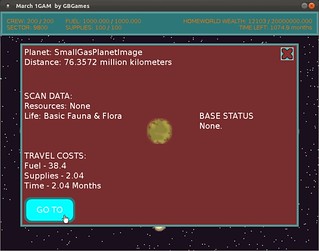
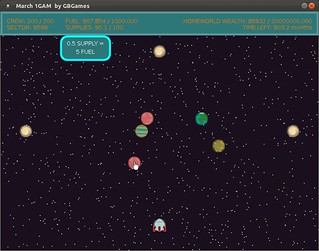
“The New Worlds” is a space exploration game. Your homeworld’s star is known to go nova eventually. Evacuating everyone is the only option, and evacuation is expensive. Explore the universe, set up bases on suitable planets, and increase the wealth of your homeworld before time runs out.

Download The New Worlds for Linux 64-bit (547 KB tar.gz file)
UPDATE: A 32-bit Linux version is available now. Download The New Worlds for Linux (543 KB tar.gz file)

I’ll have to write up how it all happened later, as I’m rushing off to see family this weekend. I had to cut back on features, such as setting up trade with alien civilizations.

There’s still at least one major issue with the game play. It’s entirely possible to run out of fuel and supplies and have the game continue to run even though you can’t do anything. You can’t go anywhere. You can’t wait to die. You can’t scrounge for supplies as it was a feature I didn’t have time to add even though I really wanted it.

I want to come back and address this issue, although the next time I touch this code I’m sure I’m in for a shock. It’s horrible and ugly and I hate myself for writing it. B-)

Still, it’s playable, and it’s possible to lose and win. And it is fun exploring and trying to survive in the universe.

March1GAM-14

March1GAM-15

Categories
Game Development Games Geek / Technical Linux Game Development Personal Development

February #1GAM Entry: Electomagnetic Play

I managed to put my February entry for One Game a Month together mostly in the last couple of weeks, sometimes with only 15 minutes at a time to dedicate to working on it. It’s amazing how much comes together in 15 minutes.

Electromagnetic Play is currently only available for 64-bit Linux as I wanted to get it in under the deadline. I’ll work on ports later when I have some time.

Download Electromagnetic Play for Linux 64-bit (1.5MB tar.gz file)

A quick description of the evolution of the game.

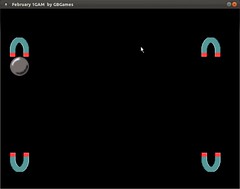
I thought of having magnets that you use to move metal balls around an arena.

February 1GAM

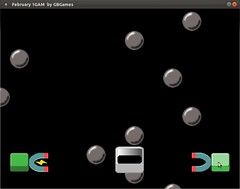
Eventually I decided on a simple game in which you have to catch the balls in a metal bucket, and you can only move the bucket by charging magnets on either end.

February 1GAM

Once I had balls dropping and magnets charging when you clicked on the green buttons, I had something that was basically finished.

February 1GAM

Add some scoring and lose conditions…

February 1GAM

…and tweak the challenge a bit by level, and we have a game.

February 1GAM

Categories
Game Design Game Development Games Geek / Technical Personal Development

12 Games in 12 Months #OneGameAMonth

OneGamePerMonth

It’s mid-December, which means people are remembering their New Year’s resolutions and rushing to accomplish them before 2013 rolls around.

Last year, I managed to release the Stop That Hero! alpha after many months of delay. This year, I similarly managed to get the next update out a few months ago after many months of delay, and it still hasn’t been ported to the Mac. Otherwise, I have a couple of Ludum Dare games under my belt. One of my aspirations is to be a prolific game developer, and this is not a good track record.

Ludum Dare has three main compos during the year (one is this weekend!), but each month in between features a miniLD with custom rules by whoever is hosting. I have been considering making it a goal to participate in each of these miniLDs if only to get 12 games in any given year.

Chris Kaitila, aka McFunkypants, wrote 12 games in 12 months about his experience in the last year attempting to make at least one game a month, so it seems I’m not the only one with such aspirations.

I set out this year to prove to myself that not all game projects need to stretch on for months or years. It was a battle against the featurecreep and code bloat that I’d suffered from for years as an indie gamedev. I’ve started so many more games than I’ve finished in the last 20 years.

From assembly language “hello worlds” to BASIC choose-your-own-adventures without an ending. From to Turbo Pascal Tron lightycles games, to Visual Basic prototypes so woefully buggy and half baked they weren’t even worth backing up. From unpolished (but complete!) C++ openGL shooters with only one level to Adobe Director (shockwave) horse-racers with no finish line. From php sports simulators with broken AI to html4 multiplayer chat worlds with server problems.

Looking in my Projects directory, I see that my unfinished 0h Game Jam about a horse race with no finish line. Hmm.

Now, Kaitila has a broader range of experience with tools and engines than I do. I could probably stand to get outside of my C++/SDL comfort zone, but the risk is taking the time to learn something new versus using what I know to work on games.

But he found that it’s easy to get sucked into a never-ending project, one that quickly stops being fun to develop, and so becomes one that never gets finished. I’m sure we’ve all been there. There’s a lot of discipline involved in game development, which isn’t obvious to anyone who hasn’t done it before.

So what can you do? Reduce scope! But feature creep is always a problem. Set short deadlines! But projects always have a way of taking more time than you planned.

Kaitila’s answer to both: game jams.

Instead of getting involved in a long marathon of game development which might force you to choose between your health/family/friends and your project, you run little sprints. Ludum Dare’s 48 hour compos and miniLDs are perfect. There are also other game jams throughout the year, such as Meaningful Game Play Game Jam and 0h Game Jam held during a missing hour due to Daylight Savings, so there are plenty of options.

Like daily workouts, each game project made me stronger. Faster. Better.

You can do this too. Challenge yourself to make a game a month this next year. Let this be your new year’s resolution. I’m going to do it all again in 2013. One game per month, on average, and a dozen finished products by the end of the year.

I’m issuing a challenge to all my gamedev friends: join me in the epic quest. It CAN be done. You don’t have to be hardcore, insane, or obsessed. Join me in the gameamonth challenge. We can help encourage each other.

If you have a Twitter account, you can sign up for the One Game A Month challenge. It’s like a game for game development. You get XP for each new game you post, and people who sign up before January 1st get 100 early adopter bonus points.

I’m in. Are you?

Categories
Games

The Response to the Humble THQ Bundle

What I love about the Humble Indie Bundles is that they are DRM-free, allow me to pay what I want, and the games are available for GNU/Linux, my preferred platform. The people behind it were involved in Wolfire Games, and I reviewed Lugaru years ago for Game Tunnel, so I was familiar with them. Even though the Humble Bundle company is now spun off and has serious investment behind it, it still felt like a great vehicle for publicity, sales, and altruism for indies.

I was surprised to learn about a new Humble Bundle while catching up on my game news. I normally receive emails from the people behind it. I even received emails when they tried branching out into ebooks and Android titles. I never received an email for their latest so-called “humble” bundle, though, and it’s probably because I’m registered as a Linux-based customer.

Humble Bundle Not So Humble

I first read about it in Ben Kuchera’s Penny Arcade Report article “The Humble THQ Bundle loses indie games, adds DRM, and is a step backward for the bundle model”. Kuchera writes about how this new bundle offers nothing that previous bundles were loved for, even pointing out that THQ no longer employs most of the people who made the games in the first place. This year alone there were reports of over 200 layoffs.

But here’s what really bothers me about the article. After lamenting the return to DRM, the removal of platforms, and the lack of indies, and stating “this is a move in the wrong direction. None of the things that make a Humble Bundle great are present. Instead we’re presented with what amounts to a Steam sale”, Kuchera says:

I’m going to be a hypocrite and buy a bundle, just because these are incredible games at a staggeringly low price, but wouldn’t it have been something if they were offered without DRM? Or if they ran on Linux? Or if the space was used to promote games that hadn’t already sold millions of copies? This isn’t a bad deal, but it’s certainly a step away from what made Humble Bundle so unique. If this is the sort of thing we can expect to see in the future, the Humble name could quickly become just another cut-rate digital retailer pushing catalog titles. Humble Bundles should be something special, and worth getting excited about.

The way I read that section: “Outrage! This is horrible! But I’m going to support its success so it has a better chance of happening more often.” Yes, it is hypocritical. Considering how over half a million bundles have been sold in only a couple of days, making it the most successful Humble Bundle yet, it’s clear that there’s a lot of people who don’t mind this Steam sale at all, but why add to their numbers if you don’t like it? Why support the “step backward”?

I’ll also call out Juuso of GameProducer.net for his Us vs Them: The New Humble THQ Bundle Case.

When looking at this offer only, it’s irrelevant whether there has been previous bundles or not. Whether previous bundle had Linux games or not, is totally irrelevant when it comes to evaluating the current offering.

If I’m having a good day today, it’s irrelevant whether I had a good or bad day yesterday. I can be happy about today, even if was shitty day yesterday.

Similarly, I can objectively look at this bundle offering, and determine whether it’s a good or bad.

I’m not quite sure where he is going with this argument. The past is irrelevant to today? There are no consequences you’re experiencing today as a result of actions from yesterday? If a company is known for being one thing does something that seems the exact opposite of what they should, I’m supposed to ignore it and pretend that it’s a brand new company? He continues with the oddness:

Equally well we could turn it around. Imagine that all the previous bundles were AAA, windows-only, DRM games — and you bought none of them.

And then comes a new bundle. If the new bundle offers indie, windows+linux+mac, no DRM games, would you not buy “because previous bundles were windows only”? To me, that makes no sense.

No, it doesn’t make any sense. Let’s take that last argument and really think about it. In reality, if such a bundle came along, I could see people deciding to buy it to support this step in the right direction. The idea that this example is the same thing at all is bizarre.

Now, I’m coming at this from a different perspective. Juuso doesn’t care that Mac and Linux were supported. He doesn’t care about DRM. He doesn’t care that the bundles have been good for indies. The Humble Bundle, to him, was just another option for getting good games at a good price, and so that’s his main criteria for evaluating this latest bundle. To him, everything else is irrelevant, and so sure, he finds the arguments against this bundle irrational.

For me, the Humble Bundle meant something else. It meant supporting independent developers. It meant explicitly not supporting DRM. It meant supporting more Linux-based games. It meant supporting charities and non-profits doing good work (it still bothers me when the EFF is not listed in a given bundle). The Humble Bundle brand made a difference. Up until now, I knew that if they were offering a new bundle, it supported all of these things, and I was happy to support them.

In contrast, I haven’t participated in Indie Royale sales or cliffski’s Show Me the Games because they almost explicitly don’t support Linux players, for one. I don’t have Steam on Linux (yet), and so I’ve only heard about the flurry of sales they always have. It’s great for you if you have a Windows-based system to play on, but irrelevant to my interests.

So let’s evaluate this bundle independently of the previous ones. I’ll use the same “facts” that Juuso used:

I get to pay whatever I want ($1 or more)

Ok, just like in previous bundles.

I get several games from a company who has paid & owns the rights for those games.

Sure, I like supporting the idea of buying the games from a legitimate and legal source. I’m not paying someone selling fake copies on a street corner.

But who is that company? Do I want to support THQ? I think that’s a legitimate question. Later in his article, Juuso asks if it would have made a difference if EA did it. Yes, I think that’s also a legitimate question, considering how many layoffs and reported bad practices there have been in the past.

I can decide the amount that charity will receive
I get to decide the amount that bundle creators receive

Here is a bit of redeeming news. Even if I have to pay a minimum of a dollar to be a hypocrite, I can decide that all of my money goes to charity, or at the very least, that none of it goes to THQ or to the Humble Bundle.

There’s DRM.

Oh, that’s a deal-breaker for me. If I paid for a game, I expect that I won’t have trouble trying to run it, and DRM is nothing but an impediment. Even if I want to try to play Windows games on my Linux-based system through Wine, paying for DRM is paying for me to have a tougher time. I don’t care how good you think the games are. The hassle is not worth it to me, and I don’t support such a draconian practice if I can help it. And I can help it here by not purchasing. I vote with my dollars by not being a hypocrite.

These are Windows-only games

Also a deal-breaker for me. If I have to reboot into Windows to play, I’m not likely to do it these days. I rarely have to use Windows, and I’m not paying for the privilege of encouraging me to do so. If I can’t play on a platform that is convenient for me, it’s a problem. It’s hard enough getting my older games to play on my modern system. I’m not interested in paying for more difficulty with simply getting the game to work.

As a GNU/Linux user, my experience is likely different from a Windows-based user’s, but I hope you can see that these aren’t irrational arguments against the newest bundle. You might think it is irrational for me to expect to play games when I use a Linux-based system, but see, that’s the thing. The Humble Bundle was responsible for many indies making their games available for me. I didn’t care if the latest major first-person shooter involving World War II or space marines wasn’t available for me to play. I did care that games such as Braid, World of Goo, and Gratuitous Space Battles were available. The latter game would NOT run in Wine, and cliffski has made it clear that he didn’t care much about Linux before. Since Humble Indie Bundles required that you supported Windows, Mac, and Linux, I’m grateful that I could finally play his amazing and innovative game.

Since I can’t play THQ’s games without encouraging DRM and a lot of effort, I’m not going to support this latest Humble Bundle. It would be irrational and hypocritical of me to do otherwise.

What’s your take? Do you find this latest bundle to be a good development?