Categories
Marketing/Business Personal Development

SIC 2008 Pics Are Up!

I uploaded my pictures from SIC 2008, and you can view them on Flickr. There are images of my exploration of Boston since I arrived a day early. The actual conference takes up the lion’s share of the images.

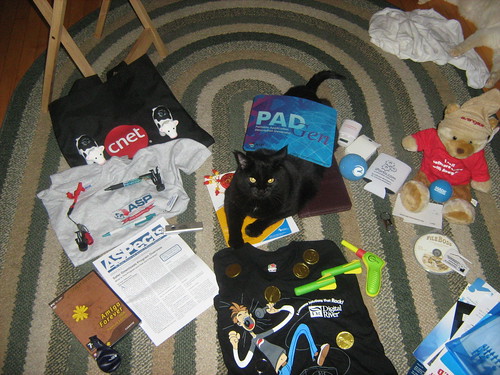
You can see how Gizmo enjoyed swimming in the free schwag I brought home.

Schwag

[tags] sic 2008, conference [/tags]

Categories
Geek / Technical

If Only It Were True…

Battletoads: The Movie.

With music by Tay Zonday.

Screenplay by Rick Astle.

Gotta love the Internet.

Categories
Game Design Game Development Games Geek / Technical Personal Development

Ludum Dare #12 is Coming Soon!

That’s right, Ludum Dare, the 48 hour game development competition, is back! Currently the themes are in voting, but the game development competition begins August 8th.

And if you need some incentive to join this time around, check out Phil Hassey’s LD#8 entry…now on an iPhone! Wouldn’t you like to be able to make a great game in a weekend and then take it farther?

I’m still working on my LD#11 entry, Minimalist, and I hope to have a better version available before the end of next month. I can’t wait to find out what the theme for LD#12 will be.

[tags] ludum dare, game development, compo, indie [/tags]

Categories
Geek / Technical General

Happy Birthday, Tim Schafer!

Today is my birthday, and according to Wikipedia, besides sharing it with George Bernard Shaw, Mick Jagger, Carl Jung, Sandra Bullock, Aldous Huxley, Stanley Kubrick, and Kevin Spacey, I share it with Tim Schafer. Seems like I’ve got great company.

Happy birthday! I’m going to have some cake and celebrate with friends!

Categories
General

Back from SIC 2008

I’m back from the Software Industry Conference. I wish I had more time to explore Boston, but the conference was great! I met a lot of cool people, saw a few good presentations, and got great advice whether solicited or not.

And yes, Boston had orange juice.

I’ve already taken actions to improve my business since coming back on Sunday. I signed up for AdWords, and I’ve made some notes on improving my currently stagnating business plan. Heck, I’ve also cleared off part of my desk in my office so I can actually sit at it.

I hope to see you at SIC next year!

[tags] sic, software industry conference, shareware professionals, business, indie [/tags]

Categories
Games

Understanding Video Games

I went to the comic book store the other day and bought Understanding Comics: The Invisible Art by Scott McCloud. I’ve seen this book referenced in video game articles before, and the idea of a comic book that explains the medium of comic books sounded great.

I was on IRC when I said it would be great to have an “Understanding Video Games” game as well, and sure enough, someone sent me a link to Understanding Games: Episode 1. Episode one focuses on the rules, which are fixed and apply to everyone. Interactivity is needed, of course.

Episode 2 is about the motivation of the player. Why are you playing this game? What feedback is the game giving you to let you know what effect your actions have? Whether a goal is game-provided or provided by the player, a game needs one so that the player has a purpose.

Episode 3 demonstrates player learning, specifically through trial and error. This goes hand-in-hand with the feedback mentioned in Episode 2. If the player performs an action, there should be some feedback to indicate that something meaningful has happened. If the effect is positive, the player learns that the action is a good one, and if the effect is negative, the player learns that the action is not good to do. Such feedback should allow the player to discern patterns that will help in decision-making.

And finally, Episode 4 covers player identification. It’s fascinating how the theme of the game affects identity. Also fascinating is the idea that abstract characters can represent more people than realistic characters. Anyone can identify with Pac-man, but not everyone can identify with Lara Croft. Control schemes also affect identification. Black & White didn’t let you control the creature directly, which upset quite a lot of people expecting to BE the creature instead of the owner. In a similar way, The Sims had people complaining about the same problem, but something about the fact that the game played as a doll house simulator probably let the indirect control scheme appeal to more people.

While I enjoyed the four episodes, I wasn’t sure if the series really captured everything that is sufficient and necessary for what makes a video game. I couldn’t help but feel that the definitions were excluding an obvious game or if they included things that shouldn’t be games. I think what bothered me more was that it didn’t really comment on the possibilities of the medium of video games the way “Understanding Comics” does with regards to comics. Still, it was enjoyable to see and interact with an explanation of video games in video game form. I just wish there was more.


[tags] video games [/tags]

Categories
Geek / Technical Marketing/Business

Off to the Software Industry Conference!

I’m off to Boston for the Software Industry Conference! It’s my first time going, and I’m sure it will be a blast.

I’ll be at the Association of Shareware Professionals luncheon, and I will definitely attend the Shareware Industry Awards banquet, so if you plan on going, look for me.

The presentations sound interesting, and I hope to meet many of the people from the ASP member newsgroups in person. I intend to come back to Chicago heavily inspired and motivated to make games.

They better have orange juice in Boston.

[tags] business, marketing, sic, conference, shareware [/tags]

Categories
Game Development Personal Development

Thousander Club Update: July 14th

For this week’s Thousander Club update:

Game Hours: 409.25(previous two years) + 80 (current year) = 489.25 / 1000
Game Ideas: 710 (previous two years) + 36 (current year) = 746 / 1000

I spent the better part of my development time playing Minimalist and trying to determine how the game play could be improved. After a discussion in #ludumdare, I realized that the current implementation wouldn’t translate well to the iPhone or the Wii since the cursor can essentially warp from one area to another. Players would be able to instantly hit the goal. I realized that someone with a Wacom tablet would essentially have the same advantage, so I’m thinking that the cursor should act as a separate entity from the player’s mouse cursor, with acceleration and velocity, to prevent such cheating. It would also prevent people from moving the mouse cursor outside of the play area, which I didn’t think was such a problem, but a friend pointed out that it broke the spirit of the game to allow it.

[tags]game, game design, productivity, personal development, video game development, indie[/tags]

Categories
Game Design Game Development

Watch Will Wright Talk About Game Design

I just finished watching Will Wright talk about game design at an SDForum Speaker Series event. It’s an old talk, but it still gives you insight into his thought process when designing games such as The Sims.

It’s a long talk that starts about 14 minutes into the video, although I still enjoyed watching Bill Budge, of Pinball Construction Set fame, introduce Wright.

Wright talked about emergence in more detail than I’ve seen elsewhere. He explained the thought process behind the design of certain elements in The Sims and SimCity. He talked about feedback loops in everything from the basic interactions all the way down to the player’s mental model of the game world. It’s amazing to think about creating interesting yet simple rule sets that take advantage of the player’s ability to identify the possibility space and game play landscape. Wright takes a lot of these complex ideas and explains them well.

Even the Q&A session at the end was fascinating. Someone asked Wright to give the top three good trends and top three bad trends he sees in game development. We can see how some of those trends are working out today, especially in games like Spore.

Watching such a talk can only get you fired up to work on your own game designs, so set aside some time and enjoy!

[tags] game design, will wright, [/tags]

Categories
Game Development Games General Marketing/Business Politics/Government

Corporations and Copyright

A few weeks back, Cliffski wrote about how some people complain about corporations and copyright as if they are all part of one big organization out to screw you over. He reminds you that not all corporations are huge, multi-billion dollar enterprises such as EA, British Airways, or Microsoft. Some corporations are as small as the local bakery or in the case of Positech Games and GBGames, one person in a spare room at home.

Cliffski doesn’t want you to paint all copyright owners and corporations with the same broad brush. Just because some companies are evil, it doesn’t mean that all of them are. Still, I wish he would be more consistent with his arguments. If you don’t argue that all copyright violators are the scum of the earth….well, you’re either with us or against us, it seems. I think the broad paint stroke shouldn’t be OK on either canvas, but that just makes me a terrorist pirate sympathizer to some people.

Still, I agree with Cliffski’s main point, that copyright isn’t evil, and corporations aren’t either. But when organizations such as the RIAA, the MPAA, and the BSA, musicians such as Madonna and Metallica, and companies such as Wal-mart, Best Buy, and Target use copyright law to abuse their customers and fans, what is a regular person supposed to think?

Copyright is a confusing topic for people who are familiar with it, so of course the lay person won’t know much about it. Copyright, trademark, and patent laws are usually thrown together as “intellectual property”, and the three are always being confused for each other. How many times have you heard someone say, “Oh, that’s a great name for a band! You should copyright it!” or “You write great poetry! You should patent it!”? How often were you the person saying such statements? By the way, I wrote an article on copyright law that should give you a better understanding than most people seem to have. You can find it at What an Indie Needs to Know About Copyright.

I don’t know how UK copyright law differs from US copyright law, but the purpose of copyright here isn’t to provide an incentive for the creator. The purpose is to promote the sciences and useful arts. Providing incentive is the means to that end. You’ll find people who supposedly support copyright who argue that it is there solely to protect the works of authors so they can make money, even though it isn’t the case at all. So there is confusion on all sides, it seems.

If you were to write a poem on a napkin, you would own the copyright to that poem. Many people are surprised that it is so simple to own a copyright. You just create something! Bam! It’s yours! Perhaps because most people don’t think about copyright in general, it never occurs to them that they can own the copyright to something and NOT make money from it. When most people think of copyrights, they think of best-selling books or blockbuster movies or hit songs. They don’t think about the struggling author or the garage band or the amateur film director with maxed out credit cards. They don’t think about the personal blog or a custom song for a lover or a love note on a windshield. Even though they might not have a profit motive, these works can be protected by copyright as well.

Years ago, Jay Barnson wrote about his personal experience with his pirate story. He worked at a now-closed game development company which created some popular games. While he estimated that the infringement rate was around 30%, which I’m sure seemed high at the time, these days we’re seeing companies reporting that more people will play games illegally than purchase a legal copy. Reflexive estimated over 90%, and even Linux Game Publishing recently announced its discovery that more people made support requests for an illegal copy than for a legal copy.

Now, only major companies are playing with the numbers to make you think that each infringement represents a lost sale. Most people know that while infringement might be high and should ideally be nonexistent, it isn’t as if 100% of the illegal copies would be sales if the illegal option didn’t exist. Still, major corporations actually try to convince you that it is true.

Is it any wonder that most people don’t respect corporations in general? The major corporations act as representatives for all corporations, and people generally don’t like being accused of crimes before they’ve committed them. And if they don’t respect the corporations, why would they treat the copyrights these corporations wield any better, especially when they don’t understand what the heck copyright is in the first place?

Is copyright infringement a problem for corporations, including the indies? I would say so. While it isn’t 1-to-1, Reflexive’s experience indicates that taking measures to prevent illegal copies results in increased sales. And I think from that same experience, we can see that not all copyright infringement comes from freeloaders who will do anything to screw hardworking people over.

The economist from Freakonomics argues that everything comes down to incentives. If you accept this idea, then of course there is an incentive for people to get their games for free rather than pay for them. If it isn’t too much effort, and there isn’t a risk of getting caught or of dealing with repercussions, then a lot of people will probably do it, too. What’s strange to me is that publishers will make the legal option less and less appealing by piling on draconian copy protection and all sorts of features that their customers don’t want. Doesn’t such a practice give people an even greater incentive to get the illegal version that doesn’t have all of the junk associated with it?

I’m afraid that major corporations have conditioned people to expect such treatment as normal. Politicians want your computer to blow up if it has allegedly infringement material on it…even though copyright law is so complicated that it is very possible that the average computer owner won’t know what constitutes infringement. Laws are passed making it illegal for you to do things that were perfectly legal for you to do before, all because the MPAA, RIAA, and BSA don’t want you to be able to do them so they can charge for the privilege. After all of this, is it any wonder that people complain about “the corporations” and copyright?

Yeah, it’s a problem that people don’t think of the mom & pop store down the street as a corporation even though it is one, and yeah, it is a problem that people don’t understand copyright and how it works, but let’s be serious. If you think that they reached their conclusions, faulty or no, outside of the experience they have from major corporations, you’re deluding yourself.

As an indie, I know I’m going to have to deal with my customers’ perception, regardless if they are the right ones. I have to build my own reputation and hope that a company such as EA or Valve or Positech doesn’t do something stupid to reflect badly on the industry as a whole. Sony’s rootkit fiasco probably put people off buying music CDs, at least those from Sony, and even if it didn’t, I’m sure it didn’t help make the RIAA look better. It is sad when The Pirate Bay provides a better value than the legally purchased product, and the more that happens, the less likely someone will have an incentive to buy, especially from the one-person corporation with no legal department to provide disincentive.

[tags] indie, piracy, business, copyright [/tags]