Categories
Games

Playing The Legend of Zelda: Wind Waker for the First Time

A few weeks ago I was at a friend’s place to play the new Mario Kart 8 for the Wii U around launch day. While waiting for everyone else to show up, I opted to start playing The Legend of Zelda: Wind Waker HD.

And it was gorgeous.

Last week I fell under the weather, and between bouts of rest and drinking plenty of fluids, I opted not to use Netflix to catch up on terrible movies my wife won’t watch with me and instead play a game, something I don’t do nearly enough on the Wii. I didn’t want to pull out Twilight Princess or Skyward Sword because both required motion controls and I didn’t feel I had the strength necessary.

So I got out my copy of Wind Waker, the non-HD Gamecube version, got out the Wavebird so I could play from the couch, and settled in.

I haven’t played it in years. I still had the save file with my then-girlfriend’s name on it, and my own save file which didn’t have much progress in comparison. I deleted both, and I started a fresh game.

Even in non-HD, it’s a beautiful game. I remember people hating the way it looked because they wanted something more realistic, but the emotions communicated on Link’s face when he fears he is disappointing his grandmother or when his sister is captured are evocative. When you are hiding in a barrel and avoiding the lumbering moblins in the Forsaken Fortress, it’s like playing out a cartoon. And I’m convinced that when the Deku Tree reveals the Koroks, it has to rank up there as the cutest introduction to an Ewok-like race since Star Wars VI: Return of the Jedi.

The world feels like a place to explore, and as you sail around, you see islands in the distance that appear to seamlessly come into view as you approach. There are hints that despite the people not leaving their islands that they know each other, and I’m looking forward to returning to my home island to see if I can do some match-making.

There’s a lot of noise out of the recent E3 about a new “open-world Zelda game” for the Wii U, but Wind Waker seems pretty open to me already.

I was having fun, and it was like the game was being seen with fresh eyes.

And then, when I came upon a volcano island I don’t remember ever seeing before, it dawned on me: I haven’t actually played this game.

Remember my then-girlfriend’s save file? Yeah, she was the one who played it. I watched sometimes, and occasionally she would hand me the controller to help her get past some dexterity-based puzzles, but I somehow thought that I had experienced this game when I hadn’t.

So, Wind Waker is my current obsession. Aside from World Cup soccer, that is.

I want to document the game design elements I notice. For instance, I liked the way you get challenged by one of the children of Outset Island to jump across rocks, which helps teach you, the player, how to handle jumping in a safe way.

I’m looking forward to playing Wind Waker again, for the first time.

Categories
Games

New Video Blog of Indie Games on IndieGameADay.com

Mike Rose, UK editor of Gamasutra, recently launched IndieGameADay.com, a video blog of new indie games.

Each day, there’s a video of Mike recording himself playing an indie game. For instance, here’s one of his session of Haunt the House: Terrortown:

I love these spotlights on the indie game development scene, and I hope he’s able to keep it up. As of this writing, he’s got about a week’s worth of posts. To navigate the site a bit easier, you should click on the menu icon at the top, then click on the monthly Archive to see all posts for that month at once.

There’s also a weekly roundup which is a playlist of the videos for the past few days so you can consume them all at once.

Categories
Games Marketing/Business

An Inspiring Indie Story: Team Football’s Licensing Deals

Team Football Logo

With the World Cup happening this month, there are bound to be some soccer games made to take advantage of the attention it brings. While most will be terrible, and many will be nothing more than “swipe to take a penalty kick” games, a few will be good.

Of course, without the official FIFA license that EA has locked in until 2022, even good soccer games will have a hard time getting noticed without something unique to offer, such as zombies or combat or familiar faces such as Nintendo’s Mario or Capcom’s Mega Man. Otherwise, it seems only Konami has a serious contender in terms of official licenses. It probably isn’t likely that other publishers, let alone independent game developers, will be able to negotiate a deal to offer any official content in their own games.

No one told indie studio Team Football, who managed to secure the official license to England national team for their game Official England Football (which is only available in England). The small startup also managed to work out a licensing deal with France, Japan, China, and Brazil, and Official Brazil Soccer is supposed to be available around the world, although I couldn’t find it at the time of this writing on my Android tablet.

Many aspiring indie developers start out realizing that games don’t appear fully-formed, that someone had to make the games in the first place, which means it is possible that they can make games. Suddenly, they are excited by the possibility, and some get burned when they bite off more than they can chew.

Eventually, they stop deluding themselves into thinking they can make the the best MMO RPG/FPS/RTS EVAH! They internalize the lesson that they need to be “realistic.” The common advice is to cut down on your scope, to recognize that you can only do so much by yourself and with your limited resources.

But being realistic is also a good way to sell yourself short. You may have the capability to achieve something fantastic, but if you assume you can only accomplish something mediocre, you’ll stop before you should.

Granted, some indies have access to different levels of resources. Some managed to save up hundreds of thousands of dollars, others inherited, some borrowed, some are leveraging income from their day jobs, and some are struggling to make ends meet. Some have a team of talented individuals, others toil away in solitude.

Team Football benefited from Birmingham’s Entrepreneurs for the Future incubator, funding from Creative England, and some good contacts in the industry.

But they showed what’s possible if you go out and chase after what you want. An indie game development studio with official licenses for their sports games is able to stand out among the crowd, and in a heavily-saturated market, getting that attention is precious.

Are you setting supposedly-realistic expectations for yourself, or are you imagining what’s really possible?

Categories
Games Marketing/Business

Advertising Your Game on YouTube

YouTube Channels

A few years ago, I read that search engine optimization (SEO) wasn’t just a way to make sure Google and Yahoo! can find your website. iTunes is also a search engine, so if you had a podcast, you know where your content needed to be listed.

Similarly, YouTube is a search engine. Are you optimizing your marketing efforts there?

You have two opportunities here: leverage existing channels and publish your own.

Leveraging Existing Channels

There are quite a few channels focused on games, and some of these channels have dedicated viewers.

In the article Advertising Through YouTubers, Kevin Harwood makes the case for introducing your game through one of these influential channels by endorsing them so they review and play your game for everyone to see.

I was a bit turned off by the “let me show you the numbers” part of the article:

It would be completely within reason to pay $250 per video made and commission four 20-minute game play videos.

100,000 viewers

$1000

even if only .5% of the viewers go forward and purchase your game for $30 on Steam (you earn only $20)

You have earned $40,000 in revenue

No this is not a “get rich quick article”. I’m simply showing the ROI on a basic initiative like this.

Now, this article was not published years ago. The race to the bottom in game pricing has already occurred. Most indies are not selling their game for $30 on Steam, and I’m sure a 0.5% conversion is one of those things that doesn’t just happen.

Still, I don’t think the basic principle is off. YouTube videos are bite-sized content that your prospective customers are actively searching for. The same may or may not be said for your game’s website. If you can do more than merely send a link to a channel’s owner, you have a better chance of your game getting featured and in a positive light.

Harwood suggests incentives to encourage the reviewer to play the game with a goal of achieving some level. It would be terrible if your intricate strategy game was reviewed by someone who didn’t seem very invested in trying and misunderstood some key aspect of it. Saying something like “If your playthrough gets past the Cow Level, you can get three free copies of the game to giveaway to your viewers” means that your exciting and awe-inspiring Cow Level has a better chance of being featured than if you merely hope the reviewer gets that far and discovers it.

Obviously you can’t control how other people will enjoy your game, and if you pay to get your game endorsed, there are even laws governing disclosure. See the FTC’s 2013 PDF dotcom Disclosures: How to Make Effective Disclosures in Digital Advertising.

The goal isn’t to deceive people into thinking that an influential reviewer loves your game. The goal is for the influential reviewer to give your game a fair chance, and you want to put in some work to make sure that your game is shown in the best light.

If you do nothing but spam emails to these video reviewers, having no relationship with them in the first place, you are just another faceless game developer. It is random chance if your game is reviewed in the first place, and if it is, who knows how the reviewer will play it.

Imagine if a game such as Mario Kart 8 was reviewed by someone who didn’t know that you can use the items that you pick up on the track. That is, this person picks up banana peels, or mushrooms, or a boomarang plant, but didn’t know to press the button that actually makes use of them. One of the key features of the game is completely ignored in the review, and suddenly the game looks somewhat flawed and confusing.

So no, getting your game featured on popular YouTube channels is not a guaranteed way to make your game popular. You still have work to do, and Harwood has some creative ideas for making it work out well for everyone involved.

Publishing Your Own

If, on the other hand, you want to make your own videos to similarly take advantage of YouTube as a search engine, there is a separate article on how to make videos for games by Alconost co-founder Kirill Kliushkin you would want to see.

My favorite piece of insight was how scripts are timed so that voiceovers are matched to on-screen events. I also really appreciate how the entire process is purpose-driven. The first question they ask is “Why do you need a video?” and the process flows from the answer.

Kliushkin covers teasers vs trailers vs in-game video intros, scripting and storyboards, and the importance of professional-quality voiceovers, among many other topics. Even if you plan on hiring someone else to make the videos for you, this article seems like a good primer on the basic things you need to keep in mind to create the right video for your marketing needs.

Categories
Games Marketing/Business

Ship on iOS or Android First?

iOS vs Android

When I talk about making apps for Android, the question I invariably get, occasionally with shock or disdain, is “Why not make apps for the iPhone/iPad/my precious device?”

To be fair, I tend to bias against what’s popular.

But not in an obnoxious way. I not that guy who insists on not having a television and makes sure to tell everyone each chance he gets. And, I’m not a counter-culture activist consumer. I run GNU/Linux, but I do so on a Dell laptop. While I don’t shop at Walmart, I do shop at Target. I make games for GNU/Linux, but I also port them to Windows because it is easy to do.

I just get suspicious when there is a rush to own a piece of something, such as the iPad, or the original iPhone before it, or the iPod before. Camping out to be the first to own a piece of consumer electronics that will be patched and/or obsolete within months is not for me. The same goes for new game consoles or games. I can wait.

I am very clearly not an early adopter, nor am I all that interested in owning an Apple product. I was fairly happy with my Linux-based computing at home, and the idea of buying something I couldn’t tweak or configure bothered me. Of course, the idea that it “just worked” and didn’t need configuration appeals to a lot more people, so Apple has been very successful.

Eventually, I got a a smartphone. It was an Android device, an HTC Evo Shift II. It had a slide-out keyboard, which meant I could text and type easily without needing to learn some gesture-based input. It was bulkier, but I never had to worry about buying an external case for it. I liked it, although eventually I started running out of memory for the thing, and that’s when I learned about how fragmented the Android market was. Also, I ran into the problems with the U.S. market in that my phone is tied to the carrier and not just a device that I can plug the carrier’s SIM card into. That means updates to this phone’s OS were never going to happen unless I jumped through a bunch of hoops.

I now have a Samsung Galaxy S4, but I kept the Shift because when it is connected to my wireless, it’s still a relevant computing device. Plus, I could use it to test any apps I make for Android.

So now I have two Android devices. No, wait, I have a third: the Google Nexus 7 tablet that my wife got me for Christmas last year, my first tablet if you don’t count the EXOPC Slate I got after GDC 2011. That’s three different Android-based devices that I can use myself as well as use as test devices for apps I create.

Android today has a much larger marketshare (so much for biasing against what is popular), but it is common knowledge that iOS apps average more revenue for developers than Android apps. The thinking is that people who are willing to spend the Apple premium are also willing to pay for apps, and the numbers getting reported tend to indicate it is true.

Apparently if someone switches from iOS to Android, it is news. For major app releases, it is very common for the iOS version to be released before the Android version, if a port comes at all. I wonder how Microsoft feels being the Linux of mobile in this regard. If the app gets updated, it is possible that the Android version will lag behind, or have an unnatural UI, or will be otherwise inferior. Now the trend seems to be changing so that Android-first is becoming more common, but not everyone is happy.

The Fallacy of Android First documents one developer’s experience with trying to go Android first. Emu is a messaging app, and apparently Dave Feldman found that Android’s fragmentation was still an issue and the development tools were not as robust or stable as Apple’s. The larger potential audience doesn’t always translate into more users of your app, especially once you take into account backwards compatibility.

Feldman says:

Running a startup is all about learning. This has been a huge lesson for us, one I wish we’d learned faster…but perhaps our experience will help others to make a more informed decision. Android’s flexibility, and its greater strength in certain markets, still make it a far better platform for certain types of product. But it’s a difficult road, and best to travel with your eyes open.

He links to Steve Cheney’s post Why Android First is a Myth from last October which similarly describes a more complex development experience for startups developing on Android, especially those who rely on venture capital.

All that said, what’s it look like for games?

iOS is still dominant in terms of revenue earnings for developers, and if you are selling apps instead of doing a free-to-play model, Apple has demonstrated that they have paying customers. Plus, there’s very little variation and customization, which means you don’t have to do nearly as much work to ensure your game will work on an iOS-based device, and when you do, you have a significant chunk of the market.

Google announced cross-platform Google Play Game Services so that developers can create apps for both Android and iOS more easily. In fact, Google is using services to provide new capabilities without a need to fragment the userbase more than necessary. So, it is getting better there. And with a F2P model, more potential users means you don’t have to worry about how stingy your players are.

But is it really that hard to release simultaneously? If you use a library like libSDL or an engine like Unity, you can have a single code-base that ports more or less seamlessly.

In any case, for my next game, I’m currently wondering if not having an iOS device and a way to develop for it is going to hurt me. I’m looking into my target market to find out if my convenience of using devices I already own to develop the app will coincidentally line up with their own needs, but more and more I’m thinking that I will need to invest in some Apple hardware if I am going to be relevant to my customers.

Do you release for iOS first, Android first, or simultaneously? What has your experience been?

Categories
Game Design Games Marketing/Business

A Shameful Game Backlog, or a Glorious Library?

Last week, cliffski once again went on the offensive against the trend of selling games at deeply discounted prices. In We Need to Talk About Unplayed Games, he argued that the constant sales of games results in bad news for everyone.

People buy games based on almost nothing but a screenshot and a low price in an almost Pavlovian response to the announcement of a deep discount. They don’t even play the games, which sit on hard drives and rarely get considered. In fact, some people buy the games over and over again simply because they are in bundles with other games or they forgot that they already purchased them.

The results? Players Game buyers don’t value quality, the organizers of sales become gatekeepers, and the games themselves are devalued. If developers optimize for results, what role does game development have? Most players won’t see even a small percentage of the actual game, so why focus there? It’s similar to the concerns about narrative in games: if people don’t finish them and never see the story play out to completion, then why invest so much on game writing and elaborate plots in the first place?

It becomes less about the games themselves. People buy into the deep discount, no matter what is being offered, and for what? A backlog of games they ignore? That’s terrible!

Or is it? Ben Kuchera thinks otherwise in Your stack of shame is a lantern for your future, and a gift to the industry:

We respect people with large libraries of books, but we tend to look down on people with shelves and shelves of games.

Oof. When you put it that way, yeah. I suppose when I look at my shelves, I see books I haven’t read yet, as well as games that I obtained partially because they weren’t at full price. I have a copy of Civilization III still in shrink wrap when I found it at the store for only $15. Two incarnations of the series have since been released. I also have a number of Neal Stephenson books that are waiting for me to read them.

Kuchera’s argues that even if you don’t play the games now, what you are doing is sending a message to the developers and the industry about what kinds of games you want to support.

On the topic of sales, both cliffski and Kuchera agree. They work. To illustrate, I was at a party recently talking about these posts (I’m a pretty wild and crazy guy!), and a colleague told me that you don’t have to look further than JCPenny to see what happens when you buck the trend there.

In early 2012, JCPenny changed its pricing strategy. Instead of markups and sales, there would be “every day” prices.

Late last year, the company announced it was reversing the decision, citing dismal sales figures.

So, JCPenny discovers the hard way that despite the logic that a low price is a low price, there is some psychology to a sale price, to the idea of getting a bargain. Now we get to benefit from that information.

But Kuchera says the biggest benefit is that increasing your catalog of games is good for you.

Maybe you’re not ready for the pace of a game like Gone Home today, but you can never tell when the game will satisfy an itch you don’t know you had. Buying games on sale allows us to browse our own selections, be surprised at something we had forgotten we had bought, and find that finally, we’re ready for that game.

I can relate. When I was a child and had no way to earn money but a weekly allowance, I would save my money for months in order to go to Toys R Us and browse the game selection. One time, I picked up Wizardry: Proving Grounds of the Mad Overlord. I might have been 10 years old at the time. I had no idea what the game was, but the back of the box had illustrations of dragons, knights, and skeletons. COOL!

I tried to play it, but I couldn’t figure it out. I mean, I understood the mechanics of walking around the first-person maze, entering selections to fight, and casting spells. But I had no idea what I was doing. I would fight incredibly tough enemies and have a total party kill before I knew what happened. It was too much, and the game wasn’t what I expected at all.

It was a few years later when I pulled it out of my collection of games to try it out again, and my more mature self was able to grok it way better. Oh, I have to map out the maze I’m exploring! I need to make sure that I gain experience and skills and purchase good equipment before venturing too far into it. It all clicked. It all made sense. I wasn’t ready to play the game when I bought it, but I’m glad I did all those years ago because the Wizardry series became one of my favorites.

I appreciate what cliffski is concerned about. It would be nice if when a new piece of entertainment is released that everyone played it together. Around 10 years ago, I bought Total Annihilation and Homeworld: Cataclysm due to the recommendations of a friend, both times years after the games had come out. Cavedog’s Boneyards and Sierra’s WON.net were mostly empty before eventually being shutdown entirely, but I was told that they used to be filled with active gamers ready for your challenge. Had I bought the games on release, I might have experienced it, but as I was late to the party, I missed out.

It’s captured perfectly in this xkcd comic.
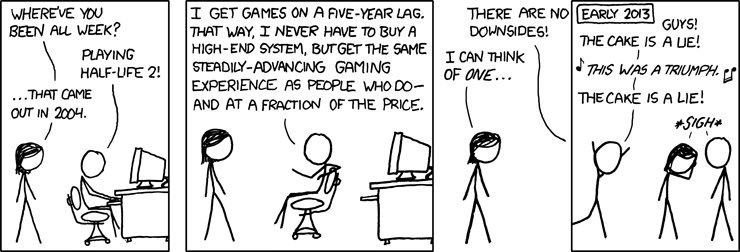
The alt-text: “I remember trying to log in to the original Command and Conquer servers a year or two back and feeling like I was knocking on the boarded-up gates of a ghost town.”

Similarly, the Steve Jobs biography that was all the rage a couple of years ago? The local library had a high double-digit long waiting list. I never ended up reading it, although I still want to. But when I do finally get to read it, it would have been years after the book was topical. Am I similarly missing out by reading it so much later than everyone else?

Or isn’t that the point of books, that they are there for me to read whenever I feel like it?

And so it is with games. For years, I’ve always wondered how people can be so comfortable selling their old games to get credit towards the purchase of new games. I, on the other hand, still have my Atari 2600. I still have my NES, SNES, N64, and original Game Boy. Despite being able to play any Gamecube games on the Wii, I still have my Gamecube.

But more important than my inclination to keep consoles beyond the point that might be reasonable, I still have the games I bought for those systems. I’m still unhappy with the discovery that my father gave away the Apple II c+ from my childhood to his coworker, which means I lost my copies of Troll’s Tale, Snooper Troops, Below the Root, Bill Budge’s Pinball Construction Set, and other games. Some of them were beyond my capabilities at the time, but I’d be ready for them today.

But being able to pull out my older consoles and play games from almost two decades ago is a capability I enjoy having.

I currently have two large six-shelf bookcases in my office filled with books. I have a computer rack with a few shelves taken up by CD cases for computer games. In the living room are the console games. In another room is a set of shelves filled with boardgames and card games.

I used to fantasize about having an entire room of a house dedicated to being a library, with books and games stored from floor to ceiling.

Video games these days end up being in the cloud. I have 30 games across 7 virtual shelves on GOG.com, quite a few Humble Bundle bundles, and a few games in Steam. If not you then people you know have much larger catalogs of games stored as bits on a server.

It’s not as tactile, but we still enjoy having those collections to pick up and play whenever we allow ourselves to do so.

What I am not sure we’re seeing is a change in the game design efforts of developers, which is I think cliffski’s biggest concern. While some developers put out buggy and shoddy games, I don’t think they last long. Even if most games don’t get played, I don’t think a pretty screenshot and a sale is enough to get people to reward the developer. Reputation still matters.

How do you feel about your backlog? What impact, if any, do you believe the constant sales and discounts has on game design and the efforts of a developer?

Categories
Games Linux Game Development

GOG.com Finally to Offer Linux-based Games

GOG Offering Linux Games

Some of the big news this past week was that GOG.com games will soon be available for GNU/Linux. At least 100 of them by fall of this year, in fact.

No specific games are announced, but it seems after all of these years of dismissing what has been the biggest demand by their community, GOG is finally ready to support games playable on Linux-based devices as official and supported offerings.

Is the decision due in large part to Valve’s recent pushes onto the OS?

No matter what the reason, I welcome the news. Perhaps it will be followed eventually by Unity offering its editor on GNU/Linux as well.

I posted in the past about a mistake I made purchasing a game on GOG because I didn’t realize there wasn’t a Linux-based version available until it was too late. Luckily, the developers provide indie-level support, but I’m looking forward to being able to go to GOG.com to get any updates easily.

What do you think about the news?

Categories
Game Design Game Development Games Linux Game Development

November #1GAM Entry: Raking Leaves

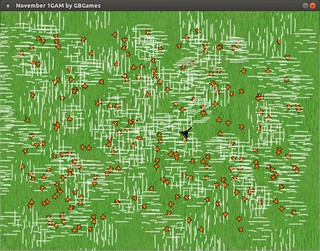
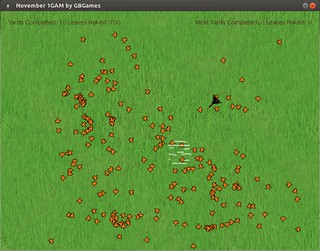
November’s One Game a Month entry is uncreatively-named Raking Leaves, a leaf raking simulator chock full of leaf-raking action!

Download Raking Leaves for Linux 64-bit (1.2 MB tar.gz file)

The object of the game is to rake all of the leaves into a single pile. The wind will blow the leaves around, however, and if you lose too many leaves off of your lawn, the game is over.

I had a lot going on this month, and so I didn’t dedicate a lot of time to making a game. Still, I wanted to make something for #1GAM. What could I make?

I recently bought a house, and with home ownership comes the oh-so-fun task of raking leaves. I decided to make a game out of that experience, and raking leaves is usually done in the Fall, which goes along with the optional theme of “Change”, so it was a perfect concept.

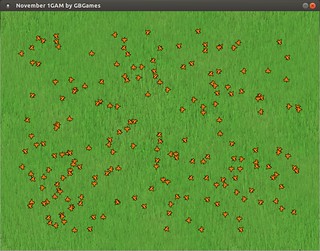
I started out making leaves and randomly throwing them about the yard.

November #1GAM

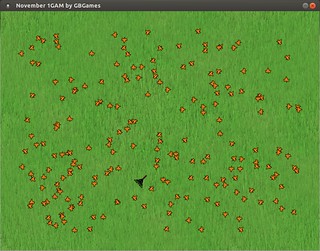
I then added a rake, which replaces the mouse cursor:

November #1GAM

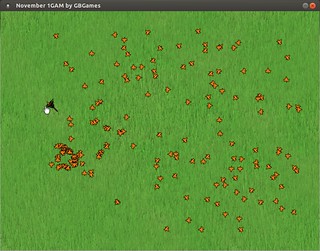
I wanted to capture the frustration of raking leaves, and so when you click and move the rake, the leaves will move, albeit a bit slower than the rake. This means you have to go rake the same leaves over and over to move them a long distance. I was pleased that it was working as well as I had planned.

November #1GAM

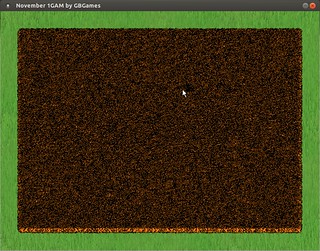
I had some funny bugs, such as this accident which features the level resetting over and over, except it wouldn’t reset the number of leaves but merely add to them. It looks like a giant set of orange hedges.

November #1GAM

Another funny moment was after I added wind. I wanted early levels be less windy, while later levels would get more wind. Here is what it looks like to rake in a hurricane:

November #1GAM

Wind affects leaves in a radius around it, and the farther away the leaves are from the center of the wind, the less of an impact the wind will have. It works very well, but out of curiosity, I set the level to 1,100, which has over 20,000 leaves in it and has winds every second. It resulted in some cool visual effects, as you can see in this video:

Eventually I think I achieved a good balance, complete with a scoring system to let you know how well you’ve done compared to your best raking.

November #1GAM

Considering I worked less than seven hours on this project, I’m pleased with what I came up with. I had plans for rocks, bushes, trees, and other obstacles, as well as a child running around jumping into your pile and scattering the leaves. Having sound would help, too, but for now, I think I’ve got one of the best games about raking leaves out there.

Categories
Game Design Games Linux Game Development Personal Development

September #1GAM Entry: Hextrap

September’s One Game a Month entry is a clone of the NES game Yoshi.

Download Hextrap for Linux 64-bit (410 kb tar.gz file)

I’ve never made a falling block puzzle game before. I had more ambitious plans, but with ISVCon 2013 taking up a lot of my time, I ended up doing most of my game development hours on the four planes I rode to and from Reno, Nevada.

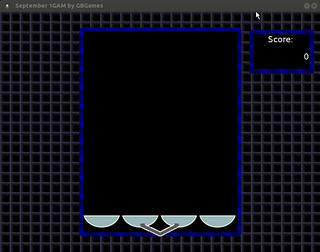
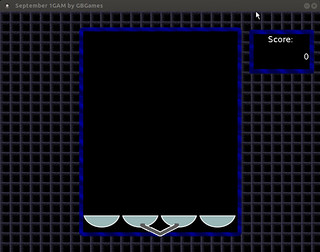
I started out with creating the four stack platforms, and a swapper which the player controls.

September #1GAM

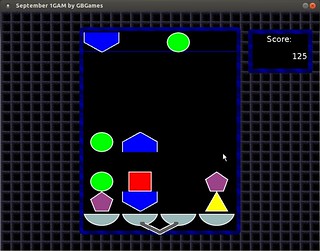
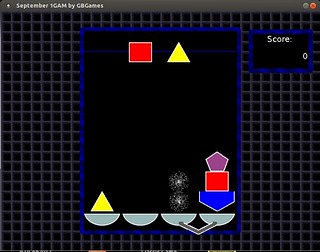
I created shapes to act as the various pieces: circles, triangles, squares, and pentagons. Hexagons were special. If a top hexagon piece is over a bottom hexagon piece, the pieces in the middle were consumed and the player got bonus points.

September #1GAM

I think what put this project in jeopardy was that I wanted some particle effects. It didn’t take long to implement, but I could have spent my precious time on the game play.

September #1GAM

But it came together quite well, even if I think it feels kind of hacked together at times.

I think the only thing missing is an issue involving the interaction of a swapping stack that is higher than a falling piece. Right now, the falling piece stacks on top, whereas it should flip around to a different stack.

Oh, and sound effects and music would be nice.

The scoring is also much simpler than in the original game.

Enjoy!

Categories
Game Design Game Development Games Linux Game Development

September #1GAM: A Puzzle Game

For September’s One Game a Month project, I wanted to try to use the optional theme: hexagons.

I toyed with the idea of making a turn-based strategy game involving a hex map, but more and more I liked the idea of a hexagon-based puzzle game.

Long ago, I thought of a game involving hexagons that you can trap as they fell down shafts. The idea was that you controlled whether they continued down or got stuck at some point, but I never fleshed it out.

So I’ve been writing down ideas. Should the puzzle area be a grid that just happens to have hexagons? Do I make a hexagonal play area?

More importantly, what is the player doing in the play area? Do I make a match-3? I kind of liked the trapping mechanic, but I couldn’t think of a good way to make it fun.

Then I looked at the calendar and realized that over a week has gone by. So I thought I better steal some game play rather than try to create my own.

I recalled playing a QBasic game by Oren Bartal called Ultimate Super Stack. The point of the game was to trap stars between two objects, and I remember finding it very compelling. Maybe I can make a hexagon-based version of it.

I realized that there was a lot to the game, and I thought back to simpler puzzle games, such as Yoshi for the NES.

So I decided to try to mimic that game instead.

September #1GAM

So far, I have four platforms in an empty play area, with a switcher at the bottom.

Eventually, I will add dropping objects, most likely shapes such as circles, triangles, and squares. If two objects match on top of each other, they’ll disappear. If a hexagon’s bottom piece appears, then it’s top piece can close it, along with any objects trapped inside of it.

The player will be able to move the switcher to one of three positions to swap the platforms and any objects sitting on top of them.

It’s a simple game, but I don’t anticipate having a lot of time to create it this month, what with me going to ISVCon 2013. We’ll see how it turns out.